Luxury Handbag Quality Control: Standards, Inspection, and Release
How is luxury handbag quality control built? It combines a written brand specification, approved physical references, incoming material checks, in-process gates, pre-production review, and final lot inspection at AQL 2.5 (ISO 2859-1), with third-party inspection optional. Defects are classified as critical, major, or minor before sampling begins, so an acceptance decision reflects commercial risk. Material evidence can draw on ISO 11644 for finish adhesion, ISO 3376 for tensile behaviour, and selected ISO 105 methods for colour fastness.
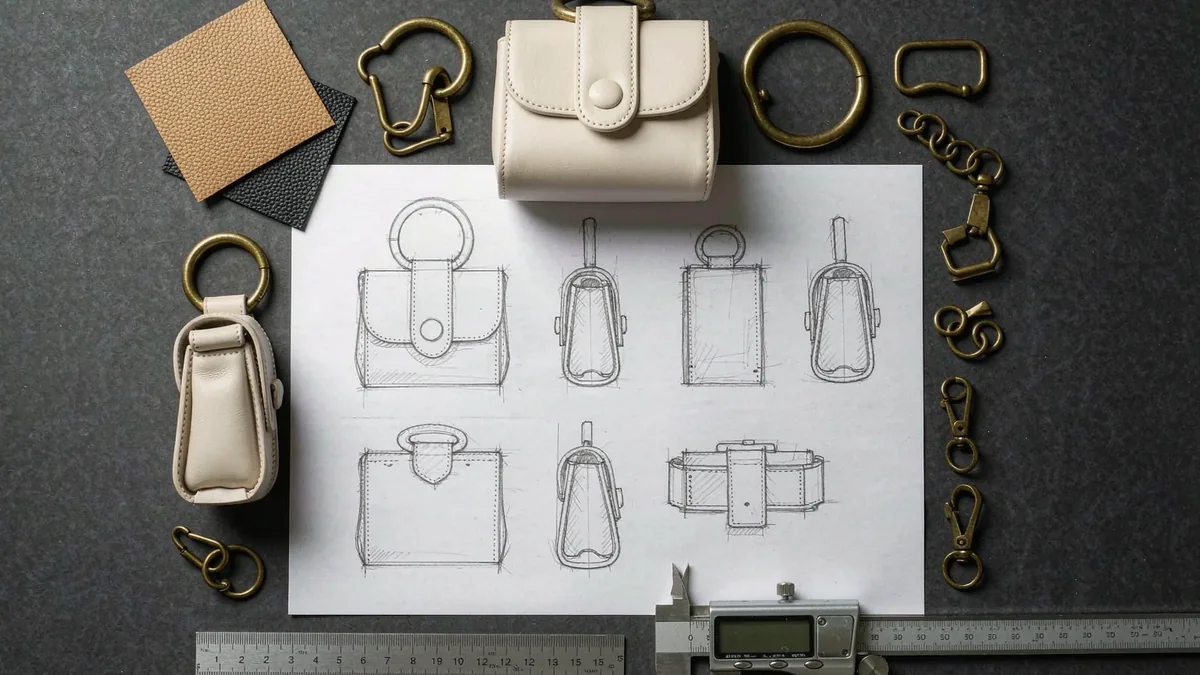
Luxury Quality Control Protects Brand Trust
Luxury quality control protects brand trust by converting expectation into measurable acceptance criteria applied at defined stages before release.
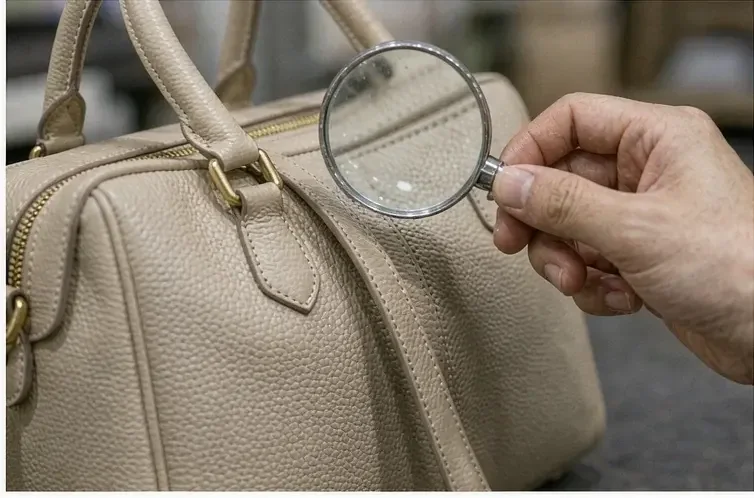
A premium handbag is judged closely: customers notice seam pitch, edge smoothness, symmetry, hardware action, and lining finish. Quality control therefore cannot be a final glance after packing. It begins when materials arrive and continues through cutting, skiving, assembly, stitching, edge work, hardware setting, cleaning, and packing. The practical question is not whether a team feels confident; it is whether the lot still matches the approved reference under agreed measurement and defect rules. For the statistical foundation, read AQL 2.5 explained.
Quality control definition
- Luxury handbag quality control is the documented system of material verification, staged inspection, defect classification, measurement tolerances, acceptance sampling, and release records that keeps a production lot aligned with an approved golden sample and brand specification.
The Document Base: Specification, Golden Sample, and Limits
Quality control is only as strong as the documents and physical references that inspectors compare against during each release decision.
The specification should define dimensions, tolerances, materials, colour standards, construction sequence, stitch rules, edge profile, hardware action, lining arrangement, branding placement, and packing. The golden sample is the physical reference for touch, proportion, and finish. Limit samples add clarity for acceptable variation: they set boundaries for shade range, grain character, edge appearance, or plating tone where natural materials cannot be identical. Defect classification must be agreed before inspection, because the same mark may be minor on an interior seam and critical on a visible front panel.
AQL 2.5 and ISO 2859-1 in Practice
AQL 2.5 (ISO 2859-1) is a lot-by-lot acceptance sampling scheme that uses sample size, inspection level, acceptance number, and rejection number to guide release decisions.
ISO 2859-1 provides sampling schemes indexed by acceptance quality limit for inspection by attributes. In practical terms, the lot size and chosen inspection level determine the sample size, and the AQL determines how many defects allow acceptance. AQL 2.5 is a common commercial reference for many soft goods programmes because it balances inspection effort with risk. It is not a promise of perfection, nor a substitute for brand-specific criteria. Critical defects usually demand a zero-acceptance position regardless of the general AQL, and lot rejection should trigger defined corrective action rather than informal sorting.
| Inspection stage | Main purpose | Typical evidence |
|---|---|---|
| Incoming material review | Confirm shade, thickness, hand feel, finish, and conformity before cutting | Lot records, shade comparison, thickness check, defect mapping |
| In-process check | Catch construction drift while correction is still contained and low cost | Component checks, seam samples, edge trials, hardware setting checks |
| Pre-production review | Validate the first controlled pieces before full line release | Measurement chart, construction review, correction list, approval sign-off |
| Final random inspection | Decide whether the finished lot may be released for shipment | AQL 2.5 result, photographs, defect classification, packing check |
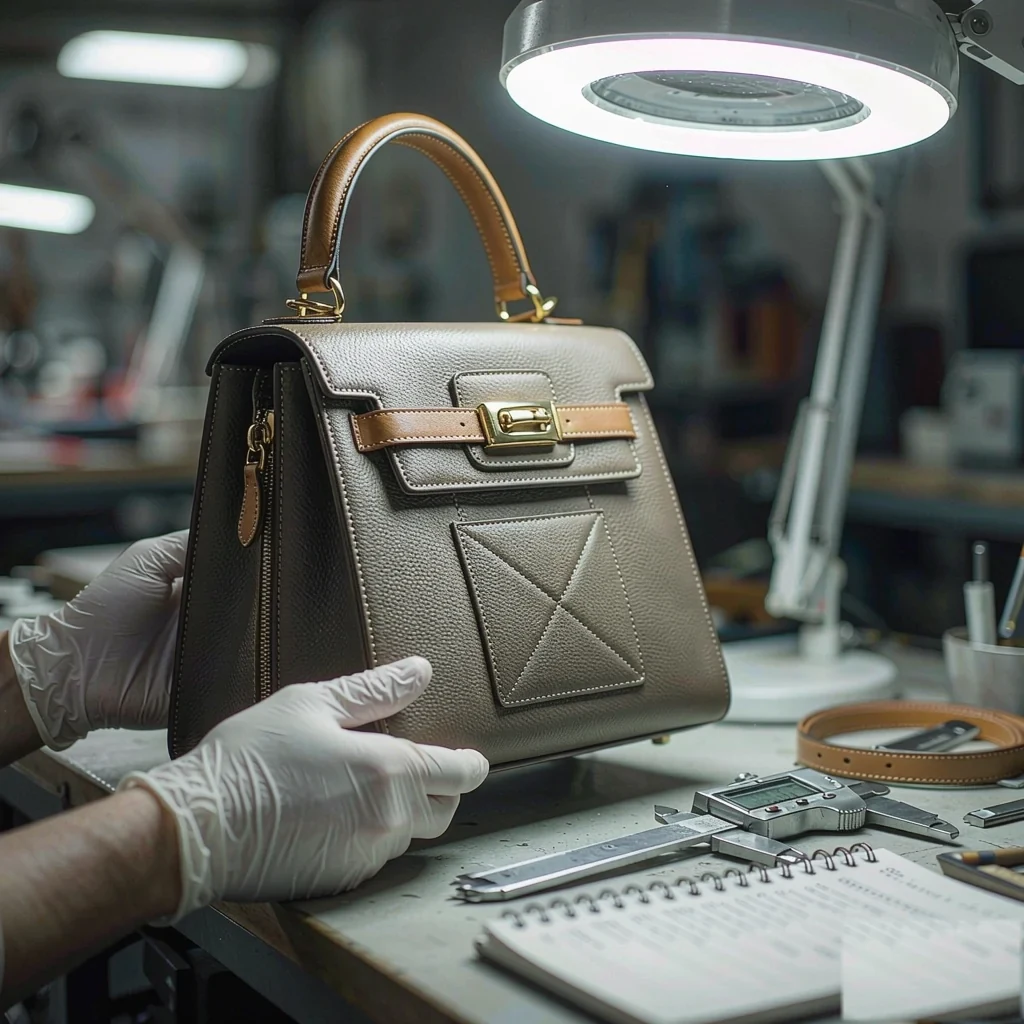
Defect Classification: Critical, Major, and Minor
Defect classification separates unsafe or unacceptable conditions from noticeable faults and from small imperfections that fall inside agreed limits.
A critical defect may make a handbag unsafe, illegal for the destination market, or fundamentally unusable; examples include broken structural attachment, sharp exposed hardware, or evidence contradicting required documentation. A major defect is noticeable and likely to generate return or complaint, such as misaligned panels, loose stitching, cracked edge paint, or a closure that catches. A minor defect is a small deviation that remains within the approved limit sample. Written definitions, severity examples, and placement rules prevent disputes. The defect classification guide expands these categories with practical examples.
Material and Laboratory Evidence
Material evidence supports quality decisions by testing defined properties under recognised methods rather than relying on appearance or tannery claims alone.
ISO 11644 addresses adhesion of finish on suitable coated leather; ISO 3376 covers tensile strength and percentage extension; selected ISO 105 methods support colour-fastness assessment. These results are most useful when conditioning, sampling location, leather type, and acceptance limits are defined in advance. Chemical conformity also matters for market access: REACH Annex XVII, California Prop 65, and CPSIA requirements should be considered for the destination, while Leather Working Group (LWG) records can support responsible tannery assessment. SGS testing is available to complement internal review when independent evidence is needed, as explained in how SGS testing complements quality control.
- Final inspection reference
- AQL 2.5 (ISO 2859-1), single or defined scheme
- Third-party inspection
- Optional, arranged by the brand when required
- Defect levels
- Critical, major, and minor agreed before sampling
- Critical defect position
- Zero acceptance, with defined corrective action
- Leather finish adhesion
- ISO 11644 method on suitable coated leather
- Chemical and market conformity
- REACH Annex XVII, Prop 65, CPSIA as applicable by destination
Measurement Tolerances and Symmetry Checks
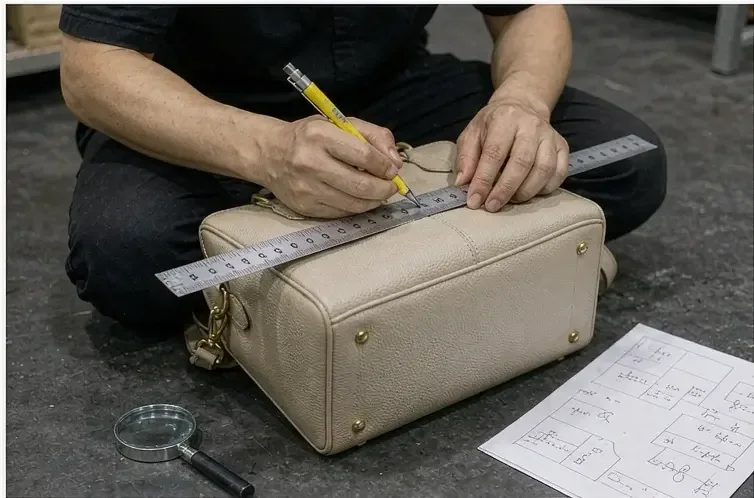
Measurement tolerances convert proportion into numbers, and symmetry checks confirm that left and right features align as the design intended.
A tolerance should be defined for exterior dimensions, strap length, drop, handle span, pocket placement, hardware position, and zipper end position. Tolerances must be realistic for the construction: a sharply structured body can hold tighter limits than a soft collapsing shape. Symmetry is checked with the bag standing naturally rather than forced; handles, darts, seams, pocket edges, corners, and locks are compared side by side. Interior checks include lining ease, pocket alignment, seam concealment, and cleanliness. The measurement tolerance guide gives a structured approach to setting limits by zone.
Colour, Shade, and Lighting Discipline
Colour control depends on agreed lighting, viewing distance, orientation, tolerance standard, and separation between batch variation and unacceptable mismatch.
Natural leather varies, so the objective is control rather than identical uniformity. Inspectors compare panels under defined lighting, view assembled bags at a realistic distance, and use approved shade limit samples. Colour-fastness expectations should be defined for rubbing, light, or perspiration where the use case demands it, referencing appropriate ISO 105 methods. Hardware tone is judged in the same session because a plating difference can change perceived colour. Packing materials, dust bags, and tissue should be reviewed for colour transfer risk during storage. Colour shade quality control details the viewing protocol.
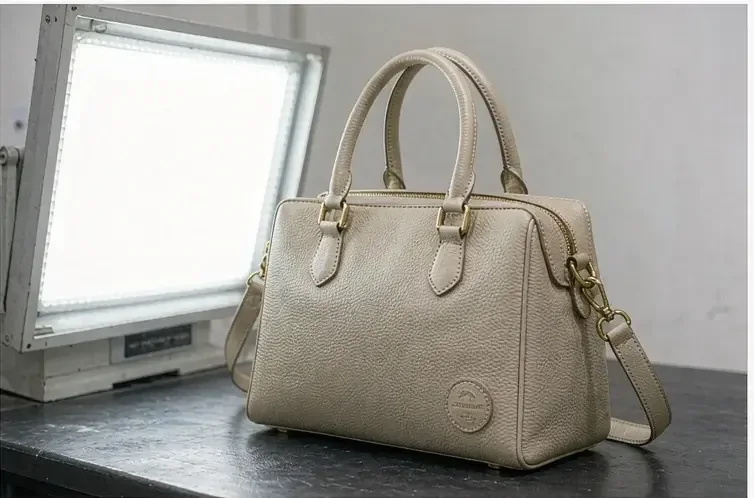
Hardware, Function, and Wear Simulation
Hardware and functional checks verify that every moving element operates smoothly, stays aligned, and withstands realistic handling without marking the leather or failing early.
Locks, turn-locks, magnets, zips, rings, feet, and adjustable straps should be operated repeatedly rather than once. Inspectors watch for catching, resistance, misalignment, noise, plating marks, or leather abrasion around contact points. Load behaviour is reviewed by lifting a filled bag and observing stress at handle anchors, strap joins, and base supports. Where the programme requires corrosion or wear testing, the method, duration, and acceptance criteria should be agreed in writing. Hardware failure checks explain how to plan this section of the inspection.
Documentation, Corrective Action, and Release
Documentation turns inspection into an auditable decision: every result, photograph, defect count, corrective action, and release approval should be recorded and traceable.
A practical report identifies lot, style, colourway, quantity, sample size, inspection level, AQL, defect counts by class, photographs, measurements, packing condition, and the final decision. Photographs should be taken from consistent angles and distances so later comparisons remain meaningful. When a lot fails, the corrective path should be explicit: rework under supervision, sorting with defined criteria, replacement of affected components, or re-inspection after correction. Recurring issues should feed back into material approval, construction change, or specification clarification rather than being treated as isolated incidents. Brands reviewing a partner should ask to see real reports, because consistent documentation usually indicates a controlled programme. See what an inspection report contains.
Documentation also supports commercial continuity. When a style returns for a repeat season, previous reports reveal which zones were sensitive, which corrections were effective, and how tolerances should be written. That history reduces repeated debate and helps a brand decide whether a specification change is worthwhile. Teams should version the specification, keep approval dates, and store photographs with corrective notes so the next inspection starts from evidence instead of assumptions.
Building a Quality Plan Around Commercial Reality
A quality plan works when inspection effort, schedule, and commercial parameters are set together, so control supports delivery rather than becoming a late obstacle.
Programme planning typically includes MOQ 500 pcs per style / colourway, sampling in 6-10 working days, complex sampling in 12-15 working days, bulk production in 35-50 days, and FOB Xiamen, with FOB, CIF, or DDP discussed where the project requires. Inspection should be scheduled before packing completion whenever possible, because corrections are easier before cartons close. A realistic calendar also reserves time for possible re-inspection, since a failed lot that has already been packed can create avoidable delay. QUANZHOU JUNYUAN BAGS coordinates export programmes with experience since 2014, 7 production lines, and about 200,000 pcs per month. Connect inspection gates to the luxury sampling and development hub so approvals, revisions, and release criteria stay consistent.
Quality planning should also define ownership. The brand states the acceptance criteria and approves limit samples; the production team performs staged checks and corrective work; independent inspectors, when appointed, verify the finished lot against the agreed scheme. Clear ownership prevents the common failure where everyone assumes another party has confirmed a detail. Written approval at pre-production and written release at final inspection create two decision points that keep a programme stable even when schedules tighten.
Specify before inspecting
Agree dimensions, tolerances, colour limits, stitch rules, edge profile, hardware action, and defect definitions early.
Inspect in stages
Review materials, in-process output, pre-production pieces, and the finished lot rather than relying on one final check.
Record the decision
Capture photographs, measurements, defect counts, corrective actions, and approvals so each release is auditable.
Define inspection criteria for your next programme
Send your product category, target market, expected quantity, and current specification. Request a quality control and inspection review to align AQL level, defect classes, test needs, and release documentation.
Frequently Asked Questions
What is AQL 2.5 in luxury handbag quality control?
AQL 2.5 is an acceptance quality limit used with ISO 2859-1 sampling schemes for lot-by-lot inspection by attributes. Lot size and inspection level determine sample size, while the AQL determines acceptance and rejection numbers. It is a practical commercial reference, not a promise of zero defects, so critical items still require explicit zero-acceptance rules.
Why is third-party inspection optional rather than mandatory?
Third-party inspection adds independent evidence, which some brands require for regulated markets, new partners, or high-value launches. Other programmes rely on internal inspection plus brand review. The decision depends on risk tolerance, destination requirements, order value, and the strength of the existing documentation system rather than on a universal rule.
How should defects be classified before inspection?
Defects should be classified as critical, major, and minor with written definitions and placement examples. Critical defects may create safety, legal, or fundamental use failure. Major defects are noticeable and likely to cause complaints. Minor defects fall within approved limits. Agreeing these categories in advance prevents disputes during the release decision.
Which ISO methods support leather quality decisions?
ISO 11644 can measure adhesion of finish on suitable coated leather, ISO 3376 addresses tensile strength and extension, and selected ISO 105 methods support colour-fastness assessment. Results must be interpreted with leather type, conditioning, sampling location, construction, and agreed acceptance limits, because no single test defines overall handbag quality.
When should inspection happen during production?
Inspection should occur at material receipt, during key construction stages, at pre-production release, and at final random inspection before shipment. Staged checks find problems while correction is contained and within reach. A single final inspection can still be useful, but it cannot replace early control of materials, construction, and hardware setting.
How are colour and shade differences controlled?
Colour control uses agreed lighting, viewing distance, orientation, approved shade limit samples, and realistic assembled viewing. Natural leather variation is controlled rather than eliminated. Inspectors compare panels and hardware tone in the same session, and colour-fastness methods are applied where the destination or use case requires documented support.
What belongs in a luxury handbag inspection report?
A useful report records lot identification, style, colourway, quantity, sample size, inspection level, AQL, defect counts by class, photographs, measurements, packing condition, and final decision. It should also state corrective actions when a lot fails. Consistent documentation makes later programmes easier to audit and improves response to recurring issues.
How do tolerances differ by handbag construction?
Tolerances depend on construction and material behaviour. A sharply structured body with reinforcement can hold tighter dimensional limits, while a soft collapsing shape may need broader allowances. Tolerances should be defined by zone and feature, covering exterior dimensions, strap length, drop, handle span, pocket placement, and hardware position.
What happens when a production lot fails inspection?
A failed lot should follow a defined corrective path: supervised rework, sorting against agreed criteria, replacement of affected components, or re-inspection after correction. Root-cause review should follow, leading to clearer specification, material approval, or construction adjustment so the same failure does not recur in later lots.
How does quality control affect programme scheduling?
Quality control affects scheduling because inspection, correction, and possible re-inspection require time in the calendar. Planning should reflect MOQ 500 pcs per style / colourway, sampling in 6-10 working days, complex sampling in 12-15 working days, bulk in 35-50 days, and FOB Xiamen, while scheduling inspection before cartons are closed.
How many units are actually pulled for inspection?
Sample size follows the ISO 2859-1 table for the lot size and inspection level agreed in the quality plan; AQL 2.5 then sets accept and reject numbers. For a 500-piece lot at general inspection level II this is a manageable sample rather than a full count, which is why critical defects carry a separate zero-acceptance rule.
What is a limit sample and why does it matter?
A limit sample is the physical boundary of what is acceptable: the last passable shade, the smallest tolerable scratch, the loosest acceptable stitch line. Numbers alone rarely settle those arguments. Two people can hold one sample and agree, which is faster than arguing about adjectives when cartons are waiting.
How are hardware and closures tested before release?
Closures are cycled open and shut for the agreed count, finishes are checked for adhesion and tone, and plated parts are checked for nickel release where the destination requires it. Magnets, zips and turn-locks are functional parts: a closure that fails in use is a defect regardless of how well it photographed on release day.
People Also Ask
Is AQL 2.5 strict enough for luxury handbags?
AQL 2.5 is a widely used commercial reference that balances inspection effort and risk. For luxury programmes it should be combined with zero-acceptance critical rules, approved limit samples, and brand-specific tolerances. Brands sometimes tighten certain zones or features rather than changing the whole scheme.
What is the difference between in-process and final inspection?
In-process inspection checks components and assemblies during production so drift is corrected early. Final inspection evaluates the completed lot against the specification and sampling plan to decide release. Both are needed: in-process control prevents repetition, while final inspection provides documented acceptance evidence.
How many bags should be checked in a final inspection?
Sample size depends on lot size, inspection level, and the sampling scheme defined in ISO 2859-1. The plan determines how many units are examined and how many defects permit acceptance. Brands should confirm the inspection level in writing so sample size is predictable across programmes.
Why do limit samples matter for natural leather?
Natural leather varies in grain, shade, and hand feel, so written descriptions alone cannot capture acceptable variation. Limit samples set visible boundaries for tone, grain character, edge appearance, or plating colour, giving inspectors and brands a shared physical reference during acceptance decisions.
Should brands use full checking instead of sampling?
Full checking can suit small, high-value, or high-risk lots, but it is slower and can still miss subtle issues without defined criteria. Sampling under ISO 2859-1 provides statistically structured acceptance. Many programmes combine sampling with targeted full checks on critical features such as hardware function or safety.
Sources and further reading
Every figure on this page is either our own programme data or attributed below. Open the originals before you write them into a specification.
- ISO 2859-1 Sampling procedures for inspection by attributesInternational Organization for Standardization Official overview of AQL-indexed sampling schemes and switching rules for lot-by-lot inspection.
- ISO 11644:2022 Leather — Test for adhesion of finishInternational Organization for Standardization Official standard page for measuring finish adhesion on suitable coated leather.
- Softlines and Accessories: Bags, Footwear and Leather ProductsSGS Institutional overview of independent testing and inspection services for bags, leather goods, and accessories.
- Leather Working Group Standards and AssuranceLeather Working Group Reference for leather environmental assessment, traceability, and responsible sourcing expectations.