Luxury Handbag Quality Control Explained: Seven Checkpoints, One AQL 2.5 Draw and the Tests Worth Paying For
What does quality control on a luxury handbag programme actually consist of? Seven checkpoints run in a fixed order — incoming material, cutting, skiving, assembly, edge finishing, hardware function, and final audit — with the last of them drawn at AQL 2.5 under ISO 2859-1 at general inspection level II. On a 500 pcs lot that plan uses code letter H: 50 units drawn, accept 3, reject 4. Every checkpoint produces a written record, because a defect found at cutting costs one panel and the same defect found at audit costs the run.
The Seven Checkpoints, in the Order They Are Used
Quality control on a luxury programme is not a single inspection at the end. It is seven checkpoints arranged so that each one catches the failure the next cannot. A shade deviation is only catchable at incoming material; a stitch density error is only economic to catch at assembly; a plating failure is only visible once hardware is seated and cycled. Running them out of order is the most common reason a programme with a good inspection still ships a bad bag.
- Incoming material: hide thickness, shade against the approved swatch, and surface faults recorded per skin.
- Cutting: panel dimensions against the pattern, plus grain direction and the placement of any natural marking.
- Skiving: thickness at the fold, since a fold that is too thick will not turn cleanly and cannot be corrected later.
- Assembly: stitch density, seam allowance and panel alignment, checked on the bench rather than at the end.
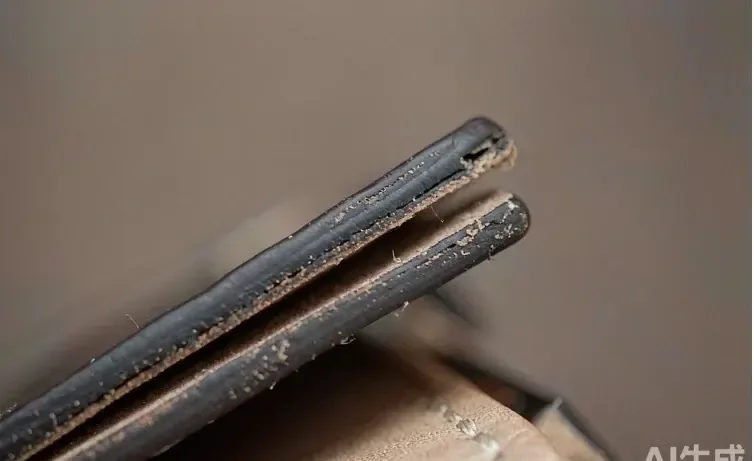
- Edge finishing: coat count, build thickness and the absence of a ridge at the turn.
- Hardware function: cycling, pull strength and finish adhesion of the plated surface.
- Final audit: the AQL 2.5 draw, packing check and document reconciliation.
Each checkpoint has an owner and a record. Where a checkpoint has neither, it is not a checkpoint, it is a habit, and habits do not survive a busy month across 7 production lines.
Checkpoint One: Incoming Material
Nothing downstream can be better than the skin it is cut from, so the first checkpoint does most of the work. Full-grain calfskin is read for thickness at five points per panel with a target of 1.2-1.4 mm, for shade against the approved swatch under D65 at a Delta E at or below 1.5, and for surface faults — healed scars, insect marks, loose grain — that have to be placed or avoided during cutting.
- Thickness: 1.2-1.4 mm on full-grain calfskin, read with a dial gauge at five points per skin.
- Shade: Delta E at or below 1.5 against the sealed reference, read in a light booth under D65 rather than under bench lighting.
- Surface faults: mapped per skin before cutting, so the marker can place them or work around them.
- Lot identity: the tannery reference and finish recorded, because a certificate is issued against a lot, not against a colour name.
- Restricted substances: declarations checked against REACH Annex XVII and California Prop 65 before the lot is released.
The mapping step is the one most programmes skip and the one that protects yield. A healed scar placed at the centre of a front panel reads as a defect; the same scar placed below the base line or inside a gusset reads as character, and it costs nothing to decide that before the blade cuts.
Checkpoints Two and Three: Cutting and Skiving
Cutting errors cost one panel to fix and a whole run to miss, because every operation after cutting assumes the panel is correct. Dimensions are checked against the pattern within 1 mm, grain direction is confirmed so that panels on the same bag stretch consistently, and the marker placement of any mapped fault is verified against the plan made at checkpoint one.
- Panel dimension tolerance
- Within 1 mm of the pattern on every edge
- Grain direction
- Consistent across all panels of one unit, recorded on the marker
- Skived fold thickness
- 0.6-0.8 mm at the turn, read with a dial gauge
- Reinforcement placement
- Centred over the load path, with no telegraphing through the outer face
- Yield record
- Panels cut against skins issued, so a yield drop is visible the same day
Skiving is where most structured bags quietly fail. A fold left at 1.0 mm instead of 0.6-0.8 mm will not turn cleanly: the edge bulks, the paint builds unevenly over it, and the corner cracks under handling. It is invisible until the bag is closed, which is exactly why it gets its own checkpoint.
Checkpoint Four: Assembly on the Bench
Assembly is checked while it happens rather than afterwards. Stitch density is counted over a 25 mm gauge at three positions per panel against a target of 8-9 stitches per inch, seam allowance is held constant, and panel alignment is read along the gusset join, where drift is most visible to a customer standing in a shop.
| Item checked | Target | Why it is checked here |
|---|---|---|
| Stitch density | 8-9 stitches per inch | Below that the seam opens under load; above it the needle perforates the leather and weakens the edge |
| Seam allowance consistency | Constant along the run | A wandering allowance shows as a wave on the finished seam that cannot be pressed out |
| Panel alignment at the gusset | No visible drift | Misalignment at the join is the first thing a customer sees when the bag is set down |
| Handle attachment | Load path reinforced, tested to 150 N | Handles carry the whole weight of a loaded bag and are the most common structural failure |
| Interior pocket placement | Within 2 mm of the pack | Interior errors are rarely seen in photographs and always seen in use |
The handle pull test is worth specifying explicitly. A handle that fails in a customer's hand is the single most damaging failure a luxury programme can ship, and 150 N applied at the attachment is a modest ask against the loads a loaded bag actually sees.
Checkpoint Five: Edge Finishing
Edge paint on a luxury body is built in three coats, each sanded back and cured, to a total of 0.35-0.45 mm read with a dial gauge 24 hours after the final cure. The reading matters less than the coat count: two coats can be brought to the same thickness and will still fail, because thickness without inter-coat sanding produces a ridge at the turn and a hairline crack within weeks.
- Coat count recorded as three, with the sanding step between each.
- Total build of 0.35-0.45 mm, read 24 hours after the final cure rather than immediately.
- No ridge at the fold, checked by running a fingernail across the turn under a bench lamp.
- Colour match to the outer face, since a mismatched edge reads as a repair rather than a finish.
- Corners inspected separately, because they fail first and are the hardest to correct.
Corners deserve their own line on the sheet. A flat run of edge can look flawless while the corner, where paint has to bridge two directions of fold, has already started to lift. Check corners on every drawn unit, not on the sample you happen to pick up first.

Checkpoint Six: Hardware Function and Finish
Hardware is checked in two ways: mechanically, by cycling and pull, and chemically, by salt spray on the plated surface. A turn-lock is cycled 200 times without scoring the receiving plate, zips are run through their full travel repeatedly, and plating is read at 0.15-0.3 µm by X-ray fluorescence on a flat surface.
- Plating thickness
- 0.15-0.3 µm, read by X-ray fluorescence on a flat, non-contact surface
- Salt spray exposure
- 24 hours neutral salt spray to ISO 9227, no bloom on the exposed face
- Turn-lock cycling
- 200 open and close cycles with no scoring of the receiving plate
- Zip travel
- Full travel repeated 500 times on a number 5 coil without tooth deformation
- Attachment pull
- 150 N at the handle attachment and at any strap anchor point
- Finish adhesion on leather
- ISO 11644, reported in newtons per 10 mm against the lot value
The 24-hour salt spray figure is the threshold below which bloom appears within a season on the shelf. It is a modest test by industrial standards and a demanding one by decorative hardware standards, which is why it belongs in the specification rather than in a conversation.
Laboratory Tests Worth Paying For
Not every test earns its fee on every programme. Four do, because each one is asked for by a retailer or a marketplace at some point, and each is issued against a lot, which means it cannot be produced retrospectively once that lot is cut and gone.
Colour fastness to rubbing
ISO 105-X12, with a target of 4/5 dry and 3-4/5 wet on pale calfskin. Pale shades bleed onto light clothing, and a report issued against the lot settles the argument before it starts.
Tensile and tear strength
ISO 3376 for tensile strength and ISO 3377-2 for tear resistance, reported in newtons per square millimetre. Recorded against the lot so a weaker skin is detectable in a re-order.
Finish adhesion
ISO 11644 for the adhesion of a leather finish, reported in newtons per 10 mm. This is the test that separates a durable corrected grain from one that will flake at the fold.
Restricted substances
REACH Annex XVII for the European market and California Prop 65 for the United States, plus CPSIA where goods are sold to children. Declarations are checked at the lot, not at the style.
Book the laboratory when the lot is named, not when the goods are finished. Reports take their own calendar days, and a capsule held at the port waiting for a certificate is the most avoidable delay in this entire discipline.
The AQL 2.5 Draw, Explained Properly
The final audit draws a statistical sample rather than inspecting everything, and the plan is fixed by lot size and inspection level before bulk begins. AQL stands for acceptance quality limit: it is the worst tolerable process average when a continuing series of lots is submitted, not a promise that every bag is perfect, and it is worth knowing the difference before signing anything.
| Lot size (pcs) | Code letter, level II | Units drawn | Accept | Reject |
|---|---|---|---|---|
| 91-150 | F | 20 | 1 | 2 |
| 151-280 | G | 32 | 2 | 3 |
| 281-500 | H | 50 | 3 | 4 |
| 501-1200 | J | 80 | 5 | 6 |
| 1201-3200 | K | 125 | 7 | 8 |
| 3201-10000 | L | 200 | 10 | 11 |
Two consequences follow from the table, and both surprise founders. First, a 500 pcs lot draws 50 units, so roughly one bag in ten is examined — variation will surface, and it is less expensive to design out than to argue about. Second, the accept number is not zero, so a lot with three minor faults still passes; if your brand needs zero tolerance on a particular defect, that has to be written as a separate critical clause.
Critical, Major and Minor: Classifying Defects
Classification decides what happens to a lot, and an unclassified defect list produces arguments rather than decisions. Three classes are standard, and the useful habit is to write your own examples under each before bulk opens rather than during an audit.
- Critical: a failure that makes the piece unsafe or unsaleable, such as a handle attachment that separates under load or a needle fragment left in a panel. Any critical defect rejects the lot outright.
- Major: a failure a customer would notice and return, such as a shade deviation above Delta E 1.5, a visible seam wave, or edge cracking at a corner. Counted against the accept number.
- Minor: a small deviation that does not affect saleability, such as a stitch tension variation inside tolerance. Counted, recorded and monitored across lots.
- Zero-tolerance defects: written separately as critical regardless of class, because the AQL accept number would otherwise permit them.
The needle fragment example is not rhetorical. Broken needle policy — recording the fragment, accounting for the whole needle before a new one is issued, and logging the event — is a basic control in garment and leather goods production, and it is worth asking to see the log.

Correct, Re-Check and Close the Record
A rejected lot is corrected or replaced and then drawn again; it is not negotiated down. The re-check is the step most often skipped under time pressure, and skipping it is how a corrected lot ships with the correction untested. The calendar carries three days for this stage, and those three days are the reason the audit behaves as a gate rather than as paperwork.
- Classify every finding as critical, major or minor before counting anything.
- Record the finding against an operation, not against a person, so the record stays useful.
- Correct the lot, then draw again at the same level rather than at a relaxed one.
- Close the record with the re-check result attached to the original finding.
- Carry the finding into the next capsule as a specification change rather than as a memory.
That last step is what distinguishes a programme that improves from one that merely ships. A defect recorded as a specification change appears in the next pack; the same defect recorded as a conversation reappears in the next audit.
What a QC File Should Contain
A quality file is the artefact a retailer, a marketplace or an insurer will ask for, and it should exist whether or not anyone asks. Ours runs to seven items, assembled as the lot progresses rather than compiled at the end, since a file compiled after the event tends to be a reconstruction rather than a record.
- Incoming material readings: thickness, shade and fault map per lot.
- In-process records from cutting, skiving and assembly, each with a date and a position.
- Hardware reports: plating thickness in microns and the salt spray exposure used.
- Laboratory reports issued against the named lot, not against the style.
- The AQL 2.5 audit sheet with accept and reject numbers written before the draw.
- Photographic sets of the drawn units, including any rejected findings.
- Documentation handling, quoted from USD 4.80 per lot file, covering assembly of the set.
Our validated partner factory Quanzhou Yingming Bags, an SGS-validated site, has run export programmes since 2014 across 7 production lines at about 200,000 pcs per month, with sampling of 6-10 working days and bulk of 35-50 days. Third-party inspection can be arranged alongside the internal audit where a retailer requires an independent draw.
See the checklist that runs your lot
Send your style, quantity and destination markets. You will receive the seven-checkpoint sheet with numeric targets, the AQL 2.5 plan for your lot size, and the laboratory list matched to the markets you sell in. Request a quote.
Frequently Asked Questions
What does AQL 2.5 mean on a handbag order?
It is an acceptance quality limit used with a sampling plan from ISO 2859-1. At general inspection level II a 500 pcs lot uses code letter H: 50 units are drawn, and the lot is accepted on 3 defects or fewer and rejected on 4. It describes a tolerable process average, not a guarantee that every unit is flawless.
How many units are inspected on a 500-piece lot?
Fifty, drawn at random from the finished lot under code letter H at general inspection level II. That is roughly one bag in ten, which is enough for process variation to surface and small enough to be practical. If your brand needs zero tolerance on a specific defect, write it as a separate critical clause.
What is the difference between critical, major and minor defects?
A critical defect makes the piece unsafe or unsaleable and rejects the lot outright, such as a handle attachment that separates under load. A major defect is one a customer would return, counted against the accept number. A minor defect does not affect saleability but is recorded and monitored across lots.
Why is inspection done before packing rather than after?
Because correction is only inexpensive while units are still on the bench. Once goods are cartoned, palletised and booked, correcting a finding means unpacking, re-checking and re-packing, and it risks missing the vessel. The sequence is the control, not merely the paperwork order, and it is worth defending in writing.
What thickness should full-grain calfskin be measured at?
A target of 1.2-1.4 mm for a structured handbag body, read with a dial gauge at five points across the skin. Consistency matters more than the absolute figure, because panels cut from a skin that varies across its area will not stretch or fold uniformly once assembled.
How is colour fastness tested on leather?
By ISO 105-X12, rubbing a white cloth against the surface dry and wet and rating staining on a grey scale. A sensible target for pale calfskin is 4/5 dry and 3-4/5 wet. Pale shades transfer onto light clothing, so the wet rating is the one that generates complaints if it is skipped.
What plating thickness should hardware carry?
Between 0.15 and 0.3 µm, read by X-ray fluorescence on a flat surface, and paired with 24 hours of neutral salt spray to ISO 9227 with no bloom on the exposed face. Below roughly 0.15 µm, tarnishing appears within a single season on the shelf.
How many coats of edge paint should a luxury bag have?
Three, each sanded back and cured before the next, giving a total build of 0.35-0.45 mm read 24 hours after the final cure. Two coats can be brought to the same thickness but lack the inter-coat keying, so they ridge at the fold and crack at the corner under handling.
What is a broken needle policy and why does it matter?
It is the control requiring that a broken needle be recovered in full, logged, and accounted for before a replacement is issued, so no fragment remains in a panel. It is a basic control in leather goods production, and asking to see the log is a reasonable request.
When should laboratory testing be booked?
When the material lot is named, not when the goods are finished. Reports are issued against a lot and take their own calendar days, so a capsule held at the port waiting for a certificate is a delay that costs more than the test ever did.
Do I need a third-party inspection as well?
Not always, but it is available and some retailers require it. An independent draw is most useful on a first capsule, where neither side has a shared history of what counts as acceptable, and it becomes less necessary once defect classification is written and agreed.
What happens when a lot is rejected?
The units are corrected or replaced and then drawn again at the same inspection level rather than a relaxed one. The calendar carries three days for this stage. Skipping the re-check is how a corrected lot ships with the correction never actually tested, so ask for the result in writing before packing is released.
How does quality control connect to the sampling round?
The sealed approval sample is the reference the audit judges against, so the five numbers agreed at sampling become the audit criteria. A measurement never written into the pack cannot be inspected at the end, which is why the two stages are really one record.
What does the quality file cost and contain?
Documentation handling runs from USD 4.80 per lot file and covers assembly of the set: material readings, in-process records, hardware reports, laboratory reports issued against the lot, the audit sheet, and photographic sets of the drawn units, assembled as the lot progresses rather than compiled afterwards.
People Also Ask
What is AQL 2.5 in handbag inspection?
An acceptance quality limit applied with a sampling plan from ISO 2859-1. At level II a 500 pcs lot draws 50 units, accepting on 3 defects and rejecting on 4. It defines a tolerable process average across lots rather than perfection in one.
How do you check handbag stitch quality?
Count stitches over a 25 mm gauge at three positions per panel against a target of 8-9 per inch, then check seam allowance consistency and panel alignment at the gusset. Too few opens under load; too many perforates the leather.
Why does edge paint crack on bags?
Usually because it was applied in too few coats, or over a fold that was not skived thin enough. Three coats with inter-coat sanding over a fold at 0.6-0.8 mm is what keeps the corner from lifting under handling.
What tests should leather handbags pass?
ISO 105-X12 for rub fastness, ISO 3376 for tensile strength, ISO 3377-2 for tear resistance, ISO 11644 for finish adhesion, plus REACH Annex XVII and California Prop 65 declarations for restricted substances.
How long does a handbag inspection take?
The draw itself is a day or less for a 500 pcs lot, but the calendar carries three days for the stage, because correction and re-check follow any finding. Those three days are why audit behaves as a gate rather than as paperwork.
Sources and further reading
Every figure on this page is either our own programme data or attributed below. Open the originals before you write them into a specification.
- ISO — International Organization for StandardizationISO Publisher of ISO 2859-1 for the AQL sampling plans, ISO 105-X12 for colour fastness to rubbing, ISO 3376 and ISO 3377-2 for strength, ISO 11644 for finish adhesion and ISO 9227 for salt spray.
- REACH legislation (European Chemicals Agency)ECHA Annex XVII restrictions on substances in leather and hardware, checked against declarations issued for each material lot.
- California Proposition 65OEHHA The substance list applied to goods sold into California, checked alongside REACH at the declaration stage for each lot.
- Leather Working GroupLeather Working Group Tannery audit protocol referenced when a hide lot is named, which affects consistency of thickness and shade between lots.
- CPSC — Consumer Product Safety CommissionU.S. Consumer Product Safety Commission Administrator of CPSIA requirements, relevant where handbags are sold into children's product channels in the United States.