Premium Handbag Production: How a Premium Line Is Specified, Sampled, Priced and Run at Scale
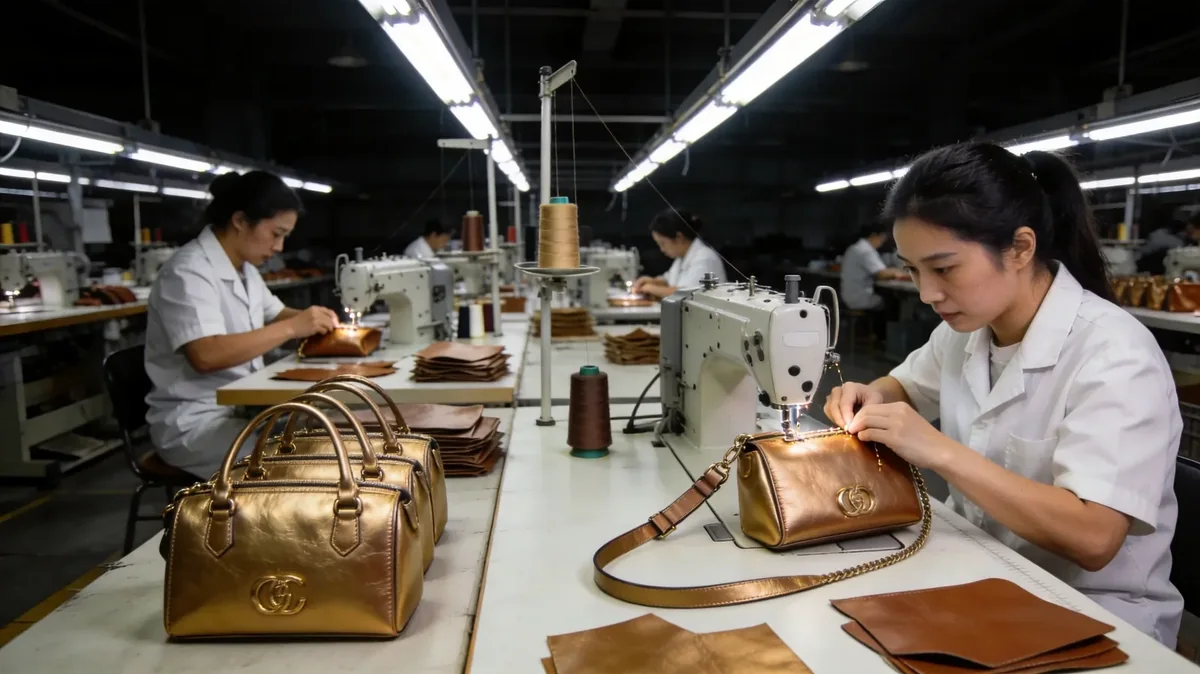
What separates premium handbag production from an ordinary order is that every parameter is written down and measured: leather thickness, stitch density, edge coats and plating are stated before cutting and audited at intake. Sampling runs 6-10 working days, or 12-15 where hardware tooling is needed, and bulk runs 35-50 days from the signed sample to FOB Xiamen. Orders start at 500 pcs per style and colourway, are audited to AQL 2.5 under ISO 2859-1, and are carried out through our validated partner factory Quanzhou Yingming Bags, an SGS-validated production site with export experience since 2014, 7 production lines and about 200,000 pcs per month.
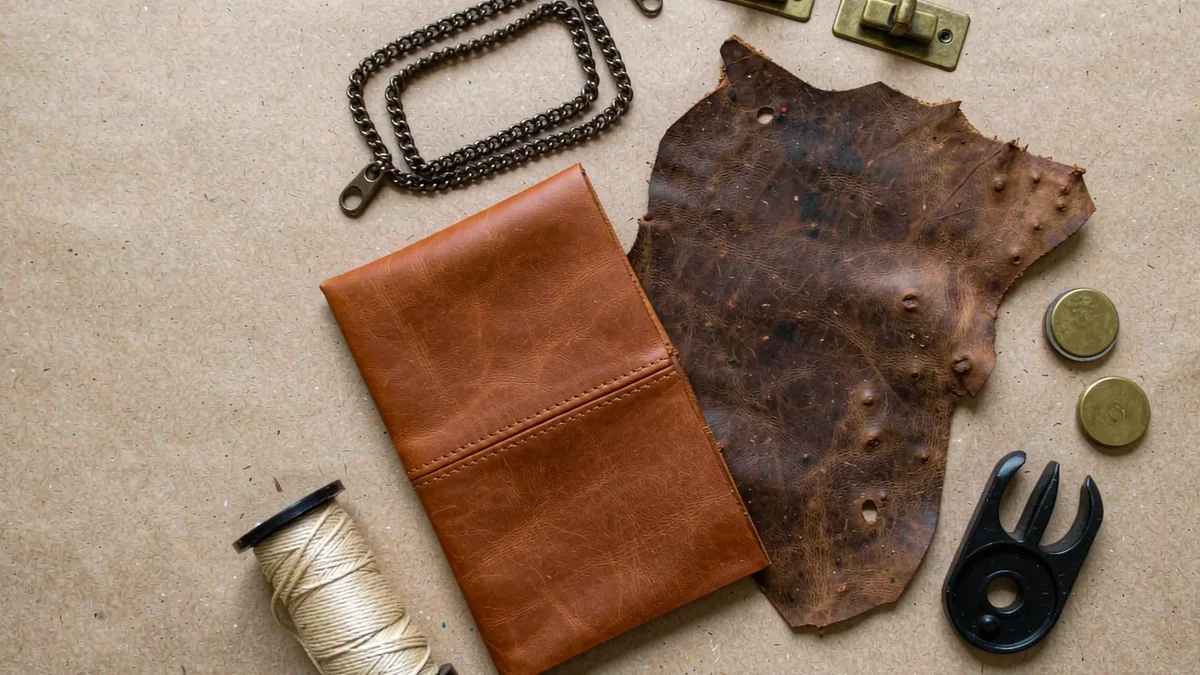
What Premium Handbag Production Actually Promises
Premium handbag production is a promise about tolerance: the five-hundredth bag has to sit inside the same measurement window as the approved sample, written down before the first cut rather than argued about after the cartons are sealed.
Three habits separate it from a standard run. The hide lot is named instead of described, the finishing parameters are stated in numbers instead of adjectives, and the inspection protocol is agreed before bulk starts rather than after packing.
Buyers who have been burned know the pattern: a beautiful sample, then a bulk run that drifts, usually because a specification was never written down. The checks worth making first sit in the eight things to check on a production floor.
The Specification Sheet: Twelve Numbers That Decide the Outcome
A premium line is defined by the numbers on its specification sheet rather than by the drawing above them. These twelve decide how the bag looks, wears and survives a season.
- Body leather
- 1.2-1.4 mm full-grain calf, after splitting
- Lining
- 0.6-0.8 mm nappa or suede, ISO 105
- Stitch density
- 8-9 per inch, bonded nylon at 0.45 mm
- Thread tension
- Set per machine, re-checked at unit 50
- Edge paint
- 3 coats, 6-8 min flash-off at 60 °C
- Turn allowance
- 3.0 mm allowed at every turn
- Base metal
- Solid brass or stainless; zamak if weight demands
- Plating
- 0.15-0.30 µm, neutral salt spray 24 h
- Reinforcement
- 0.8 mm non-woven behind the flap
- Tolerance
- ±1.0 mm to 300 mm, ±1.5 mm beyond
- Load test
- Handle and strap cycled 500 times
- Colour
- Lab dip plus signed swatch, D65 light
Two of those do the heavy lifting. Set stitch density at 8-9 per inch and a 1.2 mm calf seam keeps its line under a loaded handle; drop to 7 and the same panel gaps after a season of daily use. Three edge coats with a genuine flash-off cure through rather than skinning over.
The bench technique behind them is in craftsmanship and the grades in luxury materials.
Materials and Yield: Why the Hide Lot Sets the Price
Material is the largest line in a premium quote and the least understood, because the brand is buying a yield from one hide rather than a price for it.
Full-grain calf, 1.2-1.4 mm
Graded by cut: the shoulder and the flank behave differently, and the pattern should say which it wants.
Vegetable-tanned shoulder, 1.6-1.8 mm
Chosen for handles and straps that are expected to darken with use rather than stay flat.
Nappa and suede linings, 0.6-0.8 mm
Weight governs drape; light linings ripple at the corners once the bag has been carried.
Solid brass hardware, 0.15-0.30 µm
Read in the hand as weight and closure, and repairable rather than replaceable.
CITES-listed exotics
Available skin by skin, with permits matched to the invoice on each consignment.
Yield is the arithmetic underneath. A structured body cut from full-grain calf typically returns 60-70% usable area once neck, belly and scars are excluded, and that ratio is set by the pattern long before price is discussed.
Sampling: Rounds, Corrections and Where Price Freezes
Sampling is where a design becomes a buildable object, and the only stage at which a change still costs least. Each round ends at a decision rather than a comment.
- Brief and feasibility: the sketch is measured, the panel breakdown is drawn, the yield is estimated.
- Pattern and first cut: templates made, panels skived, the prototype assembled on the bench.
- Correction round: fit notes applied to the flap, the gusset and the hardware seating.
- Complex builds only: lock tooling proven, plating shade confirmed, frame closure tested.
- Sign-off: the physical reference is agreed and the unit price is reconfirmed.
A straightforward build returns in 6-10 working days; one needing hardware tooling returns in 12-15. The additional days belong to the lock rather than to the leather, since a closure has to exist in metal before the panels around it can be finalised.
Cost is fixed at sign-off. Anything settled earlier is inside the number; anything altered afterwards brings a fresh cutting plan, and usually a further sampling round. See luxury sampling.
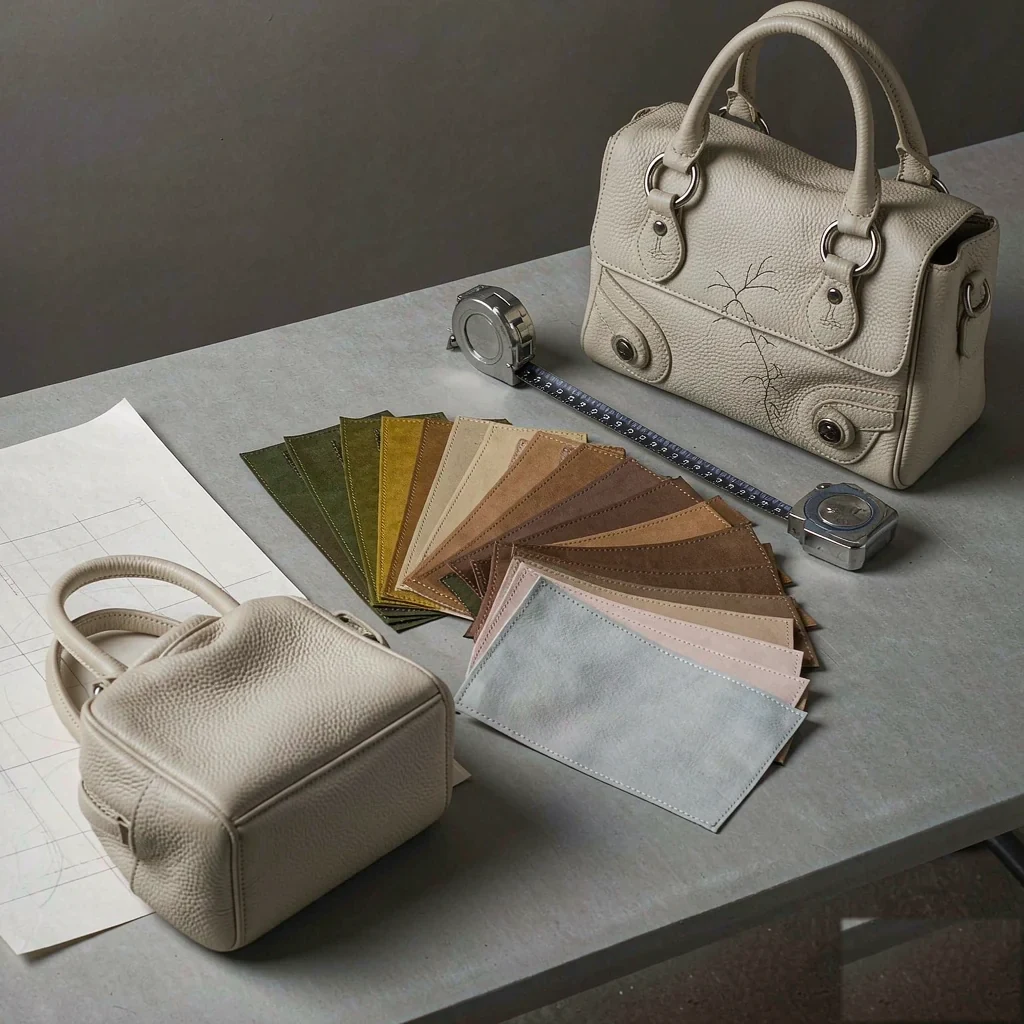
Bulk: Inside the 35-50 Day Window
Bulk takes 35-50 days from the signed approval sample to handover at FOB Xiamen. Each stage needs the days it is given.
- Days 1-6: material intake, hide inspection, panel cutting and skiving.
- Days 7-10: interlining applied, edges prepared, hardware received and counted.
- Days 11-26: bench assembly across the line, stitch density audited daily.
- Days 27-33: edge finishing, creasing, burnishing and final pressing.
- Days 34-38: AQL 2.5 audit under ISO 2859-1, defects logged by type.
- Days 39-50: corrections, re-inspection, packing, documents, handover.
What keeps a run inside 50 days
- Freeze the hide lot and the base metal before intake.
- Approve the sample in the hand, not from a photograph.
- Agree accept and reject numbers before bulk starts.
- Keep one named contact on each side throughout.
Schedules slip for two reasons above all: a closure chosen once the panels are already cut, and a hide swapped after sign-off. Volume is seldom the obstacle, since the site runs 7 production lines at about 200,000 pcs per month and has held export experience since 2014.
The Cost Structure, Written in Six Lines
A serious quotation is broken into six lines, because neither side can negotiate a single figure per bag in good faith. Four of them are already settled once the pattern exists.
| Line | Share of FOB | Main lever | Typical surprise |
|---|---|---|---|
| Material | 38-52% | Hide grade, yield, lot size | Lot re-selected after approval |
| Hardware | 12-22% | Base metal, plating, tooling | Lock tooling billed late |
| Bench labour | 14-20% | Stitch density, hand finishing | Construction change late |
| Finishing | 4-8% | Edge coats, creasing, pressing | Fourth edge coat at bulk |
| Compliance | 2-4% | REACH, Prop 65, CPSIA | Retest after coating change |
| Packaging | 3-6% | Dust bag, rigid box, tissue | Artwork approved late |
The lesson is about sequence rather than bargaining: hide and base metal chosen early keep the number steady, whereas pressure applied late moves very little.
The first sample set, a swatch card, a hardware sample and one built panel, is invoiced at USD 4.80 and credited in full against the first bulk order. More in the real cost of a premium run.
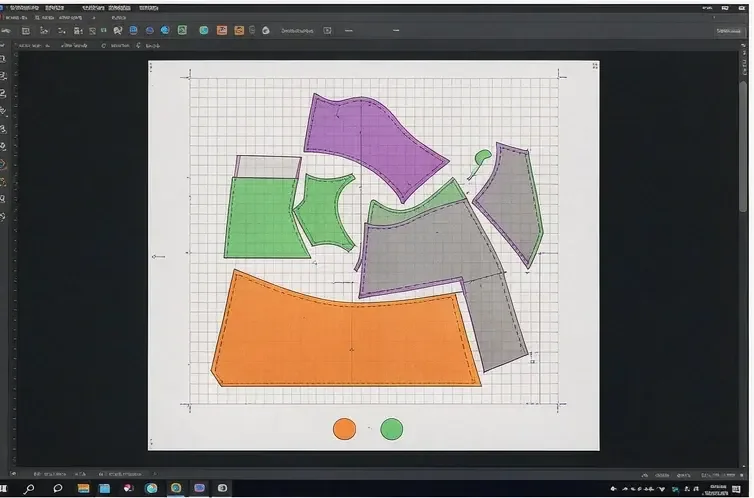
Quality Gates: AQL 2.5 and the Tests Behind It
AQL 2.5 sets the acceptable count of minor and major defects in a random sample drawn under ISO 2859-1. It works because the sample size and the accept and reject numbers are agreed before bulk rather than after packing.
| Check | Method | Target | When |
|---|---|---|---|
| Dimensional audit | Spec and approved sample | ±1.0 mm to 300 mm | Intake, final audit |
| Stitch density | Counted over one inch | 8-9 per inch | First unit daily |
| Edge paint adhesion | Tape and fold check | No lift after 20 folds | After finishing |
| Colourfastness to rub | ISO 105 | Grade 4 on linings | Per lot, pre-cut |
| Hardware corrosion | Neutral salt spray | 24 h, no base metal | Per plating run |
| Final random audit | AQL 2.5, ISO 2859-1 | As agreed in writing | Before sealing |
Finish adhesion is checked to ISO 11644 and tensile strength to ISO 3376 when a lot or coating changes. Independent inspection is worth ordering when goods ship straight to a stockist.
The full protocol sits on luxury quality control and AQL 2.5 explained.
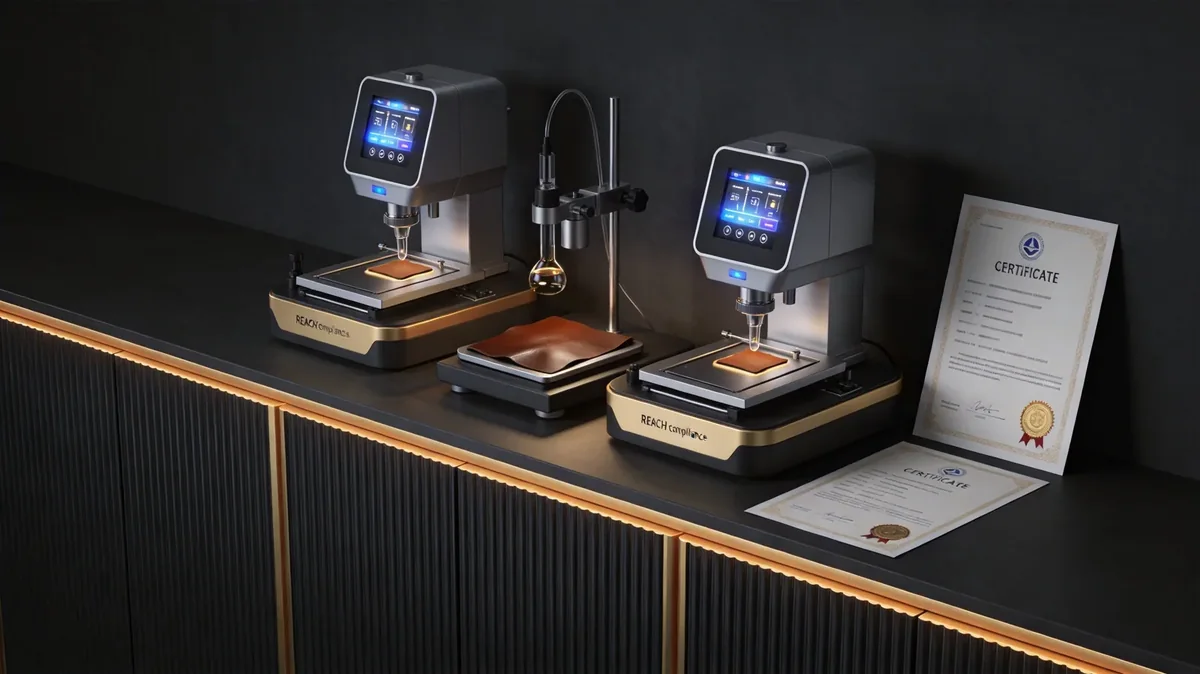
Certifications, Audits and the Compliance File
Compliance is a document set that travels with the order, and gaps in it are found at the border rather than at the bench.
- BSCI and Sedex audit reports covering the social audit side of the site.
- REACH Annex XVII declarations for leather, coatings and metal parts sold into Europe.
- California Prop 65 assessment whenever a plating or a coating changes.
- CPSIA documentation where a line carries a small-parts classification.
- GRS documentation where a recycled fibre or lining is specified.
- Leather Working Group (LWG) references from the tannery supplying the hide.
Ask for the report number and the date rather than the logo, since the useful question is what has changed in the lot since. The sourcing version sits on high-end handbag sourcing.
Protecting the Design and the Technical File
Protection here is procedural before it is legal, and the instrument that does the work is the file rather than the contract.
- Graded patterns are drawn for one label and stay out of any shared library.
- Any tooling invoiced to the label belongs to it, and the cost sheet should say so.
- Secrecy terms should name the tech pack, the material list and the launch window.
- Recording the hide lot means the next season can be repeated, not guessed at.
- Both sides sign the sample record, so the reference exists as an object.
Contracts cannot hold judgement: the reason a strap was narrowed two years ago, the brass tone the house settled on. That memory is what keeps a later collection recognisable. The steps sit in protecting your designs with a production partner.
Working Remotely: The Rhythm That Holds
Most premium programmes run across time zones, and the ones that drift are the ones without a rhythm.
- One named contact on each side, copied on everything, for the whole programme.
- A weekly written note with a photograph of the real unit, not a render.
- A single decision log, so a change agreed on a call exists in writing the next day.
- A fixed approval deadline per round, after which silence counts as acceptance.
- Measurements quoted with the tolerance attached, never as a bare number.
A phone picture flattens an edge and hides a gusset, so the sample that decides anything is the one held in the hand. The onboarding sequence is in how to onboard a premium production partner.
When to Scale, and When to Change Partner
Scaling is a question about the file rather than the volume, and the signals that say a line needs a new partner are specific.
- Scale when the specification has held for two seasons and the defect log is stable.
- Scale when the construction repeats rather than being reinterpreted.
- Change when tolerances are defended with adjectives instead of measurements.
- Change when the material lot changes without the brand being told first.
- Change when defect counts arrive without the type breakdown behind them.
- Change when the calendar slips twice for reasons nobody can name.
The decision is easier before a season is committed, which is why the file should stay portable from the first order.
Getting Started: What to Send, and What Comes Back
The fastest programmes start with one complete message: sketches or reference images, target dimensions, leather and hardware intent, quantity per colourway, destination market and launch date. A quote and sampling calendar follow within two working days.
Orders begin at 500 pcs per style and colourway. Reaching 500 means one hide lot can be held and one plating batch run to a single tone; under it, minimum plating charges and whole-hide buying work against the label.
Start a premium production programme
Send your sketches, target dimensions, hide and hardware preferences, quantity per colourway and launch date. A quote broken into six lines, a sampling calendar and a material shortlist arrive within two working days. Request a quote.
First-time labels often start on premium production for first-time brands, and the capabilities worth comparing sit in what matters most to brands.
Frequently Asked Questions
What does premium handbag production include?
It includes specification, material sourcing, sampling, bulk, inspection and packing, all run against one written tolerance. The specification sheet carries leather thickness, stitch density, edge coats and plating thickness, and every later decision is checked against it rather than against a photograph, so arguments about intent end at the file.
What is the minimum order for a premium programme?
The threshold is 500 pcs per style and colourway. Reaching it allows one hide lot to be held and one plating batch to run in a single tone. Under it, minimum plating charges and whole-hide buying raise the unit figure, so a compact launch is usually better concentrated in one colourway.
How long does premium sampling take?
A standard build returns in 6-10 working days; one requiring new lock tooling returns in 12-15. The brief and pattern take the first two days, the first cut and bench build the next four, and corrections the remainder. The extra days belong to metalwork rather than to leather.
How long does bulk production take after sample approval?
From the signed sample to handover at FOB Xiamen, bulk occupies 35-50 days: intake and cutting, skiving, bench assembly, edge finishing, the AQL 2.5 audit, any correction and packing. What overruns it is usually a closure chosen late or a hide swapped after sign-off.
Which materials can be specified for a premium line?
Grades are chosen by behaviour. Full-grain calf at 1.2-1.4 mm carries a structured body, vegetable-tanned shoulder at 1.6-1.8 mm takes handles and straps, and nappa or suede at 0.6-0.8 mm lines the interior. Crocodile and python are possible, with permits matched to the invoice.
What does AQL 2.5 mean for my order?
Under ISO 2859-1, AQL 2.5 defines how many minor and major faults a random sample may contain. Its value lies in procedure: sample size and accept and reject figures are settled before bulk begins, so release follows a rule rather than a mood. Independent inspection can be added.
How is the cost of a premium handbag built up?
The quote is written in six lines: material 38-52%, hardware 12-22%, bench labour 14-20%, finishing 4-8%, compliance 2-4% and packaging 3-6% of FOB cost. Four of those six are fixed before the pattern is cut, so price is set in the specification rather than negotiated at the end.
Which certifications and test reports should I ask for?
Ask for BSCI and Sedex audit reports, REACH Annex XVII declarations for Europe, a California Prop 65 assessment when plating or coatings change, CPSIA documentation where relevant, GRS papers for recycled content and Leather Working Group references from the tannery. Ask for the report date too.
Who owns the patterns and the tooling?
Patterns and graded sizes developed for a brand belong to that programme and live in its technical file. Tooling the brand paid for is the brand's, and it is worth stating both on the cost sheet at the start, because that determines what happens if the programme later moves elsewhere.
What should I send to get a premium quote?
Send sketches or reference images, target dimensions, the leather and hardware you have in mind, quantity per colourway, destination market and launch date. With those six items on the table, a six-line costed quote, a sampling calendar and a material shortlist can be returned inside two working days.
How is the quoted unit price protected until bulk?
The unit figure holds for the stated validity window and is fixed once materials are booked against the deposit. Before that it moves with hide prices, plating costs and quantity. Protection comes from booking early and from freezing decisions at the approval gate, which is why revision discipline during sampling has a commercial value.
What actually happens inside the 35-50 day bulk window?
The window begins after sample approval and material booking. It covers hide cutting, panel preparation, skiving, assembly, edge work, hardware setting, lining installation, cleaning, in-line inspection and final packing. Cut-to-pack time varies with structure and finishing: a soft body moves faster than a framed bag with turned edges.
What happens if incoming material fails inspection?
Incoming material is checked before it reaches the benches. Failed lots are quarantined, documented and returned or replaced against the material claim. Because the calendar assumes first-time-right material, a replacement lot can move the delivery date; that risk is why named materials are booked early and inspected on arrival rather than later.
Can this line run alongside our existing production source?
Yes, and it is often the sensible arrangement for a first season. The requirement is a complete specification plus a reference sample so both sources work to the same numbers. Without those, quality drifts between sources and neither can be held to a measurable standard when a claim arrives months later.
What does the pre-production gate cover?
The pre-production gate confirms the build before bulk starts: correct materials from the booked lot, confirmed patterns, agreed tolerances, hardware function, edge finish and constructions signed against the golden sample. Passing it means the remaining risk is execution, not definition, which is the point at which a bulk release is honest.
People Also Ask
Why does MOQ apply per colourway rather than per style?
Each colourway needs its own hide lot and its own plating run. Splitting 500 pieces across four colours means four lots and four plating batches, so the unit price reflects setup rather than volume.
When should hardware be specified?
Before the pattern is cut. Lock geometry and thickness drive the panel allowances around them, so a late decision usually costs a revised pattern and a second sampling round rather than a simple swap.
What causes a bulk run to drift from the approved sample?
Most often a material lot re-selected after approval, or a parameter that was never written down. Both are specification problems rather than bench problems, and both show up in the defect log by type.
Is third-party inspection worth ordering?
It is worth ordering when the launch date is fixed and goods ship straight to a stockist. The internal AQL 2.5 audit already draws a random sample; a third party adds an independent count before the cartons leave.
How early should an exotic skin programme start?
Earlier than the calfskin equivalent. Permit processing runs on its own timetable, so an exotic collection should add that calendar before the sampling window is planned.
Sources and further reading
Every figure on this page is either our own programme data or attributed below. Open the originals before you write them into a specification.
- ISO — International Organization for StandardizationISO Publisher of ISO 2859-1, the sampling procedure behind AQL 2.5, plus ISO 105 for colourfastness, ISO 11644 for finish adhesion and ISO 3376 for tensile strength.
- Leather Working GroupLeather Working Group Environmental audit protocol for tanneries, referenced when a brand asks for audited hides and a named lot on a premium calfskin programme.
- CITES — Convention on International Trade in Endangered SpeciesCITES Appendix II and III listings govern the permit documents required for crocodile and python skins on every shipment.
- ECHA — REACHEuropean Chemicals Agency REACH Annex XVII restrictions apply to substances in leather, coatings and metal components sold into the European market.
- Proposition 65California Office of Environmental Health Hazard Assessment The warning assessment reviewed whenever the hardware plating or the coating on a bag changes.
- SedexSedex Social audit reporting platform; the audit reference a buying team should ask to see alongside the BSCI report.
- SGSSGS Third-party testing and site validation, referenced for the validated status of the partner production site and for optional independent inspection.