Luxury Handbag Packaging and Presentation: Rigid Boxes, Dust Bags, Inserts and the Unboxing Ritual
Luxury handbag packaging is the protective and ceremonial set that travels with every bag: shipping carton, rigid gift box, dust bag, acid-free tissue, insert, care card and hang tag. Specified properly it prevents transit damage, carries the brand's first physical gesture and survives boutique handling; specified badly it scuffs hardware and flattens a structured silhouette before the client ever lifts the handle. On a 500 pcs per style / colourway programme the full set is developed in 6-10 working days, runs inside the same 35-50 day bulk window as the bags, is inspected to AQL 2.5 (ISO 2859-1) and ships FOB Xiamen. Our reference landed cost for a foil-blocked rigid box at 500 pieces is about USD 4.80 per unit.
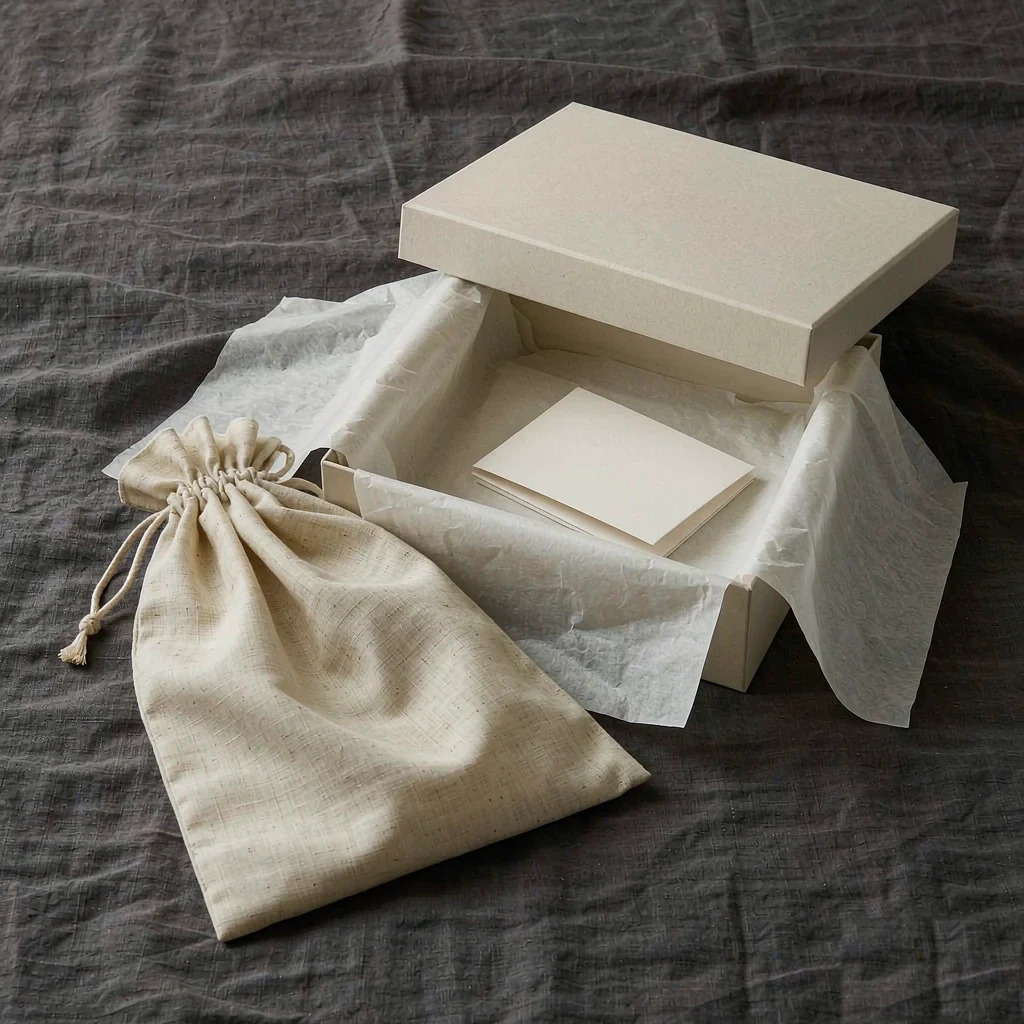
What Does Luxury Handbag Packaging Include?
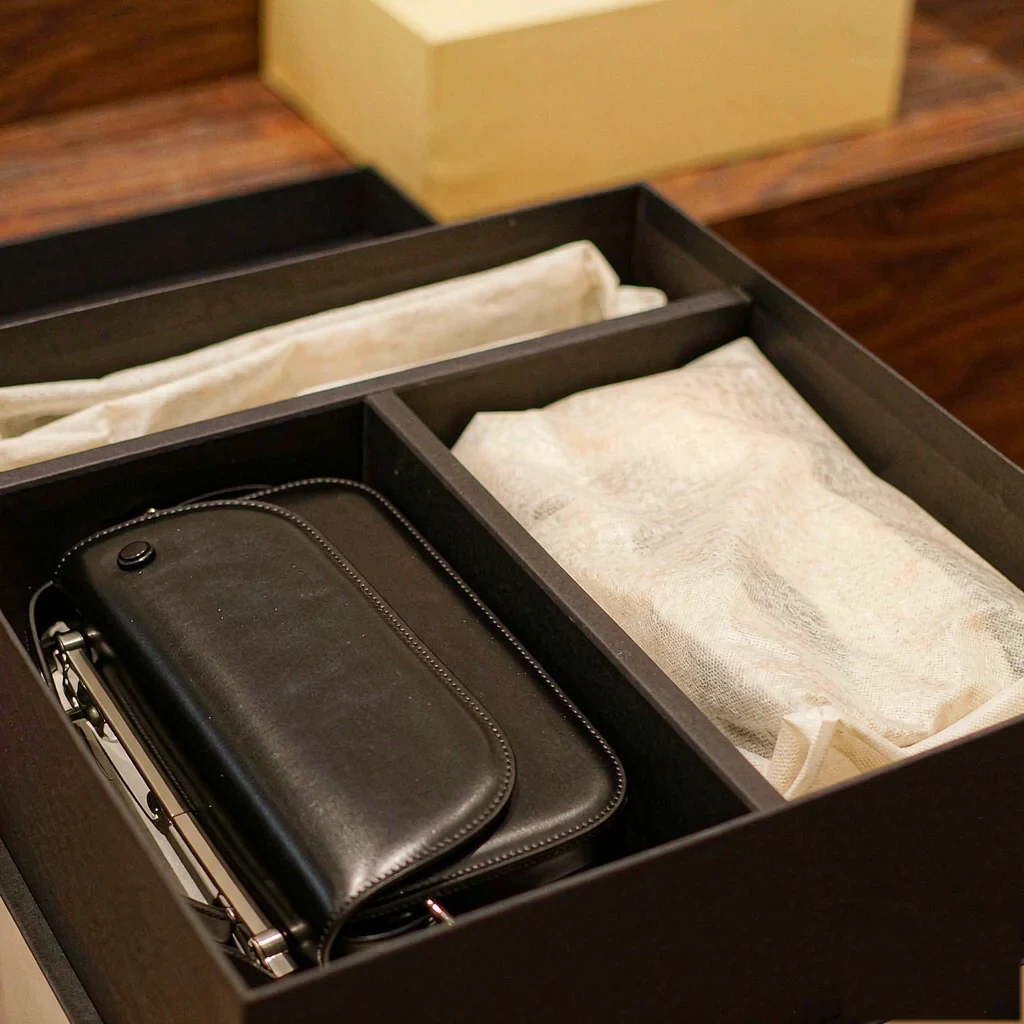
A complete luxury handbag packaging set has seven parts, and a premium line is judged on all seven at once: the outer shipping carton, the rigid presentation box, the dust bag, acid-free tissue, the internal insert or former, the care card, and the hang tag or seal. The box carries the ceremony, the dust bag carries the daily ritual, and the insert carries the bag's shape. Most disappointing unboxings are not a design failure but a specification failure at one of these seven points, usually board weight or insert depth.
- Outer carton: single or double wall, sized so the gift box cannot rattle more than 3 mm on any face.
- Rigid presentation box: wrapped greyboard with a magnetic, ribbon or lift-off lid closure.
- Dust bag: cotton or flannel at 110-140 gsm with a double drawcord, sized to the bag plus clearance.
- Acid-free tissue: 17-22 gsm, three sheets minimum, folded rather than crushed around the handle.
- Insert or former: die-cut EVA or moulded pulp that holds the silhouette under stacking load.
- Care card and authenticity card: 300-350 gsm board, matched typography and serialized where required.
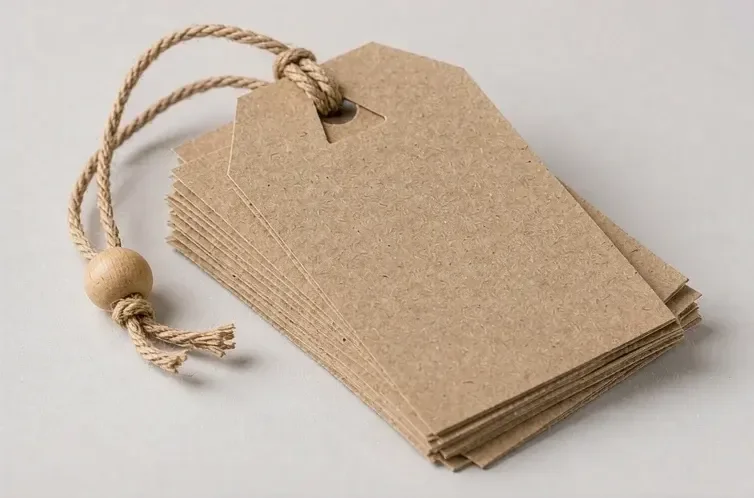
- Hang tag or seal: 350-400 gsm board with a 1.5 mm cord, or a foil seal over the closure.
Rigid Box Construction: Board, Wrap and Closure
A luxury rigid box is built from 1000-1200 gsm greyboard wrapped in 120-157 gsm printed art paper, with a 2.0-3.0 mm wall and a magnetic or ribbon closure. Anything thinner reads as a shoe box on the shelf and visibly bows when five boxes are stacked in a boutique stockroom. Board weight is therefore the single fastest way to tell whether a packaging quotation belongs in the premium band or the mass band.
| Layer | Typical specification | Why it matters |
|---|---|---|
| Greyboard | 1000-1200 gsm, 2.0-3.0 mm caliper | Holds corner shape under a five-box stack |
| Wrap paper | 120-157 gsm art paper, matte or soft-touch | Takes foil without cracking at the fold |
| Lamination | Matte BOPP 12-15 µm | Resists scuffing through the carton |
| Magnet closure | N35-N42 grade, 12-18 mm diameter | Rated for about 5,000 open and close cycles |
| Hinge | 0.6-0.8 mm cloth or kraft spine | Stops the lid splitting at the back edge |
| Insert | Die-cut EVA 3-5 mm or moulded pulp | Keeps the handle upright and the base flat |
| Footprint | Bag footprint plus 8-12 mm on width and depth | Prevents rim pressure on edge paint |
Dust Bag Specification: Fabric Weight, Drawcord and Print
A dust bag for a luxury handbag should be cotton or cotton flannel at 110-140 gsm with a double drawcord and overlocked seams. Below roughly 90 gsm the print strikes through to the reverse, the fabric snags on turn-locks and feet, and the bag emerges from storage with fibre lint on the hardware. The drawcord matters as much as the cloth: a single thin cord pulls the mouth into a pucker that presses against a top handle.
- Fabric
- 100% cotton flannel, 110-140 gsm
- Drawcord
- Double 3 mm cotton cord with knotted ends
- Seam
- Four-thread overlock, 10-12 stitches per inch
- One or two colour screen print, 25-35 mm logo height
- Sizing rule
- Bag width plus 60 mm, height plus 80 mm
- Colour fastness
- Crocking and wash checked to the ISO 105 series
- Hardware contact
- Lint-free inner face, no exposed raw edge
Inserts, Tissue and Void Fill That Protect the Bag in Transit
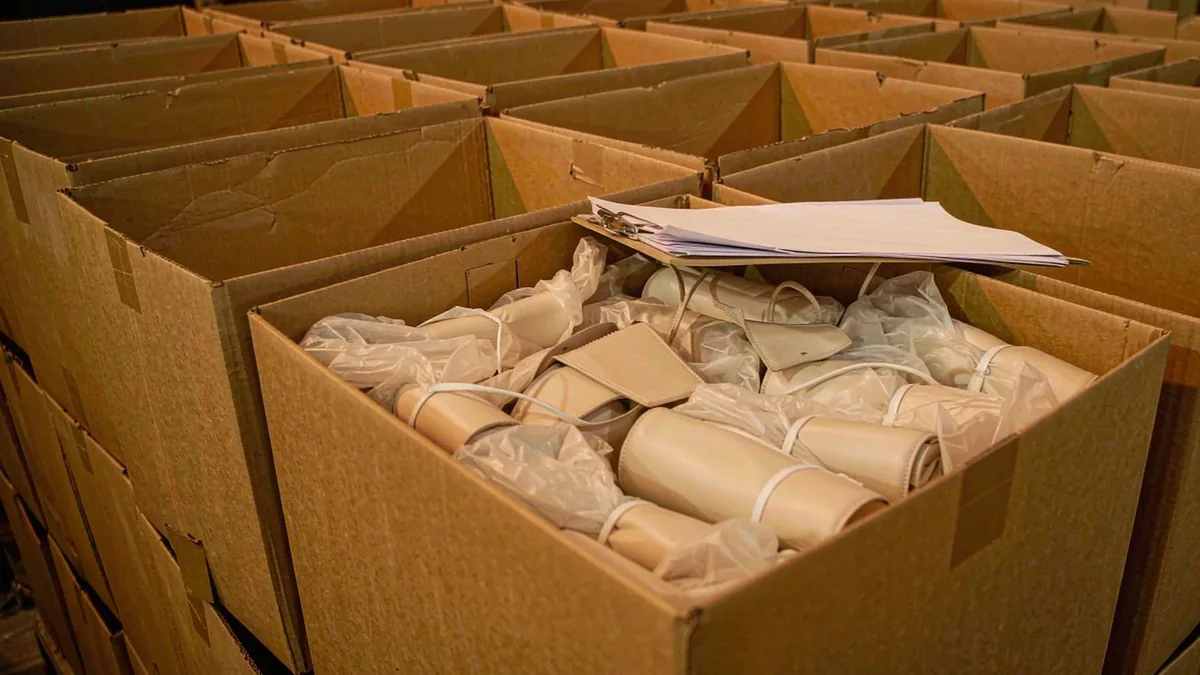
Transit damage on structured bags is almost always compression or abrasion, not impact. The insert should carry the load, the tissue should separate every leather surface from every other surface, and the carton should be filled so nothing can migrate. A bag that arrives with a flattened crown or a scuffed foot has usually been packed in a box that was 20 mm too large, with no former inside.
- Die-cut EVA or moulded-pulp former sized to the base, not the widest point of the bag.
- Acid-free tissue at 17-22 gsm, folded around the handle and over the flap, never crumpled.
- Handle wrap in soft paper or foam sleeve so the leather cannot rub against the box lid.
- Feet and turn-locks covered with a microfoam patch before the bag is lowered into the box.
- Silica gel sachet at 2-5 g per box for sea freight, placed away from direct leather contact.
- Void fill to remove all movement; the box should not shift when the carton is tilted 30 degrees.
- Carton drop and vibration performance referenced to ISTA 3A for parcel shipments.
Print Finishes: Foil, Emboss, Deboss and Spot UV
Four finishes do almost all the work on premium packaging, and each one has a different failure mode. Foil gives the metallic hit that reads as ceremony, blind emboss gives the tactile depth clients feel before they see it, deboss gives restraint for quiet lines, and spot UV gives contrast on a matte wrap. Combining more than two on a single box usually dilutes the result rather than enriching it.
Hot foil
Metallic or pigment foil at 120-140 °C on a soft-touch wrap. Best for a 25-40 mm wordmark; fine serif type below 6 pt tends to fill in.
Blind emboss
Raised relief with no ink or foil, 0.3-0.6 mm depth. Reads best on uncoated 250-300 gsm stock and on large, simple marks.
Deboss
Pressed-in relief for quiet lines. Needs tighter registration than emboss and shows board fibre if the wrap is under 120 gsm.
Spot UV
Gloss varnish over matte lamination for contrast. Durable, but it cracks at a hard fold, so keep it 3 mm clear of creases.
Soft-touch lamination
Matte film with a velvet hand. Excellent for photography, though it marks under fingernails on high-touch edges.
Edge and seam
Wrapped corners, no visible greyboard, and a spine that closes flush. The seam is what a boutique client notices first.
Compliance Marks on Packaging: FSC, REACH, Prop 65 and Fibre Names
Packaging is a regulated article in its own right, separate from the bag inside it. Paper and board sold in the European Union carry fibre and board claims under EU Regulation 1007/2011 style labelling discipline, chemical content is screened against REACH Annex XVII, and any shipment into California must be assessed against Proposition 65 warning obligations. Recycled content claims should be traceable to a chain-of-custody certificate rather than asserted on the artwork.
Documentation to request with every packaging order
- Ask for FSC chain-of-custody evidence on board and paper, a REACH Annex XVII statement covering inks, coatings and adhesives, a Proposition 65 assessment for the Californian market, CPSIA tracking where the carton is handled in the United States, and a GRS transaction certificate if the dust bag or cord uses recycled fibre. Keep these documents with the packaging tech pack, not in a separate folder, so the same revision number appears on both.
Packaging Cost, MOQ and Lead Time for a 500-Piece Programme
Packaging is not bought after the bags are finished; it is bought on the same calendar. The board, fabric and print plates all need development time, and the carton has to be on the dock before the bags are. On our programme the packaging set is quoted at 500 pcs per style / colourway, sampled in 6-10 working days, extended to 12-15 working days for multi-part or engineered builds, and produced inside the same 35-50 day bulk window, then shipped FOB Xiamen alongside the bags.
| Component | MOQ | Development | Bulk window |
|---|---|---|---|
| Rigid box with foil | 500 pcs | 6-10 working days | 35-50 days |
| Dust bag | 500 pcs per colourway | 6-10 working days | 35-50 days |
| Insert and former set | 500 pcs | 6-10 working days | 35-50 days |
| Care card and authenticity card | 500 pcs | 6-10 working days | 35-50 days |
| Hang tag and seal | 500 pcs | 6-10 working days | 35-50 days |
| Complex engineered build | 500 pcs | 12-15 working days | 35-50 days |
How to QC Luxury Packaging Before the Carton Closes
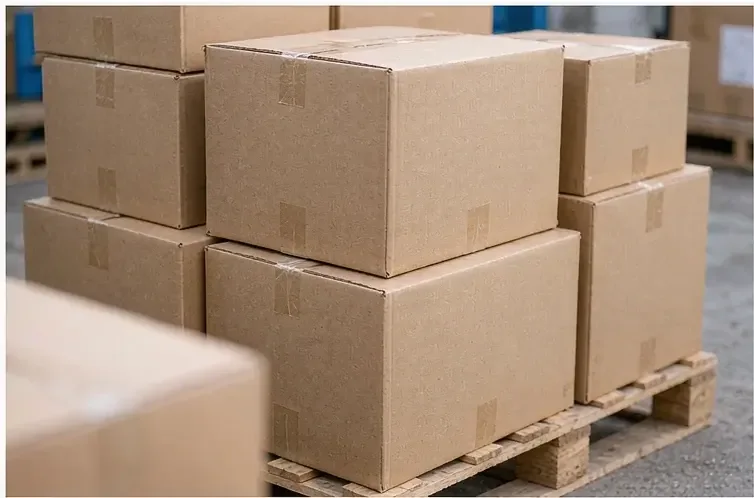
Packaging faults are quick to find on the bench and expensive to find in a boutique, because they are discovered one box at a time in front of a client. The inspection should be a sampling inspection under ISO 2859-1 at AQL 2.5, applied to print registration, foil adhesion, board squareness, dust bag seams and carton fill, with a separate functional check on closure strength and drop behaviour.
- Confirm the revision number on the packaging tech pack matches the artwork and the plate.
- Measure board caliper and box squareness on five random pieces before the run starts.
- Check foil adhesion with a tape test on the first fifty boxes and again at the end of the run.
- Open and close the lid twenty times on three samples to check magnet alignment and hinge stress.
- Load a bag into the box and tilt the closed carton 30 degrees; nothing should shift.
- Inspect dust bag seams, drawcord knots and print registration against the approved reference.
- Verify every compliance mark is legible and placed where the market requires it.
- Record the result under AQL 2.5 (ISO 2859-1) and hold the reference sample for the next repeat.
Sustainable Packaging That Still Reads as Luxury
Sustainable packaging works in the premium band when the restraint is visible rather than apologetic. A mono-material box that can be recycled without separating foil from board, a moulded-pulp former instead of foam, and a dust bag designed to be reused for travel are all read as confidence. What clients reject is a thinner box presented as an environmental gesture.
- Specify mono-material board and avoid film lamination where a water-based varnish will do.
- Replace foam formers with moulded pulp or die-cut board that carries the same stacking load.
- Use soy or water-based inks, and keep foil coverage under roughly 15 percent of the printed face.
- Design the dust bag as a travel bag so it earns a second life instead of being discarded.
- Right-size the carton; the largest sustainability win is usually fewer void-fill materials.
- State the claim precisely and keep the certificate behind it, never an unqualified green phrase.
Packaging Inside the Wider Handbag Programme
Packaging decisions should be locked at the same moment as the silhouette, because the box footprint, the insert depth and the dust bag clearance are all derived from the bag. That is why the packaging set is quoted with the bag, sampled with the bag and inspected with the bag. If you want the detail behind each piece, start with the luxury handbag packaging brand presentation guide, then read how to design luxury dust bags and boxes and the packaging materials explainer.
Two further decisions tend to move the perceived value most: the box itself and the paper inside it. Compare FSC board against standard board before you fix the cost line, and read how certificates and cards elevate a bag before you decide whether to serialize. Cost behaviour is set out in the packaging cost guide and the packaging MOQ explainer, and the inspection routine is covered in how to QC luxury handbag packaging.
Request a packaging and bag quotation
Send us your silhouette drawings, target box style and quantity per colourway. We will return a packaging specification, a sampling plan and a landed cost for the full set on FOB Xiamen terms, quoted at 500 pcs per style / colourway.
Where Packaging Sits in the Sampling Calendar
The packaging sample should be approved one round before the final bag sample, so that the two can be packed together and photographed as they will ship. In practice that means artwork approval in the first week, board and fabric sample in 6-10 working days, and a packed reference unit ready before bulk, so the unboxing sequence can be shot for the lookbook at the same time.
Because our validated partner factory Quanzhou Yingming Bags runs seven production lines with about 200,000 pcs monthly capacity and export experience since 2014, packaging and bags can be consolidated into one shipment. That is why the packaging specification belongs in the same tech pack as the bag.
Frequently Asked Questions
What does a complete luxury handbag packaging set include?
A complete set has seven parts: the outer shipping carton, a rigid presentation box, a cotton dust bag, acid-free tissue, an insert or former that holds the silhouette, a care card, and a hang tag or foil seal. Each part is specified separately in the packaging tech pack and quoted with the bag.
How much board weight does a luxury rigid box need?
Specify 1000-1200 gsm greyboard with a 2.0-3.0 mm caliper, wrapped in 120-157 gsm art paper. Lighter board bows visibly when several boxes are stacked in a stockroom, and it lets rim pressure mark the edge paint of a structured bag.
What fabric weight should a handbag dust bag use?
Use 100% cotton or cotton flannel at 110-140 gsm with a double 3 mm drawcord and four-thread overlocked seams. Below roughly 90 gsm the print strikes through to the reverse and the cloth snags on turn-locks and feet.
What is the MOQ for luxury handbag packaging?
Packaging is quoted at 500 pcs per style / colourway, the same threshold as the bag programme. Running the box, dust bag, insert and cards at one quantity keeps the set identical across a season and avoids mixed-revision packaging in the same shipment.
How long does packaging development take?
Artwork and board sampling take 6-10 working days, extended to 12-15 working days for engineered or multi-part builds. Bulk production runs inside the 35-50 day window used for the bags, so packaging and product land on the same vessel.
How much does a foil-blocked rigid box cost?
A foil-blocked rigid box at 500 pieces is about USD 4.80 per unit in our reference costing. The figure moves with board caliper, foil coverage, insert material and carton size, so it is quoted as part of the full set rather than in isolation.
How is luxury packaging inspected before shipment?
Packaging is inspected under ISO 2859-1 at AQL 2.5. The check covers print registration, foil adhesion by tape test, board squareness, lid alignment over twenty open and close cycles, dust bag seams, carton fill and legibility of every compliance mark.
Which compliance documents should packaging carry?
Request FSC chain-of-custody evidence for board and paper, a REACH Annex XVII statement covering inks and coatings, a Proposition 65 assessment for California, CPSIA tracking where relevant, and a GRS certificate if the dust bag uses recycled fibre.
How do you stop a structured bag arriving flattened?
The insert must carry the load, not the bag. Size the former to the base rather than the widest point, wrap the handle, cover feet and turn-locks with microfoam, and fill the carton so nothing shifts when it is tilted 30 degrees.
Can sustainable packaging still look luxurious?
Yes, when the restraint is visible rather than apologetic. Mono-material board, water-based varnish instead of film lamination, moulded-pulp formers and a dust bag designed for travel all read as confidence; a thinner box presented as a green gesture does not.
When should packaging be approved in the sampling calendar?
Approve the packaging sample one round before the final bag sample. That lets the two be packed together, photographed as they will ship, and checked as a single unit before bulk starts, which is the most economical moment to find a fit problem.
Should packaging ship separately from the handbags?
No. Consolidating packaging and bags into one FOB Xiamen shipment keeps revision numbers aligned and prevents a season arriving with mixed artwork. Our validated partner factory Quanzhou Yingming Bags packs both on the same line schedule.
People Also Ask
Why does packaging matter for a luxury handbag brand?
Packaging is the first physical gesture a client receives and the last surface that touches the leather. It protects the silhouette in transit, carries compliance documentation, and sets the perceived value of the bag before the lid is lifted.
What is the difference between a rigid box and a folding carton?
A rigid box is wrapped greyboard at 1000-1200 gsm that cannot collapse and is assembled by hand, while a folding carton ships flat from 300-400 gsm board. Premium handbag lines use rigid boxes because stacking load and ceremony both demand it.
Does a dust bag need to be cotton?
Cotton flannel at 110-140 gsm is the safe default because it breathes, takes print cleanly and does not abrade hardware. Non-woven alternatives can pass a cost screen but tend to pill and hold lint against turn-locks and feet.
How do I choose between foil and blind emboss?
Choose foil when the brand mark needs to catch light for photography, and blind emboss when the house wants restraint that is felt rather than seen. Both fail on fine serif type below roughly 6 pt, so simplify the mark first.
What causes most transit damage to luxury bags?
Compression and abrasion, not impact. An oversized carton with no former lets the bag migrate, and unprotected feet and hardware rub against the lid. Right-size the box, add a base former, and fill every void.
Sources and further reading
Every figure on this page is either our own programme data or attributed below. Open the originals before you write them into a specification.
- ISO standards catalogueInternational Organization for Standardization Home of ISO 2859-1 sampling procedures and the ISO 105 colour fastness series referenced for dust bag print and fabric.
- FSC chain of custodyForest Stewardship Council Certification scheme behind board and paper claims on rigid boxes, cartons and hang tags.
- REACH legislationEuropean Chemicals Agency Annex XVII restrictions screened for inks, coatings and adhesives used on packaging.
- Proposition 65California Office of Environmental Health Hazard Assessment Warning obligations assessed before shipping packaged goods into California.
- ISTA transit test proceduresInternational Safe Transit Association Parcel drop and vibration procedures used as the reference for carton fill and void fill checks.
- Leather Working GroupLeather Working Group Tannery audit programme referenced when leather and packaging documentation are reviewed together.