How to Design Luxury Dust Bags and Boxes: A Walkthrough From Brief to Approval
Dust bags and boxes are designed as a pair, never separately, because the box protects the piece in transit and the dust bag protects it for the rest of its life. This walkthrough follows one structured top-handle programme through six design decisions: sizing the dust bag, choosing fabric and closure, drawing the box around the piece, selecting board and wrap, running artwork to approval, and writing the specification sheet that ships with the set.
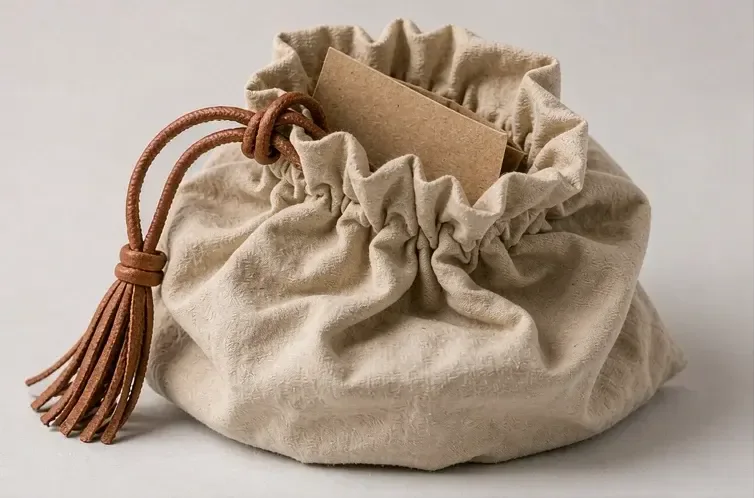
The brief that arrived was ordinary in the best way: one structured top-handle in two colourways, a presentation set that had to open well on camera, and a packing line that had to assemble it without slowing down. What made it useful as a walkthrough is that every decision had a number attached, and every number was settled before artwork started rather than after.
The Brief: One Top-Handle, Two Colourways
The piece was a structured top-handle in full-grain calfskin at 1.2-1.4 mm, 8-9 stitches per inch, three-coat edge paint, with a #5 zip and palladium-finish hardware plated at 0.15-0.3 µm. Finished dimensions sat at 280 mm wide, 210 mm tall and 130 mm deep, with a handle drop of 120 mm. Those four numbers are the entire input to the dust bag and the box, and getting them confirmed before design starts is most of the work.
The second input is how the set will be assembled. A set that is packed by one person at a bench can be tighter and more layered than a set packed on a line at rate. This programme ran at volume, so the design brief carried a packing time target, and that target is what ruled out a ribbon tie in favour of a lift-off lid.
Sizing the Dust Bag Before Drawing It
A dust bag is sized from the piece plus allowance, not from a nominal size list. The working rule is the finished width plus 60 mm and the finished height plus 80 mm, with the extra height taken up by the drawcord channel and the gathered fabric above it. For a 280 mm by 210 mm piece that gives a flat bag of 340 mm by 290 mm, which is enough for the piece to go in without being pushed and enough fabric above the drawcord for the gather to sit properly.
- Sizing rule
- Finished width plus 60 mm, finished height plus 80 mm
- Flat dust bag size on this brief
- 340 mm by 290 mm
- Drawcord
- 4 mm cotton cord
- Drawcord channel
- 12 mm, turned and top-stitched
- Channel stitch density
- 8-9 stitches per inch, matched to the bag
- Fabric weight
- Cotton in the 120 to 140 gsm band for this piece size
- Print method
- Single-colour screen print, one pass
- Drawcord test
- 50 open and close cycles before approval
Choosing the Dust Bag Fabric and Closure
Fabric choice is a decision about the second year, not the first day. A lightweight non-woven bag looks acceptable on the packing line and tears at the drawcord within a season of real use. Cotton in the 120 to 140 gsm band costs more per piece and lasts, and because it is the only part of the set the client keeps, the extra is spent where it is seen. The brief chose cotton.
The closure decision is a one-handed test. A drawcord has to open and close with one hand holding the bag, because that is how it is used in a wardrobe. The channel is where failures begin: a channel that is too narrow binds, one that is too wide lets the cord ride above the stitch line, and one that is under-stitched pulls away from the fabric under repeated tension. Twelve millimetres, turned and top-stitched at the same stitch density as the bag, is the specification that survived fifty cycles.
Drawing the Box Around the Piece
Boxes fail in two directions. Too tight and the piece rides against the wall, which marks the leather and makes the lid hard to lift. Too loose and the piece moves, which is worse because it moves in transit and arrives with the tissue displaced. The target is 5 to 10 mm clearance per side, held by the tissue rather than by friction. On a 280 by 210 by 130 mm piece that gives an internal box of roughly 295 by 225 by 145 mm before the wrap is accounted for.
The lid decision follows from how the piece is lifted out. A top-handle wants to be lifted vertically, which argues for a lift-off lid or a hinged lid that opens clear of the handle. A shoulder bag can be lifted from a hinged lid without difficulty. This brief used a lift-off lid, chosen partly for the opening gesture and partly because a hinged lid adds a glue operation and a failure mode at the hinge.
Board, Wrap and Closure
Board weight is the largest cost line in the set and the one most often set by eye rather than by test. Greyboard at 1,200 gsm, giving a wall around 2.5 mm once wrapped, holds its corner through packing, shipping and shelf life. Board at 800 gsm shows corner crush on a piece this size, and it shows it after the client has already formed an impression, which is the expensive time to discover it.
| Element | Option chosen | Option rejected | Reason for the choice |
|---|---|---|---|
| Board | 1,200 gsm greyboard, 2.5 mm wrapped wall | 800 gsm greyboard | Corner crush resistance on a piece this size |
| Wrap | Uncoated textured stock | Coated art paper | Takes a blind deboss with more depth |
| Box mark | Blind deboss at 0.4 mm depth | Hot foil in light gold | Reads at arm's length without catching light |
| Lid | Lift-off | Hinged | No hinge glue operation and no hinge failure mode |
| Internal fit | 5 to 10 mm clearance per side | Friction fit | The tissue holds the piece, not the wall |
| Dust bag fabric | Cotton, 120 to 140 gsm | Lightweight non-woven | Survives repeated opening in the wardrobe |
| Dust bag print | Single-colour screen print | Two-colour screen print | Two colours added cost, not legibility |
| Closure on dust bag | 4 mm cotton drawcord, 12 mm channel | Ribbon tie | One-handed opening and closing |
Artwork: Three Rounds to Approval
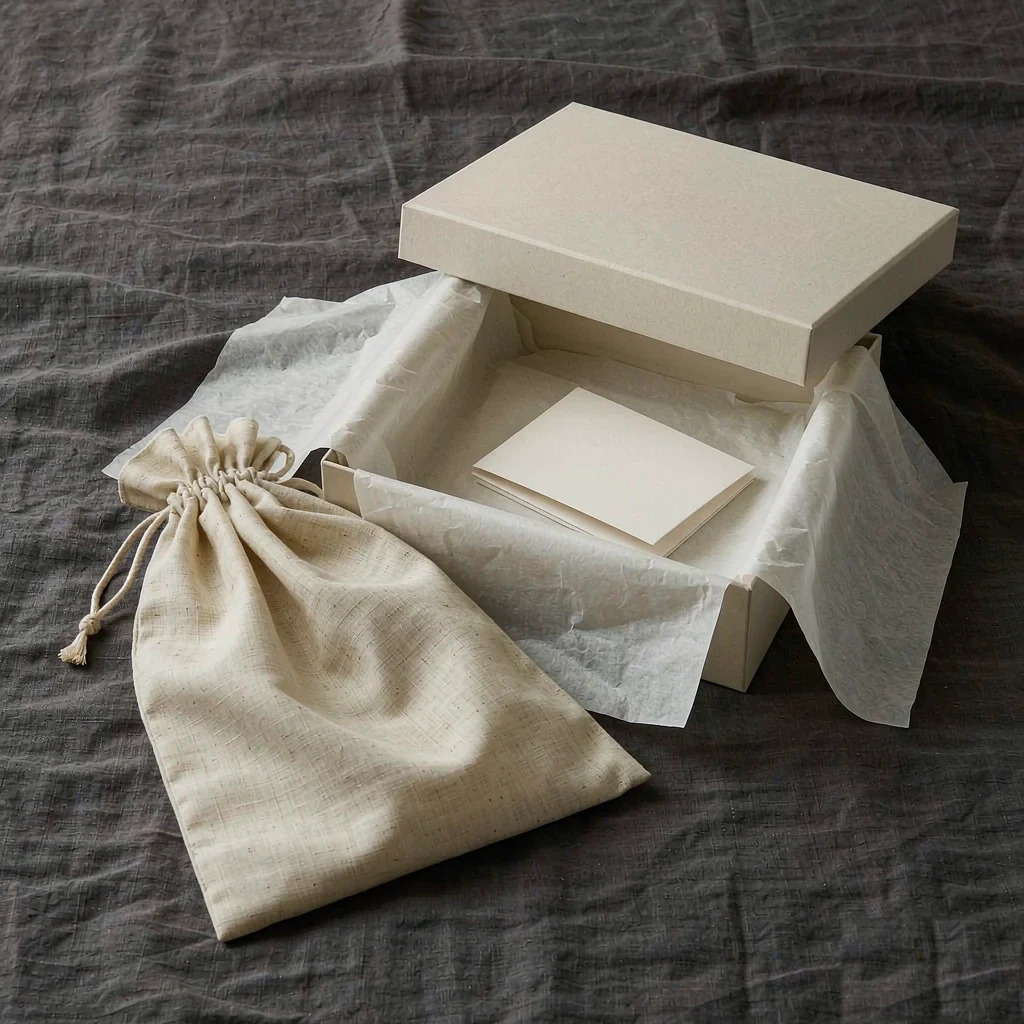
Artwork took three rounds, which is one more than it should have and one fewer than it often is. Round one established the mark size and its position on the lid. Round two corrected the position, because the proof had been placed against a template rather than against a wrapped production box, and the wrapped surface moved the optical centre by 4 mm. Round three confirmed the dust bag print against production fabric rather than against a paper proof.
- Always proof on the production material. A paper proof does not predict how a textured wrap takes a deboss.
- Proof the dust bag on the production fabric, not on a substitute, because fabric stretch moves a screen mark.
- Set the mark position from the wrapped box, not from the flat blank, or the optical centre will be wrong.
- Record the deboss depth in millimetres so a second run can be matched to the first.
- Approve a physical piece, not a photograph. Depth does not photograph the way it reads in the hand.
The 20-Day Approval Path
From brief to approved set, the programme took twenty working days. That is longer than most programmes plan for and shorter than most actually take, and the difference is whether the specification was closed before artwork started. Here the sequence ran: sizing and specification in the first three days, blanks and a fabric swatch set by day seven, first artwork round by day eleven, corrected round by day fifteen, and a physical approved set by day twenty.
The path runs alongside the bag programme rather than after it. Bag sampling takes 6-10 working days and 12-15 for complex constructions, bulk takes 35-50 days, inspection sits at AQL 2.5 under ISO 2859-1, and handover is on FOB Xiamen terms. A twenty-day packaging path started at the same time as the tech pack finishes comfortably inside the bulk window; the same path started at bulk packing does not.
What Changed Between Round One and Round Three
Three things, and each one is a lesson worth carrying. The mark moved 4 mm because it had been positioned on a flat blank. The dust bag print dropped from two colours to one because the second colour was invisible on cotton at that weight. The box wall came down from an initially specified higher figure to 1,200 gsm once the corner crush test showed the extra board was not doing measurable work on a piece this size.
None of those three would have been caught on paper. All three were caught on a physical piece, which is the argument for budgeting an approval round that produces an object rather than a proof. A disapproved set is a contained failure; a disapproved bulk packing run is not, and correcting one rejected set at the bench costs around USD 4.80 before any rework is counted.
Designing the dust bag from a nominal size list instead of from the finished piece. A bag 20 mm short forces the piece in and stresses the drawcord channel on every use; a bag 40 mm long gathers badly and looks wrong on camera. Size from the piece plus 60 mm and plus 80 mm, then test the gather.
The Specification Sheet That Ships With the Set
Every approved set should leave behind a one-page specification sheet, because the second run will be quoted against something and it should be against the thing that was approved rather than against a memory. The sheet carries eight lines: dust bag flat size, fabric weight, drawcord and channel, print method and colour, box internal dimensions, board weight, wrap stock, and deboss depth.
- Dust bag flat dimensions in millimetres, derived from the finished piece.
- Fabric weight band and the mill reference where one is held.
- Drawcord diameter and channel width, with the stitch density.
- Print method, colour count and the colour reference used.
- Box internal dimensions in millimetres, to the nearest 5 mm.
- Board weight in gsm and the wrapped wall thickness.
- Wrap stock reference and the surface it presents.
- Deboss depth in millimetres and the die reference.
Common Design Errors and Their Cost
Four errors account for most of the redesign work we see. Sizing the dust bag from a list rather than from the piece. Proofing artwork on a substitute material. Specifying board by eye rather than by a crush test. And leaving the lid decision until after the board is ordered, which constrains a choice that should have been made from how the piece is lifted out.
All four are simple to avoid and expensive to correct late, because each one is discovered at packing rather than at design. The pattern is always the same: a decision that felt small at specification time becomes a physical constraint at packing time, and physical constraints at packing time cost schedule. The remedy is to treat the eight lines on the specification sheet as gates, each with an owner and a date.
Take this to the bench
- Size the dust bag from the finished piece plus 60 mm and 80 mm, specify a 4 mm drawcord in a 12 mm channel, allow 5 to 10 mm box clearance per side, use 1,200 gsm board, and proof every mark on the production material. Eight lines on one sheet, approved as an object.
Design a dust bag and box set
Send the finished dimensions and the colourway list and we will size the set from the piece. Work runs through our validated partner factory Quanzhou Yingming Bags, an SGS-validated site operating since 2014 with 7 production lines and capacity of about 200,000 pcs per month. Request a quote
Frequently Asked Questions
How do you size a dust bag for a handbag?
From the finished piece plus allowance, not from a nominal size list. The working rule is finished width plus 60 mm and finished height plus 80 mm, with the extra height taken up by the drawcord channel and the gather above it. Test the gather on a physical sample before approving.
What drawcord and channel specification works best?
A 4 mm cotton drawcord in a 12 mm channel, turned and top-stitched at the same 8-9 stitches per inch used on the bag. A narrower channel binds, a wider one lets the cord ride above the stitch line, and an under-stitched channel pulls away under repeated tension.
What fabric weight should a luxury dust bag use?
Cotton in the 120 to 140 gsm band for a piece around 280 mm wide. A lightweight non-woven looks acceptable on the packing line and tears at the drawcord within a season of real use, and the dust bag is the only part of the set the client keeps.
How much clearance should a box have around the piece?
Five to ten millimetres per side. Too little and the piece rides against the wall, which marks the leather and makes the lid hard to lift. Too much and the piece moves in transit and arrives with the tissue displaced, which is the worse failure.
What board weight is right for a structured top-handle box?
Greyboard at 1,200 gsm, giving a wrapped wall of around 2.5 mm. Board at 800 gsm shows corner crush on a piece this size, and it shows it after the client has already formed an impression, which is the expensive moment to discover it.
Should a luxury box use a lift-off or a hinged lid?
Choose by how the piece is lifted out. A structured top-handle wants to be lifted vertically, which suits a lift-off lid or a hinged lid that opens clear of the handle. A lift-off lid also avoids a glue operation and the hinge failure mode that comes with it.
How many artwork rounds should a packaging set need?
Two is the target and three is common. The extra round is almost always caused by proofing against a template rather than against the production material, which moves the optical centre and changes how a textured wrap takes a deboss.
How long does it take to approve a dust bag and box set?
Twenty working days from a closed brief to an approved physical set. That fits comfortably inside the bulk window when it starts alongside the tech pack, and it does not fit when it starts at bulk packing.
Why does artwork have to be proofed on production material?
Because a paper proof does not predict how a textured wrap takes a deboss, and a substitute fabric does not predict how cotton moves under a screen print. Both errors are invisible on paper and obvious on the object, which is why approval should be against a physical piece.
What should the packaging specification sheet contain?
Eight lines: dust bag flat size, fabric weight, drawcord and channel, print method and colour, box internal dimensions, board weight, wrap stock, and deboss depth in millimetres. The second run is quoted against something, and it should be that sheet rather than a memory.
What is the most expensive dust bag design error?
Sizing from a nominal list instead of from the finished piece. A bag 20 mm short forces the piece in and stresses the drawcord channel on every use. The error is simple to avoid at specification and expensive to correct once packing has begun.
How does packaging design fit the bag programme timeline?
Alongside it, not after it. Bag sampling runs 6-10 working days and 12-15 for complex constructions, bulk runs 35-50 days, inspection sits at AQL 2.5 under ISO 2859-1, and handover is on FOB Xiamen terms. A twenty-day packaging path started with the tech pack finishes inside the bulk window.
People Also Ask
How do I design a dust bag?
Start from the finished bag dimensions, add 60 mm to the width and 80 mm to the height, choose a cotton in the 120 to 140 gsm band, specify a 4 mm drawcord in a 12 mm channel, then proof the print on the production fabric.
Should the dust bag and box be designed together?
Yes. The box protects the piece in transit and the dust bag protects it for the rest of its life, and the box internal dimensions are set by the piece plus the tissue, which is the same allowance that sets the dust bag.
What makes a box feel expensive?
Weight in the board, a clean lift, and restraint in the mark. A 1,200 gsm board with a lift-off lid and a blind deboss reads better than a lighter board with a foil mark and a hinged lid, because the weight and the lift are felt before the mark is seen.
How deep should a blind deboss be?
Around 0.4 mm on a textured wrap, recorded in millimetres so a second run can be matched to the first. Depth does not photograph the way it reads in the hand, so approve it on a physical piece rather than from an image.
Why do packaging designs need redesigning?
Four reasons: sizing from a list, proofing on a substitute material, specifying board by eye, and leaving the lid decision until the board is ordered. Each is discovered at packing rather than at design, which is where it becomes a schedule problem.
Sources and further reading
Every figure on this page is either our own programme data or attributed below. Open the originals before you write them into a specification.
- FSC certification and chain of custodyForest Stewardship Council Chain of custody reference for greyboard, wrap stock and tissue used in a presentation set.
- ISO standards catalogueInternational Organization for Standardization Reference for ISO 2859-1 inspection levels and paper and board test methods.
- REACH legislationEuropean Chemicals Agency Substance restrictions applicable to inks, adhesives and textile coatings used on dust bags.
- Proposition 65California Office of Environmental Health Hazard Assessment Warning requirements relevant to printed packaging entering the California market.
- Incoterms 2020 rulesInternational Chamber of Commerce Defines FOB, CIF and DDP terms used for handover of packed presentation sets.