Luxury Handbag Craftsmanship and Atelier Techniques
What defines luxury handbag craftsmanship? It is the controlled union of pattern accuracy, material judgment, balanced structure, disciplined stitching, refined edge work, and documented inspection. A credible atelier translates a design into repeatable specifications: leather may be split to 1.2-1.4 mm, visible seams may run at 8-9 stitches per inch, and painted edges may receive 3 carefully cured coats. The result is not decoration alone; it is a handbag whose silhouette, touch, movement, and durability remain coherent from approved sample to delivery.
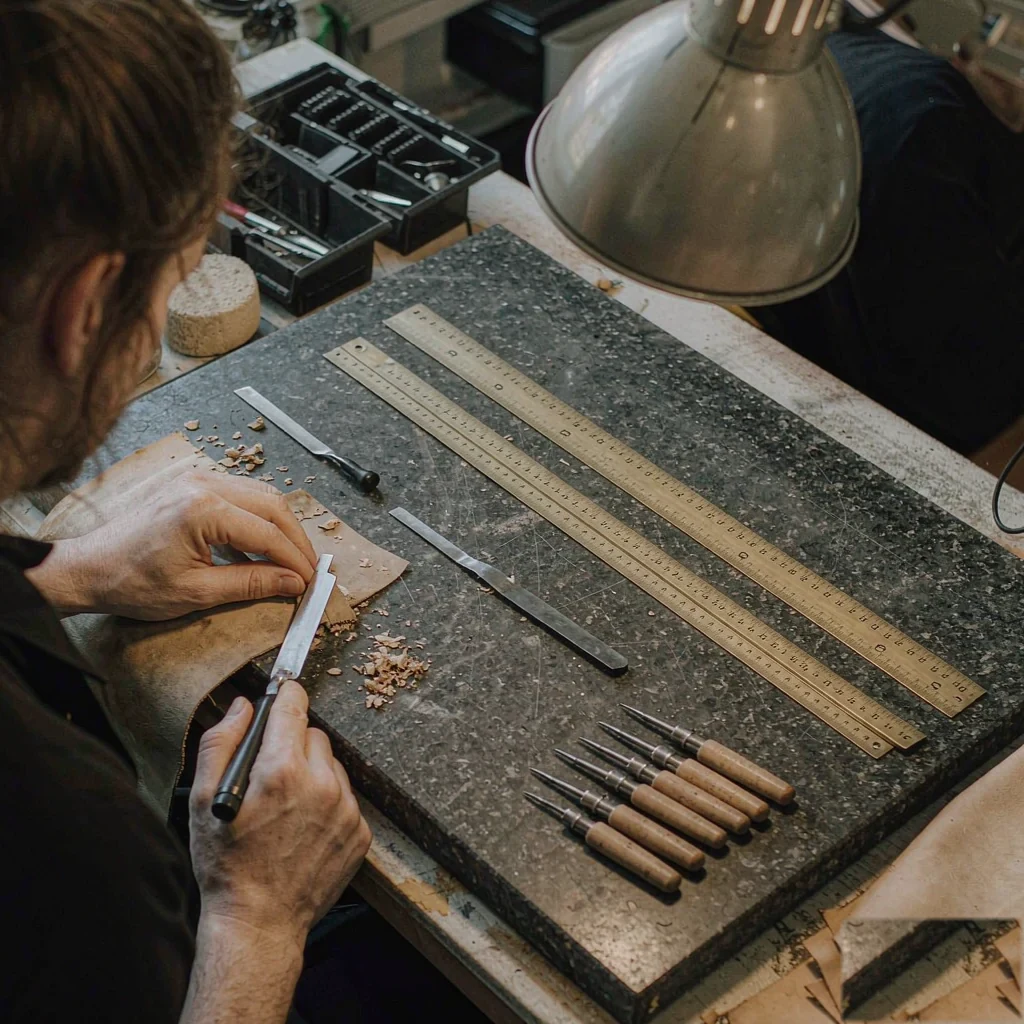
Craftsmanship Is a Controlled System, Not a Styling Effect
Luxury craftsmanship is a connected system in which every material, tolerance, operation, and approval protects the intended character of a handbag.
A polished surface cannot rescue an unstable base, just as beautiful stitching cannot correct an inaccurate pattern. The atelier therefore treats silhouette, grain direction, reinforcement, seam construction, edge profile, hardware movement, and lining behaviour as one design language. Decisions are recorded in the specification rather than left to memory. That discipline allows the approved sample to become a practical reference for a full programme, while hand judgment remains available where natural leather or curved geometry demands it. For a detailed view of the core techniques, read atelier techniques explained.
The atelier test
- Ask whether the house can explain how one visible feature is created, measured, approved, and repeated. A precise answer should connect the drawing, material, tool, operation order, tolerance, and final inspection evidence.
From Creative Intent to a Bench-Ready Specification
A bench-ready specification converts visual intent into dimensions, construction sections, material references, stitch rules, edge standards, and measurable acceptance points.
The process begins with the design brief and tech pack, but an atelier also needs answers that a flat drawing cannot provide. Should the body feel softly collapsible or hold a crisp wall? Where should the opening resist, and where should it flex? Is a 2 mm edge profile part of the signature, or should the edge visually disappear? Pattern engineers resolve these questions through paper patterns, sectional mock-ups, leather trials, and one approved golden sample. Sampling normally takes 6-10 working days; complex styles take 12-15 working days. Revisions should identify the old value, new value, location, and reason, so each correction strengthens the master record instead of creating a second interpretation.
Material Reading Comes Before Material Cutting
Expert material reading places every component according to grain, stretch, thickness, surface character, colour, and the stress it will carry.
Calfskin is not a uniform sheet: the backbone, shoulder, belly, and flank can behave differently under folding, skiving, and tension. A cutter maps the most visible panels first, pairs mirrored pieces for shade and grain, and moves less stable zones toward suitable internal parts. On exotic skins, scale centre, symmetry, legal documentation, and yield planning must be considered together; CITES Appendix II or III status should be verified before commercial movement where relevant. Leather Working Group (LWG) records can support responsible tannery assessment, while the physical lot still needs shade, thickness, hand-feel, and finish checks. Explore the wider luxury materials framework before fixing a construction route.
Pattern Cutting, Skiving, and Allowance Control
Accurate cutting and graduated skiving determine whether panels meet cleanly without bulk, distortion, exposed fibres, or weak stress points.
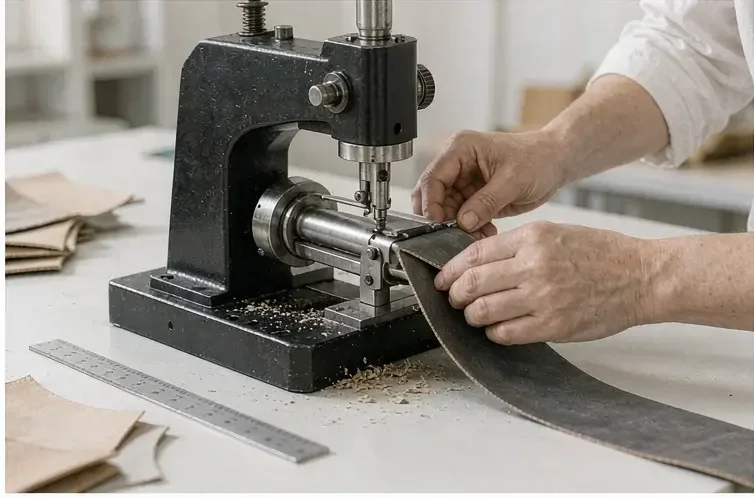
Pattern notches, drill points, centre lines, fold marks, and seam allowances create the shared geometry for every later operation. Critical paired panels are cut in a mirrored sequence and checked before assembly. Skiving then reduces thickness selectively: a turned edge may taper toward 0.6-0.8 mm, while a loaded handle anchor keeps more substance. The transition must be gradual because an abrupt step can print through the face or become a tear line. Knife sharpness, feed pressure, and grain direction are adjusted to the leather rather than copied from another article. The deeper guide to luxury handbag pattern cutting explains how nested patterns, yield, and grain placement interact.
- Typical body leather reference
- 1.2-1.4 mm after approved splitting
- Turned-edge taper reference
- 0.6-0.8 mm where construction permits
- Visible stitch density
- 8-9 stitches per inch unless the design specifies otherwise
- Edge treatment
- 3 thin coats with sanding and curing between stages
Stitch Architecture: Hand Work and Machine Precision
The right stitch method is selected by seam function, visual rhythm, repair logic, leather behaviour, and the level of control required at curves and stress zones.
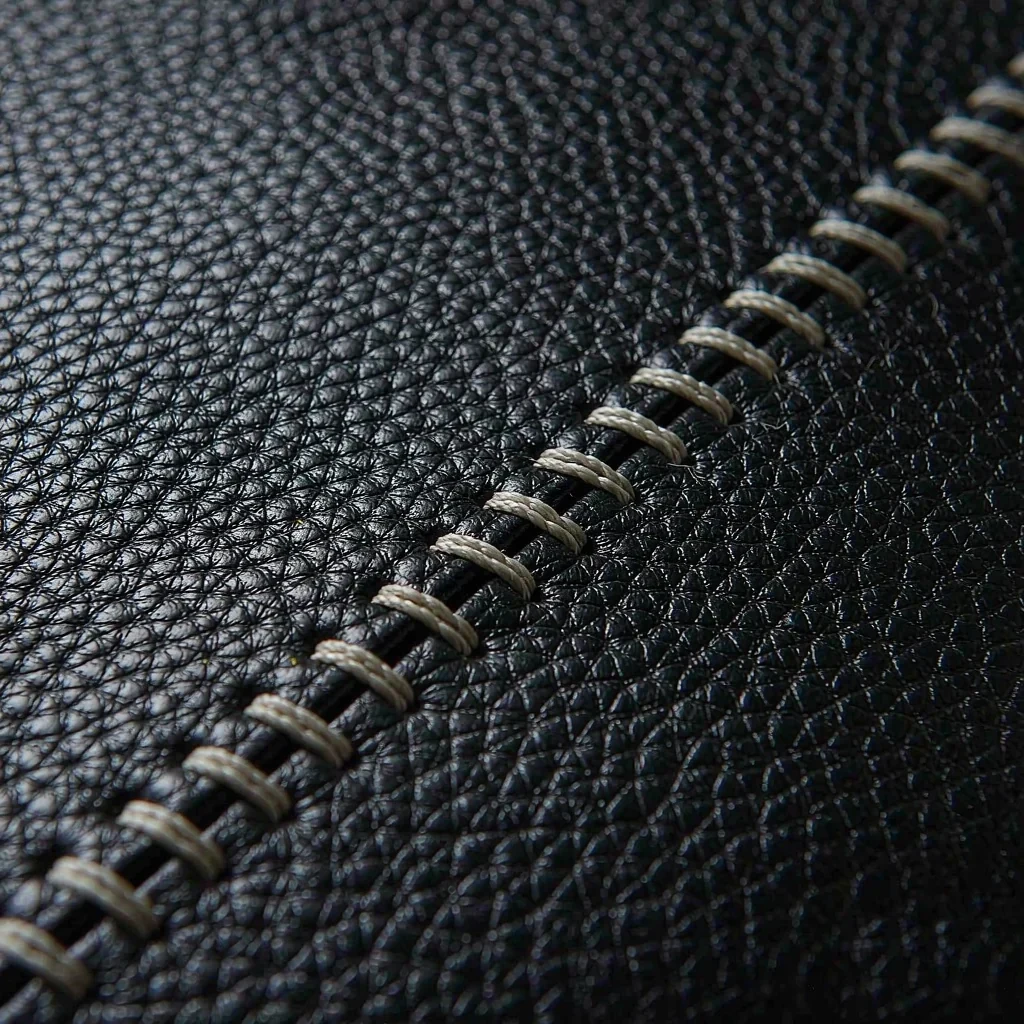
Saddle stitching uses two needles passing through the same prepared holes from opposite sides, creating a resilient interlocked line with a distinctive slant. It suits selected handles, tabs, decorative seams, and areas where hand control adds meaning. Calibrated machine stitching is often preferable for long structural seams because it delivers stable tension and repeatable pitch. A luxury programme can use both without contradiction. Thread around 0.45 mm may suit a refined visible line, but hole size, needle, seam margin, and leather firmness must be developed as a set. See how hand stitching elevates a luxury handbag and the comparison of machine and hand stitching.
| Stitch decision | Preferred control | Approval evidence |
|---|---|---|
| Long structural seam | Stable feed, balanced upper and lower tension | Straightness, pitch, reverse view, seam strength |
| Tight curve or shaped tab | Slower guidance and accurate corner turning | Smooth arc, no skipped holes, even margin |
| Saddle-stitched detail | Pricking angle, thread lay, hand tension | Consistent slant and clean back face |
| Handle anchor | Reinforced stack and controlled backstitch | Symmetry, pull performance, no surface marking |
Structure, Reinforcement, and the Feel of Balance
A luxury handbag feels balanced when reinforcement supports the silhouette and load path without making the body rigid, bulky, or visually strained.
Structure is built as a graded system. A 0.8 mm support layer may stabilise a base or panel, while thinner backing protects a soft wall from local pull. Handle anchors need a load path that spreads force beyond the visible attachment; strap ends, rings, feet, locks, and magnetic closures need similar planning. Reinforcement edges are feathered to prevent ridges from printing through smooth calfskin. Adhesive coverage must be even, allowed to flash correctly, and kept away from visible edges. The final bag is assessed filled and empty, because a form that looks correct only with tissue inside has not resolved its natural posture. Strap reinforcement methods provide a focused extension of this principle.
Edges, Corners, Piping, and Turned Finishes
Refined edges and corners require controlled preparation, thin applications, complete curing, and geometry that remains clean when the bag flexes.
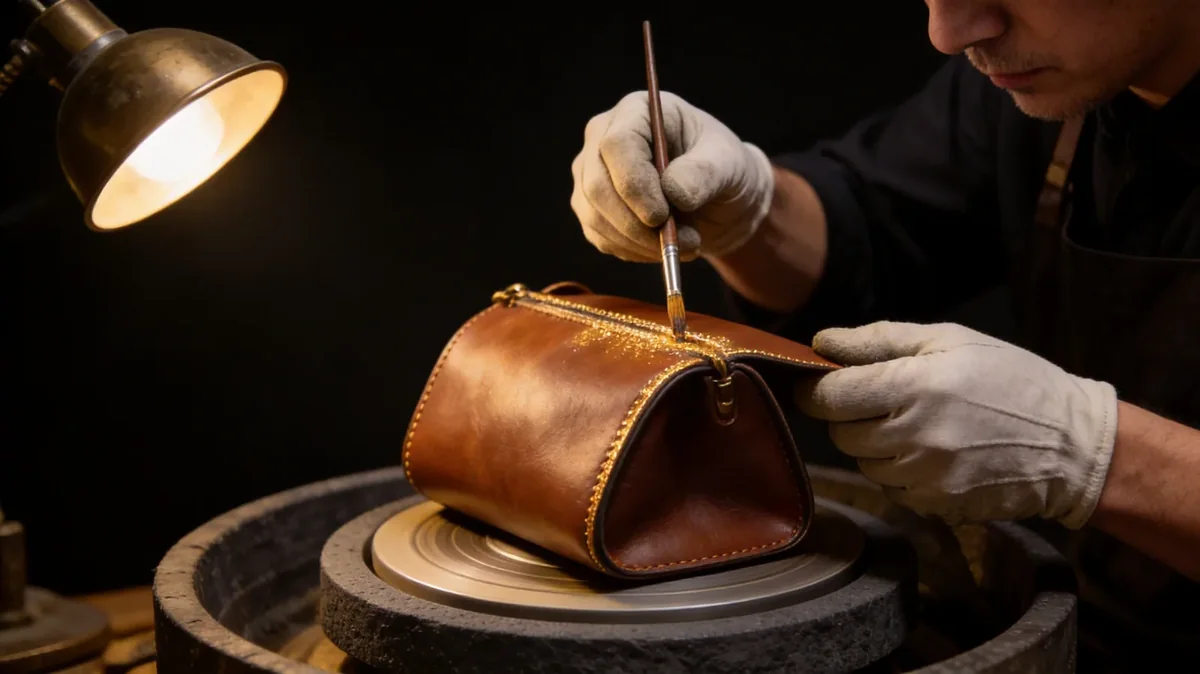
For a painted edge, the raw cut is levelled, sealed when needed, coated, cured, and lightly sanded before the next layer. Three thin coats generally produce a more controlled profile than one heavy layer. Corners receive extra attention because paint can pool on the inside radius and thin out on the outside radius. Turned edges demand accurate skiving and tension so the fold does not ripple. Piping must remain centred through curves, with joins placed discreetly and cord diameter held to the approved reference. Colour is judged after full drying under agreed lighting, not while the coating is wet. The visual checkpoints are expanded in how corners and edges are finished.
Hardware, Lining, and Interior Resolution
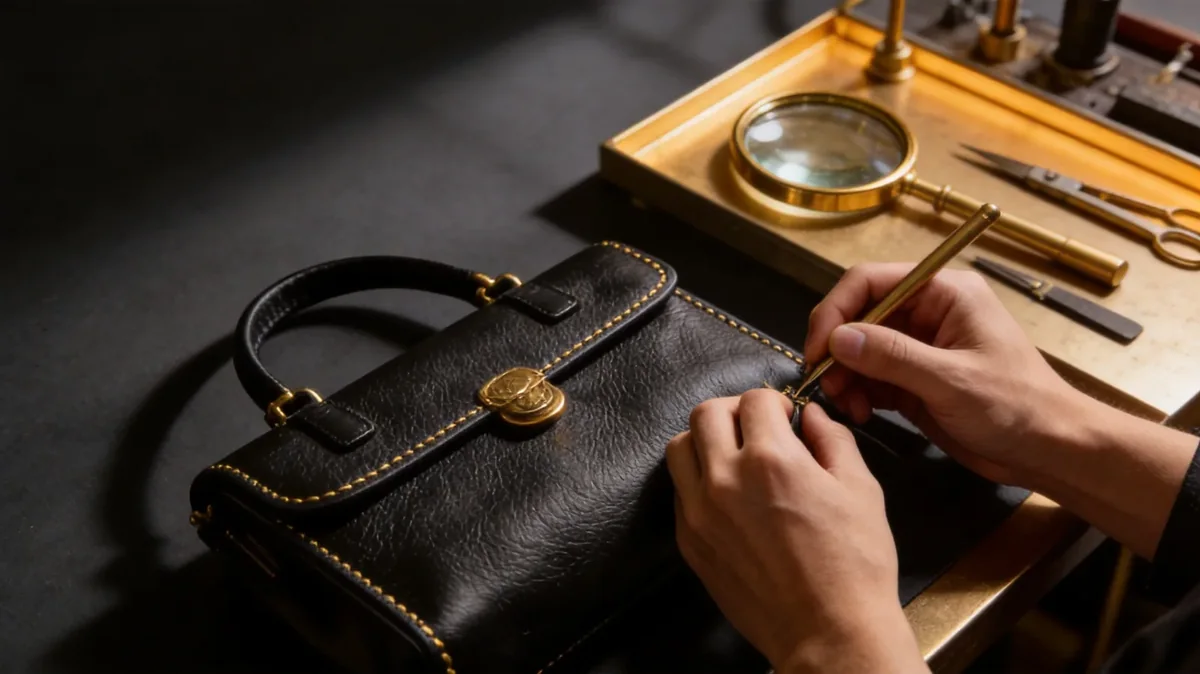
Hardware and lining are resolved as structural components whose alignment, movement, attachment, and touch must equal the exterior standard.
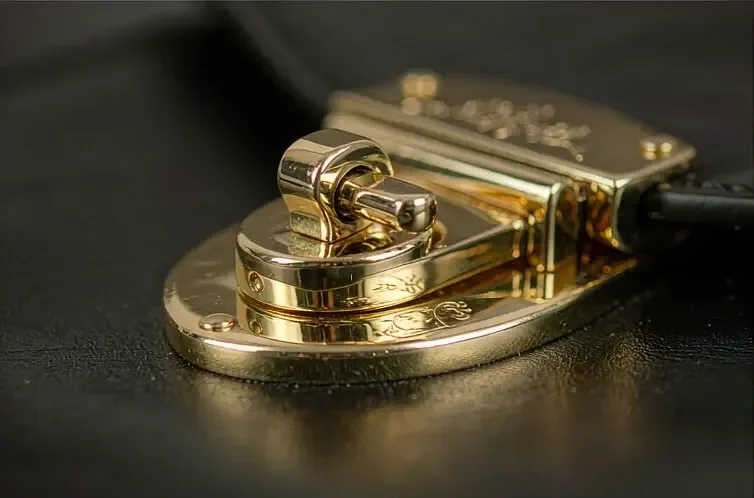
Locks should engage without forcing the flap out of line; zips should travel smoothly without waviness; rings should move freely without cutting the leather. A decorative plating reference may be specified around 0.15-0.3 µm when appropriate, but the programme must define finish, colour range, base metal, test route, and use conditions rather than treating thickness as a universal promise. Lining panels are checked for grain direction, pocket symmetry, seam concealment, and slack. A lining that is too tight can pull the exterior inward, while excessive ease creates folds and noise. Interior branding, date codes, care labels, and pocket positions belong in the approval map with the same precision as the visible lock.
Atelier Quality Gates and Objective Evidence
Atelier quality gates combine visual judgment with measurements, approved references, material tests, and recorded acceptance decisions at defined stages.
Incoming leather, cut components, first assembled body, hardware setting, edge completion, and packed presentation should each have a release point. ISO 11644 provides a method for measuring adhesion of a finish on suitable coated leather; ISO 3376 covers tensile strength and percentage extension; relevant ISO 105 methods can support colour-fastness evaluation. These methods do not replace a brand specification, but they give technical teams shared language. Final lot review follows AQL 2.5 (ISO 2859-1), with third-party inspection optional. Critical, major, and minor defect definitions must be agreed before inspection so the result reflects brand risk rather than an improvised opinion. The luxury quality control hub connects these gates to shipment release.
Where Hand Work Actually Earns Its Cost
Hand work is not automatically better, and paying for it everywhere is how handbag costs drift without any visible return.
It earns its cost where a machine cannot reach or cannot judge. Turning a corner on a padded flap, easing a lining around an interior curve, setting a closure under tension and matching a panel edge to the approved reference all depend on feel.
It does not earn its cost where consistency is the whole point. Long straight seams, repeated strap construction and bulk edge application are usually more even, and often stronger, when a machine sets the rhythm.
A useful way to decide is to ask what happens if this operation varies by ten percent between units. If the variation is invisible, machine it. If it changes how the bag looks or closes, put it on the bench and pay for it.
Cost follows minutes, so this is really a question of where those minutes land. A hand-turned edge may add several minutes per bag; across 500 units that is a real sum, which is why it appears on the quotation as its own line.
The same logic applies to finishing. Three thin edge coats cost more than one thick one, but they sand to a smoother line and survive flexing. The saving is real and so is the difference, and the client should choose deliberately.
What should never vary is evidence. Whichever method is used, the outcome has to be measurable: stitch density counted, edge thickness checked, geometry measured and the result compared against the golden sample before release.
Buyers evaluating an atelier can test this quickly. Ask which operations are done by hand, why those ones were chosen, and what measurable check follows each. Evasive answers usually mean the hand work is decoration rather than engineering.
Where the answer is precise, naming the seam, the edge, the closure and the check that follows, the extra minutes are buying something that survives contact with a customer.
The corollary is that a hand-worked bag built without that evidence is a marketing story. It photographs well and then arrives with variation nobody documented.
Held together, the rule is simple: put hand work where judgment is required, machine work where repetition is required, and measure everything either way.
How Brands Evaluate an Atelier Programme
Brands should evaluate an atelier by its sample fidelity, technical records, material judgment, controlled line capability, inspection evidence, and clarity about commercial parameters.
Request a walkthrough from sketch to golden sample and ask who owns each approval. Review seam cross-sections, paired-panel matching, edge repairs, hardware setting, and the way revisions are transferred to the line. A credible programme states MOQ 500 pcs per style / colourway, bulk lead time 35-50 days, and FOB Xiamen, with FOB, CIF, or DDP options discussed for the project. QUANZHOU JUNYUAN BAGS coordinates export programmes with experience since 2014, 7 production lines, and about 200,000 pcs per month. Capacity matters only when paired with style-specific controls, approved materials, and a realistic calendar.
Bring the intent
Provide silhouette references, target feel, use case, dimensions, material direction, and the visual details that cannot drift.
Define the proof
Agree the golden sample, measurement chart, colour standards, edge reference, hardware sample, and test expectations before release.
Control the change
Use numbered revision notes with photographs, locations, old values, new values, and one accountable approval path.
Build an atelier brief around your signature details
Share your concept, target materials, construction references, launch date, and expected quantity. Request a craftsmanship and development review to map the sample route, technical priorities, and commercial framework.
Frequently Asked Questions
What makes luxury handbag craftsmanship different?
Luxury handbag craftsmanship connects design intent to measurable execution across pattern accuracy, leather placement, skiving, reinforcement, stitching, edges, hardware, lining, and inspection. The difference is not simply more hand work. It is better judgment at each interface, supported by an approved sample and records that keep the silhouette, touch, and detail language consistent across the programme.
Is hand stitching always better for a luxury handbag?
Hand stitching is valuable where saddle construction, tight curves, repair logic, or visible artisan character supports the design. Calibrated machine stitching can be stronger and more repeatable for long structural seams. A refined handbag often uses both methods, selecting each by function, leather behaviour, desired stitch rhythm, seam accessibility, and the standard established during sampling.
How many stitches per inch suit premium leather bags?
A common visible reference is 8-9 stitches per inch, but there is no universal count for every leather or seam. Fine leather, thread diameter, needle size, seam margin, curve radius, and load must be considered together. Excessively dense holes can weaken an edge, while a pitch that is too open may look coarse or reduce control.
Why does leather placement matter in handbag construction?
Leather placement matters because one hide contains zones with different firmness, stretch, grain, and visual character. The most stable and harmonious areas are reserved for prominent or loaded panels, while suitable secondary zones serve less exposed components. Thoughtful pairing also keeps mirrored pieces consistent in shade and grain, improving symmetry and reducing unexpected distortion during use.
How are painted handbag edges finished?
Painted edges are cut cleanly, levelled, prepared, coated in thin layers, fully cured, and lightly sanded between stages. Three controlled coats are a useful reference for many refined constructions, though leather and edge geometry determine the final route. Corners and joins receive extra attention because coating can pool, thin, crack, or reveal an uneven substrate there.
What is a golden sample in an atelier programme?
A golden sample is the approved physical reference that embodies agreed dimensions, materials, construction, colour, stitching, edge quality, hardware action, lining, and presentation. It works with the signed specification rather than replacing it. The production team and inspectors compare later pieces with both records, preventing informal revisions or memory from becoming the new quality standard.
How long does luxury handbag sampling take?
Sampling takes 6-10 working days for a developed brief with available materials, while complex styles take 12-15 working days. Timing can extend when custom hardware, unusual leather, repeated structural changes, or unclear approval ownership is involved. Brands accelerate the process by supplying complete dimensions, sectional drawings, colour references, material codes, and consolidated revision notes at the start.
Which leather tests support craftsmanship decisions?
Relevant methods depend on the leather and claim. ISO 11644 can measure finish adhesion on suitable coated leather, ISO 3376 addresses tensile strength and extension, and selected ISO 105 methods support colour-fastness evaluation. Test data should be interpreted beside intended use, construction, conditioning, and the approved material standard; one laboratory result cannot define complete handbag quality.
How should a brand inspect craftsmanship on a sample?
Inspect the sample from overall silhouette to small interfaces. Check it empty and filled, compare left and right alignment, measure critical dimensions, operate every closure, examine stitch faces and reverse sides, flex edges, and review handle load paths. Record each issue with a photograph, location, severity, required correction, and final approval decision for the next round.
What commercial details should accompany an atelier quote?
The quote should identify material assumptions, construction scope, included development rounds, custom hardware or mould charges, packaging, testing, quantity, trade term, and schedule. The programme reference is MOQ 500 pcs per style / colourway, sampling in 6-10 working days, complex sampling in 12-15 working days, bulk in 35-50 days, and FOB Xiamen unless another option is agreed.
What is skiving used for in handbag construction?
Skiving thins leather locally so joins do not create bulk. Turned edges may taper toward 0.6-0.8 mm while the body stays around 1.2-1.4 mm. Done badly it weakens the joint; done well it lets a seam lie flat and a corner turn cleanly without the stiffness that makes a bag look padded rather than constructed.
Why does stitch density vary between panels?
Density follows the load and the read of the seam. Visible seams often run 8-9 stitches per inch for evenness, while internal or stress-bearing joins may be closer with heavier thread. Uniform counting everywhere ignores why the number exists, so the atelier states density per seam rather than as one blanket figure.
How is lining installed so it does not sag?
Lining is cut slightly short, anchored at stress points, and eased rather than stretched into the shell. Interlining choice matters as much as the fabric: too soft and the shape collapses, too stiff and it telegraphs through the leather. The test is how the interior behaves after repeated loading in use.
How long does a bench worker need to learn an edge finish?
Longer than most people expect. Levelling, thin coating, curing and sanding are simple to describe and hard to repeat; consistency comes from many months of supervised repetition against a reference. That learning curve is why stable teams matter more to luxury finishing than any single machine purchase.
People Also Ask
What are the main stages of luxury handbag craftsmanship?
The main stages are specification review, material inspection, pattern preparation, cutting, skiving, reinforcement, component assembly, stitching, edge finishing, hardware setting, lining completion, cleaning, and final inspection. Each stage should release against defined measurements and an approved physical reference.
Why do luxury handbags use multiple edge coats?
Multiple thin edge coats build an even, refined profile while allowing sanding and defect correction between layers. Proper curing limits dragging and surface marks. One heavy coat may skin over before the centre stabilises, creating an edge that looks full initially but is less controlled at curves and corners.
What does an artisan check before stitching leather?
An artisan checks leather thickness, skive transitions, grain direction, component alignment, seam allowance, needle and thread pairing, stitch pitch, tension, and reinforcement position. A short trial on the actual material can reveal marking, puckering, skipped penetration, or colour transfer before the visible component is committed.
Can luxury craftsmanship be repeated across a full order?
Yes, when hand judgment is supported by controlled patterns, operation standards, approved material lots, limit samples, trained line allocation, staged checks, and a golden sample. Repeatability does not erase natural leather character; it controls the aspects that should remain stable while defining acceptable variation clearly.
How does craftsmanship affect handbag longevity?
Craftsmanship affects longevity through seam strength, load distribution, reinforcement transitions, edge preparation, hardware attachment, lining ease, and repairable construction. A visually refined bag can still fail early if those hidden interfaces are weak, so durability must be designed and verified rather than inferred from appearance.
Sources and further reading
Every figure on this page is either our own programme data or attributed below. Open the originals before you write them into a specification.
- ISO 11644:2022 Leather — Test for adhesion of finishInternational Organization for Standardization Official standard page describing the method for measuring finish adhesion on suitable coated leather.
- Leather Working Group Standards and AssuranceLeather Working Group Institutional reference for leather environmental assessment, traceability, and responsible sourcing programmes.
- CITES Appendices I, II and IIICITES Secretariat Official appendix reference for species subject to controls in international trade.
- ISO 2859-1 Sampling procedures for inspection by attributesInternational Organization for Standardization Official overview of AQL-indexed sampling schemes for lot-by-lot inspection.