Luxury Handbag Pattern Cutting Explained: The Checklist Behind a Structured Body
Luxury handbag pattern cutting is the stage where a drawing becomes a set of 12-18 graded pieces that a bench can actually assemble, and it is the stage where most silhouettes fail. A workable pattern carries a grain line held to ±3 degrees, a seam allowance of 8-10 mm on the body and 6 mm at the turn, and registration marks that let five stations assemble the body one way only. Miss any of the three and the fault appears at the bench, not on the drawing.
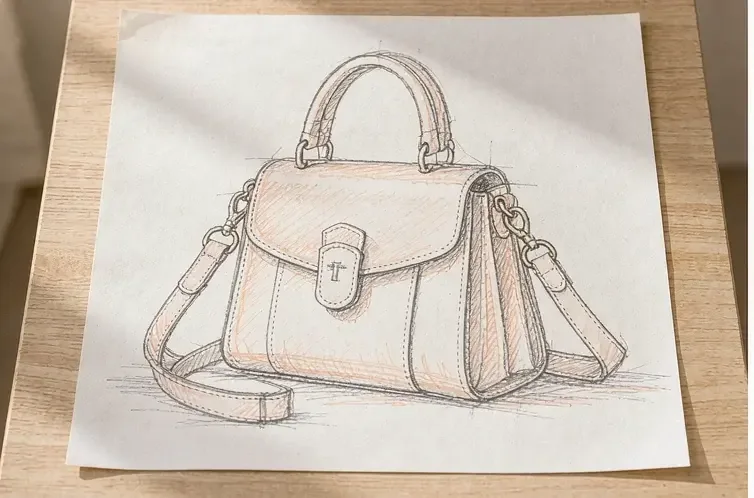
What a Pattern Set Actually Contains
A structured body is not one shape but a set. Between 12 and 18 pieces make up the pattern: front and back faces, two gussets, a base, a facing, the handle plies, the closure reinforcement, the base board, the pocket bags and the linings. Each carries its own allowance, its own grain line and its own annotation, and the set only works when all of them are read together. A drawing showing a beautiful silhouette can still produce a set that cannot be assembled, and the difference is usually two millimetres of allowance on one piece.
- Pieces in a structured set
- 12-18, including linings and reinforcements
- Body seam allowance
- 8-10 mm, graded to 6 mm at the turn
- Grain line tolerance
- ±3 degrees from the marked line
- Marker efficiency
- 78-84% on a mixed-grade hide
- Notch depth
- 3 mm maximum, never crossing the stitch line
- Digitising tolerance
- ±0.5 mm against the hand-drawn original
Checklist: Seven Things Every Pattern Must Carry
Run this list against any pattern before it is released to a bench. Seven items, each one quick to check on card and costly to discover in leather, and each one the cause of a specific failure that will otherwise be blamed on the hide or on the bench.
- A grain line on every piece, with the tolerance written beside it rather than implied.
- Seam allowance marked, not assumed: 8-10 mm on the body, 6 mm where the panel turns.
- Registration notches at every corner and at the midpoint of every long seam.
- Turn allowance confirmed: the panel folds without the allowance showing past the stitch line.
- Hardware positions drilled at true size, with the plate footprint drawn rather than centred by eye.
- Reinforcement pieces drawn separately, at the finished size, not traced from the face panel.
- A revision number and a date, so the bench and the office are never working from different sets.
The one-line test
- A pattern that has been checked is one a bench can assemble in a single correct way. A pattern that has not been checked is one the bench will assemble in three ways, two of them wrong.
Grain, Direction and the ±3 Degree Rule
Leather is directional. It stretches more across the fibre than along it, so two panels cut from the same hide at different angles will behave differently on the same body, and a gusset that has been cut five degrees off will pull the silhouette to one side within a week. The grain line on the pattern exists to prevent that, and the tolerance that makes it enforceable is ±3 degrees from the marked line.
The rule is stricter than it sounds for a reason. A single panel at five degrees out is invisible on the bench and visible on the shelf, where the body leans. Three panels at five degrees produce a bag that will not stand square on its feet, which is the fault a customer notices before any other and the one a returns department cannot argue with.
Seam Allowance: 8-10 mm on the Body, 6 mm at the Turn
Allowance is where a silhouette is won or lost. Too little and the seam pulls open at the corner; too much and the allowance will not turn cleanly and shows as bulk under the edge paint. On a structured body the working figure is 8-10 mm on the body seams, graded down to 6 mm wherever the panel turns, with the grading drawn on the pattern rather than left to whoever is holding the knife.
| Location | Allowance | Why that number |
|---|---|---|
| Body seams | 8-10 mm | Enough to hold a loaded seam without pulling at the corner |
| Turn and fold | 6 mm graded | More than this will not turn cleanly and shows as bulk |
| Gusset to base | 8 mm, notched at the radius | The radius needs relief or it gathers under the stitch line |
| Handle join | 10-12 mm, skived to 0.8 mm | The join carries the whole load of the piece |
| Lining seams | 10 mm with 1.5% shrinkage allowance | Linings move differently from the face leather |
| Zip opening | 12 mm, held to a guide | A guide holds the margin more consistently than an eye |
Marker Efficiency and What 78-84% Means
Marker efficiency is the percentage of a hide that ends up as panels rather than as offcuts, and on a mixed-grade hide the realistic figure is 78-84%. Below that, someone is nesting without reading the grade; above it, someone is placing visible faces on belly or on scar. The number is worth asking for because it sits at the intersection of cost and quality, and it moves before either of them does.
Below 78%
The marker is being nested without grade placement, and the hide has been booked at a size the panels do not need. Cost rises and the visible faces are usually fine, which is why the problem survives for seasons.
78-84%
Realistic on a mixed-grade hide with visible faces placed first and hidden panels taking what remains. Grade placement against an ungraded marker is worth 8-11 percentage points on its own.
Above 84%
Worth querying rather than celebrating. Efficiency at that level usually means scar or belly has been accepted on a visible face, and the fault will not show until the piece is assembled.
Notches, Drill Marks and Registration
Registration is what lets five stations assemble a body one way only. Notches at every corner and at the midpoint of every long seam, drilled hardware positions at true size, and a sewn order written on the set rather than remembered. Notch depth is capped at 3 mm and must never cross the stitch line, because a notch that crosses the stitch line becomes a hole the first time the seam is loaded.
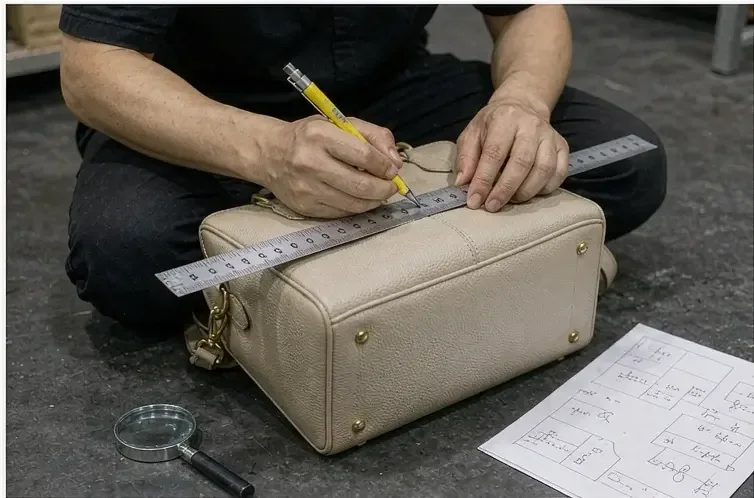
Hardware positions deserve particular care. A plate footprint should be drawn at true size on the pattern, not centred by eye at the bench, because the eye centres a plate on the panel it can see rather than on the panel as it will sit once the gusset is set. Two millimetres of error in plate placement is enough to make a closure sit visibly off-centre on a finished body.
Reinforcement and Interfacing Placement
Reinforcement pieces are drawn separately at finished size. They are not traced from the face panel, because the face panel carries allowance and the reinforcement does not; tracing produces a board that sits under the stitch line and shows as a ridge through the face. Base board at 0.8 mm, handle reinforcement at two plies of 0.8 mm skived at the join, and closure reinforcement sized to the plate footprint plus 6 mm on each side.
- Base board 0.8 mm, cut 2 mm inside the base seam allowance.
- Handle reinforcement two plies at 0.8 mm, skived to a feather edge at the join.
- Closure reinforcement at plate footprint plus 6 mm per side, never traced from the face.
A reinforcement traced from the face panel carries the face allowance, sits under the stitch line and shows as a ridge through the leather. It is found at final dress, when the body is already closed.
From Pattern to Graded Set: Tolerance Across Sizes
A single pattern becomes a graded set when a silhouette is offered in more than one size, and the tolerance that matters is the digitising one: ±0.5 mm against the hand-drawn original. Grading a handbag is not grading a garment, because the hardware does not scale — a 32 mm turn-lock stays 32 mm across every size, which means the plate footprint and its reinforcement are constant and only the panels grow.
That constraint is why handbag sets are graded from the panels outward rather than scaled as a whole. The base, the gusset depth and the handle drop change by the increment; the plate, the feet spacing and the pocket openings do not. Mixing the two produces a larger bag with a closure that looks undersized on the face, which is a design fault that reads as a cost decision.
The Four Rounds Before Bulk Sign-Off
A pattern rarely survives first contact with leather. The usual path is four rounds: a card set to check fit and assembly order, a first leather sample to check turn and allowance, a corrected sample to check hardware and reinforcement placement, and a confirmation sample that is kept as the reference for the run. Each round answers a different question, and trying to compress them into two is the most common cause of a bulk run that differs from the approved sample.
- Round one, card: does the set assemble at all, in the written order?
- Round two, first leather: does the allowance turn, and does the edge sit flush?
- Round three, corrected: are hardware and reinforcement where the drawing said?
- Round four, confirmation: retained as the physical reference the run is measured against.
What makes the four rounds worth protecting is that each one fails on a different evidence. Card catches a missing piece and a grain conflict; first leather catches allowance and turn; the corrected sample catches hardware and reinforcement; the confirmation sample catches nothing new and exists only so that the run has something physical to be argued against. A house that offers to compress four rounds into two is not offering a faster route to the same place — it is offering to find the allowance problem during bulk, where it costs a run rather than a sample.
Programme Timing and What a Pattern Costs
Our programme runs through our validated partner factory Quanzhou Yingming Bags, an SGS-validated site with 7 production lines and roughly 200,000 pcs per month of capacity, holding export experience since 2014. Sampling, including the pattern rounds above, takes 6-10 working days, or 12-15 on a complex build; bulk occupies 35-50 days; minimums sit at 500 pcs per style and colourway; and shipments leave FOB Xiamen with FOB, CIF and DDP terms all available. Inspection is drawn at AQL 2.5 under ISO 2859-1, with leather tested against ISO 3376 for tensile strength and the pattern fit checked against the retained confirmation sample. Material direction is covered on luxury materials.
Have the set checked before it reaches leather
Send the drawing, hardware direction, target size range and quantity per colourway. You will receive a pattern review against the seven-point checklist plus a costed sampling schedule. Request a quote.
Frequently Asked Questions
What is luxury handbag pattern cutting?
It is the stage where a drawing becomes a set of 12-18 graded pieces a bench can assemble, each carrying its own seam allowance, grain line and registration mark. It is also the stage where most silhouettes fail, usually through two millimetres of allowance on a single piece.
How many pattern pieces does a structured bag need?
Between 12 and 18, depending on the silhouette. That count covers the front and back faces, two gussets, the base, the facing, the handle plies, the closure and base reinforcements, the pocket bags and the linings.
Why does the grain line matter so much?
Because leather is directional and stretches more across the fibre than along it. Two panels cut from the same hide at different angles behave differently on the same body, and a gusset cut five degrees off will pull the silhouette to one side within a week.
What is the correct seam allowance on a handbag?
8-10 mm on the body seams, graded down to 6 mm wherever the panel turns. Too little and the seam pulls open at the corner; too much and the allowance will not turn cleanly and shows as bulk under the edge paint.
What is marker efficiency and what should it be?
It is the percentage of a hide that becomes panels rather than offcuts, and the realistic figure on a mixed-grade hide is 78-84%. Below that the marker is nested without grade placement; above it, scar or belly is probably being accepted on a visible face.
How deep should registration notches be?
No more than 3 mm, and never crossing the stitch line. A notch that crosses the stitch line becomes a hole the first time the seam is loaded, and the failure appears at the corner where the load concentrates.
Why should reinforcements not be traced from the face panel?
Because the face panel carries seam allowance and the reinforcement does not. Tracing produces a board that sits under the stitch line and shows as a ridge through the leather, and the fault is only found at final dress when the body is already closed.
How is a handbag pattern graded across sizes?
From the panels outward rather than scaled as a whole, because hardware does not scale. A 32 mm turn-lock stays 32 mm in every size, so the plate footprint and its reinforcement stay constant while the base, gusset depth and handle drop change.
How many sample rounds does a pattern need?
Four as a rule: a card set to check assembly order, a first leather sample for turn and allowance, a corrected sample for hardware placement, and a confirmation sample retained as the reference for the run. Compressing them is the usual cause of a bulk run that differs from the approved piece.
What digitising tolerance should be specified?
±0.5 mm against the hand-drawn original. That figure is what keeps a graded set consistent with the sample that was approved, and it is the number a bench will quote back when a panel does not fit the reference.
How should hardware positions be marked on a pattern?
Drilled at true size, with the plate footprint drawn on the pattern rather than centred by eye at the bench. The eye centres a plate on the panel as it lies flat, not on the panel as it will sit once the gusset is set.
How long does pattern development take?
Sampling, including the pattern rounds, takes 6-10 working days, or 12-15 on a complex build, and bulk occupies 35-50 days at 500 pcs per style and colourway. Shipments leave FOB Xiamen with FOB, CIF and DDP terms available.
People Also Ask
What is the difference between a pattern and a marker?
The pattern is the set of piece shapes with allowances and grain lines; the marker is how those shapes are laid on a particular hide. The pattern is fixed for the style; the marker is rebuilt whenever the hide grade changes.
Why does a bag look right on paper but wrong in leather?
Usually allowance. Leather has thickness, so a fold drawn as a line needs 6 mm graded material to turn. A drawing that ignores thickness produces a set that assembles flat and distorts the moment the body closes.
Can a pattern be reused for a repeat order?
Yes, and it should be. A retained pattern with its revision number lets a reorder skip the first two rounds, which is why a house that records its sets can quote a shorter development window on a second drop.
What is a confirmation sample for?
It is the physical reference the bulk run is measured against. Every inspection question during the run — allowance, hardware placement, edge build — is settled by comparison with that piece rather than by recollection.
How do you check a pattern before cutting leather?
Assemble it in card first. Card has no thickness, so it will not catch turn problems, but it catches assembly order, grain conflict, notch mismatch and any piece that was simply never drawn.
Sources and further reading
Every figure on this page is either our own programme data or attributed below. Open the originals before you write them into a specification.
- ISO — International Organization for StandardizationISO Publisher of ISO 2859-1 for the AQL 2.5 inspection plan and ISO 3376 for leather tensile strength.
- Leather Working GroupLeather Working Group Tannery audit protocol for hide traceability, the material basis for grade placement and marker efficiency.
- SATRA Technology CentreSATRA Independent testing body for leather goods, referenced for seam strength and dimensional stability test methods.
- European Chemicals AgencyECHA Regulator for REACH, whose Annex XVII restrictions apply to the finishes and adhesives used in assembly.