What Is Saddle Stitching in Couture Bags: Definition, Method and How It Is Inspected
Saddle stitching in couture bags is a seam made with a single waxed thread and two needles, one at each end, passed through every hole from opposite sides so the thread crosses inside the seam. Because each stitch is tensioned independently, cutting one does not release the run. It is specified by pitch, thread diameter and hole preparation, and it is slower by roughly an order of magnitude than a machine seam.
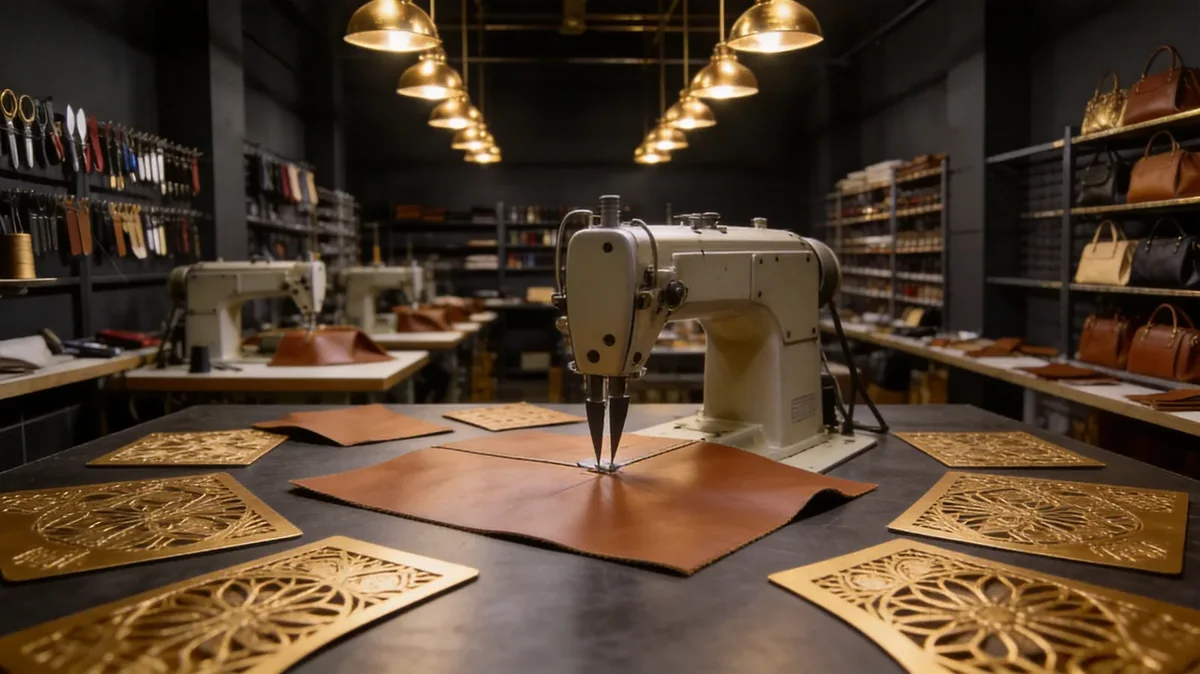
The Definition in One Sentence
A saddle stitch is a hand seam in which one waxed thread carries a needle at each end, and both needles pass through the same hole from opposite directions so the thread crosses inside the material on every stitch rather than interlocking once beneath it. That crossing is the whole definition, and it is the reason the seam behaves differently from a machine lockstitch when it is cut, loaded or repaired.
Everything else — the pitch, the iron, the thread diameter, the wax — is a variable applied to that structure. A couture specification does not describe saddle stitching as a look; it names the pitch in stitches per inch, the thread ticket in millimetres, and the number of back stitches at each end.
Three Ways to Lay the Seam, Compared
There are three routes to a seam that looks slanted, and only one of them is a saddle seam. The comparison below is the fastest way to settle which is being offered, because the differences show up in hole preparation and thread count rather than in the finished photograph.
| Attribute | Pricking iron saddle seam | Awl saddle seam | Machine saddle-look seam |
|---|---|---|---|
| Holes | All holes struck at once with an 8 or 9 tooth iron, 3.18 or 2.82 mm pitch | Each hole opened individually with a 0.9 mm diamond awl as the stitch advances | No pre-punched holes; the needle pierces as it feeds |
| Thread | One waxed thread, two needles, crossing in each hole | One waxed thread, two needles, crossing in each hole | Needle thread interlocked with bobbin thread inside the plies |
| Pitch held | Very consistent, set by the iron | Consistent but dependent on the hand | Consistent, set by the feed |
| Best on | Long straight visible seams, 1.0-1.4 mm shell | Curves, gusset turns and corners where an iron cannot sit flat | Hidden interiors and linings where slant is decorative |
| Failure | Damage stops at the adjacent stitch | Damage stops at the adjacent stitch | One cut releases the run |
| Output | Roughly 8-12 minutes per metre of seam | Roughly 12-18 minutes per metre of seam | Roughly 30 seconds per metre of seam |
The recommendation follows from the comparison rather than from taste. Pricking irons for straight visible runs, an awl where the seam turns or the iron will not sit flat, and the machine only where no one will load or repair the seam. Specifying an awl seam on a two-metre straight run is a way of buying minutes nobody can see; specifying a machine look-alike on a handle join is a way of buying a return.
Thread Length, Wax and the Reason Both Are Specified
Thread is cut at roughly six times the length of the seam, plus about 150 mm at each end for the needles and the final set. Undershooting is the commonest self-inflicted problem on the bench, because joining a thread mid-seam produces two weak points and a visible change in tension at exactly the place a hand rests.
- Thread length
- About 6x the seam length, plus 150 mm per end
- Waxed linen 18/3
- About 0.55 mm diameter, the usual couture body thread
- Bonded nylon #69
- About 0.30 mm, used where abrasion resistance is preferred
- Wax
- Beeswax or synthetic blend, applied and then warmed through
- Thread per metre of seam
- Roughly 1.8-2.2 metres, because both passes run the full length
- Exit point from the edge
- 3-4 mm, constant along the run
- Hand tension per stitch
- Firm and even, roughly 1.5-2.0 kg of pull
Wax does three jobs at once: it locks the twist so the thread does not untwist through a hole, it reduces friction on the draw, and it holds the knot ends down after trimming. A seam sewn with unwaxed thread looks identical on the bench and loosens within weeks of use, which is why the wax is written into the specification and not left to the bench.
Hole Preparation: Pricking Iron at 8 or 9 Teeth
Pitch is set by the iron. An 8 tooth iron gives 3.18 mm between holes, a 9 tooth gives 2.82 mm, and a 10 tooth gives 2.54 mm. On a couture body the choice is usually 8 or 9, because at 2.54 mm a 0.55 mm waxed thread begins to crowd the hole on a 1.0-1.2 mm shell and the seam reads raised rather than drawn. Awl work uses a 0.9 mm diamond blade, which leaves a hole big enough for the thread without a visible gap.
- Strike the iron square to the panel; a tilted iron gives a slant that alternates down the seam.
- On a curve, switch to the awl rather than forcing the iron around the turn.
- Holes 3-4 mm from the edge, held constant, are what make the seam line read straight.
- A hole spacing below about three times the thread diameter crowds and raises the seam.
The Cast-On, the Running Stitch and the Cast-Off
A saddle seam has three distinct passages: the cast-on, the running body, and the cast-off. The cast-on takes the first two or three holes with a double pass so the thread anchors before load arrives. The running body is the alternating cross: left needle through, right needle through, drawn even. The cast-off reverses for three to four stitches back through holes already sewn, then the thread ends are trimmed to about 1.5 mm and set with a dab of wax.
Each of the three is a place where a seam is won or lost, and each can be checked. A missing cast-on shows as a loose first stitch; uneven draw shows as a seam that rises off the panel at the fold; a cast-off that runs fewer than three stitches is the first place a seam begins after a snag.
Reading a Saddle Seam: Five Things a Loupe Shows
At arm's length a good machine seam and a good saddle seam can look alike. Under 10x magnification they separate immediately, and five checks are enough to settle any dispute without a conversation about intent.
- Both threads enter the same hole from opposite sides and sit flush, not stacked one over the other.
- The slant is constant: each stitch leans the same way at 15-20 degrees, with no reversal mid-run.
- There are no thread ends protruding; ends are trimmed to about 1.5 mm and waxed down.
- The panel between holes is flat, with no puckering that would indicate the thread was over-drawn.
- At a corner the pitch tightens deliberately rather than drifting, usually to 10-11 per inch through the turn.
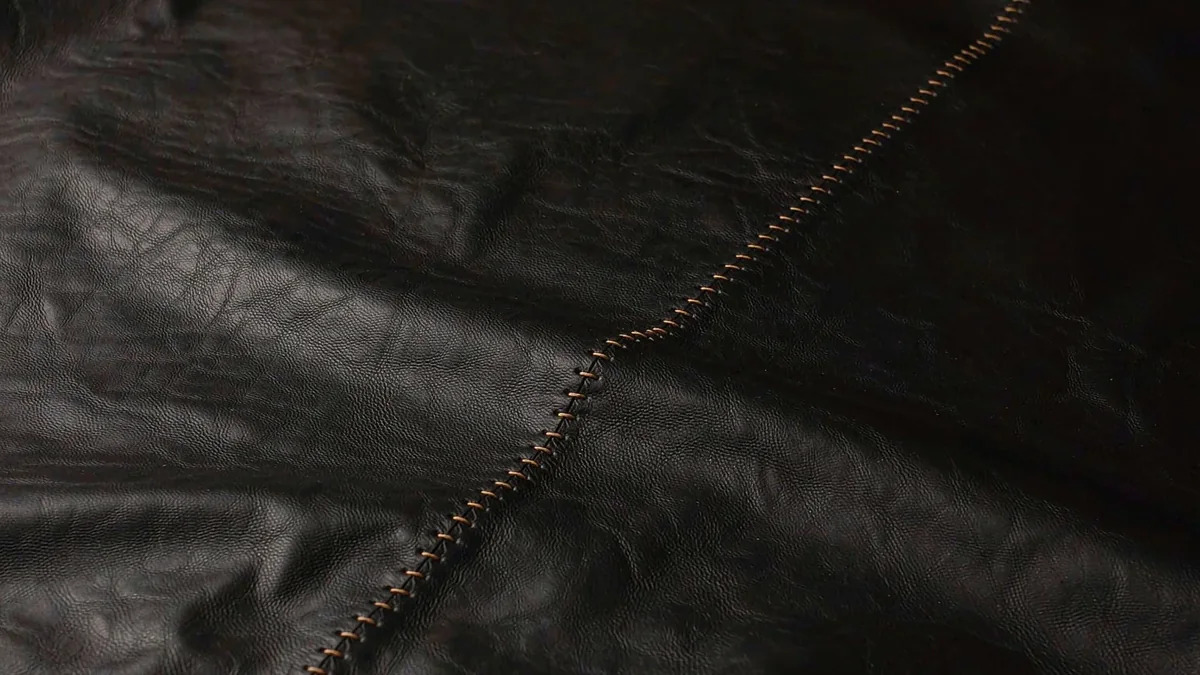
A seam that passes all five will behave as specified under load. A seam that fails the first check is not a saddle seam at all, whatever it is called on the costing sheet, and it will not stop a break the way a saddle seam does.
Where Couture Houses Put It, and Where They Do Not
Always hand
Handle joins, top-handle wraps at 10-12 per inch, gusset corners, mitred turns and closure reinforcement patches. Load arrives at a point and the seam must be repairable in place.
Usually hand
Visible body seams on a structured silhouette, the base seam, and the seam running under a flap. These are the seams a customer's hand finds within seconds of picking the piece up.
Rarely hand
Linings, pocket bags, zip insertion and dust bags. Uniformity across a run matters more than local repairability, and a machine holds the 3 mm zip margin more consistently.
The distribution is remarkably consistent across houses, which is the useful observation: nobody puts saddle work where it cannot be seen or loaded. Where a brief asks for it everywhere, the reason is usually a photograph rather than a specification.
What the Minutes Buy, in Numbers
A saddle seam occupies roughly 8-12 minutes per metre with an iron and 12-18 minutes per metre with an awl, against about 30 seconds per metre on a machine. On a structured body with six visible seams averaging 0.9 metres, that is 45-65 minutes of bench time per piece attributable to hand work alone. At 500 pieces the number is large, which is exactly why the placement decision is made at briefing rather than at costing.
Set against that is the repair arithmetic. Reworking one closure on a returned piece costs around USD 4.80 in parts and bench time before any freight is counted, and a seam that releases along its length cannot be repaired in place at all. The minutes buy local repairability on the four or five seams where it will eventually be needed.
Writing Saddle Stitching Into a Specification
Six lines are enough: method (iron or awl), pitch in teeth or millimetres, thread type and diameter, wax, cast-on and cast-off stitch counts, and the distance of the hole from the edge. Add a 1:1 photograph of the approved seam, because pitch disputes are settled with a loupe rather than with correspondence.
The programme runs through our validated partner factory Quanzhou Yingming Bags, an SGS-validated site with 7 production lines and about 200,000 pcs per month of capacity, holding export experience since 2014. Sampling takes 6-10 working days, or 12-15 on a complex build; bulk occupies 35-50 days; minimums sit at 500 pcs per style and colourway; and inspection is drawn at AQL 2.5 under ISO 2859-1, with third-party inspection available alongside the internal audit. Shipments leave FOB Xiamen, and FOB, CIF and DDP terms are all available.
Common Substitutions and How to Catch Them
Four substitutions account for most disputes about saddle stitching, and all four are visible at goods-in if the checks are written into the inspection plan rather than assumed.
- A machine saddle-look seam offered as hand work: check whether both threads enter each hole from opposite sides.
- A single-needle running stitch sold as saddle: check for the crossing inside the hole.
- Unwaxed thread: look for a dry, fluffy thread surface and ends that lift after trimming.
- Pitch drift towards the end of a run: count over 25.4 mm at three points rather than once.
Leather itself is tested against ISO 3376 for tensile strength and ISO 11644 for finish adhesion, with colour fastness against ISO 105, so the seam is assessed against a panel whose behaviour is already recorded. Where an exotic shell is used, CITES documentation is checked before the panel reaches the bench at all.
Specify the seam by the numbers
Send the drawings, your material direction, quantity per colourway and delivery date. You will receive a costed specification naming iron or awl, pitch, thread diameter and cast counts for every seam. Request a quote.
Frequently Asked Questions
What is saddle stitching in a couture bag?
It is a hand seam made with one waxed thread carrying a needle at each end. Both needles pass through every hole from opposite directions, so the thread crosses inside the seam rather than interlocking once beneath it. Each stitch is tensioned independently, which is why cutting one does not release the run.
Why is it called a saddle stitch?
The name comes from saddlery, where the same two-needle crossing seam was used to join harness leather long before it appeared on bags. The method is unchanged: two needles, one waxed thread, one crossing inside every hole along the length of the seam.
How is a saddle stitch different from a machine lockstitch?
A lockstitch interlocks a needle thread with a bobbin thread inside the plies, one needle entry per stitch. A saddle seam puts two thread passes through each hole from opposite sides. The practical difference appears at failure: a lockstitch releases along the run, a saddle seam stops at the adjacent stitch.
What pitch is used on couture bags?
Eight or nine stitches per inch is standard, which is 3.18 mm or 2.82 mm between holes. Ten per inch, at 2.54 mm, is used on fine detail such as a handle wrap, but on a 1.0-1.2 mm shell it begins to crowd a 0.55 mm thread and the seam reads raised.
Should holes be made with a pricking iron or an awl?
An iron for long straight runs, because it sets the pitch mechanically and holds it across the whole seam. An awl for curves, gusset turns and corners, where an iron cannot sit flat. Awl work is slower, at 12-18 minutes per metre against 8-12.
Why does the thread have to be waxed?
Wax locks the twist so the thread does not untwist as it is drawn through a hole, cuts friction on the pull, and holds the trimmed ends down afterwards. An unwaxed seam looks identical on the bench and loosens within weeks of use, which is why wax is specified rather than assumed.
How much thread does a saddle seam use?
Roughly 1.8-2.2 metres per metre of finished seam, because both passes run the full length. Thread is cut at about six times the seam length plus 150 mm at each end, so no join falls mid-seam and creates two weak points where a hand rests.
Can a saddle stitch be repaired after damage?
Yes, and that is its practical advantage. The damaged section can be unpicked and re-sewn locally because the break stops at the adjacent stitch. A machine seam that has released along its length generally has to be re-run from the start, which means opening the panel.
How can you tell a real saddle stitch from a machine imitation?
Use 10x magnification and check whether both threads enter each hole from opposite sides and sit flush. A machine imitation shows a single interlock buried between the plies. Also check the slant is constant at 15-20 degrees and that no thread ends protrude past 1.5 mm.
Where should saddle stitching not be used?
Linings, pocket bags, zip insertion and dust bags. These are hidden, carry distributed rather than concentrated load, and need uniformity across the run more than local repairability. A machine also holds the 3 mm zip margin more consistently than a hand can.
How much bench time does saddle stitching add?
Roughly 8-12 minutes per metre with an iron and 12-18 with an awl, against about 30 seconds by machine. On a structured body with six visible seams averaging 0.9 metres, that is 45-65 minutes per piece attributable to hand work.
What should a tech pack say about saddle stitching?
Six lines: method, pitch in teeth or millimetres, thread type and diameter, wax, cast-on and cast-off counts, and hole distance from the edge. Add a 1:1 photograph of the approved seam, because a pitch dispute is settled in seconds with a loupe.
People Also Ask
Is saddle stitching stronger than machine stitching?
Not in peak load. Its advantage is failure behaviour: a break stops at the adjacent stitch instead of releasing along the run, so the seam can be repaired locally rather than re-run from the start.
How many stitches per inch is couture saddle work?
Eight or nine per inch, equal to 3.18 mm or 2.82 mm between holes. Ten per inch is reserved for handle wraps and fine detail where the shell is thinner.
What thread is used for saddle stitching?
A waxed braid at about 0.55 mm, typically waxed linen 18/3, chosen because the seam shows its thread. Bonded nylon #69 at about 0.30 mm is used where abrasion resistance matters more than appearance.
Why is saddle stitching so slow?
Each hole is pre-punched and each stitch is drawn and tensioned by hand, at 8-12 minutes per metre with an iron and 12-18 with an awl, against about 30 seconds per metre on a machine.
Can a machine reproduce a saddle stitch?
It can reproduce the slanted appearance but not the structure. Under magnification a machine seam shows one interlock between the plies rather than two passes crossing in each hole, and it fails differently when cut.
Sources and further reading
Every figure on this page is either our own programme data or attributed below. Open the originals before you write them into a specification.
- ISO — International Organization for StandardizationISO Publisher of ISO 3376 for leather tensile strength, ISO 11644 for finish adhesion, ISO 105 for colour fastness and ISO 2859-1 for the AQL inspection plan.
- CITES — Convention on International Trade in Endangered SpeciesCITES The convention whose Appendices determine which exotic shells require documentation before a panel reaches the bench.
- Leather Working GroupLeather Working Group Tannery audit protocol used to evidence hide traceability, which fixes the panel grade before holes are struck into it.
- SATRA Technology CentreSATRA Independent testing body for leather goods, referenced for seam strength and thread abrasion methods used to validate a seam specification.