Machine vs Hand Stitching on Luxury Handbags: A Comparison Buyers Can Specify
Machine stitching is faster and more uniform; hand saddle stitching is slower and survives a broken thread. On a luxury handbag the honest answer is both: a machine lockstitch at 6-7 per inch on hidden interior work, and a hand saddle seam at 8-9 per inch on every seam a customer sees or loads. The variables that decide it are pitch, hole geometry, thread size and where the seam sits on the body.
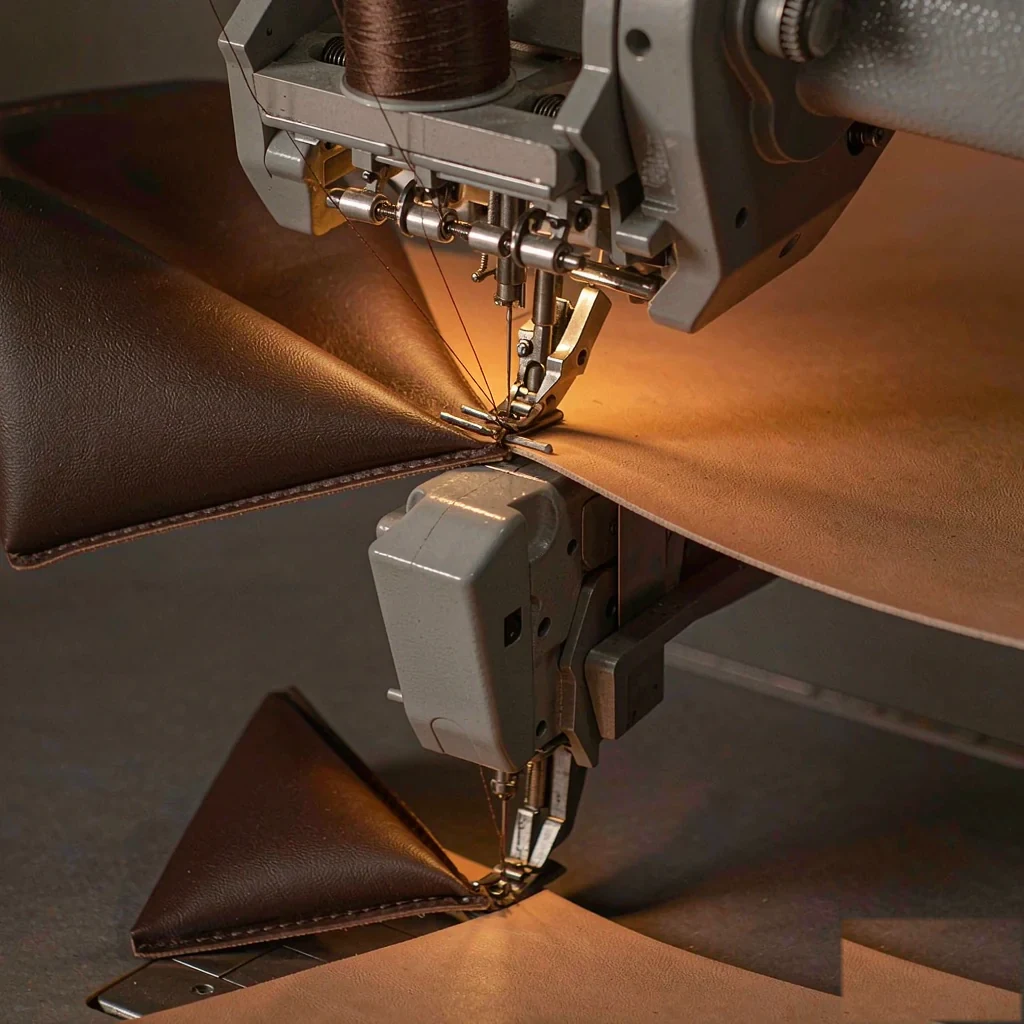
The Decision Checklist: Six Questions Before a Seam Is Specified
Decide the seam in this order, because each answer constrains the next one: where the seam sits, what load it carries, whether it is visible in use, what pitch the design language wants, what thread fits the hole, and how the piece will be repaired in year three. Worked forwards, the choice takes an hour at the briefing table; worked backwards from a reference photograph, it usually costs a sampling round and a second pattern.
- Is the seam visible when the bag is carried? Visible seams are specified by pitch and slant, not by speed.
- Does the seam carry load? Handle joins, gusset corners and base seams take the weight of the contents.
- What pitch does the house standard use? 8-9 per inch reads as designer; 6-7 reads as casual goods.
- What thread diameter fits the hole? A 0.55 mm waxed thread will not sit in a 0.9 mm awl hole twice.
- Can the seam be repaired locally? Ask what happens when one stitch is cut, not whether it looks correct.
- Is the run 500 pieces? At that quantity, uniformity between piece one and piece 500 is the harder problem.
The one-line rule
- Specify hand work where the seam is seen or loaded, and machine work where it is neither. Every exception to that rule should be written down with a reason, because it will be queried again at costing.
The checklist exists because the two seams are not interchangeable finishes applied to the same joint. They are two different structures, and the structure decides what the seam does under load, what it does when it fails, and what it costs to put right.
How a Lockstitch and a Saddle Seam Differ
A machine lockstitch passes a needle thread and a bobbin thread and interlocks them inside the material, one needle entry per stitch, with the knot buried between the plies. A hand saddle seam passes two needles on one waxed thread through the same hole from opposite sides, so each stitch crosses inside the seam rather than locking against it. The structural consequence is simple and worth stating plainly: cut one stitch of a lockstitch and the seam runs; cut one stitch of a saddle seam and the damage stops at the neighbouring stitch.
| Attribute | Machine lockstitch | Hand saddle seam |
|---|---|---|
| Structure | Needle thread interlocked with bobbin thread inside the plies | One waxed thread, two needles, crossing inside every hole |
| Typical pitch | 6-7 per inch on interior work | 8-9 per inch on visible seams |
| Holes | Punched by the needle itself, one entry per stitch | Pre-punched with a pricking iron or awl, one hole per stitch |
| Thread | Bonded nylon #69 at about 0.30 mm | Waxed linen or bonded nylon at 0.45-0.55 mm |
| Slant | None, the stitch sits square to the seam line | 15-20 degrees, consistent along the whole run |
| Failure | One cut stitch unravels the run | One cut stitch stops at the adjacent stitch |
| Repair | Seam is usually re-run from the start | Damaged section can be unpicked and re-sewn locally |
| Output | Roughly 1.8-2.4 metres per minute | Roughly 90-140 mm per minute |
Two further differences follow from the structure. The saddle seam puts two thread passes through each hole, so at the same pitch it consumes roughly twice the thread of a lockstitch; and because the thread is drawn by hand, tension is set at every stitch rather than once at the machine head. That second point is why a saddle seam reads as a seam and a lockstitch reads as a line.
Pitch and Hole Geometry: Where 8-9 Per Inch Comes From
Pitch is the distance between holes, and it is the single number that most changes how a seam reads. At 8 per inch the pitch is 3.18 mm; at 9 per inch it is 2.82 mm; at 12 per inch it is 2.12 mm. Fine work at 10-12 per inch is reserved for handle wraps and small leather goods, because on a 1.2-1.4 mm shell a pitch that tight begins to perforate the panel rather than sew it.
- Pitch on visible seams
- 2.8-3.2 mm (8-9 per inch)
- Awl or pricking iron
- 8 or 9 teeth per inch, blade 0.9 mm
- Leather needle
- 110/18 for a 1.2-1.4 mm shell
- Seam allowance
- 8-10 mm on body seams, 6 mm on turning
- Back-tack at start and end
- 3 stitches, drawn back through the same holes
- Stitch slant
- 15-20 degrees, constant along the run
- Thread ends
- Trimmed to 1.5 mm and set with a dab of wax
The relationship to hold is that hole spacing should not fall below roughly three times the thread diameter. A 0.55 mm waxed thread in holes at 2.8 mm sits comfortably; the same thread in holes at 2.1 mm crowds, and the seam begins to look raised rather than drawn.
Thread, Needle and Awl: The Three Consumables
Thread is specified by ticket and diameter, not by colour alone. Bonded nylon #69 at about 0.30 mm is the usual body thread for machine work and carries the tensile margin a gusset needs; #46 at about 0.24 mm keeps interior work from bulking at the fold. Hand work on a visible seam typically takes a waxed braid at 0.45-0.55 mm, because a saddle seam shows its thread and a thin thread disappears into the hole.
- Wax matters more than colour: it locks the twist, reduces friction through the hole and slows abrasion at the fold.
- A 110/18 leather needle has a cutting point; using a round-point needle on dry crust leaves a torn hole.
- An awl blade at 0.9 mm gives a 0.55 mm thread room to sit without the panel puckering between holes.
- Machine tension is set once per run; hand tension is set at every stitch, which is the difference in feel.
Needle size is the most frequently overlooked line on a tech pack. A needle that is too fine deflects on a 1.4 mm shell and produces a wandering seam line; one that is too heavy leaves a hole the thread cannot fill. Either way the defect only appears at assembly, which is the most expensive place to discover it.
Speed, Minutes and Where the Difference Actually Lands
A bench hand draws a saddle seam at roughly 90-140 mm per minute; a lockstitch machine runs at roughly 1.8-2.4 metres per minute. On a body seam of 1.2 metres that is about ten minutes of hand work against about half a minute on the machine. Six visible seams on a structured body therefore carry close to an hour of difference, and that hour is the entire argument against specifying hand work everywhere.
The hour is also the argument for being selective rather than uniform. Putting hand work on the four seams a customer sees and machine work on the interior costs a fraction of an all-hand build and is indistinguishable in use. The pieces that suffer are the ones where the decision was made by price rather than by position.
Failure Modes: What Each Seam Does When It Breaks
Ask what happens after the failure, not whether the seam is strong enough. A lockstitch seam tested to failure typically holds its rated load and then releases along the run when a single stitch is cut, because the interlock depends on the previous stitch. A saddle seam loses that stitch and stops: each stitch is independently tensioned, so the break is local.
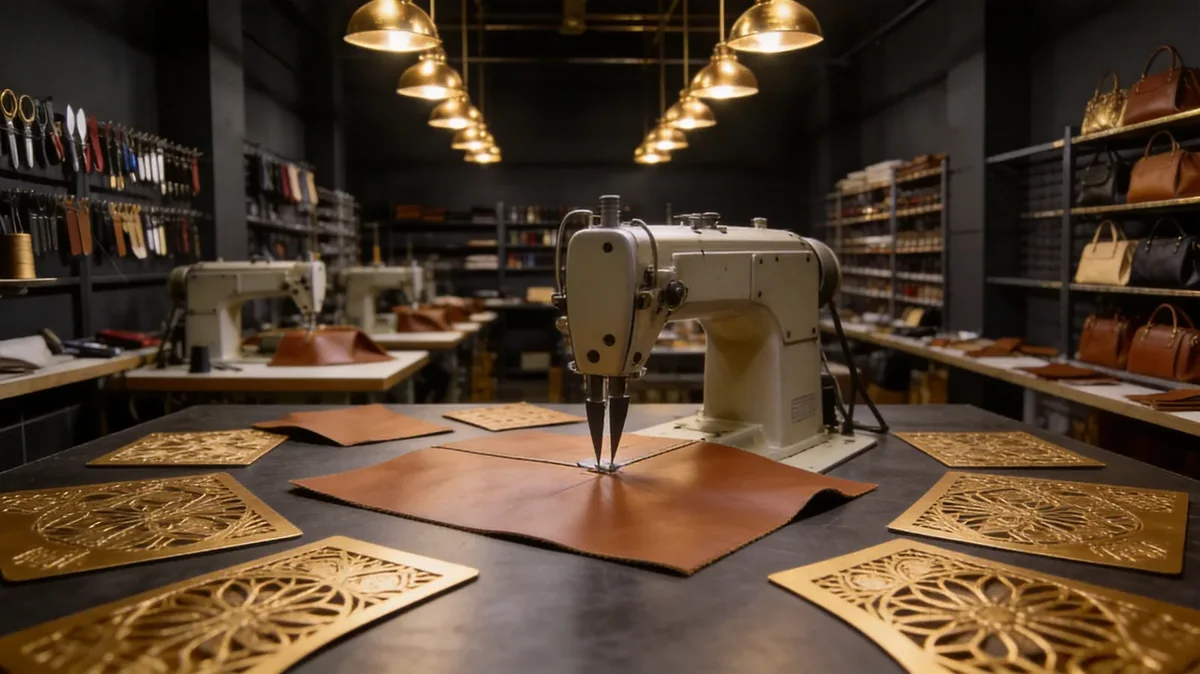
This is not an aesthetic argument. A handle join that unravels sends the piece back; a handle join that loses one stitch can be unpicked across 30 mm and re-sewn on the bench. Reworking one closure on a returned piece costs around USD 4.80 in parts and bench time before freight is counted, which is why the failure mode is worth specifying at briefing rather than discovering at goods-in.
Where Hand Work Is Non-Negotiable
Handle joins and top-handle wraps
These carry the full weight of the contents and are the first thing a hand finds. Hand work at 8-9 per inch with a back-tack of three stitches is the standard, and the wrap is normally tighter at 10-12 per inch.
Gusset corners and mitred turns
A corner concentrates load at a single point. The pitch is often tightened to 10-11 per inch through the turn, and the panel is skived to about 0.5 mm so the fold does not bulk.
Closure and reinforcement patches
A turn-lock or magnetic closure loads its patch every time the bag is opened. The patch is sewn by hand so the stitch can be placed around the hardware foot rather than across it.
The common feature is load concentration. Where force arrives at a point rather than along a line, the local repairability of a saddle seam is worth the minutes it costs.
Where the Machine Is Honestly the Better Choice
Long straight interior seams, linings, pocket bags and zip tapes are better sewn by machine. The seam is hidden, the load is distributed rather than concentrated, and uniformity across 500 pieces is easier to hold on a machine head set once than across several benches. On lining work a lockstitch at 6-7 per inch with #46 thread is faster, flatter and less likely to bulk at a fold than a hand seam of the same length.
- Interior seams: hidden, distributed load, no repair consequence — machine.
- Lining and pocket bags: bulk matters more than slant — machine, #46 thread.
- Zip insertion: the tape needs a consistent 3 mm margin, which a machine holds better by hand.
- Dust bags and presentation: uniformity across a run is the only requirement.
There is also a consistency argument at run length. Across 500 pieces, ten benches will not draw an identical hand seam; one machine with a fixed tension and a fixed guide will. Where the seam is invisible, that consistency is worth more than the repairability nobody will use.
How to Inspect Either Seam at Goods-In
Both seams can be inspected with a gauge, a loupe and five minutes. Take the pitch count at three points on every seam — start, middle and turn — rather than once, because a seam that opens up towards the end of a run is the signature of a hand losing rhythm or a machine feeding unevenly.
- Count stitches over 25.4 mm at three points; the count should not vary by more than one.
- Check the back-tack: three stitches drawn back through the same holes at every start and stop.
- Look for the slant: 15-20 degrees and constant, with no reversal part-way along a seam.
- Run a fingernail along the seam; a thread end left longer than 1.5 mm catches and then lifts.
- Flex the panel at the fold and look for the thread rising out of the hole, which indicates low tension.
Inspection is drawn at AQL 2.5 under ISO 2859-1, with a re-work reserve held so a finding is corrected on the bench rather than at the destination. Leather itself is tested against ISO 3376 for tensile strength and ISO 11644 for finish adhesion, and colour fastness against ISO 105, so the seam is checked against a material whose performance is already recorded.
Writing the Seam Into the Tech Pack
A seam specification is five lines: method (machine or hand), pitch, thread ticket and diameter, needle or awl size, and back-tack. Anything less is a description, and a description is what gets substituted when a schedule tightens. Add a photographed reference of the approved seam at 1:1 magnification, because pitch disputes are settled faster with a loupe than with an email.
The programme runs through our validated partner factory Quanzhou Yingming Bags, an SGS-validated site with 7 production lines and about 200,000 pcs per month of capacity, holding export experience since 2014. Sampling takes 6-10 working days, or 12-15 on a complex build; bulk occupies 35-50 days; minimums sit at 500 pcs per style and colourway; and inspection is drawn at AQL 2.5 under ISO 2859-1 with third-party inspection available alongside the internal audit. Shipments leave FOB Xiamen, with FOB, CIF and DDP all available.
Specify the seam, not the idea of one
Send the drawings, your material direction, quantity per colourway and delivery date. You will receive a costed specification naming the method, pitch, thread and needle for every seam on the body. Request a quote.
Frequently Asked Questions
Is hand stitching stronger than machine stitching on a handbag?
Not in raw tensile terms. The difference is in failure behaviour: a machine lockstitch tends to release along the run once one stitch is cut, while a hand saddle seam stops the damage at the adjacent stitch because each stitch is tensioned independently. For a loaded join, that behaviour matters more than the peak number.
What stitch count should a luxury handbag use?
Eight to nine per inch on visible body seams is the designer standard, equal to 2.8-3.2 mm between holes. Interior and lining work runs at 6-7 per inch. Handle wraps and fine detail go to 10-12 per inch, but not on a 1.2-1.4 mm shell, where the holes begin to perforate the panel.
Why does a hand seam look different from a machine seam?
Because the thread is drawn by hand at every stitch, so tension varies slightly and each stitch sits at a slant of 15-20 degrees rather than square to the seam line. A machine sets tension once at the head and feeds the panel past a fixed guide, which produces a flat, uniform line.
Can a machine imitate a saddle stitch?
A machine can produce a slanted, saddle-like appearance, but it does not reproduce the structure: one waxed thread crossing inside every hole. Visually the two can be close at arm's length; under a loupe and after a cut stitch they behave differently, which is why appearance alone should not settle the specification.
How much slower is hand stitching in practice?
A bench hand draws roughly 90-140 mm per minute against 1.8-2.4 metres per minute on a lockstitch machine. On a 1.2 metre body seam that is about ten minutes against half a minute, so six visible seams on a structured body carry close to an hour of difference.
Which seams should always be sewn by hand?
Handle joins, top-handle wraps, gusset corners, mitred turns and closure reinforcement patches. All four concentrate load at a point rather than distributing it along a line, and all four are difficult or impossible to repair locally if the seam releases along its length.
Where is machine stitching genuinely the better choice?
Long straight interior seams, linings, pocket bags and zip insertion. These are hidden, carry distributed rather than concentrated load, and benefit from the uniformity a machine head holds across a 500 piece run. Bulk at the fold is also easier to control with #46 thread on a machine.
What thread size fits a hand saddle seam?
A waxed braid at 0.45-0.55 mm is typical, because a saddle seam shows its thread and a thinner thread disappears into the hole. The matching rule is that hole spacing should not fall below about three times the thread diameter, so 0.55 mm thread sits well in holes at 2.8 mm.
What is a back-tack and why is it specified?
A back-tack is three stitches drawn back through the same holes at the start and end of a seam, which locks the thread so it cannot pull free. Without it, the first stitch is the weakest point on the seam and the most likely place for a run to begin after a snag.
How do you check stitch quality at goods-in?
Count stitches over 25.4 mm at three points on each seam, confirm the back-tack is present, check the slant is constant at 15-20 degrees, and feel for thread ends longer than 1.5 mm. Then draw inspection at AQL 2.5 under ISO 2859-1 with a re-work reserve held.
Does the leather need testing before the seam is judged?
Yes, because a seam can only be assessed against a known material. Leather is tested against ISO 3376 for tensile strength and ISO 11644 for finish adhesion, with colour fastness against ISO 105. Without those recorded, a seam failure cannot be attributed to the thread or the panel.
What should the tech pack say about a seam?
Five lines: method (machine or hand), pitch, thread ticket and diameter, needle or awl size, and back-tack. Add a photographed reference of the approved seam at 1:1 magnification, because a pitch dispute is settled in seconds with a loupe and takes days by email.
Does a longer run change the hand-versus-machine decision?
It sharpens it. Across 500 pieces, ten benches will not draw an identical hand seam, so uniformity becomes the harder problem on visible work. On hidden work, uniformity is the only requirement and the machine wins on both counts, which is why the split usually widens as the run grows.
Is hand stitching worth the additional cost on every seam?
No. It is worth it on the seams that are seen or loaded and not on the ones that are neither. A mixed specification puts hand work on four visible seams and machine work on the interior, and in use the two are indistinguishable from an all-hand build at a fraction of the bench time.
People Also Ask
What is the difference between a lockstitch and a saddle stitch?
A lockstitch interlocks a needle and bobbin thread inside the plies; a saddle stitch passes one waxed thread through each hole from both sides, crossing inside the seam. The difference shows at failure: one runs, the other stops locally.
How many stitches per inch is considered luxury?
Eight to nine per inch on visible seams. Interior work sits at 6-7, and fine detail such as a handle wrap goes to 10-12, though a tighter pitch on a thin shell begins to perforate the panel.
Can you repair a hand-stitched seam?
Yes, and that is the point. The damaged section can be unpicked and re-sewn locally, whereas a machine seam that has released along its length usually has to be re-run from the start.
Why is hand stitching slower?
A bench hand draws 90-140 mm per minute because each hole is pre-punched and each stitch is tensioned by hand. A machine sets tension once and feeds the panel past a guide at 1.8-2.4 metres per minute.
Should the whole bag be hand stitched?
Rarely. The costed answer is a mixed specification: hand work on visible and loaded seams, machine work on linings, interiors and zip insertion, where uniformity matters more than repairability.
Sources and further reading
Every figure on this page is either our own programme data or attributed below. Open the originals before you write them into a specification.
- ISO — International Organization for StandardizationISO Publisher of ISO 2859-1 for the AQL 2.5 inspection plan, ISO 3376 for leather tensile strength, ISO 11644 for finish adhesion and ISO 105 for colour fastness.
- Leather Working GroupLeather Working Group Tannery audit protocol used to evidence hide traceability, which is the first item on the seam decision checklist because it fixes the panel before any hole is punched.
- SATRA Technology CentreSATRA Independent testing and research body for footwear and leather goods, referenced for seam strength and thread abrasion test methods.
- European Chemicals AgencyECHA Regulator for REACH, whose Annex XVII restrictions apply to dyes, finishes and adhesives used on leather and lining materials.