Luxury Handbag Construction Inside the Atelier: Eight Stages From Hide to Finished Piece
Luxury handbag construction runs in eight stages: hide selection and grading, clicking, preparation and skiving, interlining and reinforcement, assembly and turning, stitching at 8-9 per inch, edge and corner finishing, then hardware setting and the final read against the approved reference. Each stage has a number attached — shell at 1.2-1.4 mm, interlining at 0.8 mm, three edge coats — and those numbers are what make the second run match the first.
What Holds the Bag Up Before Anything Is Sewn?
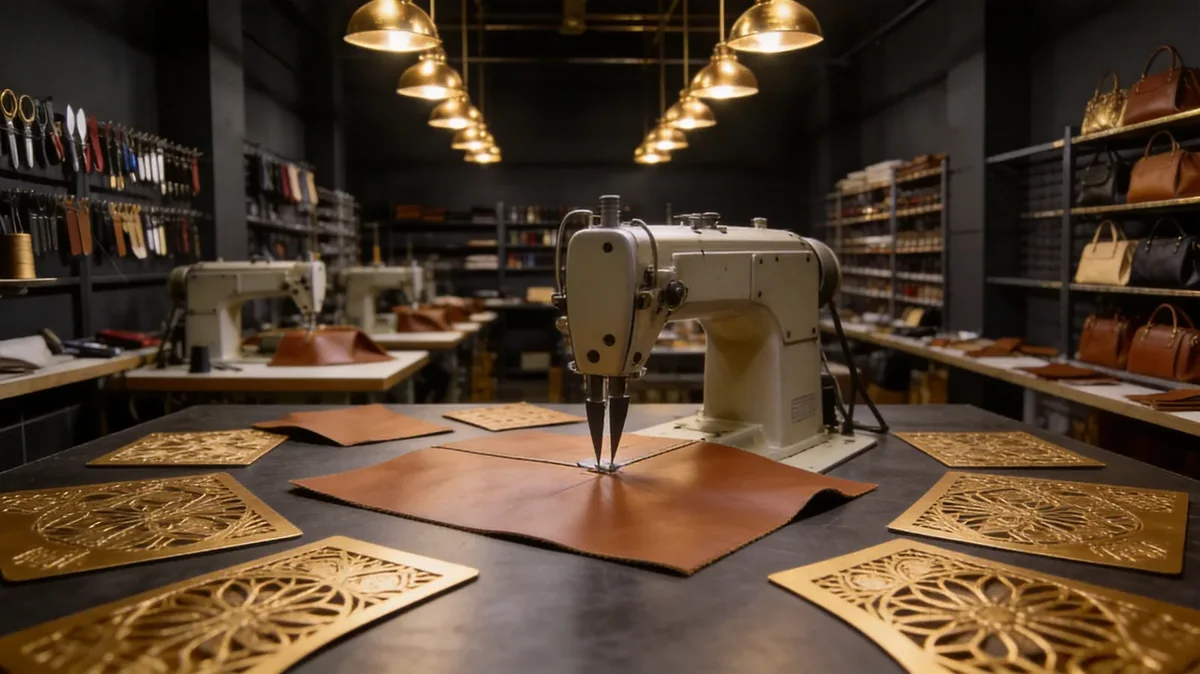
The structure of a luxury piece is decided before the first stitch, by three thicknesses and one board. The shell is cut at 1.2-1.4 mm, the interlining bonded at 0.8 mm, the lining at 0.6 mm, and a base board at 1.5 mm carries the load of the contents. If those four numbers are wrong, no amount of finishing will make the piece stand, which is why they are settled at development rather than at assembly.
- Shell thickness
- 1.2-1.4 mm full-grain calf or equivalent
- Interlining
- 0.8 mm on the base and at every handle join
- Lining
- 0.6 mm, with a 10 mm seam allowance
- Base board
- 1.5 mm, wrapped and set before assembly closes
- Handle reinforcement
- 0.4 mm non-woven, 25 x 25 mm patch per join
- Foot studs
- 4 mm, five on a structured base
- Panel alignment tolerance
- ±1 mm against the approved reference
The order matters as much as the values. The board is wrapped and set before the body closes, because once the body is turned there is no route to a board that has shifted. Reinforcement goes in at preparation, not at assembly, for the same reason.
How Is the Hide Selected and Clicked?
Selection is made by lot, not by hide. A single lot is booked against the programme, grain direction is fixed and marked on every panel of the marker, and visible faces are placed clear of scars and growth marks. Full-grain calf typically yields 62-70% usable area on a structured panel set once grade placement has been applied, so the marker is nested before any knife touches the hide.
- Lot reference and tannery are recorded with the compliance reports before cutting begins.
- Grain direction is fixed once, marked on the marker, and never decided at the bench.
- Visible faces are clicked first; hidden panels take what remains.
- A panel clicked across a scar line will open at the fold in the third week of use.
Traceability is evidenced through Leather Working Group tannery audits, and restricted substances are screened against REACH Annex XVII and California Prop 65 before the lot is released. That paperwork is part of construction, not an afterthought bolted on at despatch.
What Does Preparation Do to the Panel?
Preparation thins, bonds and shapes the panels so they can be joined without bulk. Skiving takes every edge that will be folded or joined down to a residual thickness of 0.6-0.8 mm across a width of 8-10 mm at a 45 degree bevel. Interlining is bonded at 0.8 mm to the base and to every handle join. Reinforcement patches of 0.4 mm non-woven are set at the four handle joins and behind the closure.
Two failures trace back to preparation more than to any other stage. Skiving too deep loses the panel outright; skiving too shallow leaves a step at the seam that no amount of edge paint will hide. Both are measurable at the bench, which is why the bevel is specified with a tolerance rather than described.
How Does the Body Go Together on the Bench?
Assembly closes the body in a fixed order: gusset to base, side panels to the gusset, then the top line and the turning. The turning allowance is 5 mm on a 1.4 mm shell, shaped while the material is receptive, and the panel is then left to relax for four to six hours before any edge work begins. A fold that has not finished moving will crack its edge coat in the second month, long after the piece has been invoiced.
| Stage | What is set | Tolerance or value |
|---|---|---|
| Gusset to base | Seam line and fold radius | 6 mm minimum internal radius |
| Side panels | Panel alignment to the marker | ±1 mm |
| Handle joins | Reinforcement patch and stitch placement | 0.4 mm patch, 25 x 25 mm |
| Turning | Allowance and relaxation | 5 mm allowance, 4-6 hours relaxation |
| Top line | Stitch distance from the edge | 3-4 mm, constant |
| Handle drop | Measured loaded | ±3 mm under a 300 g load |
The relaxation period is the item most often questioned and the one least safely shortened. It is not a queueing artefact: the fold is still moving, and an edge coat applied across a moving fold is an edge coat that cracks.
Where Does Stitching Enter, and at What Pitch?
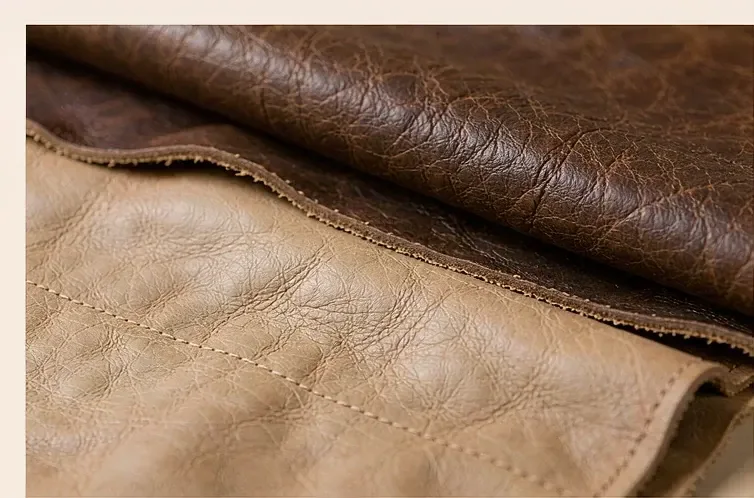
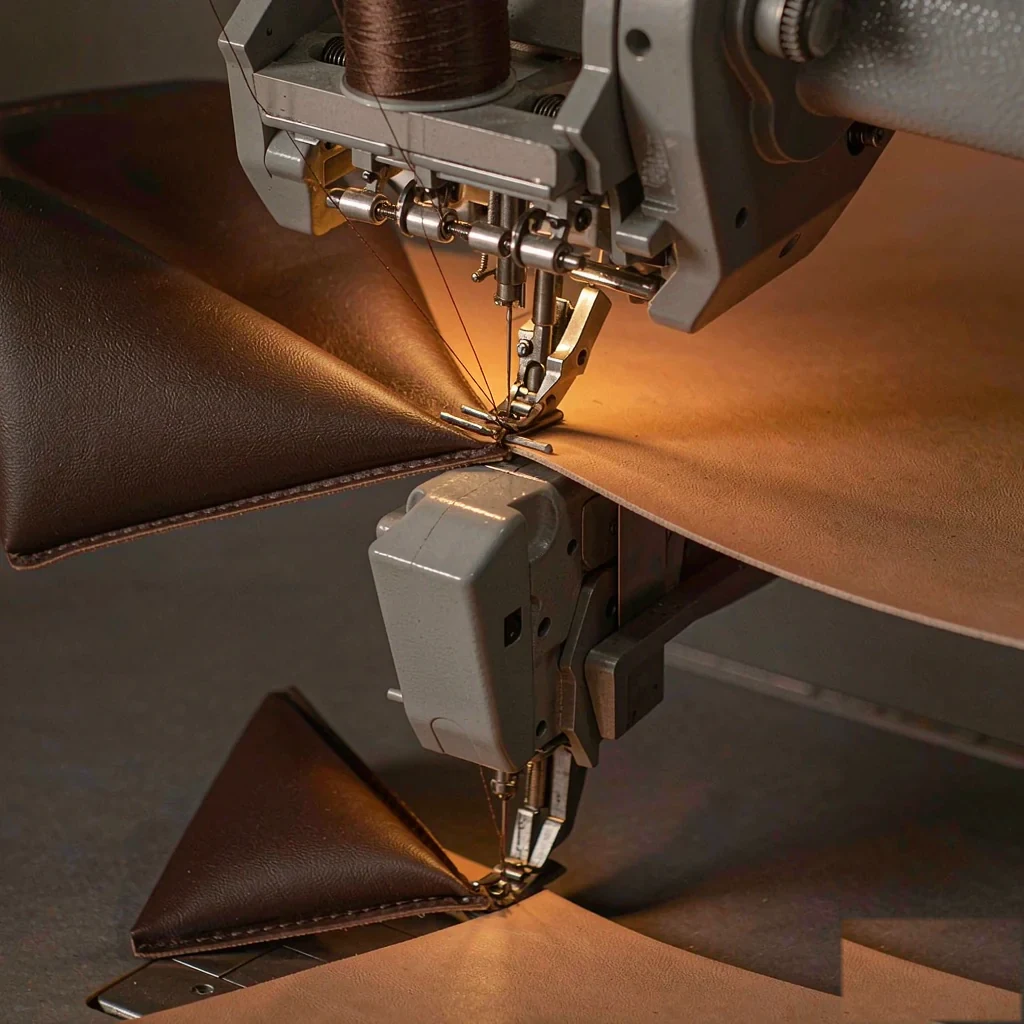
Stitching is specified by position rather than uniformly across the piece. Visible body seams run at 8-9 per inch with a waxed braid at 0.45-0.55 mm, drawn by hand where the seam is loaded. Interior and lining work runs at 6-7 per inch with bonded nylon #46. The stitch line sits 3-4 mm from the edge and is held constant, because a wandering stitch line is the first thing an eye finds even when nothing else is wrong.
- Body seams at 8-9 per inch, or 2.8-3.2 mm between holes.
- Handle wraps tighter at 10-12 per inch, where the shell is thinner.
- Back-tack of three stitches at every start and stop.
- Thread ends trimmed to 1.5 mm and set with wax.
The internal kit — base board, interlining, reinforcement patches and four foot studs — adds roughly USD 4.80 per unit, and it is the kit that decides whether the silhouette survives its first month. Nothing in it is visible in a photograph, which is precisely why it is the first place a cost-led revision looks.
How Are Corners and Edges Closed?
Corners are mitred or turned, with the internal fold radius held at a minimum of 6 mm, and the pitch tightened to 10-11 per inch through the turn. Edges are built in three coats at 0.08-0.12 mm wet, with 8-10 minutes of flash time between passes, sanded at 400 then 800 grit between the second and third coat. One thick coat looks acceptable at despatch and fails earlier, because solvent trapped under a skinned surface keeps moving.
Mitred corner
Two panels meet at 45 degrees and the seam runs tight through the turn. Cleaner line, more bench time, used where the corner is the design statement.
Turned corner
The panel folds around the corner with the fold skived to 0.6 mm. Softer line, more forgiving on a 1.4 mm shell, used on everyday structured bodies.
Bound edge
A separate strip is folded over the raw edge and stitched. Used where the shell is too thick to paint cleanly, and where the edge will take abrasion.
Whichever route is chosen, the corner is reinforced from the inside before it is closed. A corner patch that stops short of the fold is the commonest cause of a corner that opens after a season, and it is a defect that presents late: the piece looks correct on the bench, correct at despatch, and correct for roughly six weeks of use.
The grading sequence between coats is the other item worth writing down. Sanding at 400 grit removes the ridge left by the previous pass; sanding at 800 before the final coat removes the 400 grit scratches and gives the top coat something to key into. Skipping the second grade produces an edge that looks flat under bench light and reads orange-peel under shop light, which is the light the customer will use.
When Does Hardware Go On?
Hardware is set after the body closes and before the final read, with two exceptions: magnetic closures and turn-lock feet are fitted at assembly because the reinforcement behind them has to be stitched around the foot rather than across it. Plating is specified at 0.15-0.3 µm on brass, and salt spray is run for 24 hours on a standard finish and 48 hours on a marine or high-wear specification.
- Plating thickness 0.15-0.3 µm, checked on a sample from each lot.
- Salt spray 24 hours standard, 48 hours on high-wear finishes.
- Foot studs 4 mm, five on a structured base, set after edge work.
- Every hardware item needs its own drawing sheet with finish and tolerance.
What Does the Final Read Check?
The final read is comparative rather than absolute. The piece is placed beside the approved reference and examined under the same light for panel alignment within ±1 mm, seam line at a constant 3-4 mm from the edge, edge build-up no more than 0.15 mm proud of the surface, hardware gaps under 0.3 mm, and handle drop within ±3 mm measured under a 300 g load. Anything that differs is corrected on the bench rather than explained in a note.
Inspection is then drawn at AQL 2.5 under ISO 2859-1, with a re-work reserve held so a finding is corrected rather than airfreighted. Leather is tested against ISO 3376 for tensile strength and ISO 11644 for finish adhesion, with colour fastness against ISO 105, so every measurement above is taken against a material whose behaviour is already on file.
How Long Does the Sequence Take, and What Is Kept?
Bulk occupies 35-50 days, and the bench time inside that window is dominated by the last four stages: turning, stitching, edge finishing and the final read. Preparation and clicking are fast by comparison. That distribution is why a slipped calendar lands on edge work first, and why shortening the flash time is the least safe saving available.
- Lot reference, tannery and thickness, kept with the compliance reports.
- Skiving width, bevel and the tolerance actually held at assembly.
- Stitch density and thread size, checked at assembly and again at final inspection.
- Edge specification: coat count, wet thickness, flash time and grit sequence.
- Handle drop under a 300 g load, recorded with the archive set.
The programme runs through our validated partner factory Quanzhou Yingming Bags, an SGS-validated site with 7 production lines and about 200,000 pcs per month of capacity, holding export experience since 2014. Sampling takes 6-10 working days, or 12-15 on a complex build; minimums sit at 500 pcs per style and colourway; and shipments leave FOB Xiamen, with FOB, CIF and DDP terms all available.
Build the construction schedule with us
Send the drawings, your material direction, quantity per colourway and delivery date. You will receive a costed construction schedule naming every thickness, tolerance and stage date. Request a quote.
Frequently Asked Questions
What are the stages of luxury handbag construction?
Eight: hide selection and grading, clicking, preparation and skiving, interlining and reinforcement, assembly and turning, stitching, edge and corner finishing, then hardware setting and the final read. Each stage carries a number, and the numbers are what let a second run match a first one.
What thickness is a luxury handbag shell?
Full-grain calf or equivalent is cut at 1.2-1.4 mm, with interlining bonded at 0.8 mm on the base and at every handle join, and lining at 0.6 mm. A base board at 1.5 mm carries the load of the contents and is set before the body closes.
Why is grain direction fixed before cutting?
Because leather stretches differently along and across the fibre. Fixing grain direction once, on the marker, keeps every panel behaving the same way under load. Deciding it at the bench produces two panels on one bag that age and sag differently.
What is skiving and how much is removed?
Skiving thins a panel edge so two thicknesses meet without a step. On luxury work it runs 8-10 mm wide at a 45 degree bevel, down to a residual 0.6-0.8 mm. Too deep and the panel is scrap; too shallow and the step shows through the edge paint.
Why does a turned panel need to relax?
The fold is still moving after turning. Edge coats applied across a panel that has not settled will crack along the fold, typically in the second month, which is long after despatch and long after anyone is looking at the piece.
What tolerance is held on panel alignment?
Plus or minus 1 mm against the approved reference, checked at the final read under the same light. Edge build-up is held under 0.15 mm proud of the surface, hardware gaps under 0.3 mm, and handle drop within ±3 mm measured under a 300 g load.
How are corners constructed on a structured bag?
They are mitred or turned, with the internal fold radius held at a minimum of 6 mm and the stitch pitch tightened to 10-11 per inch through the turn. A reinforcement patch set inside the corner before closing is what stops it opening after a season.
How many edge coats are applied?
Three, at 0.08-0.12 mm wet, with 8-10 minutes of flash time between passes and sanding at 400 then 800 grit between the second and third coat. One thick coat looks fine at despatch and fails earlier because trapped solvent keeps moving.
When is hardware fitted during construction?
After the body closes and before the final read, with two exceptions: magnetic closures and turn-lock feet are fitted at assembly, because the reinforcement behind them is stitched around the foot rather than across it.
What plating thickness is specified on brass hardware?
Between 0.15 and 0.3 µm, checked on a sample from each lot. Salt spray runs for 24 hours on a standard finish and 48 hours on a marine or high-wear specification, and every hardware item needs its own drawing sheet with finish and tolerance.
How long does construction take once bulk begins?
Bulk occupies 35-50 days, and most of the bench time sits in the last four stages: turning, stitching, edge finishing and the final read. Preparation and clicking are fast by comparison, which is why a slipped calendar lands on edge work first.
What is recorded so a reorder matches the first run?
Lot reference, tannery and thickness with the compliance reports; skiving width, bevel and the tolerance held; stitch density and thread size; the edge specification including grit sequence; and handle drop under a 300 g load, kept with the archive set.
People Also Ask
What makes a handbag construction luxury rather than standard?
Specified thicknesses and tolerances at every stage: a 1.2-1.4 mm shell, 0.8 mm interlining, a 5 mm turning allowance, 8-9 stitches per inch and three edge coats, each checked rather than assumed.
Why is the internal structure important if nobody sees it?
Because it decides whether the silhouette survives. The base board, interlining and reinforcement patches carry the load, and they are the first items removed when a cost revision looks for savings.
How long should a turned panel rest before edge painting?
Four to six hours. The fold is still moving, and painting across a moving fold produces a coat that cracks in month two, long after the piece has been invoiced.
What is the final read on the bench?
A comparative check against the approved reference under the same light: panel alignment, seam line distance, edge build-up, hardware gaps and handle drop, with anything differing corrected on the bench.
Which construction stage takes the longest?
Edge and corner finishing, followed by turning and stitching. Preparation and clicking are comparatively fast, which is why schedule pressure tends to land on the flash time between edge coats.
Sources and further reading
Every figure on this page is either our own programme data or attributed below. Open the originals before you write them into a specification.
- ISO — International Organization for StandardizationISO Publisher of ISO 2859-1 for the AQL 2.5 inspection plan, ISO 3376 for leather tensile strength, ISO 11644 for finish adhesion and ISO 105 for colour fastness.
- Leather Working GroupLeather Working Group Tannery audit protocol that evidences hide traceability and underpins lot selection at the first construction stage.
- European Chemicals AgencyECHA Regulator for REACH, whose Annex XVII restrictions apply to dyes, finishes and adhesives used on shells, interlinings and linings.
- Office of Environmental Health Hazard AssessmentOEHHA California authority administering Proposition 65, whose substance list is screened against hardware plating and finish chemistry.