Handbag Maison Quality Standards Explained: AQL 2.5, Leather Substance and the Numbers Worth Auditing
What are handbag maison quality standards? They are a written set of measurable limits — AQL 2.5 inspection under ISO 2859-1, leather substance of 1.2-1.4 mm, stitch density of 8-9 per inch, hardware plating of 0.15-0.3 µm — that a production partner must clear before a single carton is released. This guide lists each number, names the test method behind it, and sets out the order in which a buyer should audit them, with 500 pcs per style and colourway minimums and FOB Xiamen terms applied throughout.
What Counts as a Quality Standard in a Maison Programme
A handbag maison quality standard is a written, measurable limit — a number, a named test method and a pass/fail rule — that every unit in a run must satisfy before shipment is released. Words such as refined or beautifully made cannot be audited; 1.2-1.4 mm leather substance, 8-9 stitches per inch and a 24-hour salt spray result can. A maison programme therefore opens with a specification ledger, agreed before the first pattern is cut, rather than with a sample that simply looks right under studio light.
That ledger is the reason a re-order lands inside the same lead time as the first drop. When the numbers are recorded, a second run of 500 pieces can be measured against the first without reopening the design conversation, and a defect can be traced to a material lot, a machine setting or a hand-finishing step instead of being argued about as a matter of taste.
Why numbers replace adjectives in a maison brief
- A number can be re-measured six months later, so consistency survives a change of hands at the bench.
- A named method — ISO 2859-1 for sampling, ISO 105-X12 for rub fastness — means both sides read the same protocol.
- A pass/fail rule removes negotiation at final inspection; the lot either clears AQL 2.5 or it is re-worked before packing.
- A recorded tolerance turns a subjective complaint into an engineering correction, which is what protects the re-order date.
The Numbers Behind Leather: 1.2-1.4 mm Substance and Grain Selection
Structured silhouettes — top-handle bags, frame bags, doctor bags — carry their shape in the leather itself rather than in hidden reinforcement, so the panel is specified at 1.2-1.4 mm full-grain calfskin. Soft hobo and slouch shapes drop to 1.0-1.2 mm and lean on a 0.8 mm interlining to hold the mouth of the bag. Below 1.0 mm the panel creases at the fold; above 1.5 mm the turn-over at the top edge grows bulky and the stitch line drifts outward.
- Panel substance, structured shapes
- 1.2-1.4 mm full-grain calfskin
- Panel substance, soft shapes
- 1.0-1.2 mm with 0.8 mm interlining
- Tensile strength method
- ISO 3376, target above 12 N/mm²
- Finish adhesion method
- ISO 11644, floor 4 N per 10 mm strip
- Rub fastness method
- ISO 105-X12, grade 4-5 dry
- Grain selection
- Full grain or corrected top grain, never split
Grain selection is a separate decision from substance. A full-grain hide keeps its natural surface and develops patina, which suits a heritage silhouette; a corrected top grain gives a more uniform colour across 500 pieces and reduces the shade variation a buyer has to accept.
Stitch Density, Thread and Seam Allowance: the 8-9 SPI Rule
Luxury handbags are sewn at 8-9 stitches per inch, roughly a 3.1-3.5 mm stitch length, using bonded polyester or filament nylon thread in the Tex 40 range. Higher counts at 10-12 SPI perforate the leather along the needle line and weaken the seam; lower counts at 6-7 SPI read as casual and let the seam grin when the bag is loaded. The seam allowance on a structured panel is held at 8-10 mm so the turn can be skived to 0.6-0.8 mm without thinning the bite.
- Skipped or doubled stitches inside a visible run are a major defect, not a minor one.
- Thread tension is checked at the start of every shift and re-checked after any needle change.
- Back-tacking at stress points — handle roots, strap joins — is specified on the pattern, not left to the operator.
Hardware: 0.15-0.3 µm Plating and 24-Hour Salt Spray
Zinc-alloy hardware for a luxury bag carries 0.15-0.3 µm of gold, palladium or ruthenium over a nickel-free undercoat, then a sealer. The number matters: below 0.15 µm the finish wears through at the contact points of a turn-lock within a single season. Thickness is verified by X-ray fluorescence on incoming parts, and every #5 zipper is cycled 500 times on a pull-test rig before it is released to the bench.
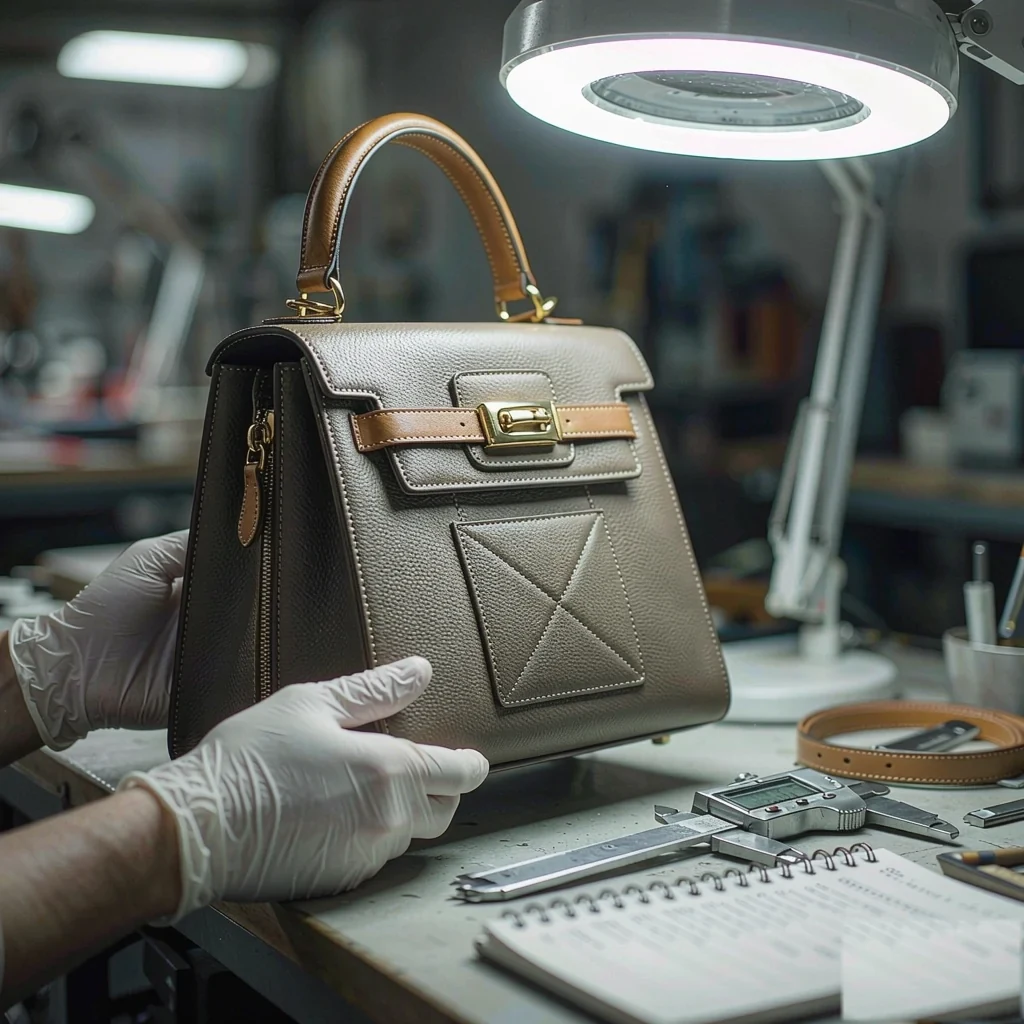
Finish durability is tested in neutral salt spray for 24 hours as standard and for 48 hours on pieces destined for humid or coastal markets, with no base-metal corrosion and no blistering at contact edges as the pass criterion. Chemistry is a parallel gate: restricted-substance declarations covering REACH Annex XVII and California Prop 65 are collected before plating begins, because a failed metal screen is far more expensive after assembly than before it.
AQL 2.5 Under ISO 2859-1: What the Sample Size Really Means
AQL 2.5 is an acceptance quality limit, not permission for 2.5% of the shipment to be faulty. Under ISO 2859-1 the lot size sets the sample size and the sample size sets the accept and reject numbers. For a 5,000-piece lot at general inspection level II the code letter is L, the sample is 200 pieces, and the lot is accepted at 10 defects and rejected at 11. A buyer who asks for AQL 2.5 without naming the inspection level and the defect classification has not actually specified anything.
| Lot size | Code letter, level II | Sample size | Accept | Reject |
|---|---|---|---|---|
| 501-1,200 pcs | J | 80 | 5 | 6 |
| 1,201-3,200 pcs | K | 125 | 7 | 8 |
| 3,201-10,000 pcs | L | 200 | 10 | 11 |
| 10,001-35,000 pcs | M | 315 | 14 | 15 |
Defects are classified as critical, major or minor before inspection begins. A critical defect — a sharp edge, a broken load-bearing stitch, a failed clasp — rejects the unit on its own, whatever the count says.
Colour, Rub and Tear: the Panel We Run Before Bulk
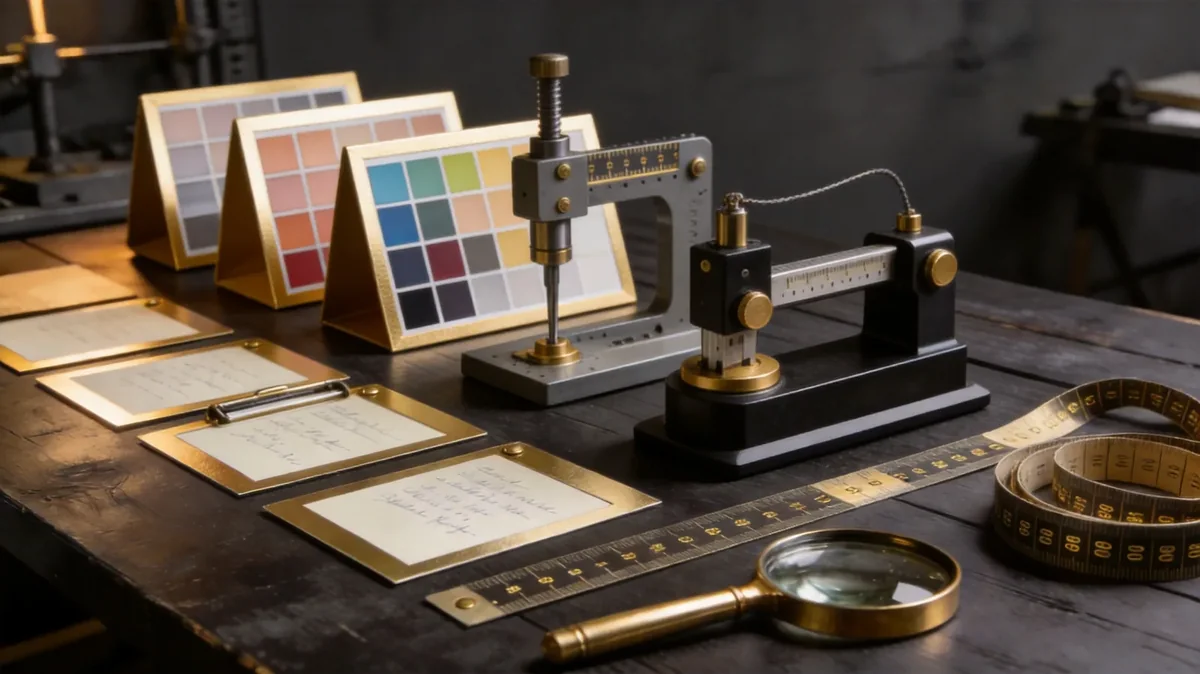
Material approval runs as a short panel of tests on the exact hide, lining and thread combination that will go into bulk, not on a generic swatch. Results are filed with the specification ledger so the next drop can be matched to them. The panel below is what a full-grain calfskin programme should clear before a cutting order is released.
- ISO 105-X12 rub fastness, dry 500 cycles and wet 250 cycles, target grade 4-5 on the grey scale.
- ISO 11644 finish adhesion, dry and wet, floor of 4 N per 10 mm strip.
- Shade matching under a D65 light booth, ΔE at or below 1.0 against the approved reference swatch.
- REACH Annex XVII restricted-substance screen and a Prop 65 declaration for goods entering California.
The Tolerance Ledger: ±1.5 mm, Shade ΔE ≤ 1.0 and Rejection Rules
Every dimension on the tech pack carries a tolerance, and the tolerance is what makes the drawing enforceable. Cut panels sit at ±1.5 mm on length and width and ±0.2 mm on skived edge thickness. Finished bag dimensions, measured on a stuffed sample, sit within ±3 mm because leather relaxes after assembly. Tolerances tighter than this are achievable but they raise cutting waste and lengthen the sampling cycle, so they should be applied only where the eye actually lands.
Tolerance defaults for a first maison capsule
- Cut panels ±1.5 mm; skived edges ±0.2 mm; finished bag ±3 mm; shade ΔE ≤ 1.0 under D65; hardware plating 0.15-0.3 µm; stitch density 8-9 SPI. Anything outside these bands is written on the ledger as a deliberate exception, with the cost and lead-time effect noted next to it, so nobody discovers the trade-off at final inspection.
Timeline Numbers: 6-10 working days of sampling, 35-50 Days Bulk
Quality has a schedule attached, and the schedule is part of the standard. A first prototype takes 6-10 working days from a confirmed tech pack and material approval. Constructions that need a made-to-order frame, a clasp or a minaudière shell take 12-15 working days because the hardware itself has to be produced. Bulk runs 35-50 days from the approved sample and deposit, quoted FOB Xiamen, with inspection at AQL 2.5 before packing.
- Day 0-2: brief, tech pack review and material confirmation.
- Day 3-10: first prototype cut and assembled on the bench.
- Day 11-18: corrections, second sample, hardware fitting.
- Approval sample signed and sealed as the reference for bulk.
- Bulk window of 35-50 days across 7 production lines, capacity about 200,000 pcs per month.
- Inspection at AQL 2.5, optional third-party inspection, then export documentation and loading.
What Quality Costs: Where the Money Goes in a Luxury Build
Standards are paid for in the bill of materials, and the bill is easier to negotiate when the buyer can see which line buys which result. The figures below are indicative bands for a mid-size structured calfskin bag at 500 pcs per colourway; they move with hide selection, hardware finish and the amount of hand work a construction needs.
Audit Checklist: Nine Questions for a First Call
- Which inspection standard do you cite, and at which general inspection level?
- What is your standard AQL for major defects, and what figure do you use for minor ones?
- How is a defect classified as critical, and who signs off on the classification?
- At what substance do you specify a structured panel, and what interlining pairs with it?
- What stitch density and thread count do you run on visible seams?
- What plating thickness do you buy, and how is it verified on incoming parts?
- Which ISO methods do you use for rub fastness, finish adhesion and tensile strength?
- What shade tolerance do you hold against an approved swatch, and under which light source?
- How long is sampling for a standard construction, and what pushes it to the longer window?
- What is the bulk window from approval sample to inspection-ready goods?
Name your inspection standard in full — AQL 2.5, ISO 2859-1, general inspection level II, major defects. An AQL figure written without those three qualifiers is the most common gap in a first specification file, and it is the one most often exploited when a lot is disputed.
Have your specification reviewed
Send the tech pack you have, even if it is incomplete. Our team will return a gap list against the numbers above, a sampling route and a costed first order through our quotation desk.
Material gate
Hide, lining and thread approved on the exact bulk combination, with ISO 3376, ISO 11644 and ISO 105-X12 results filed.
Hardware gate
Plating thickness measured at 0.15-0.3 µm, salt spray run at 24 or 48 hours, zippers cycled 500 times.
Construction gate
Stitch density 8-9 SPI, seam allowance 8-10 mm, skived edges 0.6-0.8 mm, three coats of edge paint.
Release gate
AQL 2.5 under ISO 2859-1 at level II, critical defects rejected outright, packing list matched to the sealed sample.
Frequently Asked Questions
What does AQL 2.5 mean in handbag inspection?
AQL 2.5 is the acceptance quality limit used to decide whether a finished lot can ship. Under ISO 2859-1 the lot size sets a sample size and the sample size sets the accept and reject numbers. A 5,000-piece lot at general inspection level II draws 200 pieces, is accepted at 10 major defects and rejected at 11.
How many pieces are actually checked under an AQL 2.5 plan?
The count depends on lot size and inspection level, not on a fixed percentage. At general inspection level II, 501-1,200 pieces draws 80 units, 1,201-3,200 draws 125, 3,201-10,000 draws 200 and 10,001-35,000 draws 315. Tighter control means moving to level III, which raises the sample by roughly one code letter.
What leather thickness suits a structured top-handle bag?
Structured silhouettes are specified at 1.2-1.4 mm full-grain calfskin so the panel holds its shape without heavy interlining. Soft hobo shapes drop to 1.0-1.2 mm with a 0.8 mm reinforcement. Below 1.0 mm the fold creases; above 1.5 mm the turned top edge becomes bulky and the stitch line drifts outward.
What stitch density should a luxury handbag use?
Luxury bags run at 8-9 stitches per inch, roughly a 3.1-3.5 mm stitch length, with bonded Tex 40 thread. Denser work at 10-12 SPI perforates the leather and weakens the seam, while 6-7 SPI reads casual and lets the seam grin under load. Consistency across the run matters more than the absolute number.
How thick should hardware plating be on a luxury handbag?
Plated zinc-alloy hardware for a luxury bag carries 0.15-0.3 µm of gold, palladium or ruthenium over a nickel-free undercoat, then a sealer. Under 0.15 µm the finish wears through at turn-lock contact points within a single season. Thickness is verified by X-ray fluorescence on incoming parts before assembly starts.
How long should bag hardware survive salt spray testing?
Standard finishes are tested for 24 hours in neutral salt spray; pieces bound for humid or coastal markets are held for 48 hours. The pass criterion is no base-metal corrosion and no blistering at contact edges after the cycle. Hardware that fails is returned to plating rather than fitted to a finished bag.
What is ISO 11644 and why does it matter for leather?
ISO 11644 is the test method for adhesion of a leather finish. It measures the force needed to pull the coating away from the hide, recorded in newtons per 10 mm strip. A result below 4 N on a daily-carry bag indicates a finish that will flake at the fold and along the turned edge within months of use.
What colour fastness grade should dyed leather reach?
Dyed leather for a luxury handbag should reach grade 4-5 on the grey scale for dry rubbing under ISO 105-X12 and grade 3-4 for wet rubbing. Linings that sit against light clothing are held to the same band. Anything lower risks colour transfer onto garments, one of the most expensive complaint categories to settle.
What dimensional tolerance is realistic on a handbag panel?
Cut panels are held to plus or minus 1.5 mm on length and width and plus or minus 0.2 mm on skived edge thickness. Finished bag dimensions, measured on a stuffed sample, sit within 3 mm because leather relaxes after assembly. Tighter bands are achievable but they push cutting waste up and lengthen the sampling cycle.
How long does sampling take for a made-to-specification handbag?
A first prototype takes 6-10 working days from a confirmed tech pack and material approval. Complex constructions such as a frame bag, a minaudière or a bag with a made-to-order clasp take 12-15 working days because the hardware itself has to be produced. A second correction sample adds 5-7 days.
What is the minimum order for a maison programme?
The minimum is 500 pieces per style and per colourway, quoted FOB Xiamen. A capsule of three styles in two colourways therefore starts at six production units of 500 pieces each. Lower quantities are possible for a first capsule but they carry a surcharge, because cutting, tooling and line set-up costs do not scale down with volume.
Which documents should a buyer request before bulk production?
Ask for the approved specification ledger, the material certificate set, the hardware plating report, pre-production sample photographs and the inspection protocol naming ISO 2859-1 and the defect classification. Also request the restricted-substance declaration covering REACH Annex XVII and California Prop 65 for goods entering the European Union and the United States.
What is the difference between AQL 2.5 and AQL 4.0 for bags?
AQL 2.5 allows fewer defects than AQL 4.0 at the same sample size. Under level II on a 5,000-piece lot, AQL 2.5 accepts 10 major defects in 200 units while AQL 4.0 accepts 14. Luxury programmes sit at 2.5 for major defects and commonly at 4.0 for minor ones, which keeps the line moving without lowering the visible bar.
People Also Ask
What does AQL stand for in quality control?
AQL stands for acceptance quality limit. It is the worst tolerable defect average in a sampled lot that a buyer is willing to accept. It is not a promise of zero defects; it is the threshold at which a lot switches from accept to reject under ISO 2859-1.
How do you test leather colour fastness?
Rubbing fastness is tested under ISO 105-X12 by rubbing a white cloth against the dyed surface for a set number of dry and wet cycles, then comparing staining against a grey scale from 1 to 5. Grade 4-5 dry is the practical target for a bag that meets light clothing.
Why is stitch count important in luxury bags?
Stitch count controls strength and appearance at the same time. At 8-9 stitches per inch the seam resists peeling without perforating the leather. Too few stitches let the seam open under load; too many weaken the panel along the needle line and read as machine-made.
What is ISO 2859-1 used for?
ISO 2859-1 is the international standard for sampling procedures by attributes. It supplies the code letters, sample sizes and accept-reject numbers used in pre-shipment inspection, so that an AQL figure means the same thing to the inspector, the brand and the production team.
How thick is full-grain calfskin?
Full-grain calfskin for bags is usually supplied at 1.0-1.4 mm. Structured silhouettes use the upper end of that band, soft shapes use the lower end, and the panel is often paired with a 0.8 mm interlining where the mouth of the bag needs to hold its line.
Sources and further reading
Every figure on this page is either our own programme data or attributed below. Open the originals before you write them into a specification.
- Leather Working GroupLeather Working Group Environmental audit protocol for leather tanneries, referenced when a brand specifies traceable, audited hides for a luxury programme.
- ISO — International StandardsInternational Organization for Standardization Publisher of ISO 2859-1 sampling procedures, ISO 105 colour fastness, ISO 11644 finish adhesion and ISO 3376 tensile strength.
- CITES Appendices I, II and IIICITES Appendix listings govern the permit documents required when a programme specifies exotic skins such as crocodile or python.
- Understanding REACHEuropean Chemicals Agency Annex XVII restrictions apply to substances in leather, coatings and metal hardware sold into the European Union.
- Proposition 65California OEHHA Warning and substance requirements for handbags and hardware sold into the state of California.