Designer Handbag Production vs Couture Atelier Work: A Comparison Measured in Hours, Units and Days
What is the real difference between designer handbag production and couture atelier work? It is measured in hours per unit: a couture bench spends 18-30 hours on one bag, while a programme bench spends roughly 1.5-2.5 hours across stations on each of 500. That ratio drives everything else — hand saddle stitching at 6-7 stitches per inch against machine seams at 8-9, five coats of edge paint against three, a minimum of one piece against MOQ 500 pcs per style and colourway, and a sampling window of 20-30 working days against 6-10. Below, the two routes are compared line by line, then matched to the situations each serves best.
The Numbers First: Hours, Units and Days
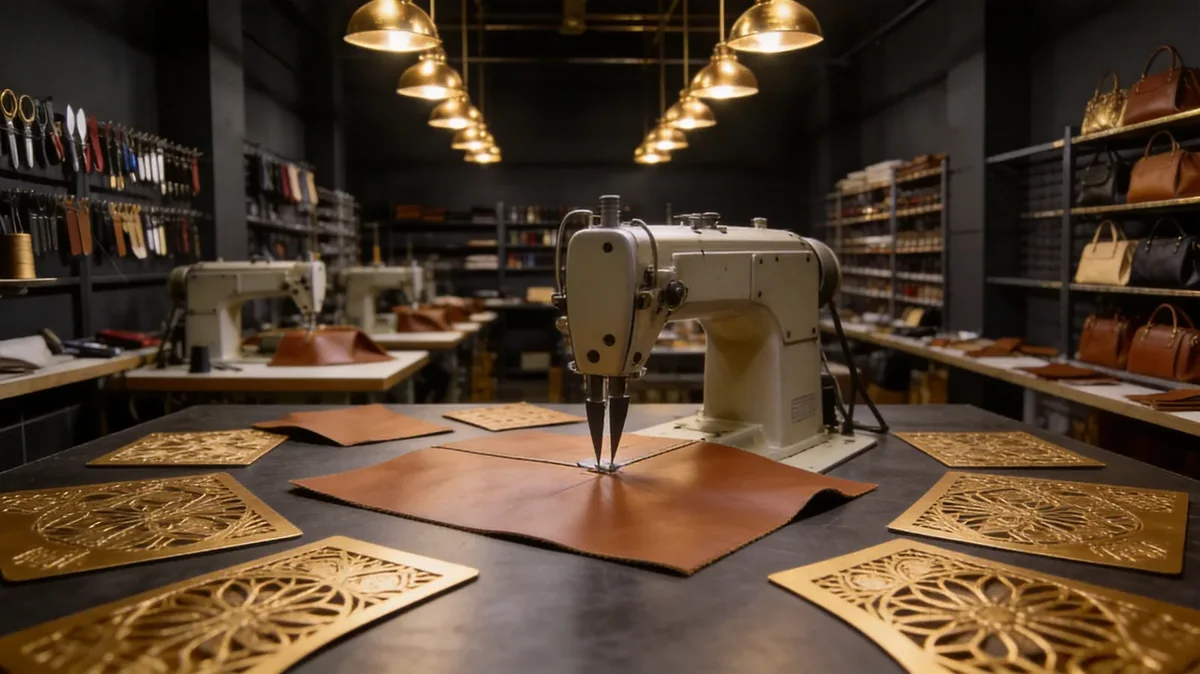
Every difference between the two routes follows from one ratio. A couture atelier allocates roughly 18-30 bench hours to a single structured bag; a designer programme allocates about 1.5-2.5 hours of station time to each unit in a 500-piece run. Multiply the second figure by the quantity and the whole comparison becomes arithmetic rather than taste.
| Measure | Couture atelier work | Designer programme work |
|---|---|---|
| Bench hours per unit | 18-30 hours, largely one artisan | 1.5-2.5 hours across specialised stations |
| Minimum quantity | One piece | MOQ 500 pcs per style and colourway |
| Sampling window | 20-30 working days | 6-10 working days, 12-15 if complex |
| Bulk or run time | Not applicable at one piece | 35-50 days from material intake |
| Stitch density | 6-7 stitches per inch, hand saddle stitch | 8-9 stitches per inch, machine lockstitch |
| Edge finish | Five thin coats, sanded between each | Three thin coats, sanded between each |
| Seam correction | Unpicked and re-stitched by the same hand | Corrected at the station and re-checked in batch |
Read the table as a statement about what is being bought. Couture buys an artisan's uninterrupted attention; a programme buys a documented, repeatable result. Neither is superior in the abstract, and confusing them is the origin of most disappointment on both sides.
Where the Bench Hours Actually Go
On a couture structured bag the hours concentrate in three operations: hand-cutting and matching, saddle stitching, and edge finishing. Those three account for roughly two thirds of the total, which is why a couture calendar is essentially a calendar of hand operations rather than of materials.
- Hand-cutting and matching
- 4-6 hours, including panel matching against the hide's natural variation
- Saddle stitching
- 7-11 hours at 6-7 stitches per inch on a structured body
- Edge finishing
- 4-6 hours across five coats with sanding between each
- Assembly, setting and hardware
- 3-5 hours, including filing and fitting a lock by hand
- Final dressing and pressing
- 1-2 hours before the piece is released
The equivalent programme splits the same operations across stations: one hand skives, another closes, a third paints edges, a fourth sets hardware. Specialisation is what compresses 18-30 hours into under three, and it is also why the programme route depends so heavily on written instructions rather than on judgement.
Hand Stitching Versus Machine Seams: The Specification Gap
A hand saddle stitch runs 6-7 stitches per inch and each stitch is locked independently, so a broken thread does not unravel a seam. A machine lockstitch runs 8-9 per inch and is faster and more uniform, but a single break can run if it is not back-tacked.
- Hand saddle stitch: 6-7 per inch, two needles crossing in one hole, independently locked.
- Machine lockstitch: 8-9 per inch, uniform tension, faster, and repairable by re-running the seam.
- Thread: linen or bonded polyester around Tex 40, roughly 0.45 mm, on both routes.
- Visible difference: hand stitch shows a slight slant; machine stitch runs perfectly parallel.
The aesthetic difference is real and so is the structural one, but the structural gap is narrower than it is often made to sound. A well-specified machine seam with correct back-tacking, correct thread and correct stitch density outlasts most of the things that actually kill a bag, which are edges, handles and hardware.
Edge Finish: Three Coats or Five
Edge finish is where the two routes come closest in method and still differ in result. Both build thin coats, sanding between passes; couture typically applies five, a programme three, and each coat needs its own drying interval.
What separates them is not the count alone but the pressing and the final burnish. A couture edge is pressed warm between coats and burnished by hand at the end, producing the glass-like line collectors recognise. A programme edge is sanded and dressed to a consistent line, which reads correctly at arm's length and survives packing better than a very hard burnish.
Neither route can replace multiple thin coats with one thick one. A thick coat shrinks as it cures and leaves a visible sink along the edge within days of packing, which is why five coats cost more in calendar than in material.
Hardware: Hand-Filed Versus Milled and Plated
Couture hardware is filed and fitted to the individual piece, which is genuinely superior where a closure must move perfectly. Programme hardware is milled to a tolerance and plated at 0.15-0.3 µm, then proved at 24 hours of salt spray, 48 for antique finishes.
Hand-filed brass
Fitted to one body, so the lock closes without play. Costs several bench hours and cannot be transferred to another unit.
Milled, plated brass
Held to a tolerance and repeatable across 500 units. Arrives in roughly 20-25 working days, or 30-40 for a bespoke development.
Die-cast alloy
Suits decorative plates and logo bars on either route. Not appropriate for a closure taking daily torque.
The repeatability point decides most cases. A closure fitted to one body is a beautiful thing and a liability in a run, because the tolerance that made it perfect belongs to that unit alone.
Materials: One Hide Versus a Reserved Lot
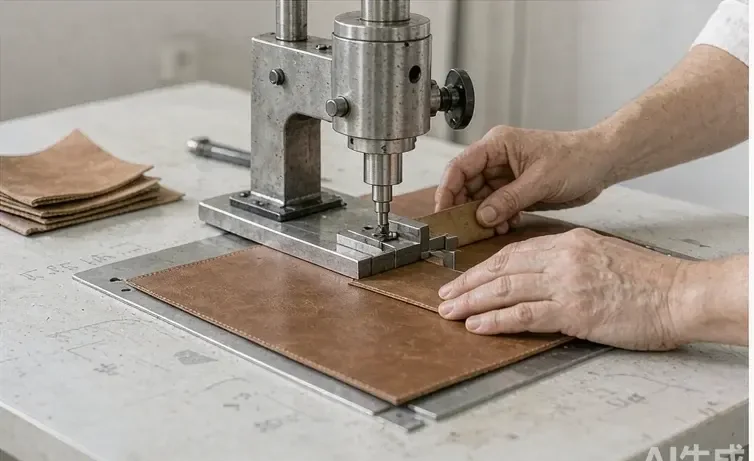
Couture selects a hide and cuts one bag from it, choosing the best area by eye. A programme reserves a lot, tests it and cuts 500 units from it, accepting the statistical variation the lot contains.
- Couture: selection by eye, yield essentially irrelevant at one piece, matching done on the hide itself.
- Programme: reservation by lot, yield typically 70-80% for calfskin, matching planned across panels before cutting.
- Testing: couture rarely tests one hide; a programme tests the lot against ISO 3376, ISO 11644 and ISO 105 before cutting.
- Compliance: per-lot REACH Annex XVII and California Prop 65 declarations are a programme requirement, not an option.
This is the one dimension where the programme is stricter rather than looser. A couture piece escapes the reporting burden by virtue of being singular; 500 units entering the European Union or California do not, which is why lot discipline sits at the centre of the programme route.
What Each Route Costs Per Unit, and Why
Per unit, couture work typically lands at six to ten times a programme unit on a comparable structured body, and the multiple is almost entirely bench hours. Material content is broadly similar on both routes; what changes is how many hours of skilled attention each unit absorbs.
- Labour dominates: 18-30 hours against 1.5-2.5, at a comparable hourly skill rate.
- Material is close to parity: the same calfskin, interlining, thread and hardware class.
- Development amortises: sampling at 6-10 working days spreads across 500 units rather than one.
- Compliance and testing add a fixed cost to the programme route that couture rarely incurs.
- Re-work scales differently: one couture error costs one bag; one programme error can cost a batch.
The last line is the one buyers forget. Couture risk is bounded by the piece; programme risk is bounded by the plan, which is exactly why the AQL 2.5 plan under ISO 2859-1 is agreed before bulk begins rather than discussed when the cartons are packed.
Quality Control on One Unit Versus Five Hundred
On a couture piece, control is continuous: the same hand that made the bag inspects it, and a fault is unpicked rather than recorded. On a programme, control is statistical and written down, drawn at AQL 2.5 under ISO 2859-1.
| Check | Couture route | Programme route |
|---|---|---|
| Method | Continuous inspection by the maker | Sampling plan drawn at AQL 2.5, ISO 2859-1 |
| Sample size at 500 pcs | Not applicable | 50 units drawn, accept 3, reject 4 |
| Correction | Unpicked and re-made by hand | Corrected batch, then re-checked before packing |
| Record | The piece itself | Measurement sheets, defect log and re-check record |
| Third party | Rarely | Available alongside the internal audit |
Neither method is weaker in principle. The difference is that a programme has to prove control to someone who was not in the room, which is what the record is for.
When Couture Is Genuinely the Right Answer
Couture wins on four specific briefs, and loses on most others. Choosing it deliberately, for one of these reasons, produces a better outcome than choosing it as a default signal of quality.
- A one-off piece for an archive, a client gift or a runway moment.
- A silhouette that cannot be written into a technical pack because the shape is resolved on the bench.
- A listed skin where hand matching across panels is the entire point of the piece.
- A prototype intended to prove a construction before a programme version is specified.
The fourth use is underrated. Commissioning one couture piece to resolve a difficult construction, then specifying the programme version from it, often produces a better and cheaper result than trying to develop both at once.
How a Hybrid Capsule Works in Practice
Most houses end up running both. The workable structure is a couture or bench-made hero piece that sets the construction, a programme core of 500 pcs per style and colourway, and a shared material lot so the two read as one family.
- Hero piece
- One to three units on the bench, 18-30 hours each, used to resolve the construction
- Programme core
- MOQ 500 pcs per style and colourway, sampling 6-10 working days, bulk 35-50 days
- Shared lot
- One reserved calfskin lot so the hero and the core match in shade and hand
- Shared hardware
- One milled lock proved at 24 hours salt spray, used on both
- Handover
- FOB Xiamen, with CIF and DDP available on request
Swatch card sets are billed at USD 4.80 and credited against the first bulk order, which is the least costly way to confirm that the hero and the core will read as one family under retail lighting before either is committed.
Our programme runs across 7 production lines with about 200,000 pcs per month of capacity and has held export experience since 2014, carried out through our validated partner factory Quanzhou Yingming Bags, an SGS-validated site. Bench detail sits under craftsmanship and the wider route on the designer handbag production page.
Compare both routes against your brief
Send your drawings, quantity and launch date. You will receive both routes costed and calendared side by side, with the hybrid option where it applies. Request a quote.
Frequently Asked Questions
What is the difference between couture atelier work and designer production?
Hours per unit. A couture bench spends 18-30 hours on one bag, mostly hand cutting, saddle stitching and edge finishing, while a programme bench spends 1.5-2.5 hours per unit across specialised stations. That ratio drives the minimum quantity, the calendar, the finish specification and the unit cost.
How many hours does a couture handbag take?
Roughly 18-30 hours for a structured body. Cutting and matching take 4-6 hours, saddle stitching 7-11, edge finishing 4-6, assembly and hardware 3-5, and final pressing one to two. The range widens with listed skins and bespoke closures.
Is hand stitching stronger than machine stitching?
A hand saddle stitch at 6-7 per inch locks each stitch independently, so a break does not unravel the seam. A machine seam at 8-9 per inch is more uniform but can run if not back-tacked. In practice edges, handles and hardware fail before either seam does.
Why does couture cost six to ten times more?
Almost entirely bench hours. Material content is broadly comparable between the routes, but 18-30 hours of skilled attention against 1.5-2.5 produces a similar multiple. Development amortisation works the other way: programme sampling spreads across 500 units rather than one.
Can a couture piece be scaled into a run?
Yes, and it is often the best route. Commission one piece to resolve the construction, then write the programme specification from it. Development on the bench settles questions a drawing cannot, and the resulting technical pack is more reliable than one written from scratch.
What is the minimum order on each route?
Couture has no minimum; a single piece is a legitimate order. A programme runs MOQ 500 pcs per style and colourway, because a named tannery lot and a reserved line are committed per combination rather than per style alone.
How long does sampling take on each route?
Couture sampling runs 20-30 working days, since the piece itself is the sample and every operation is done by hand. A programme build takes 6-10 working days including one corrected round, rising to 12-15 where a bespoke closure or a framed body must be proved.
How is quality controlled differently?
Couture control is continuous, because the maker inspects while making and unpicks rather than records. Programme control is statistical and written: AQL 2.5 under ISO 2859-1, with 50 units drawn on a 500-piece lot, accept 3 and reject 4, plus third-party inspection if required.
Do both routes use the same leather?
Broadly yes. Full-grain calfskin at 1.2-1.4 mm suits structured bodies on either route. The difference is selection: couture picks by eye from one hide, while a programme reserves a lot, tests it against ISO 3376, ISO 11644 and ISO 105, and plans yield around 70-80%.
Which hardware approach is better?
Hand-filed brass fitted to one body closes with no play and is ideal for a single piece. Milled brass held to a tolerance and plated at 0.15-0.3 µm repeats across 500 units. Fitting a lock to one body is a liability in a run, because the tolerance belongs to that unit alone.
When should I choose couture over a programme run?
For a one-off archive or runway piece, a silhouette that can only be resolved on the bench, a listed skin where hand matching is the point, or a prototype to prove a construction. Outside those four briefs a programme usually gives a better result per hour spent.
How does edge finishing differ between the routes?
Both build thin coats with sanding between passes; couture applies five and a programme three. Couture edges are pressed warm and burnished by hand, producing a glass-like line. Programme edges are dressed to a consistent line that reads correctly at arm's length and survives packing better.
Can I run both routes in one capsule?
Yes. A common structure is one bench-made hero piece, a programme core at MOQ 500 pcs per style and colourway, and a shared reserved lot so both read as one family. Swatch card sets at USD 4.80 confirm the match before either is committed.
What trade terms apply to a programme run?
FOB Xiamen is the default, with CIF and DDP available on request. The term decides who carries freight risk and who manages customs documentation, so it should be fixed at quotation rather than at handover, because changing it later re-prices the whole shipment.
People Also Ask
How long does it take to make a luxury handbag by hand?
About 18-30 bench hours for a structured couture body: 4-6 cutting and matching, 7-11 saddle stitching, 4-6 edge finishing, 3-5 assembly, and one to two for final pressing.
Is a handmade bag better than a machine-made one?
Not universally. Hand saddle stitching and hand-filed hardware are superior on a single piece, but a documented programme with correct stitch density, edge coats and tolerances repeats across 500 units, which a hand-made piece cannot.
What does couture leather work cost compared to a run?
Typically six to ten times a programme unit on a comparable structured body. The multiple is bench hours rather than material, since the same calfskin, interlining, thread and hardware class appear on both routes.
Can a couture sample be turned into a 500-piece run?
Yes, and it is often the better sequence. One bench-made piece resolves the construction, then the programme specification is written from it and sampled in 6-10 working days before bulk at 35-50 days.
Which stitch count do luxury bags use?
Hand saddle stitch runs 6-7 per inch with each stitch locked independently. Machine seams on a programme run 8-9 per inch using bonded polyester thread around Tex 40, roughly 0.45 mm in diameter.
Sources and further reading
Every figure on this page is either our own programme data or attributed below. Open the originals before you write them into a specification.
- ISO — International Organization for StandardizationISO Publisher of ISO 2859-1 sampling plans and the ISO 3376, ISO 11644 and ISO 105 test methods referenced in the comparison.
- Leather Working GroupLeather Working Group Tannery audit protocol behind the lot qualification used on the programme route and referenced in the materials comparison.
- CITES — Convention on International Trade in Endangered SpeciesCITES Appendix listings determine which permit documents accompany listed skins, a common reason a piece is routed to a couture bench.
- Business of FashionBusiness of Fashion Reporting on how maisons structure capsules that combine bench-made hero pieces with larger programme runs.
- WWDWWD Coverage of luxury leather goods, artisan bench capacity and the economics of hand-work in high-end accessories.