Designer Handbag Production vs Fast Fashion Bag Runs: Twelve Dimensions Compared Honestly
Designer handbag production and fast fashion bag runs are not the same activity performed at different speeds; they are two different activities. The designer route assumes the object will be kept, repaired and re-ordered, so it optimises for tolerance and material, at MOQ 500 per colourway and USD 31-46 per unit. The fast route assumes the object will be replaced, so it optimises for throughput, at 3,000-10,000 pieces per style and USD 9-16 per unit. This comparison sets twelve dimensions side by side, including where a fast run is genuinely the better answer.
Two Models Built on Opposite Assumptions
Every difference that follows comes from one assumption made at the start. The designer route assumes a bag will be kept for years, repaired once, and re-ordered in a second season, so it spends money on tolerance, material and hand operations. The fast route assumes the object will be replaced at the end of a trend cycle, so it spends money on throughput and turnaround instead.
Neither assumption is wrong, and this is worth saying plainly because the category is usually discussed as if one were simply better. A brand testing a silhouette it may never repeat has no reason to pay for a specification built to survive a decade. A brand building a permanent collection has no reason to accept one that will not.
- Designer production buys tolerance, material consistency and repairability.
- Fast runs buy speed, volume flexibility and a lower commit per silhouette tested.
- Designer specifications are written to be repeated; fast specifications are written to be filled.
- The two routes fail differently, and the failure mode matters more than the price gap.
The Comparison Matrix: Twelve Dimensions
Twelve dimensions, set side by side. Read the fourth column last, because the reason a dimension differs is usually more useful than the difference itself.
| Dimension | Designer production | Fast run | Why it differs |
|---|---|---|---|
| Order quantity | 500 pcs per style and colourway | 3,000-10,000 pcs per style | Volume replaces specification as the cost lever |
| Sampling window | 6-10 working days, 12-15 complex | 3-5 working days | Fast routes compress or skip the toile stage |
| Sample rounds included | Two, with corrections recorded | One, often approved from photographs | Correction rounds are the first thing compressed |
| Bulk lead time | 35-50 days | 20-25 days | Fewer hand-finished operations and shorter setting time |
| Body leather | 1.2-1.4 mm full-grain calfskin | 0.9-1.1 mm corrected grain or bonded | Full grain is graded for surface, corrected is coated |
| Cutting yield | 63-71% of graded usable area | 78-85% | Uniform coated material nests more efficiently |
| Stitch density | 8-9 per inch | 5-6 per inch | Fewer stitches per inch shortens assembly directly |
| Edge build | Three coats at 13-16 µm, sanded between | One or two coats, machine creased | Coat count is the clearest visible difference |
| Interlining | 260 gsm at 0.85 mm | 180 gsm at 0.5 mm | Weight decides whether a flap holds its line |
| Hardware | Brass, 0.2-0.3 µm plating, 48 h salt spray | Zinc alloy, 0.05-0.1 µm, 6-12 h | Plating thickness governs how long a finish lasts |
| Inspection level | AQL 2.5 under ISO 2859-1 | AQL 4.0 or visual sampling | The acceptable quality limit is itself a product decision |
| Unit cost | USD 31-46 per unit | USD 9-16 per unit | Roughly three times the material and three times the minutes |
Notice where the gaps are largest. The two routes differ least in sampling and most in edge build, interlining and hardware, which are exactly the three things a customer notices in the second year of ownership rather than the first week.
Where the Material Differs Most
Material is the largest single line on a designer quote and the most compressed on a fast one. Full-grain calfskin is graded for its natural surface, which means it varies hide to hide and must be sorted; corrected grain is coated to remove that variation, which makes it uniform and makes it nest more efficiently.
- Body leather, designer route
- 1.2-1.4 mm full-grain calfskin, tolerance plus or minus 0.1 mm
- Body leather, fast route
- 0.9-1.1 mm corrected grain or bonded, tolerance plus or minus 0.2 mm
- Graded usable area per hide
- 47-53 sq ft, recorded against the lot reference
- Cutting yield, designer route
- 63-71% with grain direction held constant
- Cutting yield, fast route
- 78-85%, assisted by uniform coated surface
- Colour fastness to rubbing
- ISO 105-X12, target grade 4 dry and grade 3-4 wet
The consequence is not that one material is good and the other is not. It is that full-grain develops a patina and corrected grain does not, so a designer bag is expected to look better after two years while a fast one is expected to look acceptable until it is replaced.
Where the Construction Differs Most
Construction differences are arithmetic more than philosophy. Stitch density of 8-9 per inch rather than 5-6 lengthens assembly proportionally and produces a seam that resists opening at the base corners, which is where structured bodies fail first. Drop the density and the operation gets faster, not worse in any way a photograph will show.
Four construction choices that separate the routes
- Stitch density: 8-9 per inch on the designer route against 5-6 on a fast run.
- Edge build: three coats at 13-16 µm sanded between passes, against one or two machine-creased coats.
- Interlining: 260 gsm at 0.85 mm against 180 gsm at 0.5 mm, which decides whether a flap holds its line.
- Thread: 0.45 mm bonded nylon for high-density seams, against finer thread suited to lower density.
Skiving belongs on the same list. A turned edge reduced evenly over 9-11 mm folds into a fine flat line; the same edge reduced quickly or over too short a distance produces a ridge. It is the operation most invisible in a photograph and most obvious in the hand.
Where the Hardware Differs Most
Hardware is where the two routes separate most sharply, because the difference is measurable in microns and in hours. It is also where a fast run ages least gracefully, since plating is the first thing to show wear at contact points.
Alloy
Designer route: brass, which takes plating well and develops an even patina. Fast route: zinc alloy, which is lighter and less expensive per gram but plates less evenly.
Plating thickness
Designer route: 0.2-0.3 µm over a palladium underlayer, verified by X-ray fluorescence. Fast route: 0.05-0.1 µm, often without an underlayer.
Corrosion testing
Designer route: 48 hours of neutral salt spray to ISO 9227, with the result filed against the component lot. Fast route: 6-12 hours, or none recorded.
Mechanism proving
Designer route: 500 zip cycles under light load before bulk release. Fast route: a functional check on the sample, with no cycling record.
Pull-off force for feet and rivets deserves a line on any specification, whichever route is chosen. A loosened foot is among the most frequent structural returns on a structured body, and it costs far more in goodwill than the test costs in money.
What the Calendar Looks Like on Each Route
The fast route is genuinely faster, and the difference is real rather than rhetorical: roughly half the sampling window and roughly half the bulk window. What the shorter calendar removes is iteration, not efficiency.
Where a brand needs six weeks rather than twelve, the honest options are to reduce iteration or to reduce specification. Reducing the calendar without doing either is how a programme ends up approving a sample nobody has held.
What the Unit Costs Actually Reflect
A unit cost of USD 31-46 against USD 9-16 is close to a factor of three, and it is worth knowing precisely what the extra buys. Roughly, it is about three times the material by area and grade, plus about three times the minutes at the bench, plus the tooling and testing that a fast run typically omits entirely.
Presentation packing belongs in the comparison too. Care cards, a dust bag and tissue add about USD 4.80 per unit on the designer route and are usually omitted on a fast run, where a polybag and a printed label are the norm. That difference is visible the moment a customer opens the parcel.
Set the comparison against landed cost rather than unit cost. On FOB Xiamen the figures above cover goods to port only; freight, insurance and duty sit with you on both routes, and they move the multiple you thought you had.
When a Fast Run Is Genuinely the Better Answer
There are situations where a fast run is the correct commercial decision, and pretending otherwise makes the whole comparison less useful. Four of them come up repeatedly in practice.
- Testing a silhouette you may never repeat, where the object is research rather than inventory.
- A one-season colour or novelty shape whose value expires with the trend that produced it.
- Very high volume in a single style, where tooling amortisation makes specification upgrades worth deferring.
- A cash position that cannot carry both a first run and a reorder, where testing demand matters more than durability.
The honest test is whether the object is expected to survive its own trend. If it is not, paying for a decade of durability is spending money on a property nobody will use.
When Designer Production Is the Better Answer
The designer route earns its cost in four situations, each of which has to do with what happens after the first sale.
- A permanent collection that will be re-ordered, where lot records make the second season match the first.
- A price point above roughly USD 300 retail, where customers inspect edges and hardware closely.
- A brand whose positioning depends on repairability, which requires a specification and an archive.
- Any programme where a return costs more than the difference in unit cost, which is most of them.
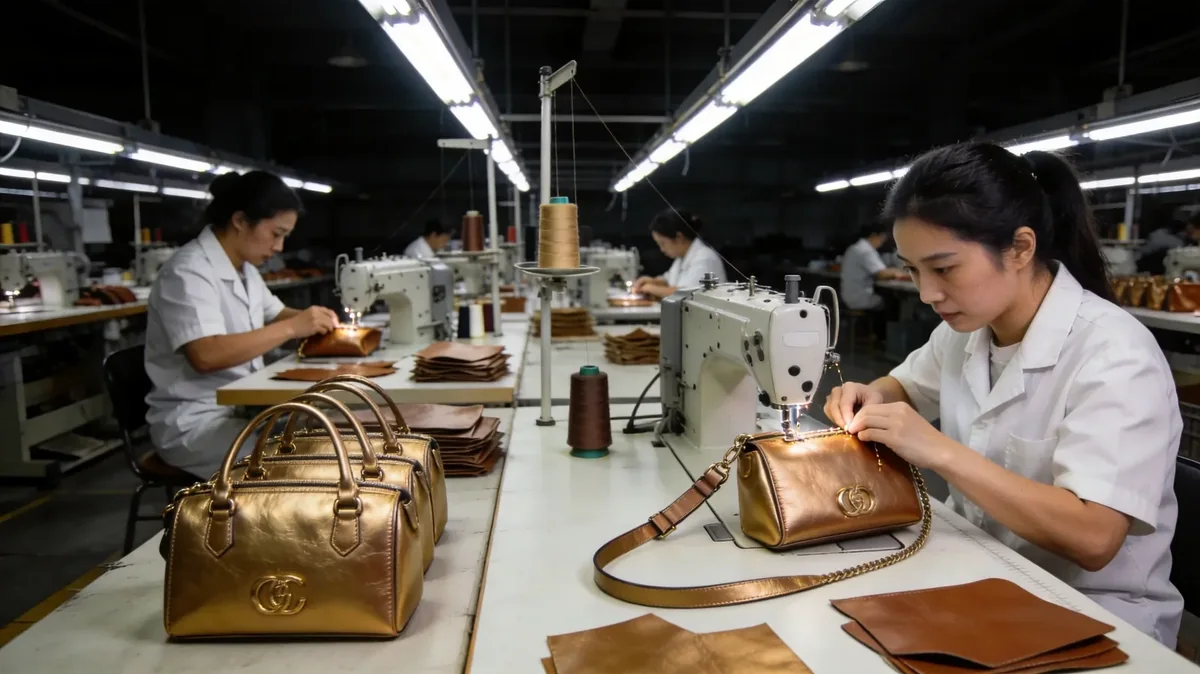
This programme runs across 7 production lines with about 200,000 pcs per month of capacity and has held export experience since 2014, executed through our validated partner factory Quanzhou Yingming Bags, an SGS-validated site. Inspection is set at AQL 2.5 under ISO 2859-1, with third-party audit available in addition.
How to Decide in Four Questions
Four questions settle most cases, and they are deliberately asked in the order a founder can actually answer them rather than in the order of the matrix above.
- Will this silhouette be re-ordered? If yes, you need lot records and a specification, which means the designer route.
- Is the retail price above about USD 300? If yes, customers will inspect edge and hardware, where the gaps are widest.
- Does the object need to survive its own trend? If no, a fast run is honest and appropriate.
- Can cash carry both a first run and a reorder? If not, test demand first and upgrade specification later.
Some capsules legitimately mix routes: a permanent hero built to a designer specification, alongside a seasonal shape produced on a faster cycle. The important thing is to specify each deliberately rather than letting one inherit the other by default.
Whatever the decision, write the specification down. A fast run with a written specification can be upgraded later; a fast run with no record has to be reverse-engineered, which costs more than the specification would have.
Compare both routes for your capsule
Send your pack, quantity per colourway and destination markets. You will receive both routes costed side by side, with the specification differences named, within two working days. Request a quote.
Frequently Asked Questions
What is the real difference between designer handbag production and a fast fashion bag run?
The assumption each is built on. Designer production assumes the bag will be kept, repaired and re-ordered, so it spends on tolerance and material. A fast run assumes the object will be replaced at the end of a trend, so it spends on throughput. The specifications follow from that single decision.
How much more does designer production cost?
Roughly three times: unit cost runs USD 31-46 on the designer route against USD 9-16 on a fast run. The gap is about three times the material by area and grade, plus about three times the minutes at the bench, plus the tooling and testing a fast run usually omits.
Why does MOQ differ so much between the two routes?
Because volume is the cost lever on a fast run, while specification is the lever on the designer route. A fast programme needs 3,000-10,000 pieces per style to make thin material and short operations worthwhile; the designer route commits 500 pcs per style and colourway and earns its economics through repeatability.
Is a fast run always lower quality?
No, and the word quality is unhelpful here. A fast run meets a different specification: thinner corrected-grain material, 5-6 stitches per inch, one or two edge coats and lighter interlining. It is fit for a shorter intended life rather than defective against a longer one.
Which differences are most visible to a customer?
Edge build, interlining stiffness and hardware finish. Three sanded coats at 13-16 µm against one machine-creased coat shows within a season; 260 gsm interlining against 180 gsm decides whether a flap holds its line; and 0.2-0.3 µm plating against 0.05-0.1 µm decides how long a closure looks new.
How much faster is the fast route really?
About half on both windows. Sampling runs 3-5 working days against 6-10, and production 35-50 days against 35-50. What the shorter calendar removes is iteration rather than inefficiency: one sample round instead of two, and often a photographic approval instead of a physical one.
When is a fast run genuinely the better choice?
When the object is not expected to survive its own trend. Testing a silhouette you may never repeat, a one-season novelty shape, very high volume in a single style, or a cash position that cannot carry both a first run and a reorder are all sound reasons.
When does designer production justify its cost?
When something happens after the first sale. A permanent collection that will be re-ordered, a retail price above roughly USD 300 where customers inspect edges closely, a positioning built on repairability, or any programme where a return costs more than the unit cost difference. The common thread is that the value is realised after the first sale rather than at it.
How does inspection differ between the routes?
The designer route runs at AQL 2.5 under ISO 2859-1, while fast runs commonly use AQL 4.0 or visual sampling. The acceptable quality limit is itself a product decision, so it belongs in the specification rather than in the quotation, and it should be stated in writing.
Does presentation packing differ much?
Yes. Care cards, a dust bag and tissue add about USD 4.80 per unit on the designer route and are usually omitted on a fast run, where a polybag and printed label are the norm. That difference is visible the moment a customer opens the parcel, which is precisely when first impressions form.
Can a capsule mix both routes?
Yes, and some do it deliberately: a permanent hero built to a designer specification alongside a seasonal shape on a faster cycle. The rule is to specify each route on purpose rather than letting the seasonal piece inherit the hero specification, or the reverse, by default.
What should I write down whichever route I choose?
The specification. Material grade and thickness, interlining weight, stitch density, edge build, hardware alloy and plating thickness, and inspection level. A fast run with a written specification can be upgraded later; one without has to be reverse-engineered, which costs more than the specification would have.
People Also Ask
What is the difference between designer and fast fashion bag production?
Assumption first, specification second. Designer production optimises for tolerance, material and repeatability at 500 pcs per colourway, while fast runs optimise for throughput at 3,000-10,000 pieces per style. The specifications follow from that single decision rather than from any difference in skill.
Why do designer bags cost about three times more to produce?
Roughly three times the material by area and grade, plus about three times the minutes at the bench, plus tooling and compliance testing that a fast run usually omits entirely.
Is a fast fashion bag run lower quality?
It meets a different specification rather than a worse one: thinner corrected-grain material, 5-6 stitches per inch, fewer edge coats and lighter interlining, all suited to a shorter intended life. The useful question is not which is better but which assumption fits the object.
How long does each route take?
Designer sampling runs 6-10 working days with 35-50 days of bulk. A fast run runs 6-10 working days of sampling and 20-25 days of bulk, mainly by compressing iteration rather than by working faster.
Which route should a new brand choose?
Ask whether the silhouette will be re-ordered, whether retail exceeds about USD 300, and whether the bag must survive its own trend. Re-ordered, higher-priced and durable pieces justify designer production; the rest may not.
Sources and further reading
Every figure on this page is either our own programme data or attributed below. Open the originals before you write them into a specification.
- ISO — International Organization for StandardizationISO Publisher of ISO 2859-1 for AQL sampling inspection, ISO 9227 for neutral salt spray testing and the ISO 105 series for colour fastness.
- Leather Working GroupLeather Working Group Tannery environmental audit protocol referenced when full-grain calfskin is specified from audited tanneries supplying named lots.
- Sourcing JournalSourcing Journal Trade reporting on material cost movements, lead time compression and the volume economics that separate the two routes.
- Business of FashionBusiness of Fashion Reporting on trend cycle compression and the commercial pressure behind shorter development calendars across the sector.
- European Chemicals AgencyECHA Authority for REACH obligations, including the Annex XVII restrictions screened for European Union destinations on both routes.