Designer Handbag Production for Emerging Brands: The Five Numbers Behind a First Capsule
Designer handbag production for an emerging brand comes down to five figures, and only one of them is the unit price: committed piece count, the calendar from sketch to shelf, development spend before bulk, unit cost against your retail multiple, and the shape of cash across the season. A first capsule of three silhouettes in one colourway commits 1,500 pieces, takes 12-18 weeks from a signed pack to cartons on a shelf, and lands between USD 31 and USD 46 per unit. This guide takes each figure in the order it actually constrains you.
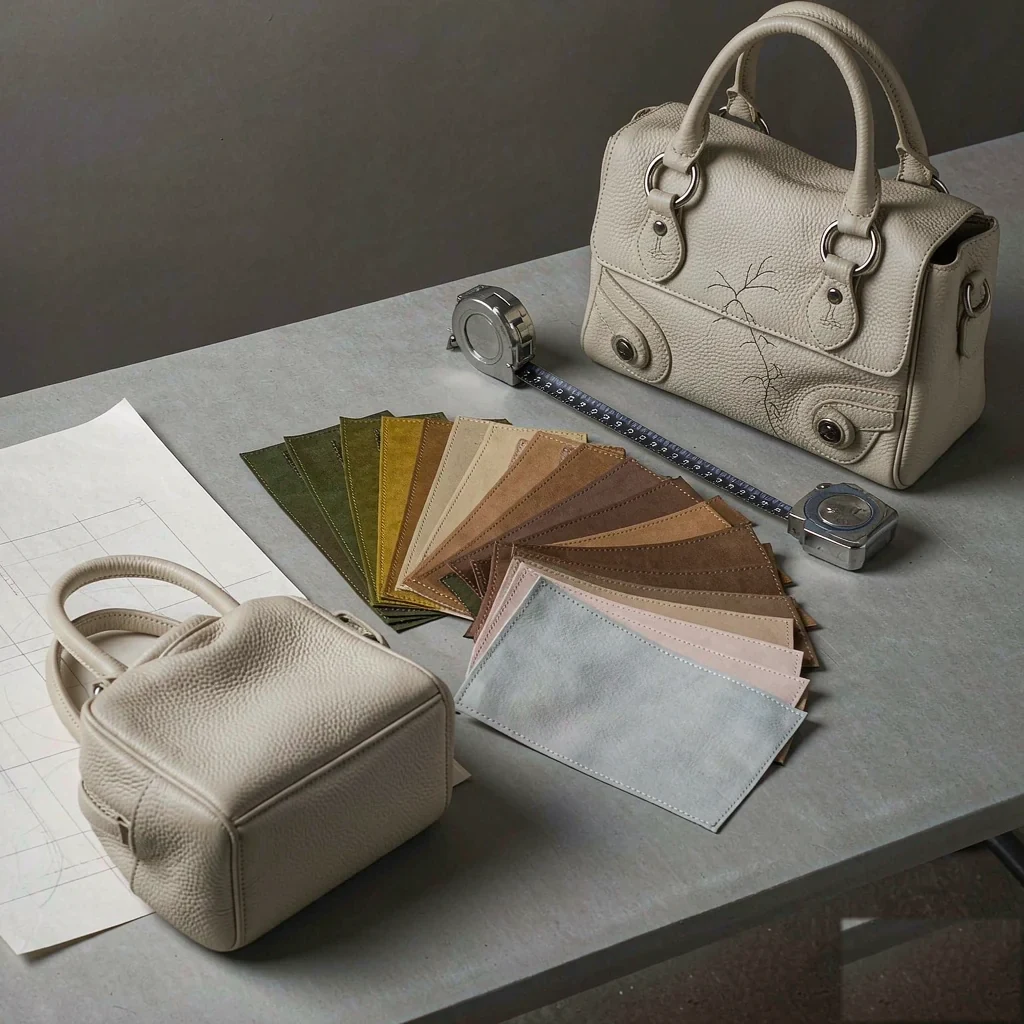
The Five Numbers That Decide a First Capsule
Five figures decide whether a first capsule works, and only one of them is the unit price. They are committed piece count, the calendar from pack to shelf, development spend before bulk, unit cost against your retail multiple, and the shape of cash across the season. Put them in that order and most remaining decisions become straightforward; take them in the wrong order and the unit price becomes the only thing you negotiate, which is where first seasons quietly go wrong.
The reason for the sequence is that each figure constrains the next. Piece count determines whether tooling is worth developing. The calendar determines whether you can afford a correction round. Development spend determines how much capital is committed before you have anything to sell. Unit cost determines your retail multiple. Cash timing determines whether you can reorder at all.
Number One: How Many Pieces You Are Actually Committing To
MOQ is quoted per style and per colourway, which founders read once and then misapply for a season. Three silhouettes in one colourway is 1,500 pieces, not 500. The same three across two colourways is 3,000. The decision that protects a first season is to launch one colourway and earn the second with sell-through rather than with optimism.
| Capsule shape | Committed units | What it buys you | What it risks |
|---|---|---|---|
| One silhouette, one colourway | 500 pcs | The lowest entry and the fastest read on demand | Little shelf presence; tooling amortises poorly |
| Two silhouettes, one colourway | 1,000 pcs | A hero plus a companion; shared hardware family | Two patterns to develop at once |
| Three silhouettes, one colourway | 1,500 pcs | A credible capsule that reads as a collection | The common first-capsule commitment |
| Three silhouettes, two colourways | 3,000 pcs | Depth for buyer and stockist conversations | Double the capital for unproven demand |
| Four silhouettes, two colourways | 4,000 pcs | A full seasonal statement | Usually a second-season decision |
The trap in the fourth row is not the quantity but the timing. Adding a colourway doubles committed units while leaving your demand evidence unchanged, so it doubles the size of a bet you have not yet won.
Number Two: The Calendar From Sketch to Shelf
Twelve to eighteen weeks is the honest range from a signed technical pack to cartons on a shelf, and almost all of the spread is decision time rather than production time. Production is the predictable part: 6-10 working days for a first sample, 12-15 for complex constructions, 35-50 days for bulk. What varies by weeks is how long you take to approve, and whether the hide lot was reserved early.
Two of these stages are invisible on most calendars and cause most of the delay. Hide lot reservation belongs in parallel with sampling rather than after approval, because waiting for a named lot after the specification freeze can add two weeks on its own. Compliance testing runs on the laboratory's timetable, which is nobody's production calendar at all.
Number Three: What Development Costs Before Bulk
Development is the figure that surprises founders most, because it is committed before anything exists to sell. It has three parts: the sampling fee per style, tooling for anything carrying your identity, and any correction rounds beyond the two included. Ask which of the three is credited against the bulk order, because the same total means very different things.
- Sampling fee, standard construction
- 2.5-3.5 times unit price per style, covering two rounds in 6-10 working days
- Sampling fee, complex construction
- 3.5-5 times unit price, 12-15 working days, mechanism proving included
- Cutting die, per size
- Indicative USD 180-320, held against the programme
- Embossing or debossing plate
- Indicative USD 240-420, stored between seasons by agreement
- Additional correction round
- Charged per round at 4-6 working days each
- Compliance testing
- Priced per material lot and per destination market
Tooling is the part worth thinking about across seasons rather than across one order. A debossing plate at USD 240-420 is expensive spread across 500 pieces and close to free spread across three years, which is why ownership and storage terms belong in the development agreement rather than in an email.
Ask who holds the dies and plates, how long they are stored after the season ends, and what happens if the programme moves. These questions are answered in a sentence before machining and in weeks afterwards.
Number Four: Unit Cost and the Multiple It Leaves
A first capsule from an emerging brand usually lands between USD 31 and USD 46 per unit at 500-1,500 pieces, on FOB Xiamen terms, for a structured body in full-grain calfskin with a brass closure. Presentation elements sit on top: a dust bag, rigid box and printed care card typically add about USD 4.80 per unit, and they lead their own schedule outside the 35-50 day bulk window.
The entry capsule
One structured silhouette in corrected-grain calfskin with stock hardware and a folding carton. Indicative USD 31-37 per unit at 500 pieces. Lowest capital, thinnest amortisation of tooling.
The credible capsule
Three silhouettes sharing one hardware family, full-grain calfskin from an LWG-audited tannery, three sanded edge coats, rigid box. Indicative USD 35-42 per unit at 1,500 pieces.
The statement capsule
Three silhouettes with a bespoke debossed plate, a proven custom closure, hand-burnished edges and presentation packing. Indicative USD 40-46 plus tooling, at 1,500 pieces.
Set your retail multiple against the landed figure rather than the unit figure. Freight, insurance and duty sit outside FOB Xiamen, and a capsule priced at USD 38 can arrive nearer USD 46 once those are counted, which changes the multiple you thought you had.
Number Five: The Shape of Cash Across the Season
Cash timing, not cash total, is what ends first seasons. The pattern is consistent: development is paid up front, material is committed at the specification freeze, a deposit is due at order placement, and the balance falls before shipment. That means the largest outflow arrives weeks before any revenue.
- Development and sampling fall at the very start, before there is anything to photograph.
- Hides and hardware are committed at the specification freeze, which is when the lot is named.
- A deposit is commonly due at placement, with the balance before shipment leaves the port.
- Presentation packing is ordered separately and usually invoiced on its own cycle.
- Freight and duty arrive after production and are frequently the least planned outflow.
- Reorder capital should be reserved at the outset, because a sold-out first capsule without a reorder plan is a missed season.
The practical fix is to model the season as four dated outflows against one dated inflow, then check whether the gap is survivable twice. A capsule that works once but cannot be funded a second time is a sample programme with extra steps.
The Order of Operations for a First Season
Eight steps, in the order that keeps each decision inexpensive to reverse. Every step here is costlier to undo than the one before it, which is why the sequence matters more than the speed.
- Fix the silhouette count and confirm it against MOQ per style and per colourway.
- Finalise the technical pack with dimensions, tolerances and the hardware direction named.
- Reserve the hide lot while the first sample is being built, not after approval.
- Approve the first sample in person or by courier, recording changes in writing.
- Freeze the specification when the approval sample is signed and the lot is named.
- Book compliance testing against that lot for every destination market.
- Release bulk, then inspect at AQL 2.5 under ISO 2859-1 before shipment.
- Confirm carton count, dimensions and gross weight, then book freight.
Where Emerging Programmes Most Often Go Wrong
The same six mistakes appear across first seasons, and none of them is about taste. Each one is a decision taken one step too late, which is the only thing all six have in common.
Six decisions taken too late
- Adding a second colourway before the first has any sell-through data behind it.
- Reserving the hide lot after approval rather than alongside the first sample.
- Naming destination markets after costing, which re-opens the compliance line.
- Ordering presentation packing after bulk starts, adding weeks outside the 35-50 day window.
- Skipping in-process inspection and discovering drift only at final AQL.
- Spending all available capital on the first run and none on the reorder.
Correcting any one of these is inexpensive. Correcting all six at once, in the final third of a season, is what turns a promising capsule into a write-off.
What Emerging Brands Should Send to Start
A first conversation is productive in proportion to what arrives before it, and four items are enough to produce a real costing rather than a range. Send dimensioned sketches or a pack, quantity per style and per colourway, every destination market, and the date the capsule must reach a shelf.
- Dimensioned sketches, so panel yield and material consumption can be estimated.
- Quantity per style and per colourway, stated separately because MOQ applies to each combination.
- Destination markets, so compliance reflects what will actually ship.
- The shelf date, counted back through 35-50 days of bulk and 3-5 weeks of freight.
This programme runs across 7 production lines with about 200,000 pcs per month of capacity and has held export experience since 2014, executed through our validated partner factory Quanzhou Yingming Bags, an SGS-validated site. Sampling runs 6-10 working days for standard constructions and 12-15 for complex ones, bulk runs 35-50 days, and inspection is set at AQL 2.5 under ISO 2859-1 with third-party audit available in addition.
Cost your first capsule properly
Send your pack, quantity per colourway and destination markets. You will receive all cost lines separated, a dated calendar and a landed estimate within two working days. Request a quote.
Frequently Asked Questions
How many pieces does an emerging brand need to commit to?
MOQ is 500 pcs per style and per colourway, so the commitment scales with both. Three silhouettes in one colourway commits 1,500 pieces, which is where most first capsules land. Adding a second colourway doubles that to 3,000 without adding any demand evidence, so it is usually better to earn the second colour with sell-through.
How long does a first designer capsule take from sketch to shelf?
Twelve to eighteen weeks from a signed technical pack to cartons on a shelf. Production is the predictable portion: 6-10 working days for the first sample, 12-15 for complex builds, 4-6 days per correction round and 35-50 days for bulk. The variation between twelve and eighteen weeks is almost entirely approval and reservation time.
What does sampling cost before bulk begins?
Expect 2.5-3.5 times unit price per style for a standard construction covering two rounds, or 3.5-5 times for complex builds including mechanism proving. Cutting dies run indicatively at USD 180-320 per size and debossing plates at USD 240-420. Ask whether any of it is credited against the bulk order once placed.
What unit cost should a first capsule expect?
A structured full-grain calfskin body with a brass closure usually lands between USD 31 and USD 46 per unit at 500-1,500 pieces on FOB Xiamen terms. Presentation packing sits on top, with a dust bag, rigid box and care card adding about USD 4.80 per unit. Freight, insurance and duty are outside FOB and change your landed multiple.
When should the hide lot be reserved?
While the first sample is being built rather than after approval. Hides from one lot share dye behaviour, and waiting until the specification freeze to reserve can add two weeks to the calendar for no benefit. Reserving early also means the sample is built in material closer to what bulk will actually use.
Why is cash timing more dangerous than cash total?
Because the largest outflows arrive before any revenue does. Development is paid at the start, material is committed at the specification freeze, the deposit falls at placement and the balance before shipment. Model the season as four dated outflows against one dated inflow and check the gap is survivable twice.
Should I launch with one colourway or several?
One. MOQ applies per colourway, so a second colour doubles committed units while demand evidence stays unchanged. Launch a single colourway, read the sell-through by size and by door, then add colour in the second season with real data behind the decision rather than an assumption.
How much capital should be held back for a reorder?
Enough to repeat the fastest-selling style on the same calendar. A sold-out first capsule without reorder capital is a missed season rather than a success, because by the time you have raised the funds the 35-50 day bulk window plus freight has moved you past the selling period.
What is the most common mistake in a first season?
Adding colourways before sell-through data exists. It doubles committed units against unproven demand and usually arrives as a late change, which is the most expensive moment to change anything. The other five frequent errors all share the same cause: a decision taken one step too late. Name the colourway decision in the pack and it stops arriving as a surprise.
Do I need a full technical pack to get a costing?
Dimensioned sketches are enough for an indicative costing, though a pack carrying tolerances, hardware direction and interlining weights produces a figure you can genuinely plan against. Undefined geometry adds research days to the sampling window, and those days are both billed and avoidable. If the pack is not ready, send the dimensions you have and say which remain open.
Which compliance obligations apply to a first capsule?
European Union destinations require REACH Annex XVII screening and EU Regulation 1007/2011 fibre labelling. United States programmes add California Prop 65 assessment and CPSIA documentation where applicable. Testing is priced per material lot and per destination, so name every market at costing rather than after it.
What happens between approval and bulk release?
The specification freeze, when the approval sample is signed and the hide lot is named. After that point the material is committed, testing is booked against that lot, and bulk is scheduled. Changes after the freeze are possible but re-open costing, testing and the calendar together.
How is quality checked before my capsule ships?
Inspection runs at AQL 2.5 under ISO 2859-1 on this programme, with third-party audit available in addition. At general inspection level II a lot of 501-1,200 units draws 80 units for inspection. Ask for the report to name defect types rather than totals, because classification practice tells you more than the count.
Can an emerging brand share hardware across silhouettes?
Yes, and it is one of the better decisions available. A shared hardware family lets plating runs be combined, which shortens component lead time and improves consistency of finish across the capsule. It also means one proven mechanism rather than three unproven ones, which matters more on a first season.
People Also Ask
What is the minimum order for a designer handbag capsule?
MOQ is 500 pcs per style and per colourway. Three silhouettes in one colourway therefore commits 1,500 pieces. Most emerging brands start there and add colourways once sell-through data exists.
How long does it take to produce a first handbag collection?
Twelve to eighteen weeks from a signed technical pack to cartons on a shelf. Sampling takes 6-10 working days, complex builds 12-15, correction rounds 4-6 days each, bulk 35-50 days, and ocean freight 3-5 weeks.
How much does it cost to start a designer handbag line?
Development runs 2.5-3.5 times unit price per style, tooling adds USD 180-420 per item, and a 1,500-piece capsule at USD 35-42 per unit commits roughly USD 52,500-63,000 in goods. Presentation packing and freight sit on top.
Why should a new brand launch one colourway?
Because MOQ applies per colourway. A second colourway doubles committed units without adding demand evidence, and late changes are the most expensive kind. Earn the second colour with sell-through data instead.
What causes delays in a first handbag production run?
Late hide lot reservation, slow approval cycles, unnamed destination markets at costing, presentation packing ordered after bulk starts, and compliance booked after cartons are packed. Each is avoidable and each costs weeks.
Sources and further reading
Every figure on this page is either our own programme data or attributed below. Open the originals before you write them into a specification.
- ISO — International Organization for StandardizationISO Publisher of ISO 2859-1 for AQL sampling inspection, the ISO 105 series for colour fastness and ISO 11644 for finish adhesion, referenced throughout the specification pack.
- Leather Working GroupLeather Working Group Tannery environmental audit protocol referenced when a capsule specifies leather from audited tanneries.
- European Chemicals AgencyECHA Authority for REACH obligations, including the Annex XVII restrictions screened for European Union destinations.
- California Office of Environmental Health Hazard AssessmentOEHHA Administrator of the Proposition 65 list that sets warning assessment scope for programmes shipping into California.
- Business of FashionBusiness of Fashion Reporting on emerging designer brand economics, retail multiples and the seasonal calendar pressure described in the cash timing section.