How Designer Handbag Production Turns Sketches Into Bags: Eight Stages From Drawing to Carton
How does designer handbag production turn a sketch into a bag? Through eight stages, in this order: dimensioned pattern, toile, cutting and skiving, assembly, edge and finish, hardware proving, approval and specification freeze, then bulk release. On this programme a standard construction moves from a signed pack to a first sample in 6-10 working days, 12-15 for complex builds, with a structured body breaking into 14-22 pattern pieces and returning 62-70% cutting yield. This article follows one drawing through all eight stages and names the measurement recorded at each.
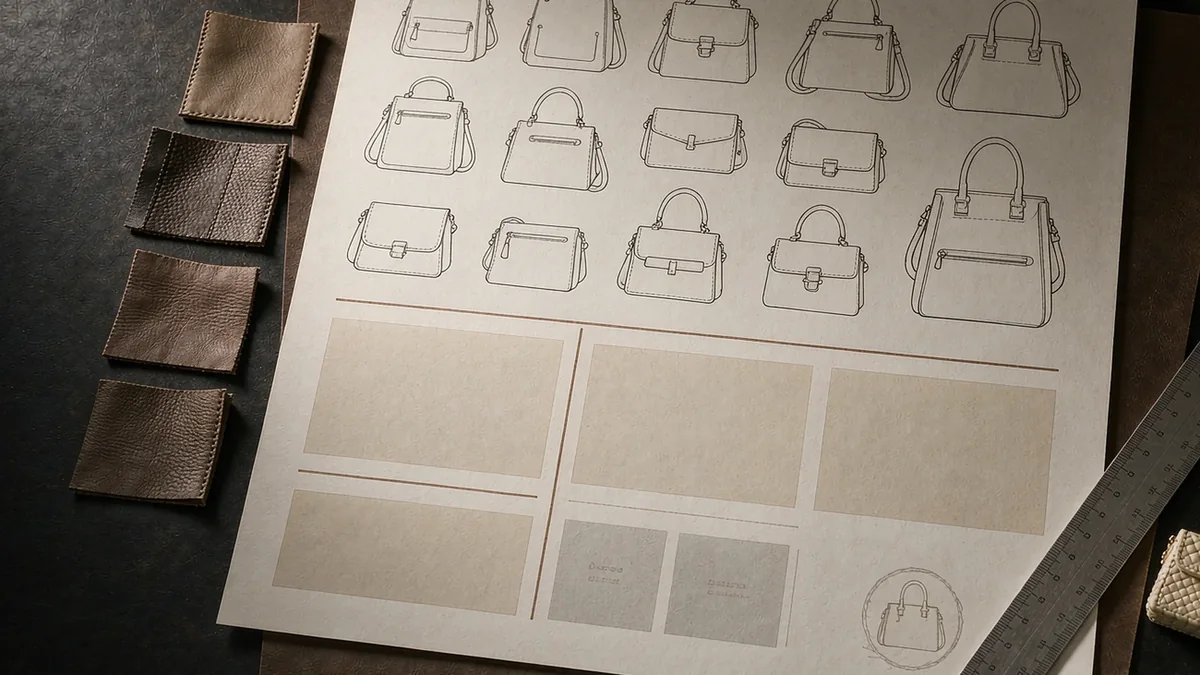
The Sketch That Arrived on Watercolour Paper
A designer sent a watercolour of a curved top-handle body, one line describing where the closure sat, and a note about the handle drop. It was a beautiful drawing and it was not a specification. It gave no panel breakdown, no gusset depth, no interlining weight and no hardware direction, so the first ten days were spent deciding what she meant rather than making anything.
That is normal, and it is worth saying plainly: a sketch is an intention, and intention has to be converted into dimensioned geometry before a bench can act on it. The conversion is the entire first stage, and it is where most of the delay in a development cycle is either created or avoided.
- The drawing carried silhouette, proportion, handle drop and the position of the closure.
- It did not carry panel breakdown, gusset depth, interlining weight, stitch density or alloy.
- Each missing item became a question, and each question became a day inside the sampling window.
- The fix was a single dimensioned drawing, which shortened the second style in the capsule by four days.
Stage 1 — From Drawing to Dimensioned Pattern
The first artefact is not a pattern but a 1:1 technical drawing with front, side and base views carrying real dimensions. From that drawing a pattern maker decides where the body breaks into panels, because a bag cannot be cut from a single piece of leather without either wasting hide or losing shape.
- Drawing scale
- 1:1 technical drawing with dimensioned front, side and base views
- Dimensional tolerance on panels
- plus or minus 1 mm, marked on the pattern itself
- Panel count, structured body
- 14-22 pieces depending on gusset depth and pocket build
- Body leather thickness
- 1.2-1.4 mm full-grain calfskin, tolerance plus or minus 0.1 mm
- Interlining build
- 240 gsm non-woven at 0.8 mm on every structured panel
- Cutting yield
- 62-70% of graded usable area with grain direction held constant
The panel breakdown is a design decision disguised as a technical one. Two extra panels cost assembly time and buy a sharper line at the base; one fewer panel costs sharpness and buys minutes. There is no correct answer, only the answer that matches the silhouette you drew.
Stage 2 — The Toile and Why It Is Not a Bag
Before any hide is cut, a toile is built in calico over board. It is not a bag, it has no closure and it will never be photographed, which is exactly why it is useful: a toile in calico and board costs roughly USD 4.80 in materials per iteration, so nobody argues about building three of them.
- A toile tests volume and proportion, which no flat drawing can confirm.
- It reveals whether the handle drop works against a real shoulder rather than against a mirror.
- It shows whether the gusset depth allows the opening the designer imagined.
- It settles panel count before leather is committed, which is the expensive moment.
- Three iterations in calico routinely save two correction rounds in skin.
Designers who skip this stage usually spend the saving later. The first sample is the first object anyone can hold, and holding it is when most proportion problems surface, so the question is only whether they surface in calico or in calfskin.
Stage 3 — Cutting, Skiving and the First Real Skin
Once the toile is approved, the pattern is nested against the hide and cut. This is the first point at which material behaviour enters: leather has grain direction, thickness variation and a limit on how far it will stretch, and all three constrain what the drawing can become.
| Operation | What it does | Measurement recorded |
|---|---|---|
| Grading and nesting | Places panels on the hide for maximum usable area | Yield percentage, typically 62-70% |
| Clicking | Cuts panels to the pattern with a blade or die | Panel dimensions against tolerance of plus or minus 1 mm |
| Splitting | Reduces full thickness to the specified gauge | 1.2-1.4 mm at plus or minus 0.1 mm, five points per hide |
| Skiving | Thins the edge where leather will fold or butt | Skive width of 8-10 mm along turned edges |
| Reinforcement | Adds backing behind hardware and stress points | Backing area and adhesive coverage |
| Sorting | Matches panels by shade within the lot | Shade grouping recorded against the lot reference |
Skiving is the operation most invisible in the finished object and most decisive in how it feels. An edge reduced evenly over 8-10 mm folds into a flat, fine line; an edge reduced unevenly or over too short a distance produces a ridge that no amount of edge paint will hide.
Stage 4 — Assembly and the Order of Operations
Assembly follows a fixed order, and the order exists because each operation makes the next one either possible or impossible. A bag assembled out of sequence can look correct and still fail early, because the seams that carry load were closed before the panels that align them.
- Close the internal pockets and linings, since these become inaccessible once the body is turned.
- Set reinforcement behind every hardware position before the panels are joined.
- Join the gusset to the front and back panels, checking alignment at each handover.
- Close the base seam, which carries the greatest load in ordinary use.
- Set the frame, magnets or stiffener that gives the body its structure.
- Attach the handles or strap anchors, reinforcing at the root where stress concentrates.
- Turn the body and press, then check that it stands true on a flat surface.
- Inspect panel alignment and seam allowance before the piece moves to edge finishing.
Alignment checked at each handover is the least costly inspection there is. Once a body is turned, an error of a millimetre at the gusset cannot be corrected without unpicking a seam that has already been skived.
Stage 5 — Edge, Finish and the Last Fifth of the Work
Edge finishing and topstitching are the last fifth of the operations and the majority of what a customer sees at arm's length. Three coats at 12-15 µm each, sanded between passes and heat set on the final coat, build an edge that flexes with the leather rather than cracking against it.
Stitch density carries the same weight. Eight to nine stitches per inch with 0.45 mm bonded nylon produces a seam that resists opening at the base corners, where structured bodies fail first, and it gives the seam a rhythm that reads as considered work rather than as a means of holding two panels together.
Four finish decisions that show at arm's length
- Edge build: three thin coats at 12-15 µm beat two heavy ones on any fold that flexes.
- Stitch density: 8-9 per inch on structured bodies, recorded at three points per unit.
- Thread: 0.45 mm bonded nylon for high-density seams on load-bearing areas.
- Topstitch distance from the edge: held constant across every panel, or it reads as drift.

Stage 6 — Hardware Setting and Mechanism Proving
Hardware is set and then proven, in that order, and proving is a separate step that first samples frequently skip. A closure that closes cleanly once has not been cycled; a closure cycled 500 times under light load has told you something useful about the slider, the tape and the alignment of the two halves.
- Confirm the alloy in writing, since brass and zinc alloy take plating and age differently.
- Specify plating thickness in microns, typically 0.15-0.3 µm over a palladium underlayer.
- Ask for neutral salt spray hours tested to ISO 9227, commonly 24 or 48 hours by programme tier.
- Cycle every zip 500 times before bulk release and record the result with the component lot.
- Record pull-off force for feet and rivets, as a loosened foot is the most common structural return.
A bespoke mechanism needs its own proving window inside development, which is why complex constructions take 12-15 working days rather than 6-10. The additional days buy the certainty that a closure will not be redesigned during bulk, which is the most expensive place imaginable to redesign anything.
Stage 7 — Approval, Specification Freeze and Lot Naming
Approval is not a feeling about a sample; it is a signature on a specification. The freeze happens when the approval sample is signed and the hide lot is named, because from that moment the material is committed, testing is booked against a real lot, and bulk can be scheduled.
What the freeze locks
Panel dimensions and tolerances, leather grade and lot reference, interlining weight, hardware alloy and plating, stitch density, edge build and packing specification.
What the freeze unlocks
Material ordering at committed pricing, compliance testing booked against the named lot, bulk scheduling across the 35-50 day window, and carton planning for freight.
What it makes expensive
Any change after this point re-opens costing, testing and the calendar together, rather than any one of the three separately.
Courier the approval sample if you cannot attend. Photographs flatten the two things that matter most at this stage, which are how an edge catches the light and whether a body stands true on a flat surface.
Stage 8 — Bulk Release and What Changes at Volume
Bulk is not the sample repeated five hundred times; it is the sample reproduced by several hands across several weeks, which is a different problem. What holds it together is station-level measurement and inspection during assembly rather than only at the end.
On this programme bulk runs 35-50 days and inspection is set at AQL 2.5 under ISO 2859-1, with third-party audit available in addition. At general inspection level II a lot of 501-1,200 units draws 80 units for inspection, with an accept number of 5 and a reject number of 6 for major defects.
What Happens When a Sketch Is Under-Specified
An under-specified drawing does not fail; it absorbs time. Each missing dimension becomes a question, each question becomes a day, and the days come out of the 6-10 working days of sampling window rather than out of bulk, which is where most founders expect them to land.
A 1:1 dimensioned drawing, the hardware direction settled before the first sample, interlining weight stated in grams per square metre, and destination markets named so compliance can be booked against the lot. None of these requires technical vocabulary, and together they routinely remove four to six days.
The programme runs across 7 production lines with about 200,000 pcs per month of capacity and has held export experience since 2014, executed through our validated partner factory Quanzhou Yingming Bags, an SGS-validated site. Sampling runs 6-10 working days for standard constructions and 12-15 for complex ones, with two correction rounds included in the development fee. Orders are placed at MOQ 500 pcs per style and colourway and quoted on FOB Xiamen terms.
Turn your sketch into a sample
Send a dimensioned drawing or a technical pack with your quantity and destination markets. You will receive a development calendar, the measurement sheet used at each stage, and a costing within two working days. Request a quote.
Frequently Asked Questions
How long does it take to turn a sketch into a finished bag?
A standard construction moves from a signed pack to a first sample in 6-10 working days, or 12-15 for complex builds requiring mechanism proving. Each correction round adds 4-6 working days. Bulk then runs 35-50 days, followed by 3-5 weeks of ocean freight depending on destination.
What should I send instead of a sketch?
A 1:1 dimensioned drawing carrying front, side and base views, with the hardware direction settled before the first sample. This is the single item that shortens development most. Interlining weight in grams per square metre and your destination markets are the next two, and together they routinely remove four to six days.
Why is a toile built before any leather is cut?
Because a toile in calico and board costs roughly USD 4.80 in materials per iteration, so three can be built without discussion. It tests volume, proportion, handle drop and gusset depth in three dimensions, which no flat drawing can confirm, and settles panel count before leather is committed.
How many pattern pieces does a handbag have?
A structured body breaks into 14-22 pieces depending on gusset depth and pocket build. The breakdown is a design decision wearing technical clothing: more panels cost assembly time and buy a sharper line at the base, while fewer cost sharpness and buy minutes. Agree the count before leather is committed, because it is settled most inexpensively at the toile stage.
What is skiving and why does it matter?
Skiving thins the leather where it will fold or butt against another panel, typically over 8-10 mm along a turned edge. Done evenly it produces a flat, fine fold; done unevenly or over too short a distance it produces a ridge that no amount of edge paint will hide. It is the operation most invisible in a finished object and most obvious in the hand.
What is the correct cutting yield for a structured body?
Expect 62-70% of graded usable area with grain direction held constant across every panel. Yield matters because hides are bought by area and consumed by panel, so a fall in yield is paid for in additional hides rather than in additional minutes of work. Nesting is therefore a design decision as much as a cutting one.
Why must assembly follow a specific order?
Because each operation makes the next one either possible or impossible. Internal pockets are closed first because they become inaccessible once the body is turned, reinforcement is set before panels are joined, and the base seam is closed while it can still be worked flat.
What is the right edge and stitch specification?
Three coats at 12-15 µm each, sanded between passes and heat set on the final coat, with stitch density of 8-9 per inch using 0.45 mm bonded nylon. Two heavy coats are faster but build a ridge that cracks at the fold within a season of ordinary use. Both figures should be recorded at three points per unit so that drift is visible rather than assumed.
How is hardware proven before bulk?
Plating thickness is specified at 0.15-0.3 µm over a palladium underlayer and verified in microns, salt spray hours are tested to ISO 9227, and every zip is cycled 500 times under light load. Pull-off force for feet and rivets is recorded against the component lot.
What exactly is a specification freeze?
The point at which the approval sample is signed and the hide lot is named. It locks panel tolerances, leather grade, interlining weight, hardware specification, stitch density, edge build and packing, and it unlocks material ordering, compliance testing and bulk scheduling. Marking the moment explicitly is what turns later changes into re-quotations rather than notes.
What changes when a design moves from sample to bulk?
The problem changes from making one correct object to reproducing it with several hands across several weeks. What holds bulk together is station-level measurement and inspection during assembly rather than only at the end, which is why in-process records matter more than a single final report. Expect the first units off the line to be checked more closely than the last.
How many correction rounds are included in development?
Two rounds are included in the development fee for a standard construction, covering a first sample and one corrected round. Further rounds are charged separately at 4-6 working days each. Corrections cost far less at the toile stage than in skin, which is the practical reason for building three toiles before cutting.
People Also Ask
What are the stages of designer handbag production?
Eight: dimensioned pattern, toile, cutting and skiving, assembly, edge and finish, hardware proving, approval and specification freeze, then bulk release. Each stage records a measurement that can be re-checked at destination.
Why build a toile before cutting leather?
Because it costs about USD 4.80 in calico and board per iteration and reveals proportion, volume and handle drop in three dimensions. Settling those questions early avoids correction rounds in leather.
How many pieces is a structured handbag cut into?
Typically 14-22 pattern pieces, depending on gusset depth and pocket build. More panels cost assembly minutes and buy a sharper line at the base, which is why the breakdown belongs in the pack rather than being left to convention.
What is a specification freeze in bag development?
The moment the approval sample is signed and the hide lot is named. Material is committed, testing is booked against a real lot, and bulk can be scheduled. Later changes re-open costing, testing and the calendar together.
How do I shorten my sampling window?
Send a 1:1 dimensioned drawing, settle the hardware direction before the first sample, state interlining weight in grams per square metre, and name every destination market so compliance can be booked against the lot.
Sources and further reading
Every figure on this page is either our own programme data or attributed below. Open the originals before you write them into a specification.
- ISO — International Organization for StandardizationISO Publisher of ISO 2859-1 for AQL sampling inspection, ISO 9227 for neutral salt spray testing, the ISO 105 series for colour fastness and ISO 11644 for finish adhesion.
- Leather Working GroupLeather Working Group Tannery environmental audit protocol referenced when a specification calls for leather from audited tanneries supplying named lots.
- CITES — Convention on International Trade in Endangered SpeciesCITES Permit framework governing exotic skins, including the Appendix II and III listings that require documentation before material is cut.
- U.S. Consumer Product Safety CommissionU.S. Consumer Product Safety Commission Administrator of CPSIA requirements applied to metal components and hardware on United States programmes.
- Sourcing JournalSourcing Journal Trade reporting on hide availability, component lead times and the development calendars that shape the sampling windows quoted here.