Designer Handbag Atelier: How It Works, Station by Station and Who Touches Your Programme
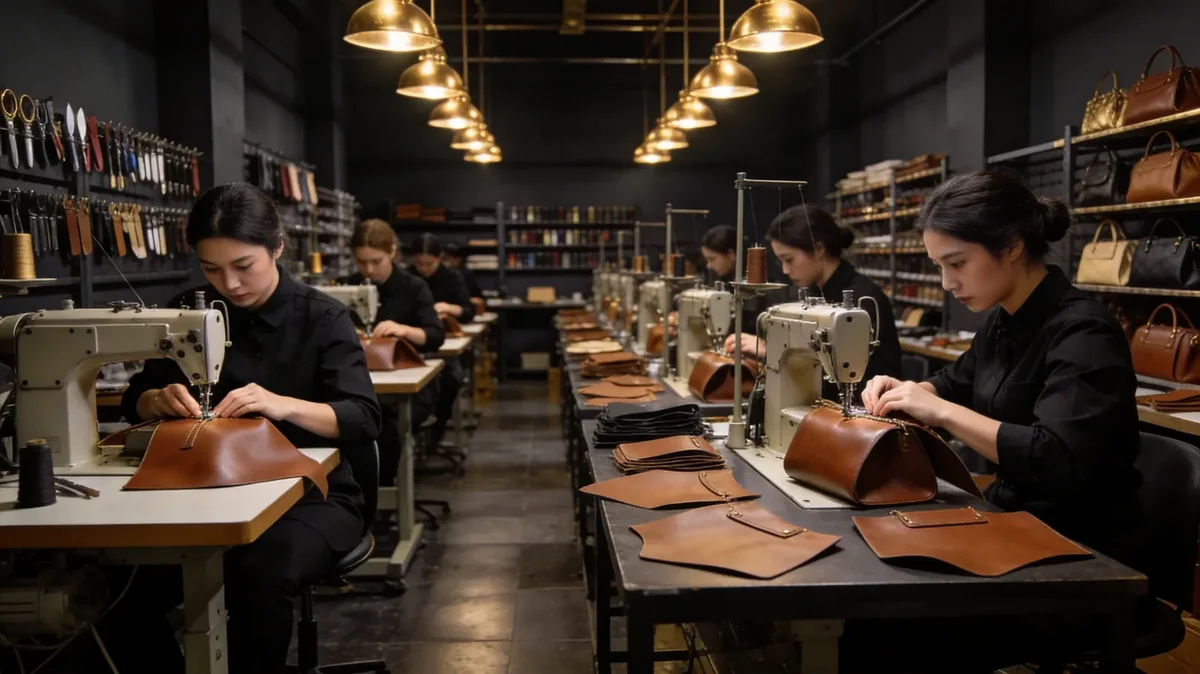
A designer handbag atelier is the room where a design is interpreted rather than executed: patterns are researched, toiles are built, first samples are made and corrections are resolved. It sits upstream of bulk and runs on a different clock, measured in days and rounds rather than weeks and units. Six stations carry the work, two sample rounds are included inside 6-10 working days, and leather is conditioned for 24-48 hours before any hide is cut. This article walks the room in order and names what is recorded at each station.
What an Atelier Is, Precisely
In handbag terms, an atelier is a development room, not a production floor. Its output is decisions and one correct object, not five hundred. Patterns are researched there, toiles are built there, the first sample is made there, and the corrections that follow it are resolved there before anything moves to bulk.
The distinction matters commercially, because the two rooms reward opposite behaviours. Bulk rewards repetition, consistency and station-level measurement. Development rewards judgement, iteration and the willingness to cut a second toile. A programme that confuses them either pushes development decisions onto the line, where they are expensive, or holds bulk to sampling tolerances, where it is slow.
- Development output is a signed specification plus one approved object.
- Bulk output is five hundred objects that match that one.
- Development is measured in working days and rounds; bulk in weeks and units.
- Development tolerances are exploratory; bulk tolerances are contractual.
There is a practical consequence worth stating. Corrections raised during development cost little because the only material at risk is one hide and a few hours at the bench. The same correction raised in week three of bulk puts an entire run at risk, which is why specification decisions should be finished in the development room rather than carried hopefully into production.
The Room: Six Stations and What Each One Decides
Most development rooms organise around six stations, walked in the order the work actually happens. The value of the sequence is that each station records something the next one needs, which is why samples made out of order tend to fail in predictable ways.
| Station | What is decided there | What is recorded |
|---|---|---|
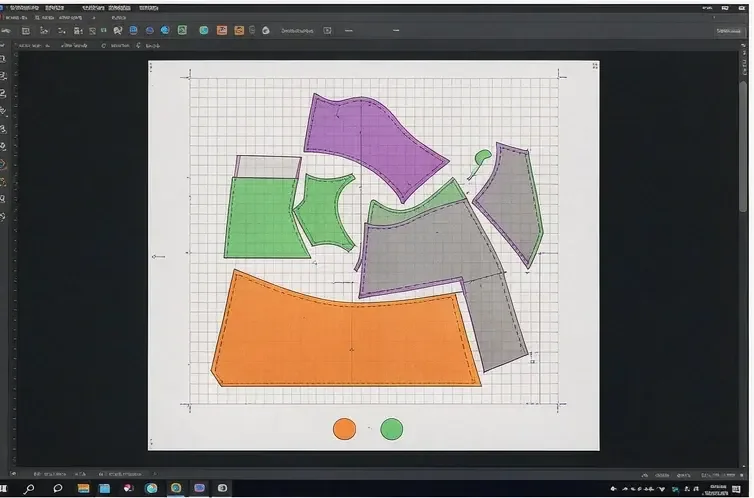
| Pattern research | Panel breakdown, seam allowances, grain direction marks | Revision number and date on every pattern piece |
| Material preparation | Nesting against the hide, thickness selection | Yield percentage and the lot reference used |
| Skiving and preparation | Fold thickness at every turned or butted edge | Skive width of 9-11 mm, checked with a gauge |
| Assembly | Order of operations and panel alignment | Stitch density of 8-9 per inch at three points |
| Edge and finish | Number of coats, sanding and heat setting | Three coats at 13-16 µm, sanded between passes |
| Hardware and proving | Setting force and mechanism behaviour | Press force in kilonewtons, 500 cycles per zip |
Two of these stations are routinely underestimated. Skiving decides how fine a folded edge can be, and proving decides whether a closure survives a season. Neither appears in a photograph, and both appear in a returns file.
Who Touches Your Programme
Five roles appear on every serious programme, and knowing which one to ask is the difference between a fast answer and a week of email. Each role owns a decision, and each decision is reversible only inside its own window.
Pattern maker
Owns the panel breakdown, seam allowances and the pattern revision history. Ask this role about whether a silhouette can be built as drawn, and what it costs to build it closer.
Material preparer
Owns nesting, thickness selection and shade sorting. Ask this role about yield, grain direction and what the hide will and will not accept.
Bench hand
Owns assembly order, alignment and stitch density. Ask this role which operations are hand-finished and what happens if one is removed.
Finisher
Owns edge build, sanding and heat setting. Ask this role how many coats a fold needs and why two heavy ones behave differently.
Programme coordinator
Owns the calendar, the specification record and compliance booking. Ask this role what is committed at the freeze and what remains open.
In smaller rooms some of these roles are held by one person, which works perfectly well. What matters is that each decision has a named owner, because unowned decisions are the ones that get made twice, in opposite directions.
The Development Checklist: Nine Items Before a Sample Is Built
Nine items, in the order they are needed. Each one removed from this list reliably adds days to the sampling window, and the days are billed.
- A 1:1 dimensioned drawing carrying front, side and base views.
- Panel breakdown agreed, or explicitly left to the pattern maker to propose.
- Leather grade and thickness stated in millimetres with a tolerance.
- Interlining weight given in grams per square metre and thickness in millimetres.
- Hardware direction settled, including alloy and plating thickness in microns.
- Stitch density and thread diameter specified.
- Edge build specified by coat count and thickness per coat.
- Destination markets named, so compliance can be booked against the lot.
- The intended shelf date, counted back through bulk and freight.
Items four, five and seven are the ones most often missing, and they are also the three that most change how an object feels. An interlining weight is not a technical nicety; it is the difference between a flap that holds its line and one that folds.
The Sample Room: Two Rounds and What Each Is For
Two rounds are included in the development fee, and they answer different questions. The first answers whether the object is right: proportion, volume, handle drop, whether the gusset gives the opening you imagined. The second answers whether the specification is right: stitch density, edge build, hardware setting and interlining behaviour.
- First sample window
- 6-10 working days for standard builds, 12-15 for complex ones
- Correction round
- 4-6 working days per round, two included in the fee
- Leather conditioning
- 24-48 hours at ambient room conditions before cutting
- Interlining build
- 260 gsm non-woven at 0.85 mm on structured panels
- Edge build
- Three coats at 13-16 µm, sanded between passes, heat set
- Colour assessment
- Panels and hardware compared under standardised lighting before approval
Treating the two rounds as interchangeable wastes one of them. Corrections raised in the first round should be about proportion, because proportion cannot be corrected later; corrections raised in the second should be about specification, because that is the round where specification is settled.
The Material Room: Conditioning, Sorting and Lot Control
Leather is a natural material that moves with humidity and temperature, so it is conditioned for 24-48 hours at ambient room conditions before cutting. Cutting before conditioning is the most common origin of a sample that fits and a bulk run that does not.
- Hides are rested flat and labelled with the lot reference on arrival.
- Thickness is checked at five points per hide against a tolerance of plus or minus 0.1 mm.
- Panels are shade-sorted within the lot so a body is not built from two different dye batches.
- Grain direction is marked on the pattern and held constant across every panel.
- Yield is recorded against the lot, typically 63-71% on a structured body.
- Offcuts from the sample are retained for colour matching in the second round.
The Bench: Tolerance and the Discipline of Measuring
An atelier is judged less by what it can make than by what it measures. Tolerances written into a specification only matter if somebody checks them at the station where they can still be corrected, which is the whole argument for in-process inspection.
Tolerances worth writing into the pack
- Panel dimensions to plus or minus 1 mm, checked against the pattern before assembly.
- Leather thickness to plus or minus 0.1 mm, measured at five points per hide.
- Skive width of 9-11 mm along every turned or butted edge.
- Stitch density of 8-9 per inch, recorded at three points per unit.
- Edge build of three coats at 13-16 µm, sanded between passes.
- Press force recorded in kilonewtons for rivets and feet, with pull-off force tested.
Record the instrument beside the figure. A measurement without the tool that produced it cannot be reproduced at destination, and reproducibility is the entire purpose of writing a tolerance down.
The measurement that most often goes unrecorded is the one taken first: panel dimensions against the pattern before assembly begins. It takes perhaps ninety seconds per unit and it catches the failure mode that no final inspection can, which is a body whose panels were cut to the right drawing and sewn in the wrong order.
The Archive: What Is Kept and For How Long
The archive is the least glamorous part of an atelier and the most valuable one in a second season. It holds the approved pattern with its revision history, the signed approval sample, the specification record, and the material references used.
Four things should be retained: the graded pattern with revision dates, a signed reference sample, the specification record with the lot references, and the packing reference including care cards, dust bags and tissue, which add about USD 4.80 per unit to the reference set and are ordered with the packing rather than after it.
Where exotic skins are involved, the archive also carries the permit documentation. CITES entries under Appendix II or III must travel with the material, and a permit discovered to be missing at export is a delay measured in weeks rather than days.
How an Atelier Differs From a Production Line
The two rooms look similar from the doorway and behave completely differently. Understanding which one you are standing in tells you which questions are fair to ask.
| Dimension | Development room | Bulk line |
|---|---|---|
| Unit of time | Working days and rounds | Weeks and units |
| Output | One approved object and a signed specification | 500 pcs or more that match it |
| Tolerance | Exploratory, tightened as the design settles | Contractual, held at AQL 2.5 under ISO 2859-1 |
| Correction | Expected and inexpensive | Expensive and schedule-breaking |
| Records | Revision history and approval sample | Station measurements and lot reports |
| People | Pattern maker, preparer, bench hand, finisher | Several hands per station, one method per operation |
This programme runs across 7 production lines with about 200,000 pcs per month of capacity and has held export experience since 2014, executed through our validated partner factory Quanzhou Yingming Bags, an SGS-validated site. Orders are placed at MOQ 500 pcs per style and colourway, bulk runs 35-50 days, and quotations are given on FOB Xiamen terms.
Your First Visit: What to Bring and What to Ask
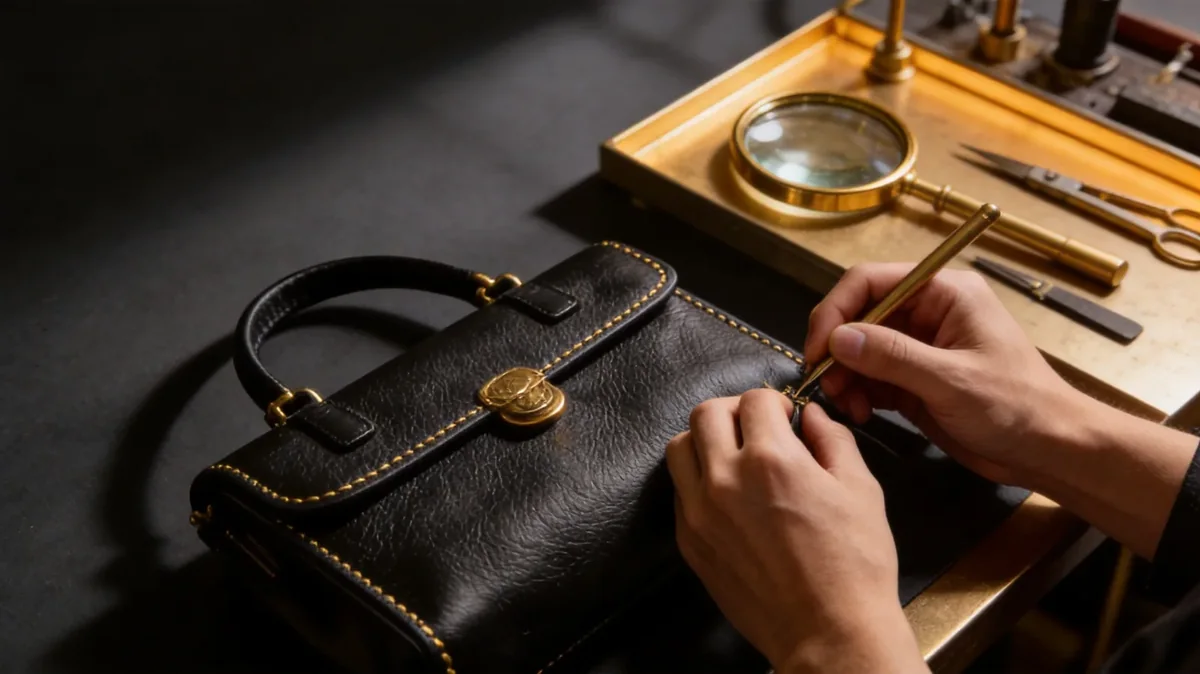
Bring the object you are trying to improve, not only the drawing of the one you want. A reference bag communicates handle drop, stiffness and interior layout faster than any specification, and it anchors the conversation in something everybody can hold.
- Bring a reference bag whose proportions you admire, whether or not you like its material.
- Bring dimensioned drawings, however rough, rather than mood imagery alone.
- Ask which operations at each station are hand-finished, and what removing one would cost.
- Ask to see the archive: a pattern with revision dates tells you how the room handles change.
- Ask what is kept after the season, and for how long, before you need it retrieved.
- Ask who owns each decision, so a later question goes to the right person the first time.
Book a development conversation
Send your drawings, a reference object and your quantity per colourway. You will receive a development calendar and the specification sheet used at each station within two working days. Request a quote.
Frequently Asked Questions
What does a designer handbag atelier actually do?
It interprets a design rather than executing it. Patterns are researched, toiles are built, first samples are made and corrections are resolved there. Its output is one approved object plus a signed specification, which is what bulk then reproduces at volume. The room exists to settle questions while they are still inexpensive to settle.
How is an atelier different from a production line?
They run on different clocks. Development is measured in working days and rounds and rewards judgement and iteration; bulk is measured in weeks and units and rewards repetition and station-level measurement. Confusing them either pushes development decisions onto the line or slows bulk with exploratory tolerances.
How many stations does a handbag development room have?
Six, walked in production order: pattern research, material preparation, skiving and preparation, assembly, edge and finish, and hardware with proving. Each station records a figure the next one needs, which is why samples built out of sequence fail in predictable ways. Skiving and proving are the two stations most often underestimated, and both appear in a returns file rather than in a photograph.
How long does sampling take in an atelier?
A first sample takes 6-10 working days for a standard construction and 12-15 for a complex one requiring mechanism proving. Each correction round adds 4-6 working days, and two rounds are included in the development fee. Raise proportion problems in the first round, because they cannot be fixed in the second without returning to pattern.
What are the two sample rounds for?
They answer different questions. The first is about the object: proportion, volume, handle drop and gusset opening. The second is about the specification: stitch density, edge build, hardware setting and interlining behaviour. Proportion belongs in the first round, because it cannot be corrected in the second without returning to pattern, so treating the two as interchangeable wastes one of them.
Why is leather conditioned before cutting?
Leather moves with humidity and temperature, so it is rested flat for 24-48 hours at ambient room conditions before any hide is cut. Cutting before conditioning is the most common origin of a sample that fits perfectly and a bulk run that does not. Resting also relaxes the hide after transit, which reduces movement between cutting and assembly.
What tolerances should be written into the specification?
Panel dimensions to plus or minus 1 mm, leather thickness to plus or minus 0.1 mm measured at five points per hide, skive width of 9-11 mm, stitch density of 8-9 per inch, edge build of three coats at 13-16 µm, and press force recorded in kilonewtons for rivets and feet.
Why does the archive matter in a second season?
Because a repeat without records is a redevelopment. The graded pattern with revision dates, a signed reference sample, the specification with lot references and the packing reference are what let a second season match the first without starting again. There are four items, and the absence of any one of them turns a repeat into a fresh development.
How much does the packing reference set cost?
Care cards, dust bags and tissue for the reference set add about USD 4.80 per unit and should be ordered with the packing rather than after it. They also carry a lead time outside the 35-50 day bulk window, which is the practical reason to specify them early.
What happens to exotic skin documentation?
It is archived with the material record and travels with the goods. CITES entries under Appendix II or III require permit documentation, and a permit found missing at export causes a delay measured in weeks rather than days, so declare exotic content at material selection, when there is still time to act on it.
Should I bring anything physical to a first visit?
Yes, a reference bag whose proportions you admire, whether or not you like its material. It communicates handle drop, stiffness and interior layout faster than any specification, and it anchors the conversation in something everyone present can hold and point at. Bring dimensioned drawings as well, however rough, rather than mood imagery on its own.
Who should I ask about a specific problem?
Match the question to the role. The pattern maker owns whether a silhouette can be built as drawn; the material preparer owns yield and grain; the bench hand owns assembly order and stitch density; the finisher owns edge build; the coordinator owns the calendar and compliance booking.
People Also Ask
What is a handbag atelier?
The development room where a design is interpreted: patterns are researched, toiles built, samples made and corrections resolved. Six stations carry the work, walked in production order, and the output is an approved object and a specification rather than volume.
How does an atelier differ from bulk production?
Development runs in working days and rounds and rewards iteration; bulk runs in weeks and units and rewards repetition. Development tolerances are exploratory, while bulk is inspected at AQL 2.5 under ISO 2859-1.
How long does it take to sample a handbag in an atelier?
6-10 working days for a first sample on a standard build, 12-15 for complex constructions. Each correction round adds 4-6 days, and two rounds are included in the development fee.
Why is leather rested before cutting?
Because it moves with humidity and temperature. Conditioning hides flat for 24-48 hours before cutting prevents the common problem of a sample that fits and a bulk run that does not.
What records should an atelier keep for a second season?
The graded pattern with revision dates, a signed reference sample, the specification with lot references and the packing reference set. Together they let a second season match the first, and without them a repeat becomes a redevelopment.
Sources and further reading
Every figure on this page is either our own programme data or attributed below. Open the originals before you write them into a specification.
- ISO — International Organization for StandardizationISO Publisher of ISO 2859-1 for AQL sampling inspection, the ISO 105 series for colour fastness and ISO 11644 for finish adhesion, cited in the tolerance section.
- Leather Working GroupLeather Working Group Tannery environmental audit protocol referenced when a specification calls for leather from audited tanneries supplying named lots.
- CITES — Convention on International Trade in Endangered SpeciesCITES Permit framework for exotic skins, including the Appendix II and III listings whose documentation must be archived and travel with the goods.
- European Chemicals AgencyECHA Authority for REACH obligations, including Annex XVII restrictions screened for European Union destinations before bulk release.
- WWDWWD Trade reporting on designer collection calendars and the development pressures shaping sampling windows across the sector.