Designer Handbag Production Materials Guide: Leathers, Linings, Hardware and the Tests Every Lot Must Clear
What materials does designer handbag production actually specify? Full-grain calfskin at 1.2-1.4 mm for a structured body, 0.9-1.1 mm where the bag must slouch, a 0.8 mm interlining behind every panel that carries load, 8-9 stitches per inch on visible seams, and hardware plated at 0.15-0.3 µm over a nickel barrier. Every lot is tested before a panel is cut, against ISO 3376, ISO 11644 and ISO 105. This guide answers the ten questions buyers raise most, from leather substance through to permit documents for listed skins, on a programme running MOQ 500 pcs per style and colourway.
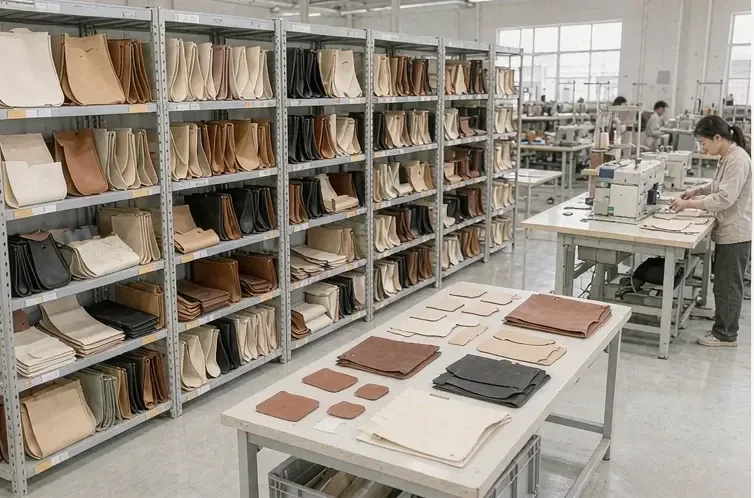
What Separates Designer-Grade Material From Ordinary Stock
Designer-grade material is defined by what can be measured and traced: substance in millimetres, finish adhesion, colour fastness on a grey scale, and a named tannery lot behind every hide. Anything sold on adjectives alone cannot be written into a technical pack, and what cannot be written down cannot be repeated next season.
The distinction shows up at re-order. A house that bought calfskin described only as soft black will find the next lot behaves differently at the skiving machine; one that bought full-grain calfskin at 1.2-1.4 mm, semi-aniline, from a named audited lot will get a hide that cuts and folds the same way.
- Substance: body leather at 1.2-1.4 mm, never an unspecified about one millimetre.
- Finish: named as aniline, semi-aniline or pigmented, because it dictates both hand and rub resistance.
- Traceability: a tannery lot number, ideally from a Leather Working Group (LWG) audited site.
- Testing: results against ISO 3376, ISO 11644 and ISO 105 issued for that lot rather than a generic certificate.
Which Leather Suits a Structured Body, and Which Suits a Soft One
Structured bodies need leather with body of its own; slouchy ones need leather that yields. The decision runs substance first, tannage second, finish third, in that order of consequence.
| Material | Substance | Where it belongs | What to watch |
|---|---|---|---|
| Full-grain calfskin | 1.2-1.4 mm | Structured top-handle and frame bodies | Must be skived at turn-ins or the ridge telegraphs through |
| Semi-aniline calfskin | 1.0-1.2 mm | Soft shoulder and hobo shapes | Marks show more readily than a pigmented finish |
| Vegetable-tanned calfskin | 1.4-1.8 mm | Rigid frames, belting, handles, bases | Firms further as patina develops; needs conditioning time |
| Goatskin | 0.8-1.0 mm | Light everyday bodies | Stretches under load; reinforce the base |
| Lambskin | 0.7-0.9 mm | Evening bags and linings | Low abrasion resistance at corners and feet |
| Bovine suede | 0.9-1.2 mm | Gussets, panels, contrast insets | Nap direction changes shade across panels |
Read the third column before the second. A 0.9 mm lambskin in a structured top-handle will not hold a corner after one season, and no interlining compensates for a leather never meant to carry load.
How Thick Should Every Panel Be?
On a structured designer body, panels are cut at 1.2-1.4 mm and skived to 0.6-0.7 mm wherever they turn in, while handles are built to 2.0-2.4 mm from two plies laminated around a core. Stating both numbers in the technical pack is what separates a repeatable bag from a lucky first sample.
- Body panels, structured
- Full-grain calfskin 1.2-1.4 mm, skived to 0.6-0.7 mm over an 8-10 mm turn-in width
- Gussets and base
- 1.4-1.6 mm, or 1.2 mm bonded to 0.8 mm interlining where the bag must sit flat
- Handles and straps
- 2.0-2.4 mm finished, built from two plies around a 1.0 mm reinforcement core
- Interlining
- 0.8 mm non-woven on load panels; 0.4 mm on facing panels where drape matters
- Lining
- 0.6-0.8 mm pig suede, or a 68 gsm twill where finished weight must fall below 500 g
- Stitch density
- 8-9 stitches per inch on visible seams; 7-8 on heavy belting and handle joins
Skiving is where most first samples disappoint. A turn-in left at full substance creates a ridge visible through the face leather after a week of handling, which is why the pack states skived width as well as thickness.
What Goes Inside: Lining, Interlining and Load Paths
The inside of a handbag is an engineering problem rather than a decorative one: interlining carries the load, lining protects it, and both must be specified before the first toile is cut.
Inside-out specification checklist
- Load panels bonded with 0.8 mm non-woven; 0.4 mm on facing panels where drape matters.
- Base reinforced to 1.4-1.6 mm, or a 0.8 mm board wrapped in lining leather where the bag must sit flat.
- Lining at 0.6-0.8 mm pig suede for structure, or 68 gsm twill where the target weight sits under 500 g.
- Handle joins riveted or saddle-stitched through a 1.0 mm reinforcement, never through face leather alone.
- Interior pocket mouths turned and topstitched at 8-9 stitches per inch so they resist stretching in use.
Weight is the constraint buyers discover late. Lining, interlining, feet, zip and hardware routinely account for a third of a finished bag's weight, so a silhouette designed on a bare shell can gain 150-200 g once specified.
Which Hardware Specification Survives Daily Wear
Hardware fails in three predictable ways: plating wears through at contact points, cast parts crack near the gate, and loose tolerances make a lock stiff after a month. All three are specification problems, not defects of fate.
Solid brass, milled
The right choice for locks, feet and any part taking daily torque. It holds a thread and a tight tolerance and can be re-plated. Heavier, and slower to arrive at roughly 20-25 working days.
Die-cast zinc alloy
Appropriate for decorative plates, logo bars and magnetic closures. Lighter and faster to source, but not the right answer for a closure that must survive daily torque.
Plating thickness
Gold tone is typically specified at 0.15-0.3 µm over a nickel barrier. Below that range, high points such as the cam of a turn-lock wear through within a single season.
Corrosion proving
Components are proved at 24 hours of neutral salt spray as a floor and 48 hours for antique or dark finishes, with any base-metal show recorded as a failure rather than a variation.
Zips deserve their own line in the pack. A #5 metal zip carries a medium body; a #3 suits interior pockets and small leather goods. Naming the gauge, tape colour and pull finish prevents the common surprise of a correct bag with the wrong zip.
Edge Paint, Thread and Adhesive: What Fails First
Edges, seams and bonds fail before leather does, which is why they carry more inspection weight than any panel. A bag that looks right in week one and wrong in month six almost always has an edge or an adhesive origin.
- Edge paint: three thin coats, each dried before the next and sanded between passes, rising to five on a couture bench.
- Thread: bonded polyester around Tex 40, roughly 0.45 mm in diameter, UV-resistant and matched to the panel rather than the dye lot.
- Stitch density: 8-9 stitches per inch on visible seams, dropping to 7-8 on belting where the needle must clear bulk.
- Adhesive: water-based contact cement on leather to leather, applied to both faces, with the open time written into the pack.
- Turn-ins: skived to 0.6-0.7 mm over 8-10 mm, then creased before folding so the edge sits flat rather than rounded.
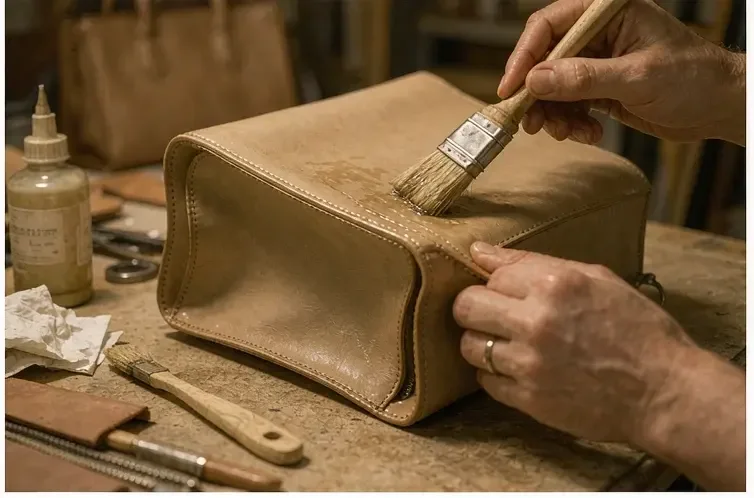
Drying time is the variable most calendars under-allow. Multiple thin coats cannot be replaced by one thick one, which shrinks as it cures and sinks along the edge within days of packing.
How Exotic Skins Are Documented, Matched and Cut
Listed skins are governed by paperwork before aesthetics. A CITES Appendix II or III listing determines whether a re-export permit travels with the shipment, and the permit species, quantity and country of origin must reconcile with the commercial invoice line by line.
- Permit documents are issued by an authority working to its own timetable, which no amount of bench resource accelerates.
- Scale or quill matching is drawn before cutting, with a centre line carried across panels so the pattern reads continuously.
- Yield is materially lower than calfskin, commonly around 40-55% against 70-80%, which changes the hide quantity ordered.
- Exotic panels are cut last and usually by hand, because a mis-cut panel on a listed skin is rarely replaceable from the same lot.
- Leftover pieces from listed skins must be reconciled and documented, not quietly held for a later style.
The practical recommendation is a two-stage launch: the calfskin version first, the listed-skin version a season later, once the pattern is frozen and the permit window is known.
Which Tests Does a Material Lot Have to Clear
Testing is issued against a lot, not against a material in the abstract. Substituting a hide after the reports are written invalidates them, which is why lot discipline sits at the centre of any serious programme.
| Property | Standard | Typical buying floor |
|---|---|---|
| Tensile strength | ISO 3376 | Most programmes set a floor near 10 N/mm² for body leather |
| Finish adhesion | ISO 11644 | No finish transfer after the specified rub cycle, checked before cutting |
| Colour fastness to rubbing | ISO 105-X12 | Grey scale 4 dry and 3-4 wet is the usual floor for dark linings |
| Colour fastness to light | ISO 105-B02 | Grey scale 4 for colourways shown in window displays |
| Hardware corrosion | ISO 9227 | 24 hours neutral salt spray as a floor, 48 hours for antique finishes |
| Restricted substances | REACH Annex XVII, California Prop 65 | Per-lot declarations; children's lines add CPSIA testing |
Two of those lines are regulatory. REACH Annex XVII restricts substances in articles sold into the European Union and California Prop 65 requires a warning above a threshold; both are answered with a per-lot declaration.
How Material Choice Moves Cost and Calendar
Material choice moves the calendar more than it moves the unit price: reserving a held calfskin lot removes 15-20 working days, while introducing a listed skin adds 30-45. Designers who measure the choice only in currency tend to misread both.
Calfskin in stock colourways
The fastest route. Sampling runs 6-10 working days and bulk 35-50 days, at MOQ 500 pcs per style and colourway on FOB Xiamen terms.
Named tannery lot, made to shade
Add 15-20 working days before cutting and allow the laboratory reports to be issued against that lot, not a reference sample.
Listed exotic skin
Add 30-45 working days for permit documents plus hand-matching time on the bench, and accept a lower cutting yield.
Swatch card sets are billed at USD 4.80 and credited against the first bulk order, which is a proportionate way to settle a colour direction before 500 pieces are committed to it. It is also the least costly correction available anywhere in the calendar.
What to Send When You Brief a Material Direction
A material brief produces a real quotation when it arrives complete. Five items do most of the work.
- Dimensioned drawings or a reference piece, with the intended silhouette described as structured, semi-structured or soft.
- Material direction by name: leather type, substance range and finish, plus hardware finish and gauge.
- Quantity per style and per colourway, remembering that MOQ 500 pcs applies to each combination.
- Destination markets, because REACH, Prop 65 and CPSIA testing are booked per lot for each one.
- The immovable date, so the calendar can be built backwards from it rather than forwards from optimism.
The programme runs across 7 production lines with about 200,000 pcs per month of capacity and has held export experience since 2014, carried out through our validated partner factory Quanzhou Yingming Bags, an SGS-validated site. Inspection is drawn at AQL 2.5 under ISO 2859-1 and handover is on FOB Xiamen terms with CIF and DDP available. Wider material selection sits under luxury materials, and the bench work itself under craftsmanship.
Specify your materials before you quote
Send your drawings, the material direction and the date you cannot move. You will receive a specification pack with substance, interlining, hardware and testing lines filled in, within two working days. Request a quote.
Frequently Asked Questions
What leather thickness should a designer handbag body use?
A structured body is normally cut from full-grain calfskin at 1.2-1.4 mm, skived to 0.6-0.7 mm wherever the panel turns in. Soft shapes sit lower at 0.9-1.1 mm, and handles are built separately to 2.0-2.4 mm from two plies over a core.
Why does skiving matter so much on a structured bag?
A turn-in left at full substance leaves a ridge that becomes visible through the face leather after a week of handling. Skiving to 0.6-0.7 mm over an 8-10 mm width removes that bulk. The technical pack should state both the skived thickness and the skived width, since one without the other is not reproducible.
Which interlining should sit behind a load-bearing panel?
A 0.8 mm non-woven interlining on load panels, reduced to 0.4 mm on facing panels where drape matters. Bases are taken to 1.4-1.6 mm or wrapped around a 0.8 mm board where the bag must sit flat. Interlining redistributes stress away from the seam line, which is why changing it after approval affects the whole body.
How many stitches per inch should a designer bag have?
Visible seams typically run 8-9 stitches per inch, using bonded polyester thread around Tex 40, roughly 0.45 mm. Heavy belting and handle joins drop to 7-8 so the needle clears the bulk. Lower densities read rustic and higher ones perforate the leather.
What plating thickness should hardware be specified at?
Gold tone is commonly specified at 0.15-0.3 µm over a nickel barrier, with components proved at 24 hours of neutral salt spray as a floor and 48 hours for antique or dark finishes. Below that range, contact points such as the cam of a turn-lock wear through within a single season.
Should I use solid brass or die-cast alloy for a closure?
Solid milled brass for anything taking daily torque: locks, feet, turn-locks and strap ends. Die-cast zinc alloy suits decorative plates, logo bars and magnetic closures where load is low. Brass is heavier and slower, typically 20-25 working days, but it holds a thread and can be re-plated rather than replaced.
How is an exotic skin documented before it is cut?
A CITES Appendix II or III listing determines whether a re-export permit travels with the shipment, and the species, quantity and country of origin on the permit must reconcile with the commercial invoice. Panels are matched by hand along a drawn centre line and cut last, because yield is lower and a mis-cut piece is rarely replaceable.
Which laboratory tests apply to a leather lot?
The usual set is ISO 3376 for tensile strength, ISO 11644 for finish adhesion, ISO 105-X12 for rub fastness and ISO 105-B02 for light fastness, with ISO 9227 for hardware corrosion. Buyers commonly set a tensile floor near 10 N/mm² and grey scale 4 dry and 3-4 wet on dark linings.
Do REACH and Prop 65 apply to handbags sold in Europe and California?
Yes. REACH Annex XVII restricts certain substances in articles placed on the European Union market, and California Prop 65 requires a warning where a listed substance exceeds a threshold. Both are answered with a per-lot declaration from the tannery or component house, not with a general statement covering a whole season.
How much does material choice change the delivery date?
Reserving a held calfskin lot removes 15-20 working days from the plan, while introducing a listed skin adds 30-45 for permit documents. Sampling itself takes 6-10 working days and bulk 35-50 days, so the material window is usually the largest variable outside bulk and the easiest one to plan around.
What is the minimum quantity for a custom material direction?
MOQ 500 pcs per style and colourway applies, because a custom shade or a named tannery lot is bought as a lot rather than by the metre. Where a brand wants three colourways of one silhouette, that is three lots of 500 and should be planned as one reservation rather than three separate ones.
How do I test a colour direction before committing to a lot?
Ask for a swatch card set with edge-painted strips and the intended lining, billed at USD 4.80 and credited against the first bulk order. Seeing the colour alongside its edge paint and lining under retail lighting settles most direction questions.
Why do exotic panels have to be cut last?
Because yield is lower, commonly 40-55% against 70-80% for calfskin, and because scale or quill matching must be drawn across panels before cutting starts. Cutting them after the pattern is frozen avoids wasting material that cannot be re-ordered from the same hide.
People Also Ask
What is the best leather for a structured handbag?
Full-grain calfskin at 1.2-1.4 mm, skived at the turn-ins. It holds a corner, accepts edge paint cleanly and develops patina rather than cracking. Vegetable-tanned calfskin at 1.4-1.8 mm suits frames and belting.
How thick is luxury handbag leather?
Body panels generally run 1.2-1.4 mm for structured shapes and 0.9-1.1 mm for soft ones. Handles are built to 2.0-2.4 mm, linings sit at 0.6-0.8 mm, and interlining is 0.8 mm on load panels and 0.4 mm where drape matters.
What hardware lasts longest on a handbag?
Solid milled brass with plating at 0.15-0.3 µm over a nickel barrier, proved at 24 hours of salt spray as a floor. Die-cast zinc alloy is fine for decorative plates and logo bars but less suited to closures that take daily torque.
Which tests should handbag materials pass?
ISO 3376 for tensile strength, ISO 11644 for finish adhesion, ISO 105 for rub and light fastness, and ISO 9227 for hardware corrosion, all issued against a named lot. Add REACH Annex XVII and California Prop 65 declarations for the destination market.
Do exotic skins need permits?
Yes for species listed under CITES Appendix II or III. The permit must match the commercial invoice on species, quantity and origin, and it is issued by an authority working to its own timetable, which typically adds 30-45 working days to a programme.
Sources and further reading
Every figure on this page is either our own programme data or attributed below. Open the originals before you write them into a specification.
- ISO — International Organization for StandardizationISO Publisher of ISO 3376 tensile strength, ISO 11644 finish adhesion, ISO 105 colour fastness and ISO 9227 salt spray testing referenced in this guide.
- Leather Working GroupLeather Working Group Tannery audit protocol used to qualify a named lot, which is the basis of traceability in a designer material specification.
- CITES — Convention on International Trade in Endangered SpeciesCITES Appendix II and III listings determine which permit documents must travel with listed skins and how they reconcile with the commercial invoice.
- European Chemicals AgencyECHA Administrator of REACH, including Annex XVII restrictions on substances in articles placed on the European Union market.
- California Office of Environmental Health Hazard AssessmentOEHHA The authority behind California Proposition 65, which governs warning requirements for listed substances in products sold in that state.