Luxury Handbag Packaging Cost Guide: Where the Money Goes, Line by Line
How much does luxury handbag packaging cost? Set against a reference unit cost of USD 4.80, a complete five-layer set adds 40% to 90% of that figure, and five variables explain almost all of the range: board weight, print method, decoration tooling, quantity, and carton volume. Board alone carries 40% to 52% of set cost, which is why it is the first place to look. This guide splits the number line by line, gives the tier breaks at 500, 1,000 and 3,000 pieces, and shows which reductions are invisible to the client and which are not.
Packaging cost is usually quoted as a single line, which makes it impossible to manage and impossible to argue with. Split into layers it becomes ordinary: a set has six cost centres, two of them dominate, and the two that dominate are also the two that are specified by number rather than by taste. Once the split is visible, most programmes find they are overspending in one of two places and underspending in one of two others, and both findings are actionable within a single run.
The Set Cost in Six Numbers
A complete presentation set breaks into six cost centres: the rigid box, the dust bag, printed matter, tissue, the outer shipper, and the amortised tooling that sits across all of them. Expressed as a share of set cost the pattern is stable across programmes, which is what makes it useful: a quotation that departs from it is usually telling you something about the specification rather than about the house that produced it.
| Cost centre | Share of set cost | What drives it | Reduction the client will notice |
|---|---|---|---|
| Rigid box | 40% to 52% | Board weight, wrap, closure | Yes, in the hand and at the lid |
| Dust bag | 18% to 26% | Fabric weight, cord, print | Yes, in the wardrobe |
| Printed matter | 9% to 15% | Piece count, colour count | Rarely |
| Tissue | 4% to 7% | Sheet count, gsm | Yes, at the reveal |
| Outer shipper | 8% to 14% | Board grade, carton size | No, unless it fails |
| Amortised tooling | 3% to 9% at 500 pcs | Die, plate, sample set-up | No |
Read that table by the last column rather than the second. Two reductions are invisible: printed matter and amortised tooling. Three are visible to some degree: board, tissue and the dust bag. One is invisible until it fails, which is the shipper. The discipline of packaging cost is to take the invisible reductions first, then stop, because the visible ones are where a programme starts spending more later to undo what it saved.
Variable One: Board Weight
Board is the largest single line and the most frequently reduced, which is why it is also the most frequently regretted. Moving from 1,200 gsm greyboard to 900 gsm on a structured piece typically removes 8% to 14% of set cost, and it shows in the way the box holds its corner on a pallet and in the weight the client feels when they lift it. On a soft construction the same move is almost free of consequence, because the piece does not need the box to hold a shape for it.
The test that governs the decision is not a cost test but a corner crush and a 24 hour stack test, both run packed. If the lighter board passes, take the saving; if it does not, the saving is being borrowed from a later return. Programmes that reduce board without running those two tests rarely connect the resulting damage to the decision, because the damage appears weeks after the spreadsheet was signed off.
Variable Two: Print Method and Colour Count
Colour count is the cleanest lever in the whole set, because it is linear in cost and almost flat in effect. A second colour on a dust bag or a card adds a pass, a plate and an approval cycle, and it is the change clients notice least. Deboss and foil sit differently: a deboss needs a die and then costs nothing per piece, while a foil needs a die, a foil and a controlled dwell, and it costs per piece as well as in set-up.
- Board redo
- 1,200 to 900 gsm removes 8% to 14% of set cost
- Second colour
- Adds a pass, a plate and an approval cycle
- Blind deboss
- Die cost once, then near-zero per piece
- Hot foil
- Die plus foil plus dwell; a per-piece cost as well
- Tier at 500 pcs
- Where tooling amortisation bites hardest
- Tier at 1,000 pcs
- Board and fabric reach standard lot sizes
- Tier at 3,000 pcs
- Tooling becomes negligible; material dominates
- Carton right-sizing
- Often removes more than any material change
- Set against reference unit
- 40% to 90% of USD 4.80 for a complete set
Variable Three: Decoration Tooling
Tooling is a fixed cost spread over a run, which means its share of unit cost is entirely a function of quantity. At 500 pieces a deboss die and a foil die together can carry 3% to 9% of set cost; at 3,000 pieces the same two dies carry a fraction of one per cent. This is the arithmetic behind the 500 pcs per style and colourway floor: below it, packaging tooling stops being an investment and starts being a penalty that no amount of negotiation removes.
Two consequences follow. The first is that a programme planning several seasons should cut tooling that will survive them, meaning a mark that will not change and a die that is not sized to a single silhouette. The second is that a genuinely short capsule should avoid tooling altogether and use a print method instead, because a single-colour screen print on a dust bag carries no die cost and reads perfectly well at the quantity involved.
Variable Four: Quantity and the 500 Piece Floor
Material prices break at lot sizes, not at round numbers, but three thresholds come up consistently. At 500 pieces per style and colourway, which is the working minimum for the bag programme itself, packaging materials are bought above their standard lot and tooling is amortised over the smallest viable run. At 1,000 pieces board and fabric typically reach standard lots and the per-unit material figure steps down. At 3,000, tooling becomes negligible and material dominates the number.
The practical implication is that a programme should decide its packaging quantity once, per season, rather than per drop. Splitting a 1,000 piece requirement into two 500 piece orders to suit a cash position costs more in material and tooling than the split saves, and it introduces a second artwork approval and a second colour-matching risk, which is where the real money goes.
Variable Five: Carton Size and Freight
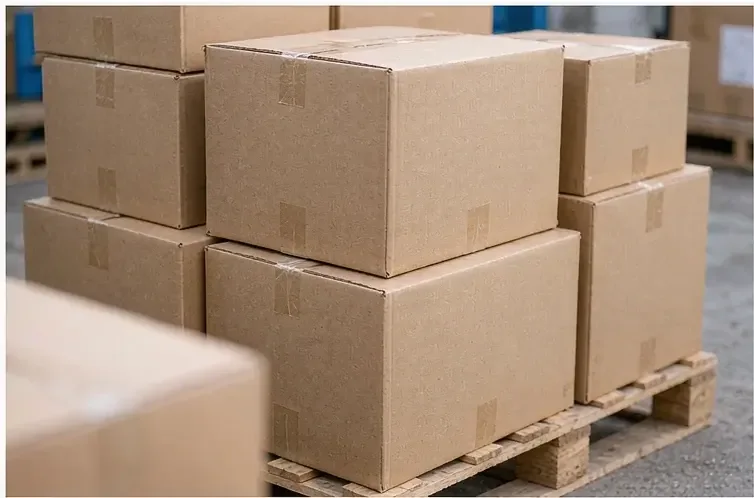
Freight is charged on volume as often as on weight, and an oversized carton is therefore paid for twice: once in board and once in the cube it occupies. Right-sizing the shipper to the packed set is the single packaging change most likely to reduce total landed cost without touching anything the client sees, and it frequently saves more than any material substitution a programme might consider.
- Size the carton to the packed set, not to a nominal carton standard.
- Keep 10 to 15 mm of void fill on every face rather than filling a loose carton.
- Check whether the route is charged on actual or volumetric weight before choosing board.
- Consolidate two small cartons into one where a set is shipped as a pair.
- Remember that a right-sized carton also arrives in better condition, which is the real saving.
What Changes the Number and What Does Not
Three changes move the figure materially: board weight, colour count and carton size. Three changes that programmes expect to matter, and which do not, are stock upgrades on printed matter, closure type on the box, and whether the envelope is printed. Each of the second group is visible in a sample photograph and invisible in the hand, which is why they are argued about at disproportionate length for the money involved.
Changes that move it
Board weight, colour count and carton size. Between them these three explain most of the range in a set cost.
Changes that do not
Card stock upgrades, closure type and envelope print. Visible in a photograph, invisible in the hand.
Reductions clients notice
Board, tissue sheet count and dust bag fabric. Take these last, or not at all.
Reductions clients miss
Printed matter piece count and colour count, and amortised tooling at quantity. Take these first.
Comparing Two Quotations Honestly
Two quotations for what looks like the same set can differ by a third, and the gap is rarely explained by margin. It is usually explained by three silent substitutions: a lighter board at the same quoted grammage, a single-wall shipper where a double-wall was assumed, and a dust bag fabric quoted at the lower end of a weight range. None of the three is dishonest, and all three are invisible in a total figure, which is precisely why the split matters more than the number.
The check takes five minutes and needs no technical background. Compare board grammage line against line, then compare the shipper's edge crush rating, then compare the dust bag fabric weight. If all three match and the totals still differ, the difference is real and worth negotiating. If one of the three differs, the cheaper quotation is not cheaper, it is a different set, and the comparison should be restarted rather than argued.
The same discipline applies across seasons. A set that was costed at launch and then re-quoted twelve months later will usually show movement in two lines only: board, which follows the fibre market, and freight, which follows the carton. A movement anywhere else is a specification change that someone has made without recording it, and packaging files are where unrecorded changes accumulate longest before they are noticed.
Reading a Packaging Quotation
A usable quotation is split the same way the cost is split: board, wrap, dust bag, printed matter, tissue, shipper and tooling, each with a quantity and a unit figure. A single-line quotation hides the two lines that matter and makes a later change impossible to price, because there is no baseline to change from. Ask for the split at the first quotation rather than the third, and ask for the tooling figure to be shown separately.
Two further questions belong in the same email. What is the price at double the quantity, which tells you where the material lot sizes actually fall. And what is the price without the second colour, which tells you how much of the number is process rather than material. Both answers are usually available immediately, and between them they locate the two or three lines worth negotiating.
Take the invisible reductions first: printed matter piece count, colour count, carton volume. Then stop. Board, tissue and dust bag fabric are the reductions a client feels, and taking them to hit a number is how a programme spends more later to undo the saving.
Programme Figures and Where Packaging Sits
Packaging runs on the bag's clock, not a shorter one. Sampling takes 6-10 working days and 12-15 for complex constructions, bulk production runs 35-50 days, inspection sits at AQL 2.5 under ISO 2859-1, and handover is on FOB Xiamen terms, with CIF or DDP available where a programme needs them. Work runs at 500 pcs per style and colourway through our validated partner factory Quanzhou Yingming Bags, an SGS-validated site operating since 2014 with 7 production lines and capacity of about 200,000 pcs per month.
Take this to the bench
- Ask for the cost split in six lines, not one. Take the invisible reductions first; hold board, tissue and dust bag fabric; right-size the carton; and decide packaging quantity once per season rather than once per drop.
Get a split packaging cost
Send the silhouette, the quantity and the markets you ship to, and we will return the cost split line by line with the tooling shown separately. Request a quote
Frequently Asked Questions
How much does luxury handbag packaging cost?
Set against a reference unit cost of USD 4.80, a complete five-layer set adds 40% to 90% of that figure. The range is explained by five variables: board weight, print method, decoration tooling, quantity and carton volume. Board alone carries 40% to 52% of set cost.
What are the six cost centres in a packaging set?
The rigid box at 40% to 52%, the dust bag at 18% to 26%, printed matter at 9% to 15%, tissue at 4% to 7%, the outer shipper at 8% to 14%, and amortised tooling at 3% to 9% at 500 pieces. A quotation that departs from this pattern is usually telling you about the specification.
Which packaging reduction does a client notice most?
Board weight, because it changes how heavy the box feels in the hand and how well it holds a corner. Tissue sheet count and dust bag fabric are next. Reductions to printed matter and to amortised tooling at quantity are effectively invisible, which is why they should be taken first.
How much does reducing board weight save?
Moving from 1,200 gsm greyboard to 900 gsm typically removes 8% to 14% of set cost. On a soft construction that is almost free of consequence. On a structured piece it shows at the corner, so the saving should be confirmed by a corner crush and a 24 hour stack test run packed.
Does colour count really affect packaging cost?
Yes, and linearly. A second colour on a dust bag or card adds a pass, a plate and an approval cycle, and it is the change clients notice least. It is the cleanest lever in the set and the first one worth pulling when a number has to move.
How is decoration tooling priced?
As a fixed cost spread over the run. At 500 pieces a deboss die and a foil die together can carry 3% to 9% of set cost; at 3,000 pieces the same dies carry a fraction of one per cent. A blind deboss costs a die once and then almost nothing per piece.
Should packaging be ordered once a season or once a drop?
Once a season. Splitting a 1,000 piece requirement into two 500 piece orders costs more in material and tooling than the split saves, and it introduces a second artwork approval and a second colour-matching risk, which is where the real money goes.
Why does carton size matter so much?
Because freight is charged on volume as often as on weight, so an oversized carton is paid for twice: once in board and once in the cube it occupies. Right-sizing frequently saves more than any material substitution, and the carton also arrives in better condition.
What should a packaging quotation show?
Six lines with a quantity and a unit figure each: board, wrap, dust bag, printed matter, tissue, shipper and tooling shown separately. A single-line quotation hides the two lines that matter and makes any later change impossible to price against a baseline.
What two questions should I ask about a packaging price?
What is the price at double the quantity, which locates the material lot sizes, and what is the price without the second colour, which shows how much of the figure is process rather than material. Both answers are usually available immediately.
Does a magnetic closure cost much more than a lift-off lid?
Less than most programmes expect, and less than the difference it makes to a sample photograph. Closure type belongs in the group of changes that are argued about at disproportionate length for the money involved; the cost sits mainly in assembly time rather than in material.
How does packaging fit the production schedule?
On the bag's clock. Sampling takes 6-10 working days and 12-15 for complex constructions, bulk runs 35-50 days, inspection sits at AQL 2.5 under ISO 2859-1, and handover is on FOB Xiamen terms. Packaging specified late borrows time from the bag rather than getting a shorter schedule.
People Also Ask
What is a realistic packaging cost for a luxury bag?
Between 40% and 90% of a USD 4.80 reference unit for a complete five-layer set. Board carries the largest share at 40% to 52%, and five variables explain the whole range.
Where should I cut packaging cost first?
Printed matter piece count and colour count, then carton volume. Both are invisible to the client. Board, tissue and dust bag fabric are felt in the hand and should be cut last, if at all.
How does quantity change packaging unit cost?
Tooling is fixed and material breaks at lot sizes. At 500 pieces tooling can carry 3% to 9% of set cost; at 1,000 materials reach standard lots; at 3,000 tooling becomes negligible and material dominates.
Is a heavier board worth the extra cost?
On a structured piece, yes, because the client feels the weight and the corner survives the pallet. On a soft construction the lighter grade usually passes the same corner crush and stack tests, so the saving can be taken.
What is the least costly packaging improvement?
Right-sizing the shipper. It reduces board, reduces freight volume, and improves arrival condition, and it touches nothing the client sees. It frequently saves more than any material change.
Sources and further reading
Every figure on this page is either our own programme data or attributed below. Open the originals before you write them into a specification.
- Technical Association of the Pulp and Paper IndustryTAPPI Test methods that underpin board specification by result rather than by eye.
- ASTM standards for packaging and transit testingASTM International Referenced for compression, drop and vibration practice on packed cartons.
- FSC certification and chain of custodyForest Stewardship Council Reference where certified board affects the material line in a cost split.
- ISO standards catalogueInternational Organization for Standardization Reference for ISO 2859-1 inspection applied to packaging at goods-in.
- REACH legislationEuropean Chemicals Agency Substance restrictions that can affect ink and coating choices and therefore the print line.