Designer Handbag Production Cost Planning Guide: Twelve Cost Lines, Four Levers and the Numbers Behind Each
How should a designer plan the cost of a handbag capsule? Build it as twelve separate lines rather than one unit price, because four of those lines determine almost everything: exterior material absorbs 40-50% of the landed figure, labour 20-28%, hardware and trim 12-18%, and development, compliance and freight the remaining 8-15%. A structured body cut from 1.2-1.4 mm full-grain calfskin never lands at the same figure as the same silhouette in 0.8-1.0 mm lining-grade split, since yield on a patterned panel set falls to roughly 55-65% and every panel lost is paid for twice, once at the tannery and once at the cutting table. Below, each line is set out as a checklist item with the reason it moves, followed by the four levers that actually change the total.
Why a Capsule Cost Is a Map and Not a Number
A quoted unit price tells you what a bag costs and nothing about why. A designer capsule cost behaves like a map of twelve lines, and the four largest — material, labour, hardware and development — account for around 85% of the total, which is where any honest conversation about price has to begin.
The reason founders are surprised by cost is that they negotiate the small lines and inherit the large ones. The trim line is visible and quotable; the yield figure buried inside the material line is neither, and it moves the answer far more.
- Material dominates because you purchase area and ship panels, and the two are never equal.
- Labour is measured in operations, not hours, so a turned edge costs several times a raw one.
- Development is a fixed cost divided by a variable quantity, which is why MOQ changes the answer.
- Compliance is booked per destination market and per lot, so expansion adds a line rather than a rounding.
The Twelve Lines in a Designer Capsule Cost
The table below sets out all twelve lines with the typical share each holds in a landed unit cost and the single variable that moves it most. Shares are indicative ranges drawn from structured calfskin bodies at 500 pcs per colourway.
| Cost line | Share of landed unit cost | What moves it most |
|---|---|---|
| Exterior material | 40-50% | Yield on the panel set; structured bodies convert 55-65% of purchased area |
| Lining and interlining | 5-8% | Lining at 0.8-1.0 mm and interlining at 0.8 mm add both weight and minutes |
| Hardware set | 8-12% | Stock brass holds it low; a bespoke lock adds tooling and a proving step |
| Trim | 4-6% | A #5 metal zip and four base feet; a plated trim set at USD 4.80 is typical |
| Cutting, skiving and splitting | 3-5% | Each skived edge is an operation before assembly even begins |
| Assembly | 12-18% | Stitch density 8-9 per inch; a turned edge takes several times a raw one |
| Edge finishing | 4-6% | Three thin coats with 8-10 minutes of flash time between passes |
| Pattern, grading and development | 3-6% | Toiles and a graded pattern, amortised across the run |
| Sampling rounds | 1-3% | 6-10 working days standard, 12-15 where construction is complex |
| Inspection and correction | 2-4% | AQL 2.5 under ISO 2859-1, then re-check of any corrected batch |
| Packing and presentation | 3-6% | Dust bag, rigid box construction and printed inserts per unit |
| Freight, duty and administration | 4-9% | FOB Xiamen is the default; CIF and DDP are available on request |
Read the third column, not the second. The shares tell you where the money is; the variables tell you what you can still influence, and they are concentrated in material yield, plating choice and the number of edge operations the design calls for.
Material: The Yield You Pay For Twice
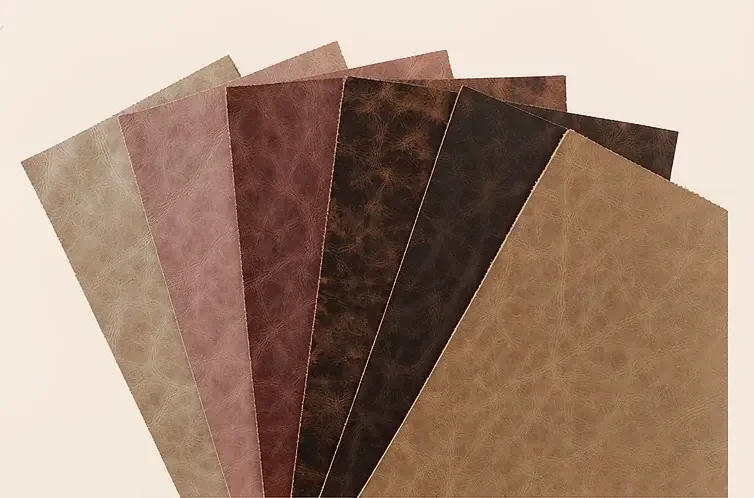
Exterior material dominates a handbag cost for a reason anyone who has watched a hide being cut understands immediately: you buy area and you ship panels. On a structured body the conversion from purchased area to usable panels is typically 55-65%, and the shortfall is not waste in the casual sense but the price of placing panels clear of scars, matching grain direction and keeping the neck and belly off visible faces.
- A 1.2-1.4 mm full-grain body needs more area per unit than the same shape at 0.8-1.0 mm.
- Grain direction must run consistently across a panel set, which reduces how tightly pieces nest.
- Visible faces are cut from the prime area; gussets and bases absorb the lower grades.
- A named lot is reserved before cutting, because yield is a property of that lot and not of the design alone.
This is why two briefs for the same silhouette can differ substantially before any labour is counted. One names a lot with a clean, even grain and a good cutting yield; the other leaves the lot open and inherits whatever arrives.
Hardware and Trim: Small Lines, Large Consequences
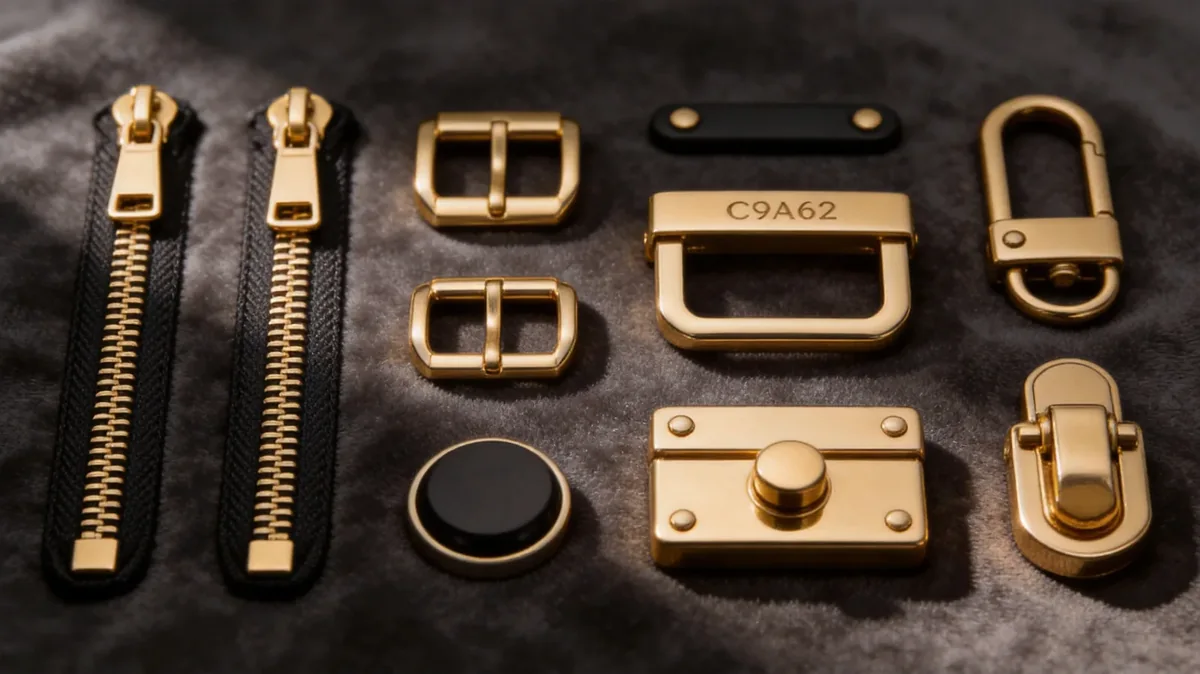
A plated brass trim set at USD 4.80 per bag is ordinary and is rarely where a cost plan breaks. What breaks cost plans is a bespoke closure, which carries tooling, a proving step on the bench and a second sample before a single panel is cut.
- Plating thickness on brass
- 0.15-0.3 µm for gold tones; thinner films show wear at the contact points
- Salt spray proving
- 24 hours for stock finishes, 48 hours for bespoke developments
- Stock versus bespoke lock
- Stock ships on the material calendar; bespoke adds 30-40 working days of tooling
- Zip specification
- #5 metal for main openings, #3 for interior pockets
- Base feet and feet inserts
- Four per body, each a separate setting operation on the bench
The practical guidance is to keep the closure stock and spend the difference on the body. A distinctive silhouette in excellent leather reads as more considered than a distinctive lock on an ordinary one, and it costs less to develop.
Labour Minutes: Where the Money Actually Goes
Labour is the line most often guessed and least often measured. Two operations decide it: stitch density at 8-9 per inch, and edge work, where three thin coats with 8-10 minutes of flash time between passes convert a cut edge into a finished one.
- Every skived edge is an operation before assembly starts, and skiving is hand-guided work.
- Stitch density at 8-9 per inch is slower to sew than the 6-7 per inch used on casual goods.
- Edge finishing in three coats cannot be rushed, because flash time is chemical rather than discretionary.
- Setting a lock, four feet and a zip closure adds discrete operations that scale with quantity only.
- Structured bodies need reinforcement and turning, and turning is the slowest step on the bench.
Labour is also the line where a design decision made in the studio becomes a cost on the bench. A raw edge is a legitimate design choice and it removes an entire operation; a painted edge in three coats is a finish statement and it costs three passes.
Development and Sampling Rounds
Development behaves as a fixed cost divided by a variable quantity, which is exactly why MOQ matters in a cost conversation. A pattern, a graded size set and two toiles exist whether you make 500 units or 5,000, and the per-unit share falls sharply across that range.
- Sampling takes 6-10 working days for a standard build and 12-15 where construction is complex.
- Each additional round costs a pattern revision and a bench build, not merely a courier charge.
- A graded pattern costs more than a single size, because each size changes panel area by roughly 8%.
- Freezing the specification before the second round is the least costly saving available on this line.
The habit that saves the most here is deciding on paper. Two toiles in calico resolve proportion, handle drop and closure placement for a fraction of what a leather round costs, and they resolve them before any hide is cut.
Compliance, Testing and the Lines Designers Forget
Compliance is booked per destination market and per material lot, so it grows when either expands. Colour fastness is assessed under ISO 105, tensile strength under ISO 3376 and finish adhesion under ISO 11644, while chemical restrictions follow REACH Annex XVII, California Prop 65 and CPSIA depending on where the goods are sold.
- Booking tests against a named lot avoids the re-testing that follows any material substitution.
- Annex XVII restricts specific substances, and a restriction issue is far cheaper to solve in the tannery.
- Prop 65 and CPSIA apply to the destination, not the origin, so they appear only when the market does.
- Leather traceability is increasingly evidenced through Leather Working Group audited tanneries.
None of these items individually dominate a cost, but collectively they are the reason a landed figure differs from an ex-works one by a margin that surprises first-time founders.
Four Levers That Move the Number Most
Four levers move a capsule cost by more than a few percent, and they are all design decisions rather than negotiating positions. Every other saving is rounding by comparison.
Levers, in order of effect
- Yield: simplify the panel layout or accept a lower conversion, because material is 40-50% of the total.
- Edge specification: raw, turned or painted in three coats, three operations at three different prices.
- Hardware choice: stock brass keeps the calendar and the cost; bespoke adds tooling and 30-40 days.
- Quantity per colourway: at MOQ 500 pcs each style and colourway carries its own development share.
The order matters. Founders typically reach for the fourth lever first, and it is the one with the least influence per unit of effort once the other three are settled.
Three Capsule Sizes, Costed Differently
The same silhouette lands at three different figures depending on how the capsule is structured. These three configurations cover most first and second collections.
500 pcs, one colourway
The development share is carried by a single run, so the per-unit figure is highest. Material yield of 55-65% applies once, and one lot serves the whole order.
1,500 pcs across three colourways
Development is amortised three ways and each colourway meets MOQ 500 pcs. Three lots are reserved, and yield should be confirmed on all three before cutting.
3,000 pcs with a bespoke lock
The best per-unit development share, offset by tooling on the closure. Allow 30-40 working days for the lock and prove it at 48 hours of salt spray.
The middle configuration is usually the sensible first target. It keeps three distinct lots at a defensible per-unit development share without committing the capsule to a bespoke closure before the silhouette has sold.
Planning the Capsule Across One Calendar
A cost plan without its calendar attached is incomplete, because several lines are time-dependent. Material is reserved against a lot, compliance is booked against that lot, and bulk occupies 35-50 days regardless of what the rest of the plan assumes.
What to Send for a Costed Answer
A costed answer needs the same six inputs every time, and sending them together is what turns an estimate into a figure you can plan a season around.
- Dimensioned drawings or a reference piece, with every intended change noted.
- The material direction, including thickness such as 1.2-1.4 mm for the body and 0.8-1.0 mm for linings.
- Quantity per style and per colourway, since MOQ 500 pcs applies to each combination.
- Hardware direction: stock or bespoke, and the finish, for example 0.15-0.3 µm gold over brass.
- Destination markets, because testing and documentation are booked per market.
- The date the goods must reach the warehouse, so the calendar can be built backwards from it.
The programme is carried out through our validated partner factory Quanzhou Yingming Bags, an SGS-validated site with 7 production lines and about 200,000 pcs per month of capacity, holding export experience since 2014. Third-party inspection can be added alongside the internal AQL 2.5 audit.
Get your capsule costed line by line
Send your drawings, target dimensions, material direction and quantity per colourway. You will receive the twelve lines with your own shares and the four levers marked, within two working days. Request a quote.
Frequently Asked Questions
How should a designer plan the cost of a first handbag capsule?
Plan it as twelve separate lines rather than one figure, and weight the four largest of those first. Exterior material absorbs 40-50% of the landed unit cost, labour 20-28%, hardware and trim 12-18%, and development, compliance and freight carry the remaining 8-15% between them. Everything else is rounding.
Why does material dominate handbag cost planning so heavily?
Because you purchase area and ship panels, and the two are never equal. On a structured body the conversion from purchased hide area to usable panels is typically 55-65%, so every panel lost to nesting constraints, grain direction or scar placement is paid for twice, once at the tannery and again at the cutting table.
What does a typical hardware and trim line look like?
A plated brass trim set at USD 4.80 per bag is ordinary and holds the line at 12-18% of the landed cost together with the closure. A bespoke closure is the exception, since it adds tooling, a proving step on the bench and roughly 30-40 working days before any panel can be cut.
How does stitch density affect the labour line?
Stitch density at 8-9 per inch is materially slower to sew than the 6-7 per inch used on casual goods, and it is guided by hand. Together with three-coat edge finishing at 8-10 minutes of flash time per pass, those two operations decide most of the assembly cost on a structured body.
What is the minimum quantity used in a cost plan?
MOQ 500 pcs per style and colourway. That figure matters to costing because development is a fixed amount divided by the run: a pattern, a graded size set and two toiles exist whether you make 500 or 5,000, so the per-unit share falls sharply across that range, and the material line moves with it.
How long do sampling and bulk take in the cost calendar?
Sampling takes 6-10 working days for a standard build and 12-15 where the construction is complex or a bespoke closure must be proved. Bulk then takes 35-50 days from intake, and inspection is drawn at AQL 2.5 under ISO 2859-1 before packing and documents, which take a further three to five working days.
Which compliance standards appear on a handbag cost line?
Colour fastness is assessed under ISO 105, tensile strength under ISO 3376 and finish adhesion under ISO 11644. Chemical restrictions follow REACH Annex XVII for the European market, with California Prop 65 and CPSIA applying where goods are sold in the United States. Each is booked per lot and per market.
How much do packing and presentation add per unit?
Typically 3-6% of the landed unit cost, covering the dust bag, rigid box construction and printed inserts. It is a small line carrying disproportionate weight, since presentation is the first thing a boutique customer touches before the bag itself, and it is the part most often left until the run is nearly finished.
What are the four levers that move a capsule cost most?
Material yield, edge specification, hardware choice and quantity per colourway. Yield leads because material is 40-50% of the total, the edge decision removes or adds entire operations, stock brass avoids tooling, and quantity governs how thinly development is spread. Ordering them by effect is what makes the list useful.
Is a bespoke closure worth the additional development cost?
Occasionally, and usually on the second capsule rather than the first. A distinctive silhouette in excellent leather reads as considered without any tooling, whereas a bespoke lock adds 30-40 working days and a proving step before a single panel is cut, which is a long commitment for an unproven shape.
How does the trade term change the landed figure?
FOB Xiamen is the default and leaves freight, duty and administration to the buyer. CIF and DDP are available on request and move those items into the quoted figure, which is why a landed cost can differ from an ex-works one by 4-9% depending on the term agreed at quotation rather than at handover.
What should be sent to receive a costed answer?
Six inputs: dimensioned drawings or a reference piece with changes noted, the material direction including thickness, quantity per style and colourway, the hardware direction and finish, the destination markets, and the date the goods must arrive. Sent together, they also shorten the reply to two working days.
People Also Ask
Why are designer handbags expensive to develop?
Development is a fixed cost — pattern, graded sizes, toiles and sampling — divided across a relatively small run. At MOQ 500 pcs per colourway, that fixed amount carries a much larger per-unit share than it would on a longer run.
What is a realistic yield on a structured leather panel set?
Roughly 55-65% of purchased hide area becomes usable panels. The shortfall covers nesting constraints, consistent grain direction and keeping the neck and belly away from visible faces on the body.
How can a designer lower the cost without lowering the quality?
Simplify the panel layout to raise yield, keep the closure stock, and choose the edge specification deliberately. Those three preserve the leather and the construction while removing operations rather than substance from the bag.
How long does a first capsule take from brief to delivery?
About 55-75 working days on a standard calendar: 15-20 on material reservation, 6-10 on sampling, 35-50 on bulk and 3-5 on inspection, packing and documents, with buffers held between the gates.
Do compliance costs apply to every market the goods enter?
Yes. Testing and documentation are booked per destination market and per material lot, so entering the United States adds Prop 65 and CPSIA considerations alongside the REACH Annex XVII work done for Europe.
Sources and further reading
Every figure on this page is either our own programme data or attributed below. Open the originals before you write them into a specification.
- ISO — International Organization for StandardizationISO Publisher of ISO 2859-1 for the AQL 2.5 inspection plan, ISO 105 for colour fastness, ISO 3376 for tensile strength and ISO 11644 for finish adhesion.
- Leather Working GroupLeather Working Group Tannery audit protocol referenced when a named lot is reserved, which governs how early the material line can be fixed in a cost plan.
- ECHA — European Chemicals AgencyEuropean Chemicals Agency Administrator of REACH Annex XVII, the restricted substance list that decides which chemical test lines appear for the European market.
- OEHHA — California Proposition 65Office of Environmental Health Hazard Assessment The state authority administering Proposition 65, whose listed substances determine whether an additional compliance line is booked for United States distribution.
- Sourcing JournalSourcing Journal Reporting on leather prices, freight conditions and material lead times, used for the market ranges quoted on the material and freight lines.