Premium Handbag Manufacturer Packaging Standards: Seven Questions From Board Weight to the Unboxing
What should a premium handbag presentation actually specify? Seven questions answer it, in this order: what the box protects, how much structure the unit price allows, what sits inside, whether the shipping carton survives transit, what compliance asks of the board and inks, where the branding goes, and how the unboxing is judged. Working figures for a 500-piece run: a rigid box built on 1200 gsm greyboard wrapped in 157 gsm art paper, acid-free tissue at 17 gsm, a dust bag in 8 oz cotton, and a five-ply shipping carton tested to an ISTA transit sequence. Presentation at this level typically lands around USD 4.80 per unit.
Question One: What Is the Box Protecting?
A presentation box protects three different things and they are not equally obvious: the silhouette during storage, the leather surface during handling, and the customer's first impression in the first four seconds.
Silhouette protection is the one most often missed. A structured bag stored flat under weight will slump, and a box that is too tight will hold that slump permanently. The internal clearance should allow the piece to sit at its natural depth with roughly 10-15 mm of headroom, not pressed and not rattling.
Surface protection is simpler and it is the reason a dust bag exists at all. Leather rubs against board, board carries ink, and ink transfers. Separating the two with a soft layer is the least costly protection in the whole specification.
Question Two: How Much Structure Can You Afford?
Structure is bought in board weight and in closure type, and at 500 pieces the two together decide most of the unit cost: a rigid lid-and-base box on 1200 gsm greyboard wrapped in 157 gsm art paper is the working standard, and a magnetic closure is the first upgrade worth paying for.
Below that standard, a 600-800 gsm folding carton reads as secondary packaging rather than as presentation, and above it — a fully wrapped rigid box with a shoulder neck and a ribbon pull — the cost climbs faster than the perceived gain. The shoulder neck is the one genuine exception: it changes how the lid lands, and customers notice that more than they notice any print finish.
- Rigid board substrate
- 1200 gsm greyboard for lid-and-base presentation boxes
- Wrap paper
- 157 gsm art paper, printed and laminated or left uncoated
- Folding carton alternative
- 600-800 gsm board, suitable where presentation is secondary
- Internal clearance
- 10-15 mm headroom so a structured piece is neither pressed nor loose
- Tissue paper
- 17 gsm acid-free, two sheets, folded rather than crumpled
Those five figures are the whole structure conversation. Board weight sets rigidity, wrap weight sets how the print reads, clearance sets whether the silhouette survives storage, and tissue weight is the difference between protection and packaging.
Question Three: What Sits Inside the Box?
Four items belong inside, and a fifth is optional: the dust bag, two sheets of acid-free tissue, a care card, a silica sachet, and optionally a numbered authenticity card with a lot reference.
The dust bag carries more weight than its cost suggests. An 8 oz cotton bag with a drawstring reads as considered; a lightweight non-woven bag reads as an afterthought, and customers feel the difference before they see it. Match the bag to the piece rather than to a house standard, because a small evening bag in an oversized dust bag looks like an error.
- Dust bag: 8 oz cotton with a drawstring, sized to the piece, not to a house standard.
- Tissue: 17 gsm acid-free, folded in two sheets, never crumpled into the cavity.
- Care card: printed on uncoated stock, with the leather type named rather than described generically.
- Silica sachet: sized to the carton rather than to the box, typically 5 g per shipping carton.
- Authenticity card: optional, and worth it only where it carries a lot or style reference.
The silica point is genuinely technical rather than decorative. Leather stores best around 45-55% relative humidity, and a sachet in the shipping carton rather than in the presentation box is what protects against a container crossing an equator.
Question Four: Does the Carton Survive the Journey?
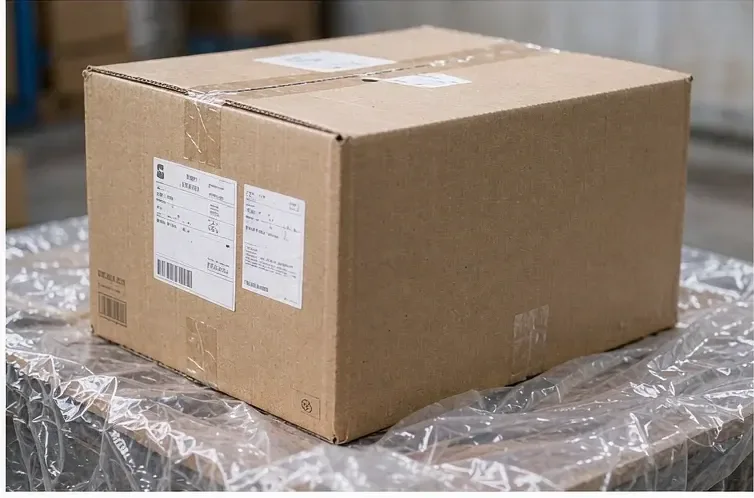
The shipping carton is a separate specification from the presentation box and it is tested to a different standard: five-ply corrugated board, a stated burst or edge-crush rating, and a transit test sequence rather than a visual check.
The International Safe Transit Association publishes the sequences most commonly used, with ISTA 1A covering non-simulation integrity testing and ISTA 2A adding a partial simulation. Ask which sequence was run, on what carton weight, and read the report rather than the claim.
| Element | Working specification | Why it is set there |
|---|---|---|
| Shipping carton | Five-ply corrugated, BC flute, stated edge-crush rating | Resists stacking load in a container over a long transit |
| Carton weight limit | Commonly held around 15 kg per carton | Above this, handling damage rises sharply at every transfer |
| Transit test | ISTA 1A integrity sequence, or ISTA 2A partial simulation | Drop, vibration and compression, not a visual inspection |
| Internal protection | Presentation boxes separated, void filled, no movement | Movement inside a carton is the largest single cause of scuffing |
| Palletisation | 1200 x 800 mm footprint, stretch-wrapped, corner boards | Matches standard container and warehouse handling across markets |
One habit prevents most transit damage: shake the packed carton before it is sealed. If anything moves inside, the void fill is wrong, and no amount of board weight will compensate for that.

Question Five: What Does Compliance Ask of a Box?
Compliance asks three things of packaging: that the board is sourced credibly, that the inks and coatings meet the chemical restrictions of the destination market, and that any fibre or material claim on the box is accurate.
The first is answered by chain-of-custody certification, with FSC the scheme most often referenced for board. The second is answered by declarations against REACH Annex XVII in the European Union and California's Proposition 65 in the United States, both of which concern substances in inks, coatings and adhesives rather than in the board itself.
- Board: FSC chain-of-custody claim stated, with the claim type named rather than implied.
- Inks and coatings: declarations held against the print specification, dated, not generic.
- Adhesives: covered by the same declarations, and the most commonly forgotten line.
- Fibre claims: textile composition rules apply to dust bags, so name the fibre accurately.
- Country of origin marking: required by most destinations, and placed where it will not be removed.
The dust bag is the item that catches people out. Once it carries a fibre claim it is a textile article, and the European fibre-name regulation applies to how that claim is written, so a generic description is not sufficient.
Question Six: Where Does the Branding Go?
Branding belongs in three places and no more: a foil or blind-emboss mark on the lid, a repeat or plain dust bag, and a care card. A fourth mark, usually a logo printed on the tissue, reads as noise.
Choose the finish by what the mark has to survive. Hot foil stamping gives a crisp metallic edge on a laminated wrap; blind embossing reads best on an uncoated stock and ages better; and a printed mark is the right choice when the logo has fine detail or a gradient that foil cannot hold.
Hot foil stamping
Crisp metallic edges on a laminated wrap, the strongest read under retail lighting. Avoid on very fine detail, which fills in at small sizes.
Blind embossing
No colour, no foil, and it ages better than any applied finish. Best on uncoated stock, where the depth of the impression is what carries it.
Printed mark
The right answer for a logo with fine detail or a gradient. Pantone-matched, and proofed on the actual wrap rather than on a substitute.
Proof on the production substrate. A logo approved on white proofing paper and then run on a matte-laminated wrap is a different colour, and that difference is discovered on a shelf rather than in a sample room.
Question Seven: How Is the Unboxing Actually Judged?
An unboxing is judged in about four seconds on three things: the resistance of the lid as it lifts, the order in which the contents are revealed, and whether anything looks like it was packed in a hurry.
Lid resistance is the most controllable of the three and the most often wrong. Too loose and the box feels empty; too tight and the customer fights it, which is worse. A shoulder neck, where the lid sits proud of the base by a couple of millimetres, gives the consistent resistance that luxury presentation is read by.
Reveal order is sequence rather than design. Tissue first, then the dust bag, then the piece; a care card tucked rather than dropped on top; and nothing rattling. Photograph the open box from above and check whether the composition reads deliberate or accidental, because that is exactly how a customer will see it.
Specification Table for a Standard Presentation
The table below is a complete working specification for one structured handbag at 500 pieces, with every line stated as a figure rather than as an intention, which is the only way a packing specification can be checked.
| Element | Specification | Note |
|---|---|---|
| Presentation box | Rigid lid-and-base, 1200 gsm greyboard | Shoulder neck where the unit price allows |
| Wrap | 157 gsm art paper, matte lamination | Proof the logo on the actual wrap |
| Closure | Concealed magnetic, two points | First upgrade worth paying for |
| Branding | Hot foil on lid, one position | Blind emboss on uncoated stock instead |
| Dust bag | 8 oz cotton, drawstring, sized to piece | Fibre claim must be accurate |
| Tissue | 17 gsm acid-free, two sheets, folded | Never crumpled into the cavity |
| Insert | Moulded pulp or EVA, cut to silhouette | Holds shape without pressing the piece |
| Silica | 5 g sachet per shipping carton | Targets 45-55% relative humidity |
| Shipping carton | Five-ply corrugated, BC flute | Around 15 kg per carton, stated rating |
| Transit test | ISTA 1A or 2A sequence | Read the report, not the claim |

Four Packaging Mistakes Seen Most Often
The same four mistakes account for most presentation failures, and all four are visible in a photograph rather than in a specification, which is why they survive so long.
- An oversized dust bag, which makes a small piece look like an error rather than a choice.
- Crumpled tissue, which reads as haste at exactly the moment a customer is deciding how much care was taken.
- A logo approved on white proofing paper and printed on a matte laminate, arriving a different colour.
- Void fill that leaves the presentation box free to move, which scuffs corners over a long transit.
All four are caught by one discipline: pack a complete unit from production stock, ship it to yourself by the route your customers will use, and open it. Nothing in a specification substitutes for that.
Costing Presentation at 500 Pieces
Presentation at this level typically lands around USD 4.80 per unit at 500 pieces, with board weight, closure type and print finish as the three variables that move it most.
Board weight is roughly linear in cost, closures step rather than scale, and print finishes cost a plate plus a run charge, which is why a foil mark is proportionately dearer at 500 pieces than at 5,000. Plan the presentation specification at the same time as the product, since its own minimums and plate charges behave the same way.
The programme holds export experience since 2014 across 7 production lines with about 200,000 pcs per month of capacity, delivered through our validated partner factory Quanzhou Yingming Bags, an SGS-validated site, with inspection drawn at AQL 2.5 under ISO 2859-1 and handover on FOB Xiamen terms. Alongside it, MOQ sits at 500 pcs per style and colourway, sampling runs 6-10 working days and 12-15 for complex constructions, and bulk runs 35-50 days from a signed approval sample.
Specify the presentation alongside the product
Send the silhouette and the quantity, and we will return a full packing specification with board weights, finishes and a transit test plan. Request a quote.
Frequently Asked Questions
What board weight should a premium presentation box use?
Rigid lid-and-base boxes are built on 1200 gsm greyboard, wrapped in 157 gsm art paper. A folding carton at 600-800 gsm is available and reads as secondary packaging, so it suits a piece whose presentation is deliberately understated rather than a hero style. Board weight is roughly linear in cost, so moving from a folding carton to a rigid box is the largest single step in the unit figure.
Is a magnetic closure worth the extra cost?
At 500 pieces, usually yes. Closures step in cost rather than scaling, so a concealed two-point magnetic closure is proportionately dearer than at volume, but it changes how the lid lands and customers notice that more than they notice any print finish. A ribbon pull and a shoulder neck are the two upgrades after it, and the neck changes how the lid lands, which customers do notice.
What should be inside a handbag presentation box?
A dust bag sized to the piece, two sheets of acid-free tissue folded rather than crumpled, a care card, and a silica sachet in the shipping carton rather than in the box. An authenticity card is optional and worth it only where it carries a lot reference.
Why is the dust bag material specified so precisely?
Because it is felt before it is seen, and because a fibre claim makes it a textile article. An 8 oz cotton bag with a drawstring reads as considered; a lightweight non-woven one reads as an afterthought, and the fibre description on it must be accurate.
How is a shipping carton tested?
To a published transit sequence rather than by eye. The International Safe Transit Association sets the commonly used ones, with ISTA 1A covering integrity testing and ISTA 2A adding partial simulation covering drop, vibration and compression. Ask for the report rather than the claim, check the carton weight it was run on, and repeat the test whenever the carton specification changes.
How much should one shipping carton weigh?
Commonly held around 15 kg. Above that figure, handling damage rises sharply at every transfer point, so splitting a heavy presentation into two cartons usually costs less than the returns it prevents. Splitting into two cartons adds a carton charge and a little handling, and both are small against the cost of goods arriving scuffed or crushed.
What compliance documents apply to packaging?
Three: an FSC chain-of-custody claim for the board, declarations covering inks, coatings and adhesives against the destination's chemical restrictions, and accurate fibre description on any dust bag carrying one. Country of origin marking is required by most destinations, and it must sit where it will not be removed when the box is opened or resold.
Which branding finish should I choose?
Hot foil for a crisp metallic edge on a laminated wrap, blind embossing for an uncoated stock that will age well, and print for a logo with fine detail or a gradient. Proof on the production substrate in every case. A logo approved on white proofing paper and then run on a matte laminate arrives a different colour, which is discovered on a shelf.
Why does lid resistance matter so much?
Because it is the first physical signal a customer receives. Too loose and the box feels empty; too tight and the customer fights it. A shoulder neck, where the lid sits proud of the base by a couple of millimetres, gives consistent resistance. Too loose and the box feels empty; too tight and the customer fights it, and both are read as carelessness rather than as design.
How much does premium packaging cost per unit?
Presentation at this level typically lands around USD 4.80 per unit at 500 pieces, with board weight, closure type and print finish as the three variables that move it most. Foil carries a plate charge, so it is proportionately dearer at lower quantities. Specify presentation alongside the product, since board, closures and finishes each carry their own minimums and plate charges.
When should packaging be specified?
At the same time as the product, not after it. Board, closures and print finishes each carry their own minimums and plate charges, so a specification added at the end of a programme is specified under pressure and costs more. Board, closures and print finishes each carry minimums and lead times of their own, and a late specification is a rushed one.
How can I check a packing specification before bulk?
Pack one complete unit from production stock, send it to yourself by the route your customers will use, and open it. Nothing in a specification substitutes for that, and it catches all four of the failures seen most often. Send it by the route your customers will use, open it on arrival, and photograph the result before anyone else touches it.
People Also Ask
What makes handbag packaging feel premium?
Three things judged in about four seconds: the resistance of the lid as it lifts, the order in which contents are revealed, and whether anything looks packed in a hurry. All three are specified in figures rather than adjectives.
How thick should a luxury box be?
Rigid lid-and-base presentation boxes are built on 1200 gsm greyboard wrapped in 157 gsm art paper. Folding cartons at 600-800 gsm suit deliberately understated presentation rather than a hero style.
What goes inside a designer bag box?
A dust bag sized to the piece, two folded sheets of 17 gsm acid-free tissue, a care card, and a 5 g silica sachet in the shipping carton rather than in the box itself to hold humidity near 45-55%.
How are shipping cartons tested?
To a published ISTA transit sequence, commonly 1A for integrity or 2A for partial simulation, covering drop, vibration and compression. Read the report and the carton weight it was run on rather than accepting a claim.
Does packaging need compliance documents?
Yes. Board carries an FSC chain-of-custody claim, inks and coatings carry declarations against the destination's chemical restrictions, and any dust bag with a fibre claim must describe that fibre accurately.
Sources and further reading
Every figure on this page is either our own programme data or attributed below. Open the originals before you write them into a specification.
- FSCForest Stewardship Council Chain-of-custody scheme referenced for board and paper used in presentation boxes and cartons.
- ISTAInternational Safe Transit Association Publishes the transit test sequences, including ISTA 1A and 2A, used to qualify shipping cartons.
- ISO — International Organization for StandardizationISO Publisher of ISO 2859-1, the sampling standard applied when packed goods are inspected before handover.
- EUR-LexEUR-Lex Access to European Union legislation, including the fibre-name regulation applied to dust bag labelling.
- ECHAEuropean Chemicals Agency Administers REACH, including the Annex XVII restrictions relevant to inks, coatings and adhesives on packaging.