What Makes a Premium Handbag Manufacturer Different: Twelve Checks a Buyer Can Run in Ten Minutes
What actually makes a premium handbag producer different from a standard one? The difference is measurable, not atmospheric: full-grain calfskin held at 1.2-1.4 mm rather than thinner corrected grain, folds skived to 0.6-0.8 mm instead of folded full thickness, 8-9 stitches per inch instead of 6-7, and an edge built from three thin coats instead of one heavy pass. Each of those can be checked by hand in a showroom without any instrument at all. Below are the twelve checks in the order a buyer would run them, followed by what premium work genuinely does not buy you, so that the extra cost can be judged against evidence rather than against a story.
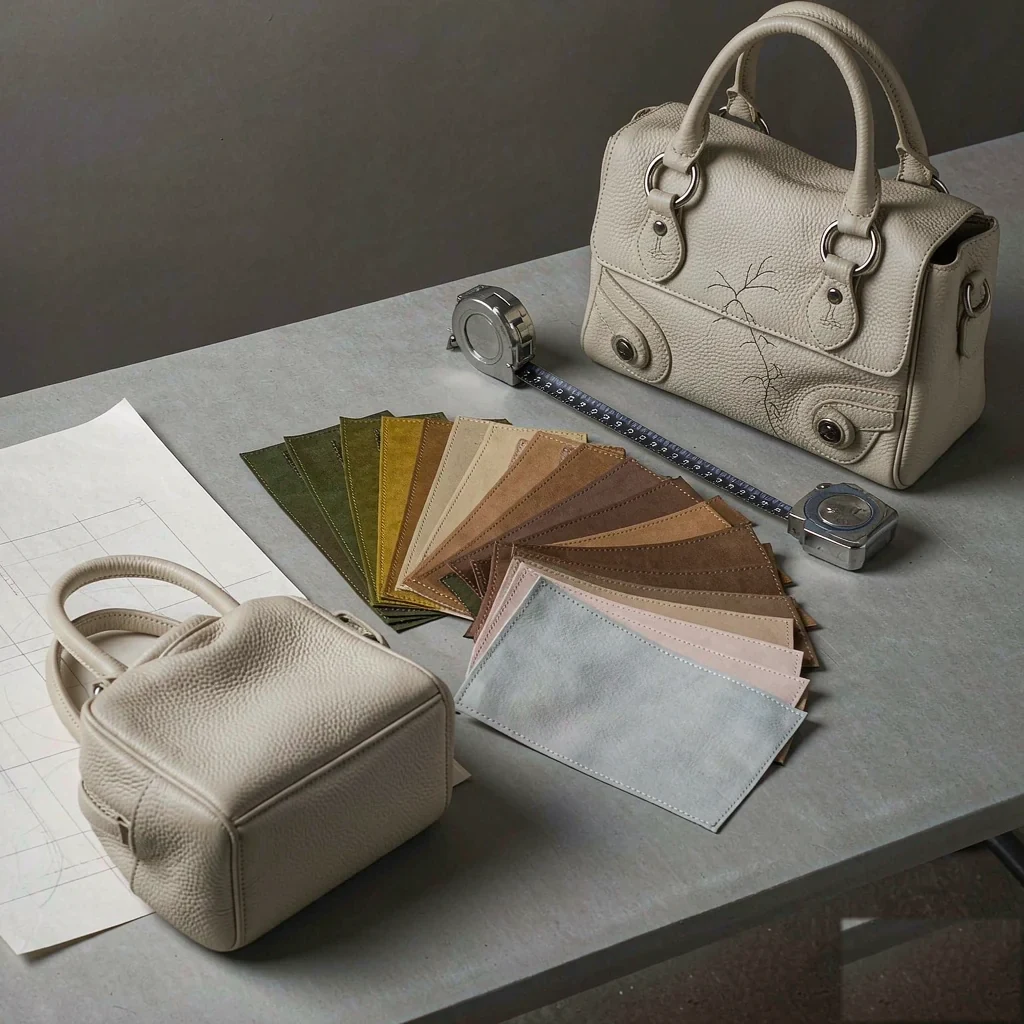
Twelve Checks, in the Order a Buyer Runs Them
A buyer deciding whether a bag is premium has about ten minutes and a well-lit table. The twelve checks below are ordered so that the fastest ones come first and the ones needing a sample or a document come last. None requires a laboratory, and each one corresponds to a decision taken on the bench weeks earlier.
- Weigh the bag empty; a structured body that feels light usually means thin leather over heavy board.
- Run a thumb along a fold; a premium fold tapers, while a standard one steps.
- Count stitches in one inch on a structural seam; 8-9 is premium, 6-7 is standard.
- Look at the edge under raking light; three thin coats read as a smooth arc, one heavy pass reads as a ridge.
- Open and close the closure twenty times; plating that is too thin already shows at the contact point.
- Turn the lining out; a premium interior is cut to the same tolerance as the exterior.
- Set the bag on a table; feet, base and gusset should meet the surface together.
- Flex the handle at its apex; reinforcement should distribute the load rather than create a hard point.
- Compare two units of the same colourway under one light source; the shade should not drift.
- Check that hardware finishes match across feet, rings and strap ends.
- Ask which lot the leather came from and whether one lot covers the whole colourway.
- Ask what inspection plan was drawn, and whether it was agreed before cutting began.
Substance and Skiving: What the Hand Feels First
Substance is the first thing a hand registers and the last thing a photograph shows. A structured body in full-grain calfskin at 1.2-1.4 mm carries its own shape, while the same body at 0.9-1.0 mm needs interlining to stand, and the interlining is what eventually cracks at the fold. Skiving is the second half of the same decision: every fold is reduced to 0.6-0.8 mm so that two panels meeting at a corner make one thickness rather than two.
Bench values behind the first two checks
- Panel substance on a structured body: 1.2-1.4 mm full-grain calfskin, measured before skiving.
- Fold thickness: 0.6-0.8 mm, checked with a dial gauge at five points along the fold.
- Interlining: 0.8 mm where reinforcement is genuinely needed, and nowhere else.
- Gusset and base: the same substance as the body, since a lighter base is the first thing to sag.
- Yield: a graded pattern changes panel area by roughly 8% per size, which alters how much hide is needed.
Stitch Density and Thread: The Seam Tells the Truth
Seams are the most honest part of a bag because they cannot be finished into looking better than they are. Premium structural seams run at 8-9 stitches per inch with a bonded thread around 0.45 mm in diameter; standard work often runs 6-7 per inch with a thicker thread that fills the hole rather than closing the seam. The denser seam holds its line under load and does not open at the corner when the bag is overfilled.
- Count stitches on a structural seam, not on a decorative one, since decorative runs are often set differently.
- Look at the needle holes: a thread that fills the hole completely leaves no room for the leather to relax.
- Handles and straps are usually set one stitch per inch denser than the body, at 9-10.
- Check the backstitch at the start and end of a run; its absence is the classic source of a seam that unravels.
Edge Finish: Three Coats Against One
Edge finish is where premium work is easiest to fake on a sample and hardest to fake on a fiftieth unit. Three thin coats, each roughly 0.12 mm, sanded between passes, produce an edge that flexes with the panel. One heavy coat photographs beautifully on day one and then cracks at the corner within a season, because a thick film cannot follow the leather it sits on.
- Edge build
- Three coats of about 0.12 mm each, sanded and re-checked between passes
- Drying interval
- Each coat cures before the next is applied; the interval is a gate, not a preference
- Corner treatment
- Radius tightened at corners so the film has no sharp turn to bridge
- Colour match
- Edge paint matched to the lot rather than to a standard swatch card
- Flex check
- Folded panel examined under raking light for hairline cracking before packing
The reason this matters commercially is timing. An edge that survives the sample may still fail at unit four hundred, and by then the fix is a re-work across a finished lot rather than a change of technique at the bench. Recording the build at sampling is what turns a subjective complaint into a checkable one.
Hardware Provenance and Plating Thickness
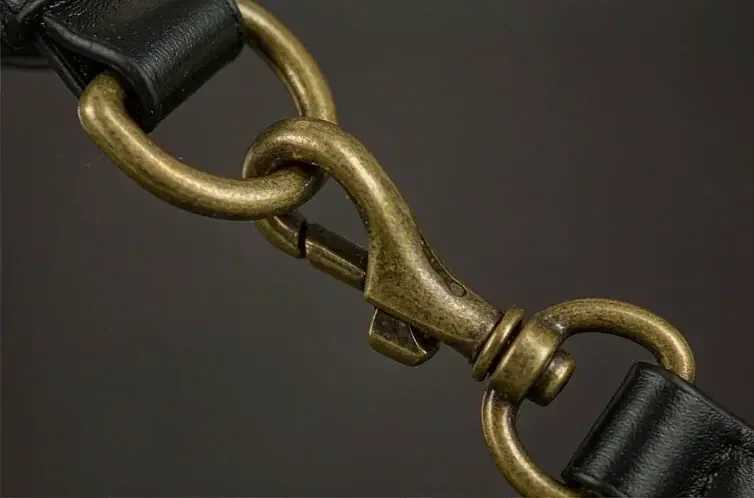
Hardware is the element most often substituted after approval, and substitution is invisible until it wears. A brass component with 0.15-0.3 µm of plating, proved at 24 hours of neutral salt spray under ISO 9227, behaves differently from the same component at half the thickness; the difference appears at the contact points first, which is exactly where a buyer's eye goes.
- Ask for the plating thickness in microns rather than for a finish name, which is not a measurement.
- Prove a turn-lock for at least 5,000 open and close cycles before panels are cut to it.
- Specify one finish family across feet, rings, strap ends and the closure so the bag reads as one object.
- Keep a signed reference component from the approved sample; it is the only reliable comparison later.
Reinforcement You Cannot See but Can Feel
Reinforcement is the least discussed and most felt part of a bag. It decides whether a handle spreads its load across the panel or concentrates it in one spot, whether a base holds a rectangle or becomes a hammock, and whether a top line stays straight after a month of being carried. Good reinforcement is distributed; bad reinforcement is a hard point that eventually shows through the leather.
Handle apex
Load should spread across the panel over at least 60 mm, not sit on one rivet. A hard point here is the most common cause of a handle that tears out rather than wears out.
Base and feet
A 0.8 mm reinforcement board under the base keeps the rectangle true when the bag is set down loaded. Feet should be fitted to the reinforced area, not merely glued to the lining.
Top line
A straight top line needs a concealed stiffener sized to the opening. Without it the mouth bows outward within weeks and the closure stops meeting cleanly.
Colour Consistency Across a Lot and a Re-Order
Colour is where premium programmes most often lose a client, because the failure appears only at the re-order. Leather is a natural material and every dye lot differs slightly, so consistency is a matter of holding one lot per colourway and recording it, rather than of asking for a match each time. The table below shows where the drift typically comes from.
| Element | Typical drift | How it is controlled |
|---|---|---|
| Exterior leather | Visible between two dye lots of the same article | One reserved lot per colourway, recorded at sampling |
| Lining | Less visible but obvious when panels are compared side by side | Lining booked from the same lot as the exterior run |
| Edge paint | Often reads darker under retail lighting than in the workshop | Matched to the lot, approved under the retail light temperature |
| Thread | Small but noticeable on a contrast stitch | One thread batch per style, noted on the technical pack |
| Hardware finish | Plating baths vary between runs | Reference component retained and compared at intake |
The practical consequence is that a re-order placed on a held lot looks like the launch drop, while a re-order placed eighteen months later on a fresh lot usually does not. That is not a defect in the leather; it is a decision that should be made deliberately rather than discovered on receipt.
Inspection: A Plan Agreed Before Cutting
Premium programmes agree the inspection plan before cutting begins, and standard ones discuss it once the goods are finished. The plan is drawn at AQL 2.5 under ISO 2859-1, with the general inspection level fixed for the lot size. Agreeing it early changes behaviour upstream, because the bench then knows exactly what the end of the run will be measured against.
- A 500 pcs lot at general inspection level II uses code letter H: 50 units drawn, accept 3, reject 4.
- At 1,200 units the same plan uses code letter J: 80 units drawn, accept 5, reject 6.
- Defects are classified as critical, major and minor before inspection, not during it.
- Corrections are re-checked rather than merely counted, and the record is kept against the operation that caused them.
What Premium Does Not Buy You
Premium work does not buy a shorter calendar, an unlimited number of revisions, or immunity from material reality. Bulk still takes 35-50 days because drying and curing intervals are physical; a revision after panels are cut still costs the lot; and a listed skin still needs permit documents that no workshop can issue on your behalf. What premium buys is predictability inside those limits.
- It does not compress a calendar: sampling stays at 6-10 working days, or 12-15 on complex builds.
- It does not remove MOQ: 500 pcs per style and colourway still applies on FOB Xiamen terms.
- It does not make a listed skin simple; permits still run on an authority's timetable.
- It does mean the finish you approved is the finish you receive, measured rather than asserted.
The programme behind these checks runs across 7 production lines with about 200,000 pcs per month of capacity and has held export experience since 2014, carried out through our validated partner factory Quanzhou Yingming Bags, an SGS-validated site. Third-party inspection can be added alongside the internal AQL 2.5 audit where a retailer requires it.
Run the twelve checks on your current sample
Send the bag you are comparing, or the drawings for the one you want built. You will receive the twelve checks applied to it line by line, with the bench values we would hold, within two working days. Request a quote.
Frequently Asked Questions
What is the fastest way to tell premium work from standard work?
Count the stitches in one inch on a structural seam and run a thumb along a fold. Premium work runs 8-9 stitches per inch and tapers every fold to 0.6-0.8 mm, so the corner makes one thickness. Standard work runs 6-7 per inch and folds at full substance, which is why its corners stand proud.
Why does leather substance matter so much on a structured body?
Because substance is what holds the shape. At 1.2-1.4 mm full-grain calfskin carries a panel without help, while at 0.9-1.0 mm the same panel needs heavy interlining to stand, and that interlining is what eventually cracks at the fold and telegraphs through the surface.
What is skiving and why is it done at every fold?
Skiving thins the leather where two panels meet, down to 0.6-0.8 mm at the fold. Without it a corner carries double substance, which looks bulky, resists closing cleanly and creates a ridge that eventually wears through the edge finish from the inside outward.
How many stitches per inch should a premium bag have?
Eight to nine per inch on structural seams with a bonded thread around 0.45 mm in diameter, and 9-10 per inch on handles and straps, which carry more load. The purpose is not decoration: a denser seam distributes load along its length instead of concentrating it between widely spaced needle holes.
Why is edge finish built from three coats instead of one?
Because a thick single film cannot flex with the panel it sits on. Three coats of roughly 0.12 mm, each cured and sanded before the next, move with the leather and stay intact at the corner. A heavy single pass photographs well and then hairlines within a season of being carried.
How should hardware quality be specified?
In microns rather than by finish name. Brass components at 0.15-0.3 µm proved at 24 hours of neutral salt spray under ISO 9227 give a measurable target, and a signed reference component kept from the approved sample is the only reliable comparison when the next run arrives.
How is colour kept consistent between a launch drop and a re-order?
By holding one dye lot per colourway and recording it on the technical pack. Leather is a natural material and every lot differs slightly, so a re-order on the held lot matches, while one placed later on a fresh lot usually does not. Matching after the fact is far less reliable.
What inspection plan applies at the end of a premium run?
AQL 2.5 under ISO 2859-1, agreed before cutting. A 500 pcs lot at general inspection level II uses code letter H: 50 units drawn, accept 3, reject 4. At 1,200 units the plan moves to code letter J with 80 units drawn, accept 5, reject 6.
Does premium work take longer than standard work?
Bulk takes 35-50 days either way, because drying and curing intervals are physical rather than procedural. What premium adds is measurement inside those intervals, so sampling stays at 6-10 working days on a standard build and extends to 12-15 only where a closure or framed body must be proved.
What does premium work not solve?
It does not shorten a calendar, remove MOQ 500 pcs per style and colourway, or simplify permit documents for listed skins. What it changes is predictability: the finish approved at sampling is the finish measured at audit, and any deviation is recorded against the operation that caused it.
How much does reinforcement affect how a bag feels?
More than any visible detail. Reinforcement decides whether a handle spreads load across 60 mm of panel or concentrates it on a rivet, and whether a base holds a rectangle or sags. Distributed reinforcement feels firm without feeling hard; concentrated reinforcement eventually shows through the leather as a ridge.
Which standards back the checks in this article?
ISO 2859-1 for the sampling plan, ISO 9227 for neutral salt spray on plated components, ISO 105-X12 for colour fastness to rubbing, ISO 11644 for finish adhesion on coated leather and ISO 3376 for tensile behaviour. Reports are issued against a named lot rather than a material family.
People Also Ask
How can you tell a premium handbag by hand?
Weigh it, then read the fold and the seam. Premium work tapers folds to 0.6-0.8 mm, runs 8-9 stitches per inch and builds edges from three thin coats. Those three checks take under a minute and correspond to decisions made on the bench weeks earlier.
Why do premium handbags cost more to produce?
Because substance, skiving, stitch density and multi-coat edges all consume material and bench time. Full-grain calfskin at 1.2-1.4 mm costs more than corrected grain, and three cured coats take three intervals where one heavy pass takes a single one.
What stitch count is considered premium?
Eight to nine stitches per inch on structural seams, rising to 9-10 on handles and straps. Below about 7 per inch the seam opens under load and shows daylight at the corner, which is why density is checked rather than merely specified.
How do you stop colour drifting between production runs?
Reserve one dye lot per colourway and record the reference. Every lot differs slightly because leather is a natural material, so consistency comes from holding and recording a lot, not from requesting a visual match each time an order is placed.
Is an AQL 2.5 inspection strict enough for premium bags?
It is the usual commercial level and, at a 500 pcs lot, draws 50 units at general inspection level II. Its value comes from being agreed before cutting and from defects being classified in advance, so the result is recorded rather than negotiated at handover.
Sources and further reading
Every figure on this page is either our own programme data or attributed below. Open the originals before you write them into a specification.
- ISO - International Organization for StandardizationISO Publisher of ISO 2859-1 sampling plans, ISO 9227 salt spray testing, ISO 105-X12 rubbing fastness, ISO 11644 finish adhesion and ISO 3376 tensile behaviour, all cited above.
- Leather Working GroupLeather Working Group Tannery audit protocol used to qualify the source of a calfskin lot before it is reserved for a colourway.
- ECHA - European Chemicals AgencyEuropean Chemicals Agency Administrator of REACH, whose Annex XVII restrictions apply to leather articles placed on the EU market and are tested per named lot.
- Sourcing JournalSourcing Journal Reporting on hardware and component sourcing, including plating quality issues that surface after approval and substitution.
- Business of FashionBusiness of Fashion Coverage of designer brand buying standards and how retail buyers assess finish quality during showroom appointments.