Premium Handbag Manufacturer vs Luxury Atelier: Which Model Fits the Collection You Are Actually Launching
Should a collection be built on a premium production programme or in a luxury atelier? The honest answer is that the two models are not competing versions of the same thing: a premium programme commits to MOQ 500 pcs per style and colourway with 6-10 working days of sampling and 35-50 days of bulk, while an atelier works in tens of pieces with hand-finishing that no line can replicate at volume. The decision turns on three questions rather than on prestige: how many units you will actually sell, how much hand work the design genuinely needs, and whether the date is immovable. Below, the two models are compared item by item, then matched to three situations with a clear recommendation for each.
The Two Models Compared Item by Item
A comparison is only useful if both columns are described at their best rather than at their worst. A premium programme at its best holds measured tolerance across several hundred units; an atelier at its best produces a finish that cannot be reproduced by a line at any volume. The table sets the two side by side on the criteria that actually decide a launch.
| Criterion | Premium production programme | Luxury atelier |
|---|---|---|
| Commitment | MOQ 500 pcs per style and colourway | Tens of pieces, sometimes one at a time |
| Sampling window | 6-10 working days, 12-15 on complex builds | Several weeks, since the piece is developed by hand |
| Bulk calendar | 35-50 days from intake | Months, scaled by bench hours rather than line days |
| Stitch work | Machine set at 8-9 per inch, 9-10 on handles | Hand saddle stitch at 6-7 per inch |
| Edge finish | Three coats of about 0.12 mm, sanded between passes | Four to five hand-burnished passes with heated tools |
| Hardware | 0.15-0.3 µm plating, proved at 24 hours salt spray | Often hand-set, sometimes hand-polished after fitting |
| Revision tolerance | Least costly before the toile is cut; costly after panels are cut | Absorbed more easily, since less is committed at once |
| Best fit | A capsule with a date and a retailer waiting | A showpiece, a couture body or a first prototype |
Read the table as a statement about currencies rather than about quality. The programme asks you to commit volume early and repays you with a date; the atelier asks you to commit time and repays you with finish. Most launches are, in the end, a decision about which of those two currencies the brand has more of.
Volume and the Shape of the Commitment
Volume is the sharpest dividing line and the least discussed. A premium programme is built around MOQ 500 pcs per style and colourway, which is the point at which cutting yield, line set-up and finish consistency settle enough for the tolerance recorded at sampling to hold across the run. An atelier has no such threshold, because it is not organised around a run at all.
What each model asks you to commit
- Premium programme: 500 pcs per style and colourway, so three colourways of one body is three commitments.
- Atelier: bench time rather than units, usually quoted per piece and scheduled around other work.
- Programme capacity: 7 production lines and about 200,000 pcs per month across the site.
- Atelier capacity: bounded by bench hours, which is why a large order simply extends the calendar.
- Both: material is still reserved per lot, and a lot has its own arrival schedule of 15-20 working days.
The consequence for a young label is arithmetic rather than ambition. If the realistic first season is 800 units across two bodies, the programme fits comfortably and the atelier would take most of the season to deliver it. If the realistic first season is forty pieces for a single flagship retailer, the reverse is true, and committing to 500 pcs would tie up cash in inventory.
Where Hand Work Actually Appears
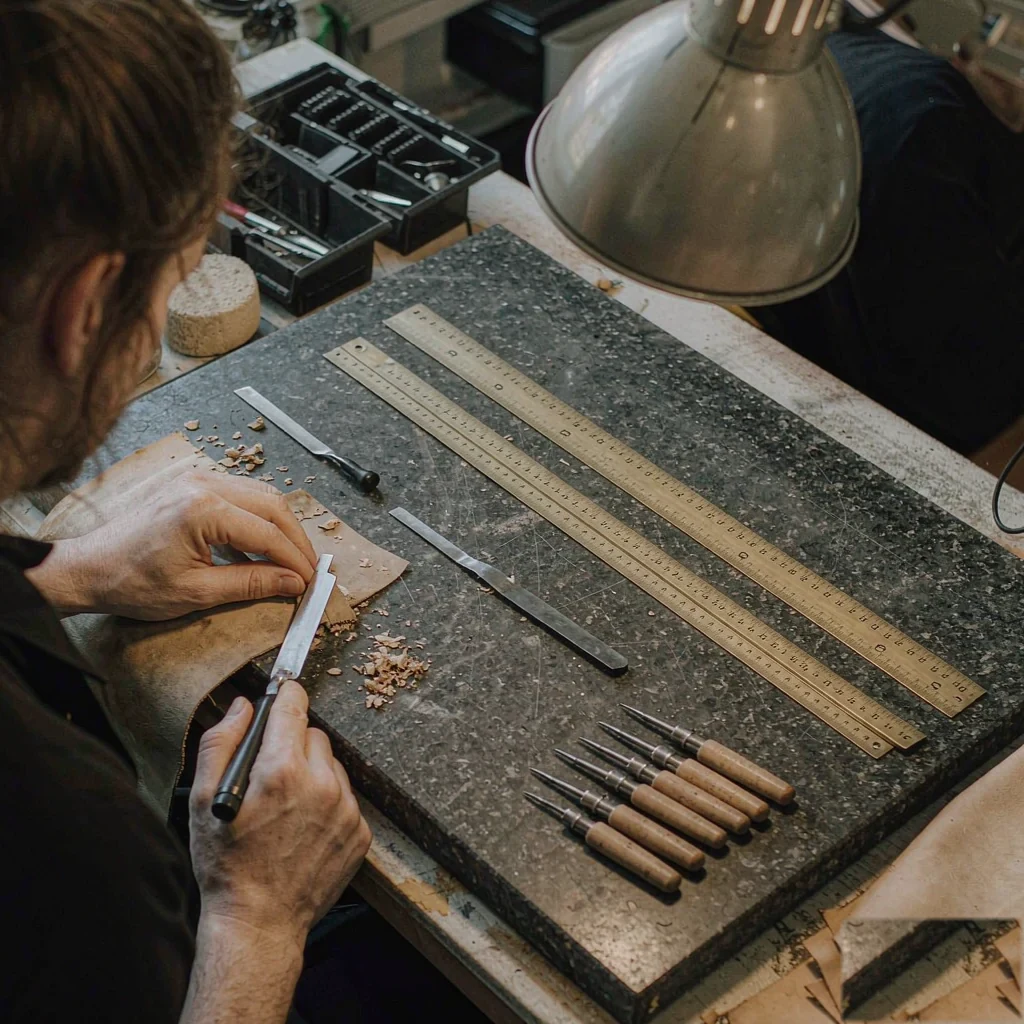
Hand work is not distributed evenly across a bag, and knowing where it sits is what makes the comparison honest. On a premium line, hand work concentrates at skiving, edge finishing, hardware setting and final assembly; on an atelier bench it extends to cutting, saddle stitching and burnishing, which is where the visible difference comes from.
- Cutting: an atelier cuts panel by panel around the hide; a line cuts to a marker for yield.
- Stitching: hand saddle stitch at 6-7 per inch holds differently from a machine seam at 8-9.
- Edge: four to five hand-burnished passes produce a depth that three sprayed coats do not reach.
- Assembly: handsetting a lock lets the maker adjust the fit to the individual panel in front of them.
What is worth noting is that the visible difference is concentrated on the parts of a bag a buyer touches most: the edge, the seam and the closure. A body that hides most of its seams behind a lining shows far less of the difference than a design that puts them on display, which is why the silhouette should influence the choice of model.
Two Calendars, Two Kinds of Waiting
The calendars differ in what they wait for. A programme waits for material lots, drying intervals and line capacity; an atelier waits for bench hours. Both are real, and neither responds to urgency, which is why the first question worth answering is what the immovable date actually is.
- Technical pack: 3-5 days on a programme, often longer where a piece is developed by hand.
- Material: 15-20 working days to hide arrival on a newly named lot, under either model.
- Sampling: 6-10 working days on a programme, extending to 12-15 on complex builds.
- Bulk: 35-50 days from intake on a programme; months of bench time in an atelier.
- Audit and packing: 3-5 days including correction and re-check at AQL 2.5.
Cost Structure: What Each Model Charges For
Neither model is simply more expensive than the other; they charge for different things. A programme spreads set-up across units, so unit cost falls as quantity rises. An atelier charges bench hours, so the unit cost stays broadly flat whether you order five pieces or fifty, and rises with the hand content of the design.
Where a programme wins
Anything that benefits from repetition: cutting yield, marker efficiency and a line that has already been set. At 500 pcs the set-up is amortised across the run rather than carried by the first few units.
Where an atelier wins
Anything that benefits from individual adjustment: a hand-set lock fitted to one panel, four burnished passes, and a saddle stitch that follows the hide rather than a marker.
Where both are equal
Material and packaging. A European calfskin lot costs what it costs, and presentation packaging adds roughly USD 4.80 per unit whichever model builds the bag.
The number to compare is landed cost per sellable unit, not unit price alone. A programme may quote a lower unit price and still cost more to land if the commitment produces inventory you cannot sell through in the season, while an atelier may quote more per unit and tie up far less cash.
How Each Model Absorbs a Revision
Revisions are where the two models behave most differently, and the difference is not intuitive. An atelier absorbs a change more gracefully because little is committed at once; a programme absorbs it least expensively at the earliest gate and most expensively after panels are cut. Both punish a change made late, but they punish different things.
- Programme: a change before the toile is cut costs 2-3 days of pattern work and nothing else.
- Programme: the same change after cutting costs the reserved lot, which rarely re-cuts at the same yield.
- Atelier: a change mid-piece costs bench hours already spent and usually pushes the queue.
- Both: a hardware change is far less damaging than a geometry change, since panels are unaffected.
Compliance and Traceability Under Each Model
Compliance does not care which model built the bag. REACH Annex XVII applies to articles placed on the EU market, California Prop 65 governs listed substances for the United States, EU Regulation 1007/2011 governs fibre naming, and CITES documents are required wherever a listed skin is involved. Reports are issued against a named lot under either model.
- Book testing when the lot is named, since reports are issued against that lot and not a material family.
- State every destination market at quotation, because one lot may need two sets of paperwork.
- Ask for the Leather Working Group scope of the tannery and check it names the tannery itself.
- Keep CITES documents aligned with the commercial invoice where a listed skin appears in the design.
Choosing: Three Situations, Three Answers
Most decisions resolve into one of three situations, and each has a clearly better answer. Choosing deliberately at the outset avoids the mid-programme switch, which is the most expensive version of this decision because it pays both sets of set-up costs.
A capsule with a retailer waiting
The programme. MOQ 500 pcs per colourway, 6-10 working days of sampling and 35-50 days of bulk, with the calendar built backwards from the delivery date and inspection drawn at AQL 2.5.
A showpiece or couture body
The atelier. Hand saddle stitch, four to five burnished passes and individually fitted hardware are exactly what the bench is for, and neither the volume nor the date argues for a line.
A first prototype, then a launch
Both, in that order. Develop the body on the bench where revisions are absorbed gracefully, then take the frozen pattern to the programme for the run.
The third case is more common than founders expect, and it is the one that uses each model for what it is genuinely best at. Development is where flexibility is worth paying for; volume is where repeatability is.
When a Brand Outgrows One Model
Brands usually move in one direction: from the bench to the line, once a body has proved itself and the order book justifies 500 pcs per colourway. The move is smoother when the atelier work has been documented, because the technical pack then describes a proved piece rather than an intention.
- Keep the approved prototype; it becomes the reference the programme measures against.
- Record substance, skiving and stitch density from the prototype so they can be held at volume.
- Expect the machine seam to differ from the hand one, and approve that difference deliberately.
- Reserve the material lot before the pattern is handed over, so the calendar does not restart.
Whichever route a collection takes, the programme behind it runs across 7 production lines with about 200,000 pcs per month of capacity and has held export experience since 2014, carried out through our validated partner factory Quanzhou Yingming Bags, an SGS-validated site. Third-party inspection can be arranged alongside the internal AQL 2.5 audit.
Decide which model fits before you commit
Send your drawings, the quantity you realistically expect to sell and the date you cannot move. You will receive both routes costed against that date, with the trade-offs written out, within two working days. Request a quote.
Frequently Asked Questions
Which model is better for a first designer capsule?
Usually the programme, provided the realistic order is several hundred units. MOQ 500 pcs per style and colourway, 6-10 working days of sampling and 35-50 days of bulk give a date a retailer can plan around, whereas an atelier would spend much of the season on bench hours for the same quantity.
Is an atelier finish genuinely visible to a buyer?
Yes, at the edge and the seam. Four to five hand-burnished passes produce a depth that three sprayed coats do not reach, and a hand saddle stitch at 6-7 per inch sits differently from a machine seam at 8-9. The difference is clearest on designs that leave seams and edges on display.
Can a body be developed on a bench and produced on a line?
Yes, and it is often the best sequence. Development is where a revision is least costly to absorb, and volume is where repeatability matters. Keep the approved prototype as the reference and record its substance, skiving and stitch density so the line can be held to them.
What is MOQ under each model?
A premium programme sets MOQ 500 pcs per style and colourway, so three colourways of one body is three separate commitments. An atelier has no comparable threshold and quotes bench time per piece, which is why a small order does not carry the same set-up burden.
How do the two calendars compare end to end?
A programme runs 3-5 days on the technical pack, 15-20 on material, 2-3 on pattern and toile, 6-10 on sampling, 35-50 on bulk and 3-5 on audit and packing. An atelier replaces the bulk line with months of bench hours, so the end date is governed by the queue rather than by a schedule.
Which model handles design changes better?
The atelier, because it commits less at once. On a programme the same change costs 2-3 days before the toile is cut and the reserved hide lot after panels are cut. Under both models a hardware change is far less damaging than a change to panel geometry.
What does presentation packaging cost per unit?
A rigid presentation box with dust bag and tissue adds roughly USD 4.80 per unit before freight and duty, under either model. Material and presentation costs do not move much between the two, because a European calfskin lot costs the same whoever cuts it.
Are compliance requirements different between the models?
No. REACH Annex XVII, California Prop 65, EU Regulation 1007/2011 on fibre naming and CITES documents for listed skins apply regardless of who built the bag. Reports are issued against a named lot, so testing is booked once the material is reserved, not once goods are finished.
How is quality checked on the programme side?
At AQL 2.5 under ISO 2859-1, with the general inspection level agreed before cutting. A 500 pcs lot at level II uses code letter H: 50 units drawn, accept 3, reject 4. Defects are classified in advance, and corrections are re-checked rather than merely counted.
What capacity sits behind the programme model?
Seven production lines with about 200,000 pcs per month of capacity, and export experience held since 2014, carried out through our validated partner factory Quanzhou Yingming Bags, an SGS-validated site. Third-party inspection can be added alongside the internal audit.
When should a brand move from bench to line?
Once a body has sold through once and the re-order justifies 500 pcs per colourway. Moving earlier risks inventory; moving later risks losing the season. The handover is smoothest when the approved prototype is documented rather than remembered.
Which trade terms apply to a programme shipment?
FOB Xiamen is the default, with CIF and DDP available on request. The term decides who carries freight risk and who prepares customs documentation, and it should be fixed at quotation rather than at handover, because changing it later re-prices the shipment entirely.
People Also Ask
What is the difference between a bag production programme and an atelier?
A programme commits volume and returns a date: MOQ 500 pcs, 6-10 working days of sampling, 35-50 days of bulk. An atelier commits bench time and returns hand finish: saddle stitching, burnished edges and individually fitted hardware, delivered in months rather than weeks.
Which production model suits a small designer label?
A programme if the first season is several hundred units and a retailer is waiting; an atelier if it is forty showpieces. Many labels use both, developing on the bench and running the proved pattern on the line.
Is hand stitching better than machine stitching?
It is different rather than better. A hand saddle stitch at 6-7 per inch holds a seam in a way a machine seam cannot, but a machine seam at 8-9 per inch is more uniform across hundreds of units, which is what a run needs.
Why does an atelier take so much longer?
Because output is bounded by bench hours rather than by line days. Cutting around a hide, saddle stitching and burnishing four or five passes are all operations that scale with hands available, so a large order simply extends the calendar.
Can I switch production models mid-collection?
Yes, but it is the most expensive version of the decision because it pays both sets of set-up. The cheaper sequence is to develop on the bench, freeze the pattern, then hand the proved piece to the programme for the run.
Sources and further reading
Every figure on this page is either our own programme data or attributed below. Open the originals before you write them into a specification.
- ISO - International Organization for StandardizationISO Publisher of ISO 2859-1, which sets the sampling plan, code letters and accept and reject numbers used for the AQL 2.5 audit on the programme side.
- Leather Working GroupLeather Working Group Tannery audit protocol referenced when a calfskin lot is reserved under either production model.
- CITES - Convention on International Trade in Endangered SpeciesCITES Appendix listings determine the permit documents required for listed skins, which apply whichever model builds the bag.
- ECHA - European Chemicals AgencyEuropean Chemicals Agency Administrator of REACH, whose Annex XVII restrictions apply to leather articles placed on the EU market and are tested per lot.
- WWDWWD Reporting on designer collection launches and the retail calendars that determine whether volume or finish is the binding constraint.