AQL 2.5 in Premium Handbag Production Explained: Sample Sizes, Defect Classes and the Limits of the Standard
What does AQL 2.5 mean on a premium handbag order? It is an acceptance quality limit under ISO 2859-1: inspectors draw a random sample of a defined size from the finished lot and reject the lot if it contains more than a stated number of defects. For a 500-piece run at General Inspection Level II, that means a sample of 50 pieces with an accept number of 3 and a reject number of 4. The number is not a promise that 2.5 percent of your bags will be faulty; it is a statistical rule about how much risk each side carries, and understanding it prevents the two arguments that otherwise happen at the end of every programme.
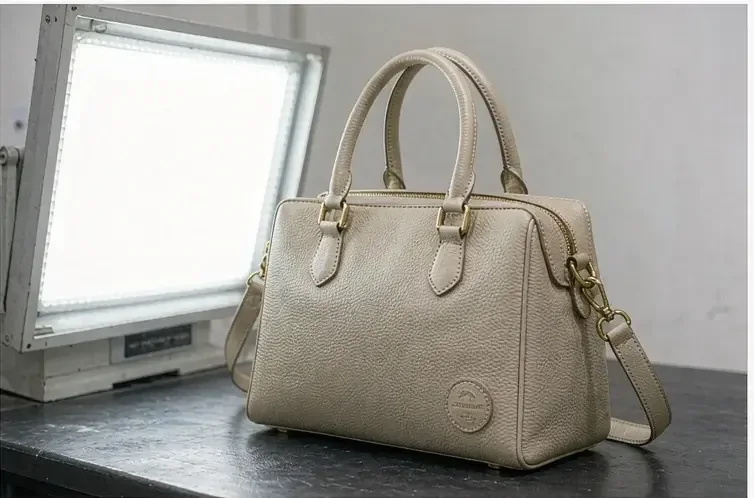
What AQL 2.5 Actually Means in Plain Terms
AQL 2.5 is a defect threshold agreed before production, not a defect rate measured after it: it sets how many faulty pieces in a random sample force a lot to be rejected, and nothing more than that.
The most common misreading is that AQL 2.5 means 2.5 percent of goods may be faulty. It does not. It means a sampling plan has been chosen whose operating characteristic accepts most lots at or better than that quality level, and the actual proportion of faulty pieces in an accepted lot can be higher or lower depending on where in the curve the lot sits.
Two consequences follow that matter commercially. First, a lot can pass and still contain faulty pieces, because only a sample was examined. Second, a good lot can occasionally be rejected, because sampling carries risk for both sides and the standard distributes it deliberately rather than eliminating it.
Reading the Sample Size Table
Three things fix the plan: the lot size, the inspection level and the AQL. Lot size gives a code letter, the code letter gives a sample size, and the sample size with the AQL gives the accept and reject numbers.
General Inspection Level II is the default in ISO 2859-1 and the one used on most programmes. Level I draws a smaller sample and is used where inspection is expensive or quality history is strong; Level III draws a larger sample and is used where the consequences of a miss are severe. Level II is the right default for a first season.
| Lot size | Code letter, Level II | Sample size | Ac at AQL 2.5 | Re at AQL 2.5 |
|---|---|---|---|---|
| 281-500 | H | 50 | 3 | 4 |
| 501-1200 | J | 80 | 5 | 6 |
| 1201-3200 | K | 125 | 7 | 8 |
| 3201-10000 | L | 200 | 10 | 11 |
| 10001-35000 | M | 315 | 14 | 15 |
Read the last row of that table before agreeing anything. On a 500-piece run, four defects in fifty pieces is the line, which is tighter than most founders expect and looser than most assume once they have thought about it.
AQL 2.5 Against AQL 1.0 and AQL 4.0
Choosing an AQL is choosing how much risk the brand carries against how much the production side carries, and the three levels in common use sit at roughly 1.0, 2.5 and 4.0.
AQL 1.0 is stricter and draws the same sample but tolerates fewer defects. It is appropriate where the cost of a faulty piece reaching a customer is high relative to the cost of rework. AQL 4.0 is looser and suits goods where a minor fault is genuinely invisible in use.
| Sample size | Ac/Re at AQL 1.0 | Ac/Re at AQL 2.5 | Ac/Re at AQL 4.0 | Typical use |
|---|---|---|---|---|
| 50 | 1 / 2 | 3 / 4 | 5 / 6 | Small first run, retail-facing launch |
| 80 | 2 / 3 | 5 / 6 | 7 / 8 | Single style, two colourways |
| 125 | 3 / 4 | 7 / 8 | 10 / 11 | Seasonal re-order |
| 200 | 5 / 6 | 10 / 11 | 14 / 15 | Multi-style capsule |
| 315 | 7 / 8 | 14 / 15 | 21 / 22 | Volume programme |
2.5 is the standard setting for premium accessories because it sits where the two risks balance: tight enough that a systematic fault is caught, loose enough that a single cosmetic imperfection does not hold a season hostage.
Critical, Major and Minor: The Classification That Decides Everything
Defect classification decides more than the AQL number does, because a plan is only as good as the agreed definition of what counts: critical, major or minor, written down before bulk starts.
A critical defect is one that makes the piece unsafe or unusable — a sharp edge on hardware, a closure that will not fasten, a needle broken off inside the construction. Critical defects are held at an acceptance number of zero: one found in the sample rejects the lot regardless of any other AQL agreed.
- Critical: unsafe or unusable, held at zero acceptance, one occurrence rejects the lot.
- Major: visible or functional, counted against the agreed AQL, usually 2.5.
- Minor: a departure from specification unlikely to be noticed in use, often held at a looser AQL.
- Undocumented: the most dangerous class, because it is discovered during an argument rather than before one.
Write the classification into the plan as a defect library, not as a description. Fifteen named faults with an assigned class remove nearly all discretion from the inspection, and discretion is where most disagreements begin.
Why Handbags Are Harder to Inspect Than Garments
A handbag is a three-dimensional object with moving parts, so inspecting one takes several times longer than inspecting a flat garment and depends far more on the inspector's judgement.
Four things complicate it. Symmetry has to be judged on a turned object rather than a laid-flat one; hardware has to be operated rather than looked at; interiors have to be examined in poor light; and leather is a natural material whose acceptable variation has to be defined against a sealed reference sample rather than against a description.
- Inspection time per structured bag
- Commonly 3-6 minutes against well under one minute for a flat garment
- Visual assessment distance
- Around 30 cm for surface faults, roughly 1 m for silhouette and symmetry
- Hardware operations per piece
- Every closure, zip and fastening cycled, not merely examined
- Reference used for shade and grain
- The sealed counter sample retained at approval, opened only disputes
- Critical defects tolerated in a sample
- Zero, regardless of the AQL agreed for major defects
Allow for the inspection time when you plan the calendar. A 500-piece lot needs fifty pieces examined thoroughly rather than quickly, and an inspection compressed into an afternoon is an inspection that will not find what it was drawn to find.
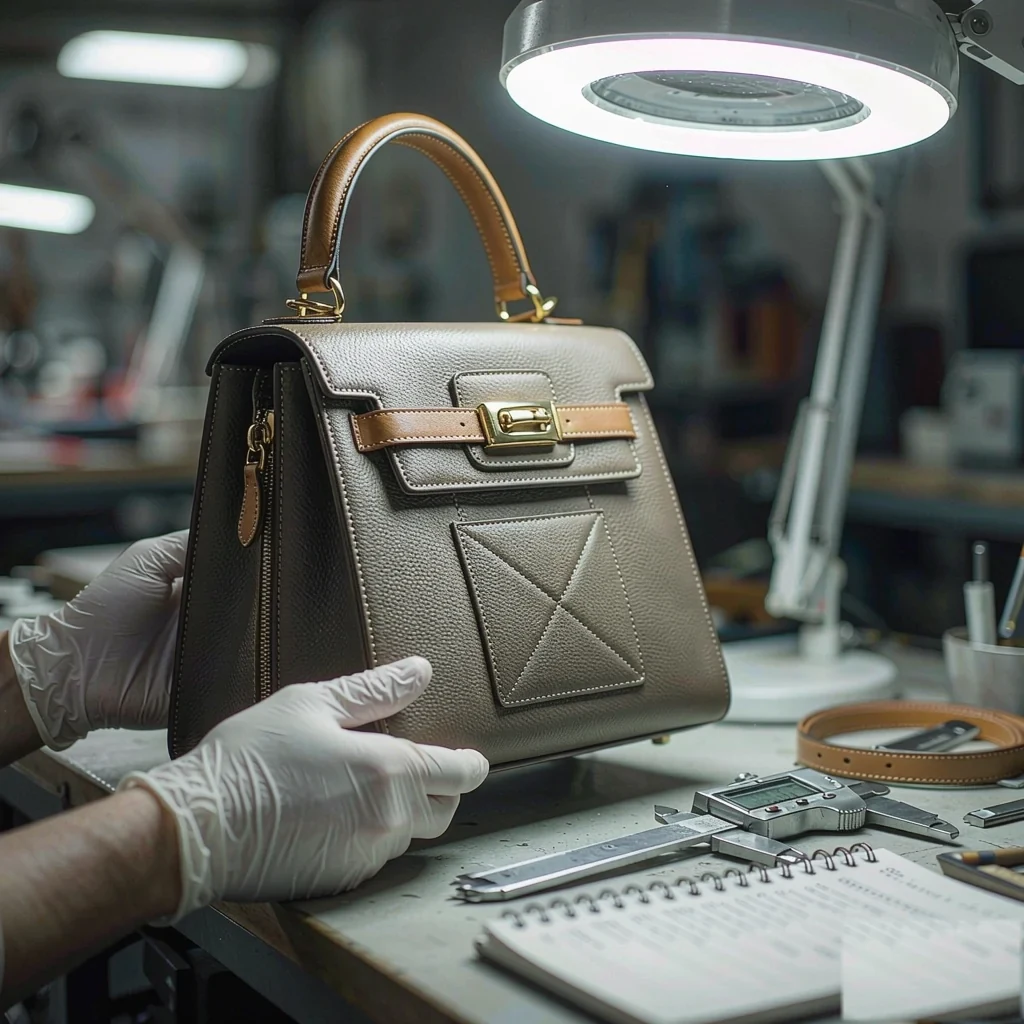
A Defect Library: Fifteen Faults and Their Class
The library below is the practical heart of an inspection plan. Agreeing these fifteen lines before bulk starts converts an argument about quality into a count that either side can verify.
- Closure will not fasten, or fastens insecurely — critical.
- Sharp edge or burr on hardware that could cut — critical.
- Broken needle or metal fragment inside the construction — critical.
- Stitch line broken or skipped on a load-bearing seam — major.
- Handle attachment asymmetric by more than 2 mm — major.
- Plating scratched or blistered, visible at 30 cm — major.
- Plating shade differs between two fittings on one piece — major.
- Edge paint uneven, chipped, or lifted at a fold — major.
- Adhesive residue visible on an exterior surface — major.
- Shade or grain differs from the sealed approval sample — major.
- Persistent odour detectable at arm's length — major.
- Branding stamp misplaced, illegible or absent — major.
- Panel misalignment beyond roughly 1 mm at a visible join — minor.
- Loose thread longer than about 5 mm — minor.
- Carton marking incorrect or carton damaged in transit — minor.
Two of these cause the most disputes: the shade comparison and the odour test, because both are sensory. The answer to both is the same — a sealed reference sample and a written protocol for how the comparison is made.
Switching Rules: Normal, Tightened and Reduced
ISO 2859-1 is not a single plan but a set of three that move: normal, tightened and reduced, with rules governing when inspection switches between them based on recent history.
Inspection starts at normal. It moves to tightened when two out of five consecutive lots are rejected, which draws a larger sample at the same AQL. It returns to normal after five consecutive lots are accepted under tightened inspection. It may move to reduced after ten consecutive accepted lots with steady production, which draws a smaller sample and accepts more risk.
When inspection tightens, the useful question is what changed in the process rather than how to argue the sample. Tightening usually follows a material change, a new operator on a difficult operation, or a rushed finishing stage.
Who Counts, and When
Three arrangements exist and they answer different questions: in-house inspection by the production team, a third-party inspector appointed by the brand, and a joint count at the point of packing.
In-house count
Fastest and least costly, and appropriate when a relationship has history and a defect library is already agreed. It answers whether the lot meets the plan, not whether the plan was the right one.
Third-party audit
Independent and slower to schedule, and worth it on a first season, on a large lot, or whenever a large share of the season's cash sits in one shipment.
Joint count
Both sides present at the bench. Slower still, but it settles classification disputes on the spot and is the fastest way to align two teams reading a defect library differently.
Whichever arrangement is chosen, the sample must be drawn at random from finished, packed goods rather than presented. A sample that has been selected by anyone with an interest in the outcome carries no statistical meaning at all.
What AQL 2.5 Does Not Cover
AQL 2.5 covers the finished lot and says nothing about four things brands assume it covers: material compliance, durability over time, packing, and consistency between lots.
- Material compliance: chemical restrictions are answered by declarations from the tannery, not by counting faults.
- Durability: a piece can pass inspection and still fail in month three, which is why load and cycle testing matters.
- Packing: carton specification and presentation standards sit outside the sampling plan entirely.
- Lot-to-lot consistency: each lot is inspected separately, so a second delivery needs its own plan and its own reference.
This is why an inspection clause sits alongside a material clause rather than instead of one. On our programme, export experience runs since 2014 across 7 production lines with about 200,000 pcs per month of capacity, delivered through our validated partner factory Quanzhou Yingming Bags, an SGS-validated site, and inspection at AQL 2.5 is agreed in writing before bulk begins.
Writing the Inspection Clause Before Bulk Starts
An inspection clause is six lines long and takes an hour to agree: standard, level, AQL per defect class, sample timing, who counts, and what happens on rejection.
The six lines to agree
- Standard: ISO 2859-1, single sampling, normal inspection, stated explicitly.
- Level: General Inspection Level II unless the piece or the history argues otherwise.
- AQL: 2.5 for major defects, looser for minor, zero for critical.
- Timing: drawn from finished packed goods, before handover, not after shipment.
- Counter: named in advance, whether in-house, third-party or joint.
- Rejection: rework and re-present, or a documented concession, agreed before it is needed.
The arithmetic of rejection is worth stating plainly. Reworking one closure on a returned piece costs around USD 4.80 in parts and bench time before any freight is counted, so a rejected lot is worth considerably more than a price concession argued for afterwards.
Against that clause, the rest of the programme is unchanged: MOQ 500 pcs per style and colourway, sampling in 6-10 working days and 12-15 for complex constructions, bulk in 35-50 days, and handover on FOB Xiamen terms.
Agree the inspection plan before bulk, not after
Tell us the quantity and the markets and we will return the sampling plan, the defect library and the clause, in writing, before production starts. Request a quote.
Frequently Asked Questions
What does AQL 2.5 mean on a handbag order?
It is an acceptance quality limit under ISO 2859-1, not a permitted defect rate. Inspectors draw a random sample of a defined size and reject the lot if it contains more than the agreed number of defects: on 500 pieces, a sample of 50 with accept 3 and reject 4.
Does AQL 2.5 mean 2.5 percent of my bags can be faulty?
No. It means a sampling plan has been chosen that accepts most lots at or better than that quality level. An accepted lot can contain more or fewer faulty pieces than that figure suggests, because only a sample was examined rather than the whole lot.
What sample size applies to a 500-piece order?
At General Inspection Level II, a lot of 281-500 carries code letter H and a sample size of 50. At AQL 2.5 that gives an accept number of 3 and a reject number of 4, so four or more defects in the fifty pieces rejects the lot.
What is the difference between AQL 1.0, 2.5 and 4.0?
The sample size is unchanged and only the tolerance moves. At a sample of 50, AQL 1.0 accepts one defect, AQL 2.5 accepts three and AQL 4.0 accepts five. Choosing between them is choosing how much risk each side carries. Sample sizes do not change between the three levels, so tightening an AQL costs nothing in inspection time and only tightens the tolerance.
What counts as a critical defect?
A fault that makes the piece unsafe or unusable: a sharp burr on hardware, a closure that will not fasten, or a broken needle left inside the construction. Critical defects are held at zero acceptance, so one found in the sample rejects the lot regardless of any other AQL.
How are major and minor defects distinguished?
A major defect is visible or functional and would be noticed by a customer, such as a scratched plating or an uneven edge. A minor defect is a departure from specification unlikely to be noticed in use, such as a loose thread longer than about 5 mm.
Why does handbag inspection take so long?
Because the object is three-dimensional and has moving parts. Symmetry is judged on a turned piece, every closure is cycled rather than examined, interiors are checked in poor light, and natural grain variation is compared against a sealed reference sample. Inspectors also cycle every closure, examine interiors in poor light, and compare grain against a sealed reference sample on each piece.
What is General Inspection Level II?
The default level in ISO 2859-1 and the right setting for a first season. Level I draws a smaller sample where inspection is expensive or history is strong, and Level III draws a larger one where the consequence of a miss is severe. Level II is the right default for a first season, and it is the level assumed in any sampling table quoted without qualification.
What happens when inspection is tightened?
Tightened inspection draws a larger sample at the same AQL and is triggered when two of five consecutive lots are rejected. It returns to normal after five consecutive accepted lots, and it is best read as a signal about the process rather than as a sanction.
Can inspection be reduced over time?
Yes. Reduced inspection draws a smaller sample and may follow ten consecutive accepted lots with steady production. It accepts more risk per lot in exchange for lower inspection cost, so it suits a mature style with a settled specification rather than a new one. It is not appropriate for a new style, where the specification is still moving and a smaller sample would hide exactly what needs finding.
Should I appoint a third-party inspector?
On a first season, on a large lot, or whenever a large share of the season's cash sits in one shipment, yes. In-house counting is faster and appropriate once a defect library is agreed and history exists between the two sides. Independent counting costs money and adds a scheduling step, and both are worth it whenever a season cash sits in one shipment.
What does AQL 2.5 not cover?
Material compliance, durability over time, packing specification and consistency between lots. Chemical restrictions are answered by declarations from the tannery, and durability is answered by load and cycle testing rather than by counting faults in a sample. Each of those four needs its own document: declarations from the tannery, cycle testing, a packing specification, and a fresh plan per lot.
People Also Ask
What is AQL 2.5 in simple terms?
An agreed defect threshold under ISO 2859-1. Inspectors draw a random sample and reject the lot if it holds more than the agreed number of faults: on 500 pieces, 50 are examined with accept 3 and reject 4.
How many pieces are checked in a 500-piece order?
Fifty, at General Inspection Level II. That gives code letter H, and at AQL 2.5 an accept number of 3 and a reject number of 4. Larger lots draw larger samples, but a smaller proportion of the whole.
Is AQL 2.5 strict enough for luxury bags?
It is the standard setting for premium accessories, balancing the risk of a systematic fault getting through against the risk of one cosmetic imperfection holding a season hostage. Critical defects are separately held at zero.
What happens if a lot fails inspection?
The clause agreed beforehand decides: rework and re-present, or a documented concession. Reworking a single closure on a returned piece costs around USD 4.80 in parts and bench time before freight, so rejection is worth more than a late price concession.
Can a passed lot still contain faults?
Yes. Only a sample is examined, so an accepted lot can still contain faulty pieces, and a genuinely good lot can occasionally be rejected. The standard distributes that risk deliberately rather than removing it.
Sources and further reading
Every figure on this page is either our own programme data or attributed below. Open the originals before you write them into a specification.
- ISO — International Organization for StandardizationISO Publisher of ISO 2859-1, the sampling standard that defines code letters, sample sizes and accept and reject numbers.
- CPSCU.S. Consumer Product Safety Commission Oversees consumer product safety requirements, the reference behind the critical defect class held at zero acceptance.
- Leather Working GroupLeather Working Group Tannery audit protocol behind the material declarations that sit alongside, rather than inside, an AQL sampling plan.
- Sourcing JournalSourcing Journal Reporting on inspection practice, acceptance sampling and quality disputes across the accessories trade.
- FashionUnitedFashionUnited Industry data on returns, rework costs and the commercial consequences of rejected lots in accessories.