Premium Handbag Quality Standards Explained: AQL 2.5, ISO 2859-1 and the Records That Settle a Dispute
What quality standards should govern a premium handbag programme? Four families answer that question: AQL 2.5 under ISO 2859-1 for the sampling plan drawn at audit, ISO 11644 and ISO 105 for finish adhesion and colour fastness on the material, ISO 9227 for plated hardware, and a dimensional tolerance written into the technical pack. A Copenhagen label once disputed a delivery of 600 units on the grounds of shade and edge finish; what settled it was not opinion but three records taken weeks earlier. That case is used below to show which standards matter, what each one measures, and which documents have to exist before a disagreement becomes resolvable.
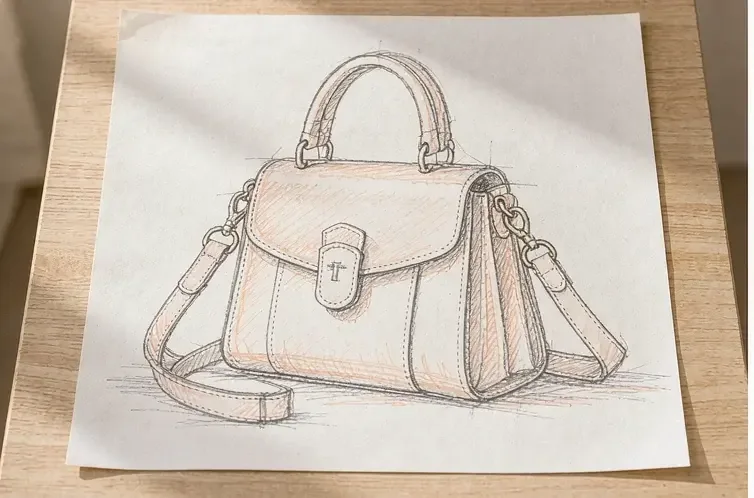
A Copenhagen Delivery That Nearly Came Back
The delivery was 600 units of a structured shoulder bag in full-grain calfskin, and the buyer's complaint arrived in two parts: the shade was darker than the approved sample and the edges were showing hairlines at the corners. Both were credible, and neither could be settled by looking at photographs. What resolved it was a lot record, a light booth reading and a retained counter sample from the spec freeze.
The shade turned out to be genuine but within the agreed tolerance: the approved sample had been read under showroom lighting at around 3000 K, while the buyer's warehouse used a cooler source, and under the same D65 booth the two matched. The edge hairlines were also genuine, and they traced to one coating interval shortened on a Friday afternoon. The first was a documentation problem; the second was a real defect with a recorded cause.
- The shade complaint was settled by a retained counter sample read under one agreed light source.
- The edge complaint was settled by a coating record that named the interval and the operation.
- Neither would have been resolvable if the pack had recorded nothing at the spec freeze.
- The correction was a re-work of one batch rather than a rejection of the whole delivery.
The Standards That Would Have Settled It
Four families of standard cover a premium programme, and each answers a different question. ISO 2859-1 answers how many units to draw and how many defects are acceptable; ISO 11644 and ISO 105 answer whether the material's finish and colour hold; ISO 9227 answers whether plated components will survive handling; and the technical pack answers what dimensional tolerance the body was built to. None of them is optional in practice, because each one corresponds to a complaint that cannot be settled without it.
| Standard | What it governs | Where it is applied | Typical target on a premium build |
|---|---|---|---|
| ISO 2859-1 | Sampling plans, code letters, accept and reject numbers | Final audit before packing | AQL 2.5 at general inspection level II |
| ISO 11644 | Adhesion of a finish to the leather surface | Coated and corrected-grain lots | Checked per lot, before panels are cut |
| ISO 105-X12 | Colour fastness to rubbing, dry and wet | Linings and dark exteriors | Grade 4 or better on both dry and wet |
| ISO 105-B02 | Colour fastness to light, blue wool scale | Any style displayed near a window | Grade 4 or better where window display is expected |
| ISO 9227 | Neutral salt spray corrosion testing | Plated brass components | 24 hours minimum, 48 for hardware near a closure |
| ISO 3376 | Tensile behaviour of the leather itself | Structural panels and handles | Read as a lot property rather than a pass or fail |
The distinction in the last column matters. A standard describes a test method; the acceptance target is a commercial decision written into the pack. Confusing the two is how a dispute ends with both parties quoting the same standard at each other and reaching opposite conclusions.
ISO 2859-1 and What AQL 2.5 Actually Draws
AQL 2.5 under ISO 2859-1 fixes three things in advance: the general inspection level, the code letter that follows from lot size, and the accept and reject numbers that follow from the code letter. Once those are agreed before cutting, the audit is arithmetic rather than argument, and the result is a decision recorded rather than negotiated.
- 500 pcs lot at level II
- Code letter H: 50 units drawn, accept 3, reject 4
- 1,200 pcs lot at level II
- Code letter J: 80 units drawn, accept 5, reject 6
- 3,200 pcs lot at level II
- Code letter K: 125 units drawn, accept 7, reject 8
- Defect classification
- Critical, major and minor defined before inspection, not during it
- Correction rule
- Corrected units are re-checked and the result recorded with the lot
On a 500 pcs run, roughly one unit in ten is examined, which is worth stating plainly to any buyer who assumes inspection means every piece. Sampling is a statistical statement about the lot, not a guarantee about any individual bag, and the two should not be presented as the same thing.
Material Testing: Finish, Colour and Substance
Material is tested per lot rather than per hide, because a report names the lot it was issued against. ISO 11644 covers adhesion of a finish, which is what fails first on corrected-grain panels; ISO 105-X12 covers rubbing fastness, dry and wet, which is what fails first on a dark lining against a pale garment; and ISO 105-B02 covers light fastness on the blue wool scale, which matters for anything displayed near a window.
- Book testing when the lot is named, since a report names that lot and not a material family.
- Test rubbing fastness on linings separately; a dark lining against pale fabric is the classic failure.
- Read tensile behaviour under ISO 3376 as a property of the lot rather than as a pass or fail.
- Record substance at 1.2-1.4 mm before skiving, and fold thickness at 0.6-0.8 mm after it.
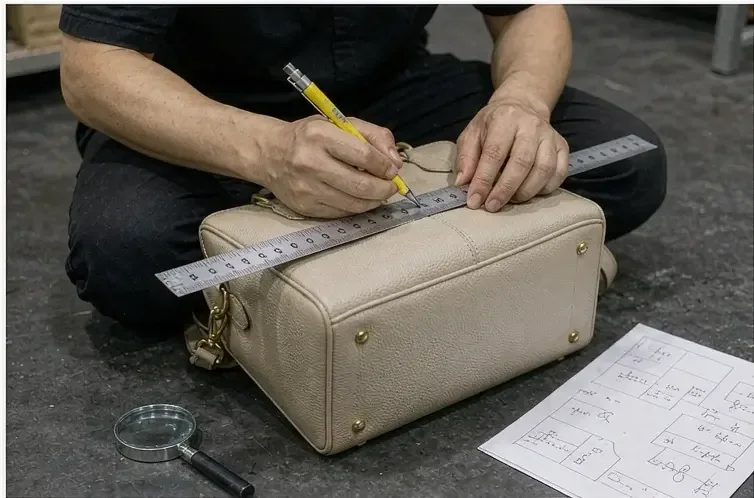
Hardware Under ISO 9227 and Cycle Proving
Hardware fails in two ways, and only one of them is a corrosion question. ISO 9227 neutral salt spray addresses corrosion, with 24 hours as the usual minimum and 48 hours for components sitting close to a closure where hands go. The other failure is mechanical: a turn-lock that drifts in tolerance makes every panel fit badly, which is why proving on the bench matters as much as plating thickness.
Corrosion
Neutral salt spray under ISO 9227, 24 hours minimum and 48 near a closure. Plating of 0.15-0.3 µm on brass is the usual target, and it should be stated in microns rather than by finish name.
Mechanical proving
A lock cycled at least 5,000 times before panels are cut to it. A closure that drifts makes each subsequent panel fit badly, so proving belongs before cutting rather than after approval.
Finish family
Feet, rings, strap ends and the closure share one finish so the bag reads as one object. A mismatch here is usually the first thing a buyer notices on the shelf.
Dimensional Tolerance: What Gets Measured Where
Dimensional tolerance is the standard most often left out of a pack, and its absence is why two people can measure the same bag and disagree. Panels are held to about ±1.5 mm against the pattern, overall dimensions to about ±2 mm, and seam alignment to the line drawn on the pack. Stitch density is held at 8-9 per inch with a tolerance of half a stitch, and edge build at three coats of roughly 0.12 mm.
- Panel dimensions: about ±1.5 mm against the graded pattern, read on a flat surface.
- Overall dimensions: about ±2 mm, measured with the bag empty and unloaded.
- Seam alignment: to the line on the pack, checked at the corner rather than mid-seam.
- Stitch density: 8-9 per inch on structural seams, 9-10 on handles, tolerance half a stitch.
- Edge build: three coats, sanded between passes, examined under raking light at the corner.
Write those five into the technical pack and the phrase 'it does not look right' becomes five checkable statements. Leave them out and every disagreement becomes a matter of taste, which is the one argument nobody wins at a delivery dock.
Colour, Shade and the Light It Is Judged Under
Shade disputes are almost always lighting disputes in disguise. The Copenhagen case turned on a sample read at roughly 3000 K and a complaint raised under a cooler source; under one agreed booth the two matched. The remedy is mundane: name the light source in the pack, keep a retained counter sample, and reserve one lot per colourway so there is only one material reality to compare.
- Name the light source for approval, commonly D65, and use it consistently at both ends.
- Retain a signed counter sample from the spec freeze as the physical reference.
- Reserve one lot per colourway, since shade drift between lots is the commonest cause of a mismatch.
- Match edge paint and thread to the lot, not to a standard swatch card.
Records That Make a Dispute Resolvable
Four documents decide whether a disagreement resolves in an afternoon or runs for weeks: the signed technical pack with its tolerances, the retained counter sample, the lot record with its test reports, and the inspection record with its defect classification. A house can be entirely competent and still lose an argument if those four do not exist.
The four documents worth insisting on
- Signed technical pack: substance, skiving, stitch density, edge build, tolerances and inspection plan.
- Retained counter sample: signed, dated and stored, read under the light source named in the pack.
- Lot record: tannery, lot reference, test reports issued against that lot and the arrival date.
- Inspection record: plan drawn, units examined, defects classified, corrections made and re-checked.
Writing the Standards Into the Pack
Standards only work if they are written down before the run rather than quoted after it. The pack should name the inspection plan and its level, the material tests and their targets, the hardware requirement in microns and hours, and the dimensional tolerances. One page of that prevents most of what follows.
Compliance sits alongside these rather than inside them. REACH Annex XVII applies to articles placed on the EU market, California Prop 65 governs listed substances for the United States, EU Regulation 1007/2011 governs fibre naming, and CITES documents are required wherever a listed skin is used. Reports are issued per lot, per market.

Our own programme holds these standards across 7 production lines with about 200,000 pcs per month of capacity and export experience since 2014, carried out through our validated partner factory Quanzhou Yingming Bags, an SGS-validated site. Sampling takes 6-10 working days, bulk 35-50, and third-party inspection can be arranged alongside the internal AQL 2.5 audit.
Get the standards written into your pack
Send your drawings and quantity per colourway. You will receive a technical pack with the inspection plan, material tests, hardware requirement and dimensional tolerances written in, within two working days. Request a quote.
Frequently Asked Questions
What does AQL 2.5 mean on a premium handbag run?
It is the acceptable quality level used with ISO 2859-1 to fix the sampling plan. At general inspection level II on a 500 pcs lot the code letter is H: 50 units drawn, accept 3, reject 4. Roughly one unit in ten is examined, so it is a statistical statement about the lot rather than a check of every bag.
Which ISO standards apply to leather used in handbags?
ISO 11644 for adhesion of a finish, ISO 105-X12 for colour fastness to rubbing dry and wet, ISO 105-B02 for light fastness on the blue wool scale, and ISO 3376 for tensile behaviour. Each is applied per named lot, since a report names the lot it was issued against.
How is hardware quality tested?
Two ways. ISO 9227 neutral salt spray tests corrosion, with 24 hours as a usual minimum and 48 hours near a closure where hands go. Separately, a lock is proved mechanically on the bench for at least 5,000 open and close cycles before panels are cut to it.
What dimensional tolerance should a technical pack specify?
About ±1.5 mm on individual panels against the graded pattern, ±2 mm on overall dimensions with the bag empty, seam alignment to the line on the pack, stitch density at 8-9 per inch with half a stitch of tolerance, and edge build at three coats of roughly 0.12 mm.
How are shade disputes actually resolved?
By agreeing the light source in advance, commonly D65, and retaining a signed counter sample from the spec freeze. Most shade complaints are lighting differences: a sample approved under warm showroom light often reads darker than the same bag examined under a cooler warehouse source.
Why is testing booked per lot rather than per material?
Because a report names the lot it was issued against. Substituting material after testing means a second cycle, which is both a cost and a delay. Reserving one lot per colourway at the outset avoids re-testing entirely and keeps a re-order consistent with the launch drop.
What is a counter sample and why keep one?
A unit retained at the spec freeze, signed and dated, held as the physical reference for bulk. It settles arguments that a written pack cannot, particularly about shade and hand feel, provided it is read under the same light source that was named at approval.
Does AQL 2.5 mean every bag is inspected?
No. On a 500 pcs lot at general inspection level II, 50 units are drawn, which is about one in ten. The plan is a statistical statement about the lot rather than a guarantee about an individual piece, and that distinction should be stated plainly rather than glossed over.
How should defects be classified?
As critical, major and minor, defined in the pack before inspection rather than during it. A classification agreed at the moment a defect is found is a negotiation conducted under time pressure, and it is the fastest route to a dispute that cannot be closed on the day.
Which compliance rules sit alongside these standards?
REACH Annex XVII for articles placed on the EU market, California Prop 65 for the United States, EU Regulation 1007/2011 for fibre naming on textile elements, and CITES documents wherever a listed skin is used. Reports are issued per lot, per destination market.
How long does sampling take when standards are written in?
Six to ten working days on a standard build and 12-15 where the construction is complex or a closure must be proved. The window covers a first built sample, measurement against the pack, a written correction list and one corrected round rather than a single attempt.
Can a third party inspect the run?
Yes. Third-party inspection can be arranged alongside the internal AQL 2.5 audit where a retailer requires it. The internal record is kept either way, with corrections re-checked and the result recorded against the operation that caused the defect.
People Also Ask
What is AQL 2.5 in handbag production?
An acceptable quality level applied with ISO 2859-1. On a 500 pcs lot at general inspection level II it draws 50 units, accepting 3 defects and rejecting at 4. The plan is agreed before cutting so the audit is arithmetic rather than argument.
Which ISO standard covers leather finish adhesion?
ISO 11644, which measures how well a finish adheres to the leather surface. It matters most on corrected-grain and coated panels, and it is checked per lot before panels are cut rather than after the run is finished.
How should handbag colour fastness be tested?
With ISO 105-X12 for rubbing, dry and wet, and ISO 105-B02 for light on the blue wool scale. Dark linings are the usual rubbing risk because they transfer onto pale garments, and window-displayed styles are the usual light risk.
Why do two people disagree about the same bag's colour?
Usually because they are judging it under different light. A sample approved under warm showroom light near 3000 K reads darker than the same bag under a cooler warehouse source. Naming one light source in the pack prevents the disagreement entirely.
What documents settle a quality dispute?
Four: the signed technical pack with its tolerances, a retained counter sample, the lot record with test reports issued against that lot, and the inspection record with defects classified and corrections re-checked.
Sources and further reading
Every figure on this page is either our own programme data or attributed below. Open the originals before you write them into a specification.
- ISO - International Organization for StandardizationISO Publisher of ISO 2859-1 sampling plans, ISO 11644 finish adhesion, ISO 105-X12 and ISO 105-B02 colour fastness, ISO 9227 salt spray and ISO 3376 tensile behaviour.
- Leather Working GroupLeather Working Group Tannery audit protocol; the lot record kept for traceability should reference the tannery named in the certificate rather than an agent.
- ECHA - European Chemicals AgencyEuropean Chemicals Agency Administrator of REACH, whose Annex XVII restrictions apply to leather articles placed on the EU market and are tested per lot.
- California Proposition 65Office of Environmental Health Hazard Assessment The California substance list that applies to goods sold into the United States, booked per destination market at quotation.
- CITES - Convention on International Trade in Endangered SpeciesCITES Appendix listings determine the permit documents required where a listed skin is used in a design.