What Is the Real Cost of Premium Handbag Production: Six Specification Decisions That Set Unit Price
What is the real cost of premium handbag production? On a structured calfskin body of about 30 x 24 x 12 cm, ordered at 500 pcs per style and per colourway, unit cost lands between USD 31 and USD 74 on FOB Xiamen terms, with presentation packing at roughly USD 4.80 per piece and tooling billed apart. The drawing does not decide where inside that band a programme falls; six specification settings do. Panel count moves the pattern, cutting yield moves the hide bill, component count moves parts and minutes at once, operation count moves the bench, packing grade moves carton efficiency, and inspection level moves the sample paid for. This article prices each of the six.
Unit Price Follows Six Decisions, Not One Drawing
Two quotations can describe the same photograph and still differ by more than forty dollars, and efficiency is rarely the explanation. Unit cost is the arithmetic result of settings taken on a specification sheet: how many panels the pattern is split into, how tightly those panels nest on a hide, how many metal components the closure needs, how many operations reach the bench, what the carton looks like, and how much of the lot is examined before release. Move any one of the six and the total shifts by a measurable amount while the silhouette on the drawing stays exactly as it was.
That is why the useful question is not whether a number is good but which lever is set where. A founder who knows the six settings can predict a quotation before it arrives and can lower it deliberately, rather than asking for a reduction against a build nobody has described. The sections below give each lever a working range, an effect on unit cost, and the moment at which it has to be decided.
The Six Levers at a Glance
| Lever | Working range | Effect on one unit | Decided at |
|---|---|---|---|
| Panels in the pattern | 12 to 31 panels on one body | USD 1.90 to USD 4.60 per group of five panels | Pattern making, before the first sample |
| Cutting yield | 58% to 72% of graded usable area | About one hide per lost point on 500 pieces | Nesting plan and grain direction rule |
| Hardware components | 6 to 17 parts per bag | USD 0.55 to USD 2.40 per part, plus 0.4 setting minutes | Concept, before plating is booked |
| Bench operations | 34 to 86 operations per unit | 24 to 61 minutes of bench work per unit | Construction meeting, before costing |
| Packing grade | Folding carton to rigid box with dust bag | USD 0.75 to USD 4.80, plus a change in carton count | Concept, since packing leads its own schedule |
| Inspection level | AQL 2.5 level II to AQL 1.0 level III | USD 0.35 to USD 0.60 in added inspection time | Quotation, so it is priced and not assumed |
Read the third column as a row of switches rather than as a bill. Every line can be moved a single step at a time, and every step has a price that is known before anything is cut, which is precisely why specification is the right place to negotiate and the wrong place to guess.
Lever One — Panel Count Inside the Pattern
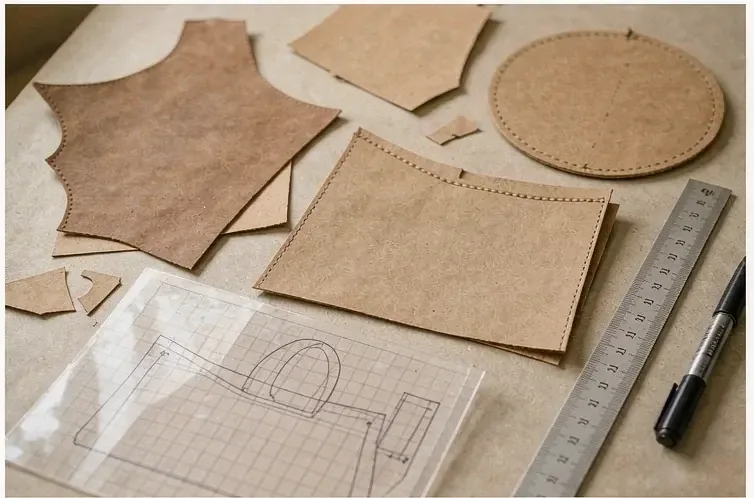
A structured body can be cut as twelve panels or as thirty-one, and the finished bags look alike in a photograph while behaving very differently on the bench. Every extra panel carries its own cutting pass, its own skiving pass to thin the turn, and one more seam that must be aligned, creased and finished. Adding nine panels therefore puts close to eleven minutes into the unit and opens several places where two edges can meet slightly out of register.
- Ask for the panel count on the pattern sheet, since it predicts bench minutes better than any drawing does.
- Groups of five panels are the natural unit of comparison, each adding roughly USD 1.90 to USD 4.60 at these quantities.
- Fewer panels mean larger pieces and larger pieces nest less well, so this lever and the next one pull against each other.
- Keep gussets single-piece wherever the silhouette allows, because a joined gusset is two seams and two skives instead of one fold.
- Fix the count before the first sample, as changing it afterwards re-opens grading and the costing behind it.
Lever Two — Cutting Yield: Points Turn Into Hides
Hides are bought whole and sold by area, so what governs the bill is not the rate per foot but how much of each hide becomes a bag. On the 30 x 24 x 12 cm body used throughout this article the finished panels take about 4.4 sq ft. At 68% yield that consumes 6.4 sq ft of hide per unit; at 58% it consumes 7.6 sq ft. Across 500 pieces the gap is close to eleven hides, which is money spent on material rather than on minutes.
- Finished panel area per unit
- 4.4 sq ft on a 30 x 24 x 12 cm structured body
- Hide consumed per unit at 68% yield
- 6.4 sq ft
- Hide consumed per unit at 58% yield
- 7.6 sq ft
- Hides needed for 500 units
- 67 at 68% yield, 79 at 58% yield
- Usable area logged per hide
- 44-50 sq ft graded usable, recorded against the lot
- Working rule of thumb
- One yield point lost costs about one hide per 500 pieces
Yield is settled by the nesting plan and by the grain direction rule, and both belong to the pattern maker rather than to the tannery. Holding one grain direction across every panel gives up a little area at cutting and saves considerably more afterwards, because panels cut across the grain relax at different rates and the body starts to twist after a season on a shoulder.
Lever Three — Hardware Components Are Counted, Not Styled
Hardware is usually discussed as a styling question and priced as a counting question. A body carrying six components — two feet, a closure, two rings and a slider — behaves very differently from one carrying seventeen, where strap adjusters, a lock plate, anchor patches and a dust-bag toggle all appear. Each part brings a purchase price of USD 0.55 to USD 2.40, roughly 0.4 minutes to set, and a reinforcement patch behind its anchor point.
- Count the components on the approved sample and ask which of them the drawing genuinely needs.
- Every anchor wants a patch behind it; without one, a plate works through plain lining early in the bag's life.
- Plating thickness stated in microns and the salt spray hours actually tested move component price more than shape does.
- Keep one finish across the capsule, since shared plating runs shorten component lead time.
- A bespoke mechanism adds mould tooling, a proving step on the bench and about two to three weeks, so decide it before the sampling window opens.
Lever Four — Operation Count and Minutes at the Bench
Bench cost is assembled from operations rather than from hours, so the count on the construction sheet is the clearest predictor of what a unit will be charged. A straightforward body runs through about 34 operations and 24 minutes. A fully structured one with turned edges, hand-set lining and burnished edging reaches 86 operations and close to 61 minutes. Stitch density and edge coats sit inside that count and can be moved independently of it.
34 operations, 24 minutes
Straightforward build: machine creasing, two edge coats, machine-set lining. The quickest route through the bench and the one most programmes choose for a first capsule.
58 operations, 42 minutes
Structured build: four sanded coats at 9-14 µm, hand-aligned panels, reinforced base. Where most collections land once a silhouette has proven itself at retail.
86 operations, 61 minutes
Atelier build: hand-burnished edging, hand-set lining, turned edges throughout, closure cycled on the bench. Slowest per unit and the level at which finishing reads across a counter.
Thread belongs to the same decision. A bonded filament around 0.45 mm holds tension at ten stitches per inch without fraying at the needle, whereas a finer thread asks for a looser seam and gives the stitch line a different rhythm along the flap. Neither is wrong; they are two settings of the same lever.
Lever Five — Packing Grade and Carton Efficiency
Packing is quoted as a unit cost and behaves as a freight cost. A folding carton sits near USD 0.75 per piece, while a rigid presentation box with a cotton dust bag and printed care card reaches about USD 4.80 per piece at these quantities. The same decision also settles how many units fit an export carton: roughly twenty-four flat-packed, roughly twelve boxed, so the freight bill doubles before a single rate changes.
- Ask for the packing price per piece and the resulting export carton count in the same request.
- A boxed unit roughly doubles carton count for identical quantity, which is a freight choice made at concept stage.
- Request carton dimensions and gross weight, since those two figures are what a forwarder prices against.
- Specify boxes and dust bags early, because their lead time sits outside the 35-50 day bulk window.
- Fix the trade term at quotation: FOB Xiamen covers goods to port, while CIF and DDP re-price the shipment.
Lever Six — Inspection Level and the Sample You Pay For
Inspection is the lever most often left at a default and then argued about once something reaches a customer. Under ISO 2859-1, a 500-piece lot examined at general level II with AQL 2.5 draws a sample of 50 pieces, accepting three defects and rejecting on four. Moving to level III raises the sample to 80 pieces with five accepted; moving to AQL 1.0 lowers the acceptance number on a 50-piece sample to one.
Both moves are available and both carry a price. Level III adds roughly 2.2 hours to a single lot, and a tighter acceptance number raises the chance of a second pass, which is where the real money sits. Ask which level and which limit the quotation assumes, because the honest answer is sometimes whatever the previous programme happened to use.
Reports are drawn per material lot and laboratories keep their own timetables. Booking at lot selection rather than when cartons are packed is the least expensive decision available on this lever.
Screening follows the destination. European Union shipments are checked against the Annex XVII restrictions under REACH, and fibre composition labelling follows EU Regulation 1007/2011. United States shipments add a Proposition 65 assessment and CPSIA documentation where metal parts are involved. Colour fastness is checked under the ISO 105 series and coating adhesion under ISO 11644.
One Body Priced Across Three Lever Settings
The six levers read most clearly when they are moved together. The three configurations below describe the same structured body at 500 pcs per style and per colourway, with nothing altered except the settings.
Twelve panels, 68% yield, six parts
34 operations and 24 bench minutes, folding carton, inspection at AQL 2.5 level II. Indicative USD 31-39 per unit on FOB Xiamen terms.
Twenty-one panels, 72% yield, eleven parts
58 operations and 42 bench minutes, rigid box with dust bag, inspection at level III. Indicative USD 45-58 per unit.
Thirty-one panels, 64% yield, seventeen parts
86 operations and 61 bench minutes, bespoke closure proven on the bench, presentation packing, AQL 1.0 level III. Indicative USD 63-74 plus tooling.
The distance between the floor and the ceiling is about USD 43, and every part of it comes from a setting rather than from the silhouette. That is the point worth carrying into a quotation call: the drawing is fixed, the levers are not, and only the levers can be argued with.
Six Questions to Ask Before Negotiating a Number
Negotiating against a total is slow, because neither side can see which assumption is doing the work. Negotiating against the six settings is quick, because each one has a price and a deadline by which it must be settled.
Questions that move a quotation faster than a request for less
- How many panels does the pattern split the body into, and what does each group of five add?
- What yield does the nesting plan assume, and how many hides does that consume at 500 pieces?
- How many hardware components are counted, and what is carried per part?
- How many operations reach the bench, and how many minutes does a unit take?
- Is packing quoted per piece, and what export carton count does it produce?
- Which inspection level and acceptance limit does the figure assume, and what would a tighter setting add?
Asked in that order, the conversation changes character. Rather than pressing for a reduction against an undescribed build, you choose the two settings worth moving, and the cost shifts by a known amount for a reason that everybody at the table can see.
What to Send So the Six Levers Can Be Priced
A first quotation call produces a usable figure in proportion to what arrives before it. Five items are enough, and each one removes a round of clarification from the sampling window.
- Dimensioned sketches or a technical pack, so panel count and nesting can be estimated rather than guessed.
- Quantity per style and per colourway separately, since 500 pcs applies to each combination.
- Every destination market, so the compliance line reflects what will actually ship.
- A target landed figure beside the target unit figure.
- The date the capsule reaches a shelf, counted back through 35-50 days of bulk and 6-10 working days of sampling.
Capacity sits at about 200,000 pcs per month across 7 production lines, and export programmes have run since 2014 through our validated partner factory Quanzhou Yingming Bags, an SGS-validated site. Sampling takes 6-10 working days for standard constructions and 12-15 for complex ones, bulk takes 35-50 days, and inspection sits at AQL 2.5 under ISO 2859-1 with an independent audit available on request.
Price your six levers
Send the pack, the quantity per colourway and the destination markets. You receive every lever priced separately, the assumption behind each, and a landed estimate within two working days. Request a quote.
Frequently Asked Questions
What is the real cost of premium handbag production per unit?
On a structured calfskin body of about 30 x 24 x 12 cm, ordered at 500 pcs per style and per colourway, expect USD 31 to USD 74 on FOB Xiamen terms, with tooling billed apart. The floor assumes twelve panels, six components and a folding carton; the ceiling assumes thirty-one panels, seventeen components and presentation packing.
Why do two quotations for the same drawing differ so much?
Because the drawing only fixes the silhouette. Panel count, nesting yield, component count, bench operations, packing grade and inspection level each carry a range, and two programmes rarely set them the same way. Ask which value each lever takes, and the difference stops being a mystery and becomes a decision.
How many panels should a structured handbag pattern use?
Anywhere between twelve and thirty-one, depending on how much shaping the body needs. Panels buy fit and are paid for in minutes: each added panel brings a cutting pass, a skiving pass and a seam to align. Groups of five are the useful comparison, since each group moves unit cost by roughly USD 1.90 to USD 4.60 at these quantities.
What does one point of cutting yield actually cost?
About one hide per 500 pieces. The finished panels on this body take around 4.4 sq ft, so a unit consumes 6.4 sq ft of hide at 68% yield and 7.6 sq ft at 58%. Over a run of 500 that spread is eleven hides, which is why nesting belongs in the costing conversation rather than being left to the cutting table.
How much does each hardware component add to a unit?
Purchase price runs from USD 0.55 to USD 2.40 per part, plus roughly 0.4 minutes to set it and a reinforcement patch behind the anchor. Count matters more than styling: a body with six components and one with seventeen differ by far more than the same body finished in two different platings.
How many bench operations does a premium handbag involve?
Between 34 and 86, and that count predicts unit price better than any hourly rate. A straightforward build runs about 24 minutes, a structured build with four sanded coats runs around 42, and an atelier build with burnished edging and hand-set lining reaches roughly 61 minutes for a single unit.
What does presentation packing add per unit?
A folding carton sits near USD 0.75, while a rigid box with a cotton dust bag and printed care card reaches about USD 4.80 at these quantities. The decision also halves carton efficiency: twenty-four flat-packed units fit an export carton where twelve boxed ones do, so the freight bill moves with the choice.
How much of a 500-piece lot is inspected?
Under ISO 2859-1, general level II with AQL 2.5 draws 50 pieces from a 500 pc lot, accepting three defects and rejecting on four. Level III lifts the sample to 80 pieces with five accepted, and AQL 1.0 lowers acceptance on a 50-piece sample to one. Each step adds paid inspection hours.
Which compliance screening applies to European and United States shipments?
European Union shipments are checked against the Annex XVII restrictions under REACH, and fibre composition labelling follows EU Regulation 1007/2011. United States shipments add a Proposition 65 assessment plus CPSIA documentation where metal parts are involved. Colour fastness is checked under ISO 105 and coating adhesion under ISO 11644.
Does ordering more pieces lower the unit cost much?
Less than most founders expect, because the heavy lines scale almost linearly. Going from 500 to 1,000 pieces improves how tooling amortises and may soften material rates, while hide area per bag and bench minutes per bag stay broadly unchanged. Ask which specific lever improves before assuming that the total does.
How long do sampling and bulk take once the pack is sent?
Sampling takes 6-10 working days for standard builds and 12-15 for complex ones, covering a prototype plus one revision round. Bulk then runs 35-50 days. Laboratory testing follows its own calendar, which is why booking it when the lot is named rather than when cartons are packed keeps the schedule intact.
Can unit cost fall without touching the silhouette?
Usually, by moving settings rather than shapes. Reduce panel count where the fit allows, tighten nesting to recover yield, drop components the drawing does not need, take edge work from four coats to two, or keep inspection at level II. Each change is separately measurable, and none alters what a customer recognises.
People Also Ask
What drives handbag cost more than order quantity?
Six specification settings: panel count, cutting yield, component count, bench operations, packing grade and inspection level. Quantity mainly improves how one-off tooling amortises, while most other lines scale close to linearly with every additional unit.
How is cutting yield measured on a hide?
As the share of graded usable area that becomes finished panels. Record usable area per hide against the lot number, divide the panel area actually cut by that figure, and review it whenever the pattern or the nesting plan changes.
What does AQL 2.5 mean in plain terms?
It is an acceptance quality limit used with ISO 2859-1 sampling. On a 500-piece lot at general level II it means drawing 50 pieces and accepting up to three minor defects, with a fourth triggering rejection of the lot.
Why does packing change freight as well as unit cost?
Because packing settles how many units fit an export carton. A flat-packed unit allows roughly twenty-four per carton where a boxed one allows twelve, so identical quantity ships in twice the cartons and is billed on that basis.
What should be settled before a first sample is made?
Panel count, hardware direction and packing grade, because each drives either the pattern or a component lead time. Changing any of them after the first sample re-opens costing, grading and the sampling calendar at the same moment.
Sources and further reading
Every figure on this page is either our own programme data or attributed below. Open the originals before you write them into a specification.
- ISO — International Organization for StandardizationISO Publisher of ISO 2859-1 for sampling inspection by acceptance quality limit, the ISO 105 series for colour fastness and ISO 11644 for coating adhesion.
- Leather Working GroupLeather Working Group Tannery environmental audit protocol referenced whenever a specification calls for leather from audited tanneries and records the audit in the pack.
- European Chemicals AgencyECHA Authority for REACH obligations, including the Annex XVII restrictions that set substance screening scope for European Union destinations.
- California Office of Environmental Health Hazard AssessmentOEHHA Administrator of the Proposition 65 list, which sets the warning assessment scope for handbag programmes shipping into California.
- Sourcing JournalSourcing Journal Trade reporting on hide pricing, material cost movement and freight conditions that shapes the indicative ranges quoted here.