Luxury Handbag Measurement Tolerances Explained: The Tolerance Table Every Luxury Handbag Tech Pack Should Carry
Luxury handbag measurement tolerances are the permitted deviation between the approved sample and the bulk piece, and they are what make an AQL inspection countable. The working set: body dimensions ±2 mm up to 300 mm and ±3 mm above, handle drop ±2 mm, strap length ±3 mm under 1 kg tension, flap alignment within 1.5 mm, stitch density 8-9 per inch, edge paint three coats, and shade within ΔE 1.0 of the master under D65. Without those numbers, AQL 2.5 has nothing to count.
Why a Tolerance Is Not a Dimension
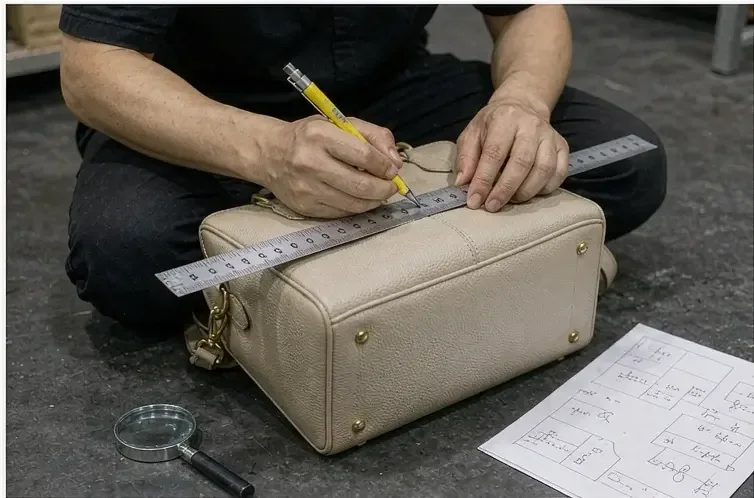
A dimension is an intent; a tolerance is the permitted deviation from that intent, and only the tolerance is enforceable. A tech pack that says the body is 280 mm wide with no tolerance has not stated a requirement at all, because no cutting, skiving or closing operation can hold an exact figure on a natural material. Leather moves with humidity, a panel stretches under the needle, and a folded gusset relaxes overnight. The tolerance is where the house and the brand agree how much of that movement is acceptable.
The second reason tolerances matter is that they convert opinion into a count. An inspector working to AQL 2.5 needs to decide, piece by piece, whether each unit conforms. That decision is only defensible when the spec gives a number and a method. 'Flap sits correctly' produces an argument; 'flap alignment within 1.5 mm across the closure line, measured at three points on the stuffed piece' produces a count. Our tech packs carry the tolerance table on the same page as the dimensions for exactly this reason.
Three fields per tolerance
- Every tolerance line needs a value, a measurement condition and an instrument. Value alone — '±2 mm' — leaves open whether the piece is stuffed, where on the panel it is measured, and with what gauge.
The Master Tolerance Table for a Structured Handbag
The table below is the set we issue as the default for a structured top-handle or frame bag in calfskin. It is deliberately conservative at the visible points and looser at the hidden ones, because tolerance allowance should be spent where the customer looks. A brand with a stricter house standard can tighten any line; what matters is that every line carries a number before sampling starts, and that the same table is used at first-article approval and at final inspection.
| Feature | Tolerance | Measurement condition | Class if exceeded |
|---|---|---|---|
| Body width and height, up to 300 mm | ±2 mm | Stuffed piece, steel rule, three points | Major |
| Body width and height, above 300 mm | ±3 mm | Stuffed piece, steel rule, three points | Major |
| Base depth | ±2 mm | Measure at both gusset ends | Major |
| Handle drop | ±2 mm | Arch apex to body top, unloaded | Major |
| Strap length, pin to pin | ±3 mm | Under 1 kg tension | Major |
| Flap alignment across closure | Within 1.5 mm | Three points on the stuffed piece | Major |
| Base flatness on glass | Rocker ≤1 mm | Piece upright, unloaded | Minor to major |
| Stitch density, structural seam | 8-9 per inch | Counted over a 25 mm gauge | Major |
| Stitch density, turned interior seam | 7-8 per inch | Counted over a 25 mm gauge | Minor |
| Shade against master swatch | Within ΔE 1.0 | D65, approximately 1,000 lux | Major |
Body and Panel Tolerances
Body dimensions are measured on the stuffed piece, stuffed to the volume the bag is designed to carry rather than to capacity. Up to 300 mm the tolerance is ±2 mm; above that it opens to ±3 mm because a larger panel accumulates more movement through cutting, skiving and closing. The measurement is taken at three points — left, centre and right — and the reported figure is the widest deviation, not the average, because the customer sees the worst point.
Panel-to-panel symmetry is a separate line even though it uses the same gauge. On a gusseted body the left and right gussets should match within 1 mm at the base and within 1.5 mm at the mouth, because asymmetry at the mouth is visible head-on while asymmetry at the base is not. This is also where asymmetry of a different kind must be excluded: hand-finished construction produces small, repeatable left-right differences that are present on the approved sample. Those are not defects, and the tolerance table should say so explicitly next to the symmetry line.
Handle, Strap and Drop Tolerances
Handle drop is measured from the apex of the arch to the highest point of the body, unloaded, and held to ±2 mm. It is the most complained-about dimension in retail because it changes how the piece sits on the arm, and a 4 mm difference is felt before it is seen. Strap length is measured pin to pin under a light 1 kg tension, which removes the slack that makes an unloaded measurement meaningless, and is held to ±3 mm. Strap width is held to ±1 mm because it must match the hardware slot it passes through.
- Handle drop
- ±2 mm, apex of arch to body top, unloaded
- Strap length
- ±3 mm, pin to pin under 1 kg tension
- Strap width
- ±1 mm, must clear the hardware slot
- Handle attachment spacing
- ±1 mm between the two attachment centres
- Top handle static load
- 8 kg for 60 seconds, no seam creep above 1 mm
- Shoulder strap static load
- 5 kg for 60 seconds, no distortion after release
Closure, Flap and Alignment Tolerances
Closure fit is where most bulk complaints originate, and it is the line most often missing from a tolerance table. Flap alignment is held within 1.5 mm across the closure line, measured at three points on the stuffed piece. Magnetic closures are held to a release force of 3-6 N on a pull gauge: below 3 N the bag opens in use, above 6 N the customer has to fight it, and both feel wrong in the hand long before they look wrong on the shelf. Turn-locks must close with the same force at the end of a 100-cycle test as at the start.
Frame bags carry an additional line: the two frame halves must meet without a visible step, held to 0.3 mm across the join, because a step at the frame is the one defect that reads as a construction failure rather than a tolerance miss. Closure testing is always run loaded, never empty. A filled body distorts, and a closure that passes on an empty piece frequently fails once the lining and contents push the panels outward.
Stitch, Edge and Seam Tolerances
Stitch density is expressed as a range rather than a single figure: 8-9 stitches per inch on structural seams, 7-8 on turned interior seams, counted over a 25 mm gauge. The range matters because both ends are limits. Below seven the seam reads as coarse and the bite is too long; above nine the needle has perforated the leather to the point of weakness. Thread itself is specified as bonded nylon at Tex 40, roughly 0.45 mm in diameter, so that the thread fills the needle hole instead of sitting proud of the surface.
Structural seam
8-9 stitches per inch, Tex 40 bonded nylon, thread sitting slightly below the surface, back-tack hidden rather than clipped at the face.
Turned interior seam
7-8 stitches per inch, no pucker at the turn, allowance trimmed to 3 mm and hidden under the lining.
Edge paint
Three coats, sanded between coats, total film 0.25-0.35 mm, no crack when the panel is folded through 180 degrees at room temperature.
Reinforcement
0.8 mm non-woven interlining behind handle attachments and magnetic closure seats on 100% of the sample, not most of it.
Hardware and Plating Tolerances
Hardware tolerances are dimensional and chemical at once. Dimensional tolerances cover the fit: a lock plate must seat flush with no gap above 0.2 mm at the edge, feet must sit flush to the base with no rocker above 1 mm, and a zip tape must track within 0.5 mm of the seam centre. Chemical tolerances cover the finish: light gold plating is specified at 0.15-0.3 µm, palladium finishes are verified with a 48-hour salt spray exposure against 24 hours for light gold, and no flake is permitted at the highest wear points.
The hardware line is also where a hidden tolerance does real work: the clearance between a strap and the slot it passes through. A strap specified at 12 mm through a slot specified at 12 mm will not pass. Our component drawings carry a nominal clearance of 0.5 mm per side on strap-to-slot fits and 0.2 mm on lock-plate-to-body fits, which is the difference between a piece that assembles at the bench and one that is forced together with a mallet.
Colour, Shade and Finish Tolerances
Colour is the one tolerance that must never be judged by eye alone. Shade is held within ΔE 1.0 of the master swatch, measured instrumentally under D65 at approximately 1,000 lux. Within a single carton the pieces should be indistinguishable from each other, and the tolerance that matters most is not the distance from the master but the spread inside the carton: two pieces at ΔE 0.8 on opposite sides of the master will read as two different colours on a boutique shelf even though both are inside tolerance.
Specify both: distance from the master within ΔE 1.0, and spread across pieces inside one carton within ΔE 0.6. The second figure is what stops a shelf looking mismatched.
Tolerances That Do Not Belong in a Luxury Specification
Some lines look rigorous and cause harm. A blanket ±1 mm on all dimensions pushes cost up without improving appearance, because the hidden features simply do not need it. A zero tolerance on grain variation guarantees a false reject on the first carton, because full-grain calfskin at 1.2-1.4 mm varies by nature. A tolerance on weight is usually noise unless the piece is sold by weight. And a tolerance written without a measurement condition is worse than none, because it invites both sides to measure differently and then argue about the method.
- No blanket tolerance across visible and hidden features — spend the allowance where the customer looks.
- No zero tolerance on natural grain variation inside the approved swatch range.
- No tolerance on subjective terms such as 'soft' or 'firm' without a durometer or hand-feel reference panel.
- No tolerance stated without a measurement condition: stuffed or empty, loaded or unloaded, gauge and light source.
- No tolerance tighter than the instrument can resolve — a ±0.1 mm line needs a calliper, not a rule.
How Tolerances Are Audited on the Bench
Audit starts at first-article approval, not at final inspection. The first piece off the line is measured against every line of the table and the results are recorded, because a tolerance miss caught at first article costs a bench adjustment while the same miss caught at final inspection costs a re-sort. Final inspection then samples to AQL 2.5 (ISO 2859-1) with the same table, on 50 pieces for a 500-piece lot, with critical defects at zero and major defects failing the lot at four.
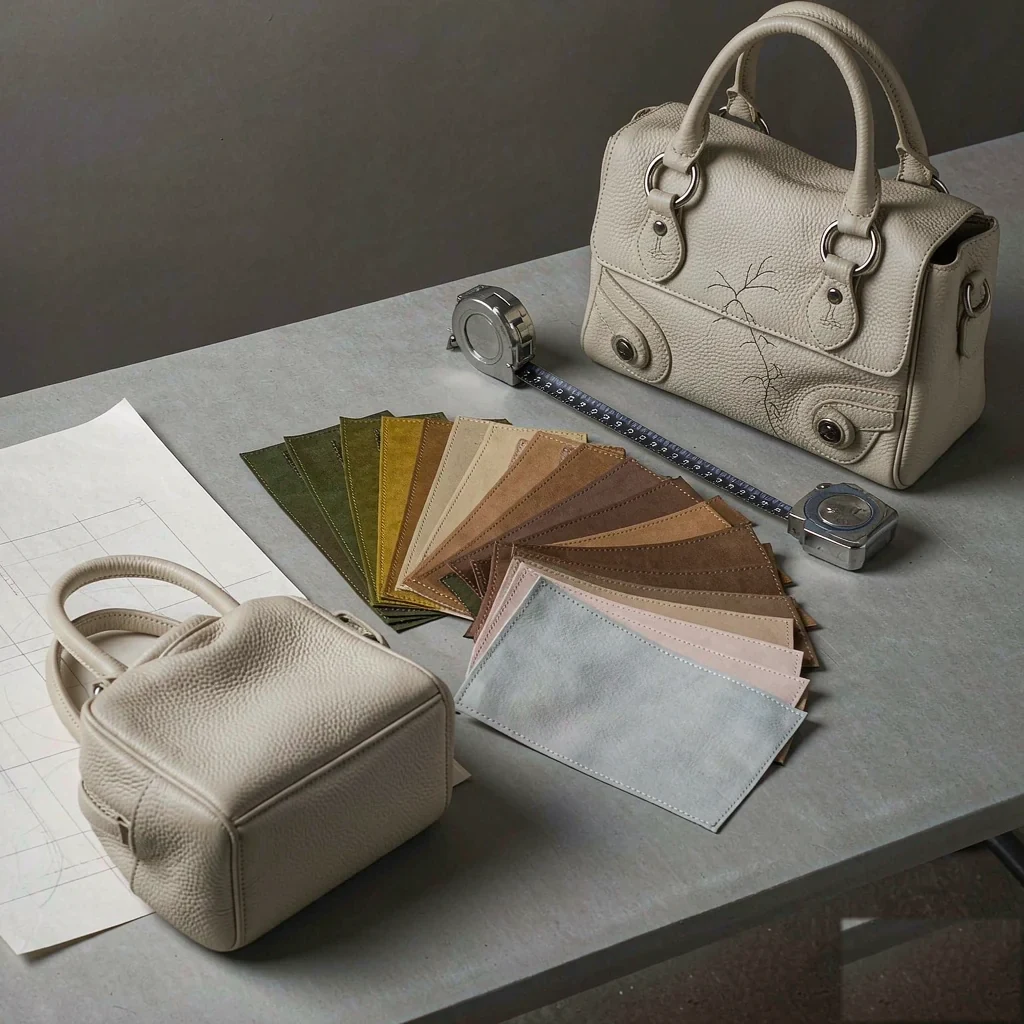
Programme timings sit around that sequence. Sampling runs 6-10 working days and 12-15 for complex constructions, bulk runs 35-50 days from approved sample, and the minimum booking is 500 pieces per style and colourway on FOB Xiamen terms. Our validated partner factory Quanzhou Yingming Bags has run export programmes since 2014 across 7 production lines at about 200,000 pcs per month, and every booking carries the same tolerance table so that a repeat style is measured identically to the original.
- Issue the tolerance table with the tech pack, before the first sample is cut.
- Measure every line at first-article approval and record the results against the piece.
- Sample the same lines at final inspection to AQL 2.5, with the approved sample on the table.
- Review any line that produced more than two major findings and tighten or loosen it for the next booking.
- Re-issue the table whenever a component changes, with a new seal date.
Get the tolerance table into your tech pack
Send us your dimensions and we will return a completed tolerance table with measurement conditions and defect classes, ready to attach to the tech pack before sampling begins.
Frequently Asked Questions
What is a measurement tolerance on a handbag?
A measurement tolerance is the permitted deviation between the approved sample and a bulk piece, stated as a value plus a measurement condition. It is what turns a dimension into an enforceable requirement, and it is the number an inspector counts against under an AQL plan.
What tolerance is normal for handbag body dimensions?
Bodies up to 300 mm are normally held to ±2 mm and larger bodies to ±3 mm, measured on the stuffed piece at three points with the widest deviation reported. The tolerance opens on larger panels because cutting, skiving and closing accumulate more movement.
Should a handbag be measured stuffed or empty?
Stuffed, to the volume the bag is designed to carry. An unstuffed structured bag measures differently from the piece on a boutique shelf, and handle drop in particular shifts once the body is supported.
What is the tolerance on handle drop?
Handle drop is held to ±2 mm, measured from the apex of the arch to the highest point of the body on the unloaded piece. It is the most complained-about dimension in retail because a small difference changes how the bag sits on the arm.
How much flap misalignment is acceptable?
Flap alignment is normally held within 1.5 mm across the closure line, measured at three points on the stuffed piece. Beyond that the misalignment reads as a construction fault rather than a tolerance miss, and it is the defect most often cited in retail returns.
What stitch density should a luxury handbag have?
Structural seams run 8-9 stitches per inch and turned interior seams run 7-8, counted over a 25 mm gauge. Both ends are limits: below seven the seam looks coarse, above nine the needle has perforated the leather to the point of weakness.
How thick should edge paint be?
Edge paint is applied in three coats, sanded between coats, with a total film of roughly 0.25-0.35 mm. The functional test is that the finished edge does not crack when the panel is folded through 180 degrees at room temperature.
What tolerance applies to hardware plating?
Light gold plating is specified at 0.15-0.3 µm in thickness, verified against a 24-hour salt spray exposure, while palladium finishes are verified against 48 hours. No flake is permitted at the highest wear points, typically the lock plate edge and the base feet.
How is colour shade tolerance written?
Shade is written as a ΔE limit against a master swatch, normally ΔE 1.0, measured instrumentally under D65 at about 1,000 lux. A second figure limits the spread between pieces inside one carton, normally ΔE 0.6, which is what keeps a shelf from looking mismatched.
Why should grain variation not have a zero tolerance?
Full-grain calfskin at 1.2-1.4 mm varies in grain tightness and finish depth by nature. A zero tolerance guarantees a false reject on the first carton, so variation inside the approved swatch range is written into the tolerance table as not a defect.
What clearance is needed between a strap and its slot?
A nominal clearance of 0.5 mm per side on strap-to-slot fits and 0.2 mm on lock-plate-to-body fits. A strap specified at the same figure as the slot it passes through simply will not assemble without force.
When should tolerances be checked?
At first-article approval and again at final inspection, using the same table. A tolerance miss caught at first article costs a bench adjustment; the same miss caught at final inspection costs a re-sort of the lot.
What magnetic closure force is correct?
A release force of 3-6 N measured on a pull gauge. Below 3 N the bag opens in use and above 6 N the customer has to fight it. Both are felt in the hand before they are visible on the shelf, so the figure belongs in the spec.
Do tolerances change for exotic skins?
The dimensional tolerances stay the same but the material tolerance widens, because scale and grain geometry vary more than calfskin. Exotic skins also carry a documentation line, with CITES paperwork reconciled to the piece count at inspection.
Can a brand tighten every tolerance line?
It can, but a blanket tightening raises cost without improving appearance. Tolerance allowance should be spent on visible and functional features — flap alignment, handle drop, shade spread — and left looser on hidden ones.
People Also Ask
What is a normal tolerance for handbag dimensions?
Body dimensions are held to ±2 mm up to 300 mm and ±3 mm above, measured on the stuffed piece at three points. Handle drop is ±2 mm, strap length ±3 mm under 1 kg tension, and flap alignment within 1.5 mm.
Why do handbag tolerances matter?
Because an AQL inspection counts conformity, and conformity needs a number. A spec that says the flap 'sits correctly' produces an argument; a spec that says within 1.5 mm at three points produces a defensible count.
How tight should luxury bag tolerances be?
Tight on visible and functional features, looser on hidden ones. Spend the allowance on handle drop, flap alignment and shade spread rather than applying a blanket ±1 mm across every dimension on the drawing.
What is ΔE in handbag colour control?
ΔE is the measured colour difference between a production piece and the master swatch. Luxury programmes normally hold to ΔE 1.0 against the master and ΔE 0.6 between pieces inside one carton, read under D65 lighting.
How many stitches per inch is luxury quality?
Eight to nine stitches per inch on structural seams and seven to eight on turned interior seams, counted over a 25 mm gauge using Tex 40 bonded nylon thread at roughly 0.45 mm diameter.
Sources and further reading
Every figure on this page is either our own programme data or attributed below. Open the originals before you write them into a specification.
- ISO 2859-1 sampling procedures for inspection by attributesInternational Organization for Standardization The sampling plan used to audit tolerance lines at final inspection.
- Leather Working GroupLeather Working Group Tannery audit framework referenced when hide lots are recorded for traceability.
- CITES AppendicesCITES Secretariat Documentation reconciled to piece count when exotic skins are specified.
- Proposition 65California Office of Environmental Health Hazard Assessment The listing that sets zero-tolerance findings on metal hardware and coatings.