How AQL 2.5 Protects Luxury Handbag Brands: Four Exposures and One Count
AQL 2.5 protects a brand in four ways: it defines acceptable as a count rather than an impression, it moves detection to before the shipment leaves, it creates a record the next drop can be compared against, and it gives the buyer a number to hold in a commercial conversation. On a 1,500-piece lot the plan draws 125 pieces and rejects on 8 major defects, which is what turns a 6 per cent destination finding into a bench correction.
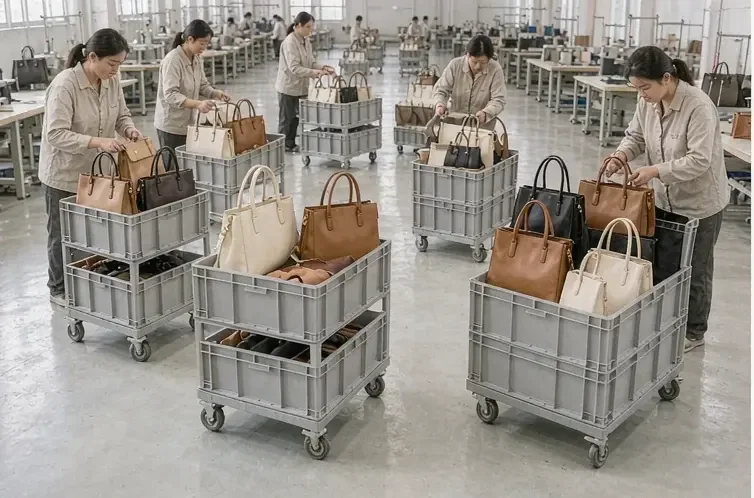
A Second Drop That Skipped the Plan
A maison ran its second drop without a pre-shipment inspection. The first drop had passed cleanly, the relationship was comfortable, and the schedule was tight, so the lot of 1,500 pieces across three colourways was released on the strength of photographs sent from the bench. The photographs showed the front panel of the best piece of the run, taken under good light, from the angle the silhouette was designed to be seen from.
What arrived told a different story. Roughly 6 per cent of the pieces carried an edge film above 0.25 mm that read as a strip stuck along the boundary, and a smaller share had a hardware gap above 0.5 mm at the plate. Neither fault was visible in the photographs. Both were visible in the boutique within a day, and both were the kind of fault a customer notices on a piece they have already decided to buy.
The resolution took longer than the run had. Replacement pieces had to be made and flown, because a sea schedule of 30-35 days would have missed the season, and the cost of that exercise exceeded the cost of the inspection by a wide margin. The third drop went out with a plan drawn at AQL 2.5 under ISO 2859-1, and a re-work reserve held above the run quantity.
What AQL 2.5 Actually Protects: Four Exposures
The case above is ordinary, and the four exposures it illustrates are the ones a sampling plan addresses. The first is definitional: without a plan, acceptable is an impression, and an impression cannot be held in an argument. The second is timing: a finding made at the bench is a correction, while the same finding made at a boutique is a return. The third is memory: without readings, the third drop cannot be compared with the second.
| Exposure | Without a plan | With AQL 2.5 |
|---|---|---|
| Definition of acceptable | An impression, argued after delivery | A count: 125 drawn, accept 7, reject 8 |
| Timing of detection | At the boutique, by a customer | At the bench, before the cartons seal |
| Record for later drops | None; each drop starts again | Readings kept against the order |
| Commercial leverage | A request, not a claim | A number written into the order |
| Cost of a finding | Air replacement and returns | Re-work at roughly USD 4.80 per unit |
The fourth exposure is the one buyers underestimate. A plan written into the order converts a quality request into a claim: not that the pieces should be better, but that a lot with nine major defects in a draw of 125 was rejected under a clause both parties signed. That difference is worth more than the inspection itself.
The Arithmetic of a Finding at Destination
Put the case in numbers. A lot of 1,500 pieces at general inspection level II draws 125, accepts on 7 major defects and rejects on 8. Inspecting those 125 pieces takes 40-60 hours of inspector time in total, at 20-30 minutes each, and the tightened plan with a re-work reserve adds roughly USD 4.80 per unit across the run.
- Lot size
- 1,500 pcs across three colourways
- Code letter
- K at 1201-3200
- Sample size
- 125 pieces
- Accept, major
- 7
- Reject, major
- 8
- Inspector time per piece
- 20-30 minutes
- Total inspection time
- 40-60 hours for the draw
- Finding rate at destination
- 6 per cent of the shipment
- Re-work reserve
- 2-3 per cent above the run quantity
- Cost of the tightened plan
- USD 4.80 per unit
Against that, the destination finding cost air replacement on a meaningful share of 1,500 pieces, returns handling, and the sell-through lost while shelves waited. The comparison is not close, and it does not become close on larger runs, because the sample size grows far more slowly than the lot: 200 pieces drawn from a lot of 3,201 to 10,000.
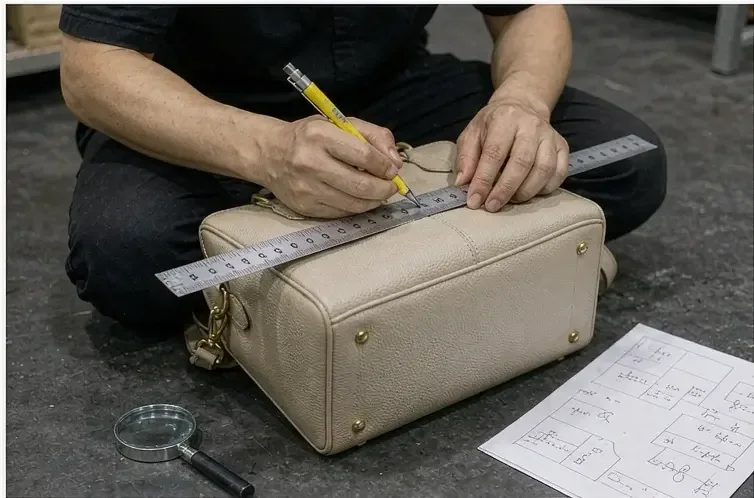
Protection One: A Countable Definition of Acceptable
The first protection is that the plan makes acceptable countable. Every tolerance behind the count is written as a number with a method: seam deviation under 0.5 mm over a 100 mm run, edge film between 0.10 and 0.15 mm dry, hardware gap under 0.2 mm, handle drop within 2 mm between sides. An inspector then counts rather than judges, and two inspectors reach the same answer.
- Write each tolerance as a number with a method, not as an adjective.
- Say where the tolerance applies: visible and loaded areas, or the interior as well.
- Agree which natural hide characteristics are not defects, and where.
- Name the instrument: rule, micrometer, feeler, loupe or gauge.
- Keep the approved sample at the inspection table, not in a file.
The third item prevents the commonest dispute on a full-grain hide. Healed scars, neck wrinkles and grain variation are properties of the material rather than faults, and unless the order says which panel positions must be free of them, an inspection becomes an argument about nature. Agreed at sampling, the same question takes thirty seconds at the table.
Protection Two: Detection Before the Shipment Leaves
The second protection is timing. A finding made before the cartons seal is a bench correction: the station that produced it is identified, the pieces are re-worked, and the reserve covers the ones that cannot be. The same finding made after delivery is a return, a replacement, and a conversation with a retailer who has already put the piece on a shelf.
Timing also changes what can be done about the cause. An edge film measured at 0.28 mm at the bench can be traced to a coat applied too wet, to a flash-off shortened by a schedule, or to a batch of finish that has thickened with age. Three weeks later, with the batch consumed and the bench moved on, the same measurement is only a number.
There is a second-order effect worth naming. A finding caught at the bench changes behaviour on the next drop without anyone having to ask for it, because the station that produced it knows it was identified. A finding caught at a boutique arrives as a complaint, and a complaint produces defensive explanations rather than a correction at the station.
Protection Three: A Written Record for Later Drops
The third protection is the record. Readings taken on the drawn pieces, kept against the order, allow the next drop to be compared with the last: was the edge film higher this time, did the hardware gap drift, is the seam deviation on the second colourway different from the first. Without readings, every drop is a fresh argument and a fresh risk.
What to record
The figure, not the verdict. An edge film of 0.14 mm tells you something; a note that the edge was acceptable tells you nothing next season.
How many pieces
The full drawn sample, and at least five pieces on bench-level checks such as handle drop and lining slack where the plan itself draws fewer.
What to photograph
Every finding, before re-work, with the piece identified. A photograph taken after correction proves nothing about what was there.
Where it is kept
Against the order number and the colourway, so a question raised a season later can be answered in an afternoon rather than a week.
Photographs taken before re-work are the item most often missed, and they are the ones that settle disputes. A finding described in words is a claim; the same finding photographed with the piece identifiable is evidence, and it is the difference between a conversation and a correction.

Protection Four: Leverage in the Commercial Conversation
The fourth protection is the one that surprises buyers: the plan is also a commercial instrument. A clause naming the standard, the level, the sample size and the accept number gives the buyer a position that does not depend on being persuasive. The conversation stops being about whether the pieces are good enough and becomes about whether the count exceeded 7.
An inspection without a clause is a favour. The same inspection written into the order is an obligation, and obligations are what protect a season.
One caution applies. Leverage only exists if the clause is written before the run rather than after a dispute. A plan agreed once pieces have already been made is a plan applied retrospectively, and the party who did not draft it will read it as a claim invented to fit a result rather than as a term both sides accepted.
That leverage is worth specifying carefully. Name the standard as ISO 2859-1, the level as general II, the sampling as single and normal, the defect classes as critical 0, major 2.5 and minor 4.0, and the reserve as a percentage above the run quantity. Written that way, the clause can be read by either party in a minute and applied without interpretation.
Where the Plan Does Not Protect You
Four exposures sit outside the plan. Compliance: restricted substances under REACH Annex XVII and California Prop 65, tested in a laboratory rather than seen on a table. Material performance: tensile strength to ISO 3376, finish adhesion to ISO 11644 and colour fastness to ISO 105. Traceability: hide provenance through Leather Working Group tannery audits, and CITES documentation where a listed shell is used.
The fourth is consistency between drops, which no plan delivers. An AQL says whether a lot passes; it does not say whether the next lot will match it. That is a bench discipline of keeping the approved sample on the line and pulling a piece from every group, and it is the subject of luxury quality control in full.
Setting the Plan Up on a Designer Programme
The programme runs through our validated partner factory Quanzhou Yingming Bags, an SGS-validated site with 7 production lines and about 200,000 pcs per month of capacity, holding export experience since 2014. Sampling takes 6-10 working days, or 12-15 on a complex build; bulk occupies 35-50 days; minimums sit at 500 pcs per style and colourway; and shipments leave FOB Xiamen with FOB, CIF and DDP terms available.
Set up in this order: agree the tolerance sheet during sampling, name the plan and level on the order, confirm who draws the sample and when, agree the reserve as a percentage, and fix what happens to a rejected lot. Agreed in that sequence and before the run starts, the plan costs roughly USD 4.80 per unit and removes the largest single risk in a seasonal programme.
The set-up, in five steps
- Agree the tolerance sheet in numbers during the 6-10 working days of sampling window. Name ISO 2859-1, level II, single and normal on the order. Confirm who draws the sample and when. Set the reserve at 2-3 per cent above the run quantity. Fix in writing what happens to a rejected lot.
Put a plan in front of your next drop
Send drawings, material direction, quantity per colourway and delivery date. You will receive the sample size, accept and reject numbers and reserve for your lot. Request a quote.
Frequently Asked Questions
How does AQL 2.5 protect a brand in practice?
In four ways: it defines acceptable as a count, it moves detection to before the shipment leaves, it creates a record later drops can be compared against, and it gives the buyer a number written into the order to hold in a commercial conversation.
What happens to a lot of 1,500 pieces under AQL 2.5?
At general inspection level II the plan draws 125 pieces, accepts on 7 major defects and rejects on 8. Critical defects sit at zero. Inspection takes 20-30 minutes per piece, so 40-60 hours for the draw.
Why not simply inspect every piece?
Because full inspection is slow, expensive and no more reliable: attention falls over a long run, and the plan is designed to give a defensible decision rather than a perfect one. Reserve the effort for the tolerance sheet instead.
What is the cost of a finding at destination?
Air replacement on the affected pieces, returns handling, and the sell-through lost while shelves wait. In the case above it exceeded the cost of the inspection by a wide margin, and the schedule slipped by the length of a sea voyage.
How much does a tightened plan cost?
Roughly USD 4.80 per unit on a designer run, covering the tightened major tolerance, a second inspector on visible stations and a re-work reserve of 2-3 per cent above the run quantity.
What should the tolerance sheet contain?
Seam deviation under 0.5 mm over 100 mm, edge film 0.10-0.15 mm dry, hardware gap under 0.2 mm, handle drop within 2 mm and lining slack under 1 mm, each with the instrument used.
Are natural hide marks defects?
Not by default. Healed scars, neck wrinkles and grain variation are properties of a full-grain hide. Agree at sampling which panel positions must be free of marks and how large a mark must be before it counts.
Who should draw the sample?
Named on the order, and preferably independent of the bench. Whoever draws it, cartons should be picked at about the square root of the count and pieces taken from across them, not from one top layer.
What is a re-work reserve?
Pieces cut above the run quantity, typically 2-3 per cent, so a finding at inspection can be corrected without waiting for another cutting. It matters most on exotic or dyed-to-match shells where a panel cannot be replaced quickly.
Does the plan cover chemical compliance?
No. Restricted substances under REACH Annex XVII and California Prop 65 are tested in a laboratory and specified separately, as are ISO 3376, ISO 11644 and ISO 105 for material performance.
Does the plan make the next drop consistent?
No. It tells you whether a lot passes, not whether the next will match it. Consistency comes from keeping the approved sample on the line and pulling a piece from every group for comparison.
When should the plan be agreed?
During sampling, in the 6-10 working day window, before bulk starts. A plan agreed after the run has begun is a plan applied to pieces that have already been made, which is the most expensive possible time to agree it.
People Also Ask
Is AQL 2.5 enough protection for a designer brand?
For major defects, yes, provided critical defects sit at zero and the tolerance sheet behind the count is written in numbers with instruments named. Most failures come from a vague sheet, not a loose AQL.
What is the biggest cost of skipping inspection?
Schedule. Replacement by air rather than a 30-35 day sea voyage costs several times the inspection, and the season it was meant to serve has already started.
Should the brand or the bench draw the sample?
Whoever is named on the order, and independent is better. What matters is that the draw is random across cartons and repeatable, not who holds the clipboard.
How large should the re-work reserve be?
Two to three per cent above the run quantity, higher on an exotic or dyed-to-match shell where a rejected panel cannot be replaced quickly without a new hide lot.
Can a rejected lot be re-submitted?
Yes, after re-work, using the reserve for pieces that cannot be corrected. Two rejections within five consecutive lots moves the programme to tightened inspection under ISO 2859-1.
Sources and further reading
Every figure on this page is either our own programme data or attributed below. Open the originals before you write them into a specification.
- ISO - International Organization for StandardizationISO Publisher of ISO 2859-1, which sets the code letter, sample size and accept and reject numbers used throughout this article.
- SGSSGS Third-party inspection and testing body whose reports are commonly issued against an AQL 2.5 plan on a designer programme.
- European Chemicals AgencyECHA Administrator of REACH, whose Annex XVII restrictions sit outside the sampling plan and require laboratory testing.
- California Office of Environmental Health Hazard AssessmentOEHHA Administers Proposition 65, referenced for the compliance testing specified alongside an AQL plan.