Luxury Handbag Quality Control: AQL 2.5 Explained in Four Numbers
AQL 2.5 is a sampling plan, not a promise: it states that a lot is accepted when the number of defects found in a drawn sample sits at or below the accept number. On a 500-piece handbag run at general inspection level II under ISO 2859-1, the plan draws 50 pieces, accepts on 3 major defects and rejects on 4. Critical defects are held at zero on any plan, and a re-work reserve sits above the run quantity.
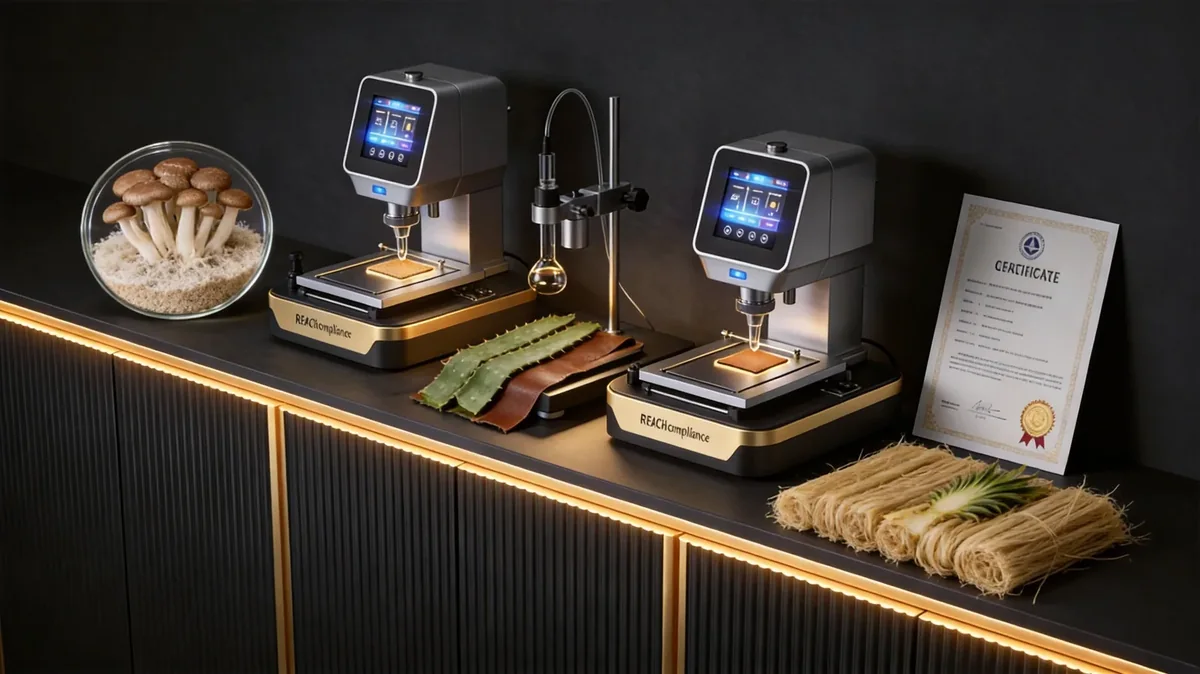
AQL 2.5 in Four Numbers
Everything that matters about AQL 2.5 can be stated in four numbers. First, the sample size: 50 pieces drawn from a 500-piece lot at general inspection level II. Second, the accept and reject numbers: 3 and 4 for major defects. Third, the defect classes: critical at zero, major at 2.5, minor at 4.0. Fourth, the switching rules: two rejections in five consecutive lots moves the plan to tightened.
- Standard
- ISO 2859-1, single sampling, normal inspection
- Inspection level
- General level II unless agreed otherwise
- Lot size
- 500 pcs per style and colourway
- Sample size code letter
- H at 281-500 pieces
- Sample size
- 50 pieces
- Accept number, major
- 3
- Reject number, major
- 4
- Critical defects
- Zero acceptance on any plan
- Minor defects
- AQL 4.0, accept 5 and reject 6 at 50 pieces
- Re-work reserve
- Held above the run quantity
The four numbers are a contract, not a technicality. Once they are written on a purchase order, a dispute about quality stops being an argument about whether a piece looks acceptable and becomes a question about a count. That is the whole value of the plan, and it is why the numbers belong in the order document rather than in an email.
What AQL Actually Means, and What It Does Not
AQL stands for acceptance quality limit, and it is the worst tolerable process average when a continuing series of lots is submitted. That definition contains two limitations worth understanding. It is a process average rather than a guarantee about an individual lot, and it is expressed as a percentage only loosely: an AQL of 2.5 does not mean 2.5 per cent of the lot may be defective, it means the sampling plan was built around a process average of that order.
What it does not do is describe the pieces that were not drawn. A plan that draws 50 and accepts on 3 says nothing directly about the other 450, and a buyer who reads an AQL as a warranty will be disappointed twice: once by the standard, and once by the argument that follows. The correct reading is that AQL 2.5 sets a consistent, defensible rule for deciding whether a lot is accepted.
Inspection at general level II, single sampling, normal, ISO 2859-1: critical 0, major AQL 2.5, minor AQL 4.0, with a re-work reserve held above the run quantity.
Reading the Table: Sample Size by Lot Size
The sample size is set by the lot size and the inspection level, and it grows far more slowly than the lot does. Doubling a lot does not double the sample. A 1,500-piece lot draws 125 pieces against 7 and 8; a 5,000-piece lot draws 200 against 10 and 11. That sub-linear relationship is deliberate, and it is the reason a large run needs process control at the bench rather than a bigger inspection at the end.
| Lot size | Code letter | Sample size | Accept | Reject |
|---|---|---|---|---|
| 91-150 | F | 20 | 1 | 2 |
| 151-280 | G | 32 | 2 | 3 |
| 281-500 | H | 50 | 3 | 4 |
| 501-1200 | J | 80 | 5 | 6 |
| 1201-3200 | K | 125 | 7 | 8 |
| 3201-10000 | L | 200 | 10 | 11 |
Two practical notes on the table. The code letter changes with the inspection level, so a plan quoted at level I draws fewer pieces and is a weaker plan than the same AQL at level II. And the figures above are for a single plan; a double plan, which allows a second draw before a decision, is available and is sometimes worth agreeing on large or expensive lots.
Critical, Major and Minor on a Handbag
Defects are classified before they are counted, and the classification does more work than the count. A critical defect is one that makes the piece unsafe or non-compliant: a broken needle fragment left in a panel, a restricted substance above a legal limit, or a closure that fails and spills contents. A major defect is one a customer would return the piece over. A minor defect is one a critical eye notices but a customer would keep the piece over.
Critical, accept 0
Unsafe or non-compliant: a needle fragment, a restricted substance above limit, a closure that fails under load, or a missing CITES document on a listed shell.
Major, AQL 2.5
A customer would return it: seam deviation above 1.0 mm, an edge film above 0.25 mm, hardware gap above 0.5 mm, or handle drop differing by more than 4 mm.
Minor, AQL 4.0
A customer keeps it: a 1 mm variance in topstitch distance, a light mark on an interior panel, or a dust speck under a lining that requires close inspection to find.
Not a defect
Natural variation in a full-grain hide: healed scars, neck wrinkles and grain difference, provided they fall outside the panel positions agreed at sampling.
The fourth card is the one that prevents the most arguments. A natural hide is not a uniform substrate, and a specification that treats every mark as a defect produces a run in which nothing passes. The agreement to make at sampling is which panel positions are visible enough to reject marks on, and how large a mark has to be before it counts.
How a Handbag Lot Is Drawn and Opened
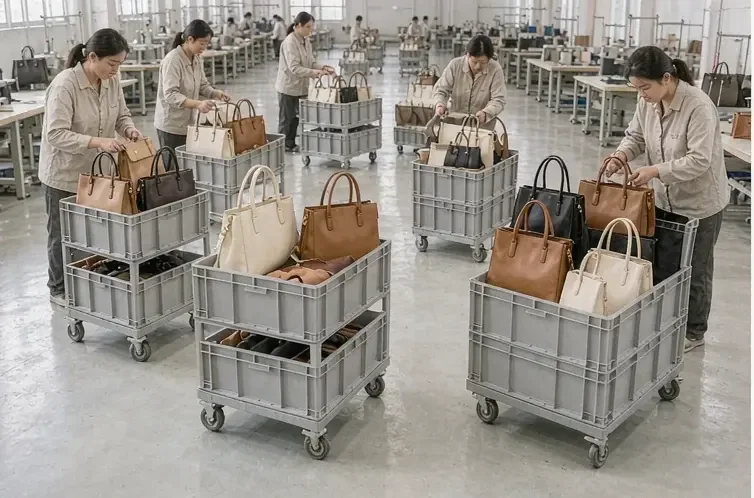
A sample is only defensible if it is drawn at random from the whole lot. Cartons are selected first, at roughly the square root of the total carton count rounded up, and pieces are then drawn from across those cartons rather than from the top layer of the first one. Each piece is checked against the written tolerance sheet, and each finding is tagged and photographed, because a finding without a record cannot be argued about.
- Select cartons at about the square root of the carton count, rounded up.
- Draw pieces from across the cartons, not from the top layer of one.
- Check exterior, interior, hardware, edge and base in a fixed order, so nothing is skipped.
- Tag and photograph each finding before any re-work begins.
- Record readings rather than verdicts, so a later drop can be compared.
The fixed order matters more than it sounds. An inspector who moves freely around a piece will find the obvious faults and miss the ones that require a deliberate look: the lining slack at the base, the mitre gap at the corner, the feeler test at the hardware plate. A written sequence is what makes the inspection repeatable between inspectors.
Switching Rules: Normal, Tightened and Reduced
ISO 2859-1 is not a single plan but a set of three with rules for moving between them. Normal is where a programme starts. Tightened follows two rejections within five consecutive lots, and it draws a larger sample against the same accept number, which is what makes it stricter. Reduced is only available after a sustained run of accepted lots and with the agreement of the responsible party, and it should be treated with caution on a luxury line.
For a designer programme, the useful way to read the switching rules is as a signal rather than a procedure. A move to tightened is telling you that the bench has drifted, and the correct response is to find the station that drifted rather than to inspect harder. A luxury line rarely wants reduced inspection at all, because the cost of a finding at the destination exceeds the cost of the inspection by a wide margin.
What AQL 2.5 Does Not Cover
Four things fall outside a sampling plan and have to be specified separately. Compliance: restricted substances under REACH Annex XVII, California Prop 65 and CPSIA where they apply, none of which can be found by looking at a piece. Material performance: tensile strength under ISO 3376, finish adhesion under ISO 11644 and colour fastness under ISO 105, all of which require a laboratory.
Traceability is the third: hide provenance evidenced through Leather Working Group tannery audits, and CITES documentation where a listed shell is specified. Consistency over time is the fourth, and it is the one a plan cannot deliver at all: an AQL tells you whether a lot passes, not whether the next lot will look the same. That is a bench discipline, described further under luxury quality control.
Cost of a Tighter Plan and the Re-Work Reserve
A tighter plan costs inspection time and re-work time, and both are small compared with a finding at the destination. Moving a major tolerance from AQL 4.0 to AQL 2.5, holding the re-work reserve above the run quantity and adding a second inspector on the visible stations adds roughly USD 4.80 per unit on a 500-piece run. Against a return rate on a designer piece, that figure is not a close call.
The reserve is the part most often cut and the part that pays for itself. Because a rejected piece cannot always be replaced quickly, particularly on an exotic or a dyed-to-match shell, the order carries a cutting allowance above the run quantity so that a finding at inspection corrects the shipment rather than delaying it. The allowance is agreed at sampling, alongside the 6-10 working day window and the 35-50 day bulk schedule.
Glossary: Twelve Terms on an Inspection Report
- AQL
- Acceptance quality limit: the worst tolerable process average
- Lot
- The quantity submitted for inspection as one unit
- Code letter
- The key that converts lot size and level into sample size
- Sample size
- The number of pieces drawn, 50 from a 500-piece lot
- Accept number
- The largest defect count at which the lot passes, 3
- Reject number
- The smallest count at which it fails, 4
- Critical defect
- Unsafe or non-compliant; zero acceptance
- Major defect
- One a customer would return the piece over; AQL 2.5
- Minor defect
- One noticed but tolerated; AQL 4.0
- Normal inspection
- The starting state of the plan
- Tightened inspection
- Larger sample, same accept number, after repeat rejections
- Re-work reserve
- Pieces held above the run quantity to replace findings
Twelve terms is enough to read any inspection report issued on a handbag programme, and enough to write the clause that governs one. Anything beyond these is either a commercial term or a material specification, and both belong in separate sections of the order rather than inside the inspection clause.
Writing the Clause Into a Purchase Order
The programme runs through our validated partner factory Quanzhou Yingming Bags, an SGS-validated site with 7 production lines and about 200,000 pcs per month of capacity, holding export experience since 2014. Inspection is drawn at AQL 2.5 under ISO 2859-1 with a re-work reserve held; sampling takes 6-10 working days, or 12-15 on a complex build; bulk occupies 35-50 days; minimums sit at 500 pcs per style and colourway; and shipments leave FOB Xiamen with FOB, CIF and DDP terms available.
The clause, in one sentence
- Inspection at general level II, single sampling, normal, ISO 2859-1, critical 0, major AQL 2.5, minor AQL 4.0; findings tagged and photographed; re-work reserve held above the run quantity; material tested to ISO 3376, ISO 11644 and ISO 105; price adjusted by USD 4.80 per unit for the tightened plan.
Have the inspection clause written for your run
Send drawings, material direction, quantity per colourway and delivery date. You will receive the sample size, accept and reject numbers and reserve for your lot. Request a quote.
Frequently Asked Questions
What does AQL 2.5 mean in plain terms?
It is a sampling rule: draw a stated number of pieces from the lot and accept it if the defect count is at or below the accept number. On a 500-piece lot at level II the plan draws 50 and accepts on 3 major defects, rejecting on 4.
Does AQL 2.5 mean 2.5 per cent of the bag may be defective?
No. The figure is a process average used to build the plan, not a permitted defect rate in the lot. Reading it as a percentage is the commonest misunderstanding and the one that causes disputes after a shipment.
How many pieces are inspected from a 500-piece run?
Fifty, at general inspection level II under ISO 2859-1, with an accept number of 3 and a reject number of 4 for major defects. Critical defects are held at zero regardless of the sample size.
What is the difference between critical, major and minor?
A critical defect is unsafe or non-compliant and has zero acceptance. A major defect is one a customer would return the piece over. A minor defect is one noticed on close inspection but tolerated by a customer.
Which inspection level should be specified?
General level II is the default and the one to write on an order. Level I draws fewer pieces and is a weaker plan at the same AQL; level III draws more and is used where the cost of a finding is very high.
Are cartons selected randomly?
They should be. The usual rule is the square root of the total carton count, rounded up, with pieces then drawn from across those cartons rather than from the top layer of the first one opened.
What happens when a lot is rejected?
The lot is re-worked and resubmitted, with the reserve used to replace pieces that cannot be corrected. Two rejections within five consecutive lots moves the programme to tightened inspection.
What is tightened inspection?
A larger sample drawn against the same accept number, which makes the plan stricter. It is triggered by repeated rejections, and on a designer line it should be read as a signal that a station has drifted.
Does AQL 2.5 cover chemical compliance?
No. Restricted substances under REACH Annex XVII, California Prop 65 and CPSIA where they apply require laboratory testing and are specified separately from the sampling plan.
Does AQL 2.5 cover material performance?
No. Tensile strength is tested to ISO 3376, finish adhesion to ISO 11644 and colour fastness to ISO 105, each in a laboratory rather than on an inspection table.
How much does a tighter plan cost?
Roughly USD 4.80 per unit on a 500-piece run, covering the tightened major tolerance, the second inspector on visible stations and the re-work reserve held above the run quantity.
Why hold a re-work reserve?
Because a rejected piece cannot always be replaced quickly, particularly on an exotic or a dyed-to-match shell. The reserve lets a finding at inspection correct the shipment rather than delay it.
People Also Ask
Is AQL 2.5 strict enough for a luxury handbag?
For major defects on a designer line, yes, provided critical defects sit at zero and the tolerance sheet behind the plan is written in numbers. Luxury work is more often failed by a vague tolerance sheet than by a loose AQL.
Should minor defects be held at 2.5 as well?
Usually not. Minor defects at AQL 4.0 keeps the plan focused on what a customer would return a piece over, while 2.5 on everything produces rejections over detail that does not affect the sale.
Can inspection be skipped on a repeat order?
It can be reduced only after a sustained run of accepted lots and with the agreement of both parties. On a luxury line the saving is small against the cost of a finding at the destination.
What should a tolerance sheet contain?
Pitch, distance from the edge, seam deviation, edge film, hardware gap, handle symmetry and lining slack, each with a number and a method, so an inspector counts rather than judges.
Who pays when a lot is rejected?
That is a commercial term and belongs in the order rather than in the inspection clause. The usual arrangement is re-work at the bench with the reserve covering pieces that cannot be corrected.
Sources and further reading
Every figure on this page is either our own programme data or attributed below. Open the originals before you write them into a specification.
- ISO - International Organization for StandardizationISO Publisher of ISO 2859-1, the sampling standard that sets code letter, sample size and the accept and reject numbers used above.
- SGSSGS Third-party inspection and testing body whose reports are commonly issued against an AQL 2.5 plan.
- European Chemicals AgencyECHA Administrator of REACH, whose Annex XVII restrictions sit outside the sampling plan and are tested separately.
- California Office of Environmental Health Hazard AssessmentOEHHA Administers Proposition 65, referenced for the compliance testing specified alongside an AQL plan.