Luxury Handbag Colour Shade QC Explained
Shade is the defect that no photograph can settle. A calfskin body approved in Milan can arrive in New York reading half a tone cooler, and neither side can prove who is right without a measured reference. The answer is to specify shade numerically before cutting: a Delta E limit measured against a signed reference panel under a named illuminant, checked in a light booth with three sources, and tied to a single dye lot per order. Our standing limit is Delta E 1.0 or better against the approved reference under D65, with adjacent panels on the same bag held to 0.8. This guide explains how that number is produced, why uncontrolled dye lots break it, and what to do when a lot lands off-shade.
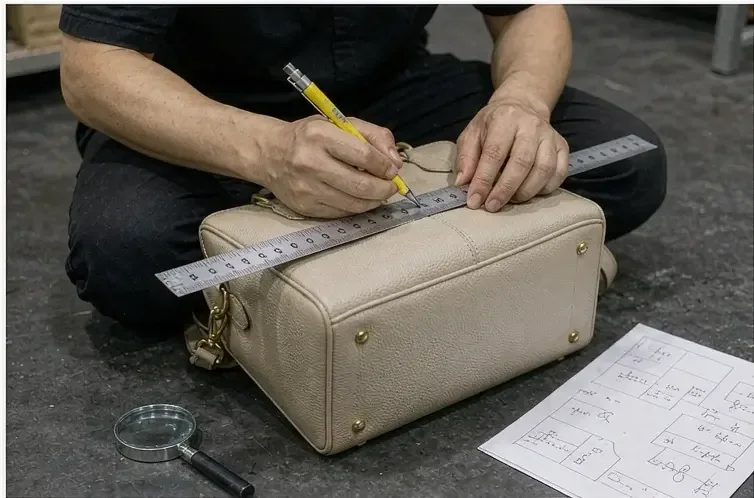
Why colour shade is the hardest defect to specify
Every other defect on a bag can be defined by a dimension or a count. Shade cannot. It is a perception that shifts with the light it is seen under, the material next to it, and the eye doing the looking. Two panels that match perfectly under a showroom lamp can separate visibly under daylight, a phenomenon the industry calls metamerism. That is why a written shade standard has to name the light source, not just the colour.
The practical consequence is that a colour argument is almost always a documentation failure rather than a production failure. Where a signed reference panel exists, is stored away from light, and is measured under an agreed illuminant, disputes resolve in minutes. Where the reference is a photograph on a phone or a description in an email, they do not resolve at all.
How inspectors actually compare a shade
The bench method is fixed and repeatable. The reference panel and the production panel are placed side by side on a neutral grey card, viewed at roughly 60 centimetres under a single named illuminant, and rotated together so grazing angle is identical. Visual judgement catches what a machine misses — surface character, depth of aniline finish, the way a pull-up leather lightens at the fold — while the instrument settles the numeric question.
- D65 simulates average daylight and is the primary source for approval decisions.
- TL84 simulates retail fluorescent lighting and is where most metamerism shows itself.
- Incandescent source A simulates warm boutique lighting and reveals red-green drift.
- Neutral grey surround prevents the eye from being influenced by adjacent colour.
- Panels are rotated together so grain direction and sheen are read at the same angle.
What counts as an acceptable shade difference
Delta E is a single number describing the distance between two colours in a defined colour space. Lower is closer. On luxury leather goods we work to Delta E 1.0 or better against the approved reference under D65 for the body panels of a single bag, and 0.8 between adjacent panels on the same piece, because the eye is far less forgiving of a mismatch it can see simultaneously on one object than of a drift between two separate bags.
| Comparison | Delta E limit | Illuminant | Action if exceeded |
|---|---|---|---|
| Body panel against signed reference | 1.0 or better | D65 | Hold the lot, re-sort by shade band, escalate to the atelier lead |
| Adjacent panels on one bag | 0.8 or better | D65 | Reject the piece, trace to cutting sequence |
| Lining against its reference | 1.5 or better | D65 | Record as minor if not visible when the bag is open |
| Plated hardware against reference | 1.0 or better | D65 plus TL84 | Reject the piece, check plating bath records |
| Stitching thread against upper | 2.0 or better | D65 | Record as minor unless contrast was specified as a feature |
Dye lot control on leather and on hardware plating
A dye lot is a single production batch of colour. Two lots of the same named colour will differ, sometimes subtly and sometimes not, because tannery dyeing is a chemical process sensitive to water chemistry, temperature and the hide stock itself. The discipline that protects a programme is simple to state and demanding to hold: one order, one dye lot, and enough material reserved at the start to finish the run without reordering.
The same logic applies to plating. A hardware plating bath drifts through its working life, and a clasp plated at the beginning of a bath can read warmer than one plated at the end. We log bath identity against hardware batches so a shade issue can be traced back to a specific run rather than to a general accusation about quality.
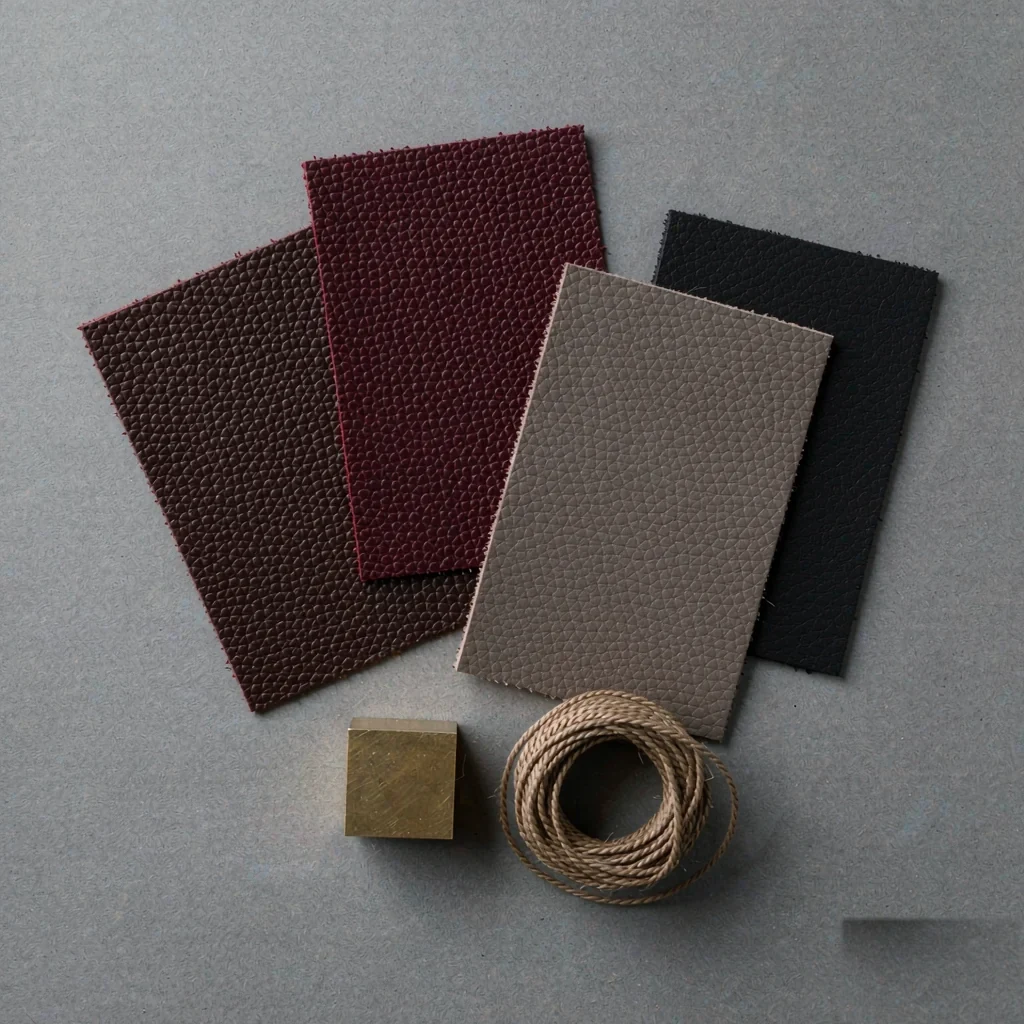
Colour fastness: the test behind the shade
A shade that is correct on delivery and gone in three months is still a failure. Colour fastness testing addresses whether the colour stays where it was put. On leather the relevant measures are fastness to rubbing, both dry and wet, and fastness to light. Our standing expectation on a dyed calfskin body is grade 4 to 5 dry and grade 4 wet for rubbing, measured to ISO 11644, with light fastness recorded separately for pale and vegetable-tanned shades.
Metamerism
Two panels match under one light and separate under another. Caught only by viewing under D65, TL84 and incandescent in sequence, never by a single-source check.
Dye lot drift
Material ordered in two batches for one order. Prevented by reserving the full requirement against a single lot before cutting begins.
Crocking
Colour transferring to a light garment. Caught by wet rub fastness testing, most often on deep navy, black and saturated reds.
Plating drift
Hardware warming or cooling through a bath's working life. Caught by logging bath identity against hardware batches and comparing to a reference clasp.
Where shade problems actually start
In our experience shade failures originate in three places, and only one of them is the tannery. The first is cutting: panels taken from different hides in a lot, or from different positions on the same hide, will vary in shade even within a single dye lot, because a hide is not uniform from shoulder to belly. The second is finishing: an edge paint or topcoat applied at varying thickness shifts the perceived depth of the leather beneath it. The third is the reference itself, faded or handled until it no longer represents what was approved.
Cutting sequence as a shade control
The most effective control is not found at inspection at all. It is a cutting rule: panels for one bag are taken from adjacent positions on the same hide, in sequence, and hides are laid and read end to end before the knife touches them. This converts shade from a statistical problem into an ordering problem, which is far cheaper to solve.
Light fastness and the pale shades problem
Pale shades carry a risk that saturated colours do not: they have less pigment to lose, so any change reads sooner. A blush, bone or powder body exposed on a boutique shelf under strong lighting will show drift before a black or chocolate body will, and vegetable-tanned leathers move fastest of all because their colour develops rather than merely sitting on the surface. That development is a feature of the material, but it has to be anticipated in the specification rather than discovered by a client.
We record light fastness separately for every pale and vegetable-tanned shade, and we tell brands plainly which ones will patina. Where a brand wants a shade that will hold still, we steer the conversation toward a pigmented finish. Where the patina is the point, we say so on the order file, so that a bag arriving a tone deeper after a season is a documented expectation and not a claim.
How to build a shade reference that travels
- Cut two panels from the approved hide at the moment of approval, not from a later reorder.
- Sign and date one panel and store it flat, away from light, in a sealed sleeve; this is the master.
- Issue the second panel to the bench as the working reference and replace it from stock when it shows handling wear.
- Record the dye lot number, the tannery batch and the illuminant used at approval on the order file.
- Measure and record the Delta E between master and working reference every quarter so drift in the reference itself is caught.
What to do when a lot arrives off-shade
First establish whether it is off-shade or simply different from expectation. Measure against the master under D65 and record the Delta E. If the number is inside the agreed limit, the lot conforms and the argument is about perception, which the number settles. If it is outside, band the lot: sort every piece into shade families so a boutique receives visually consistent units, and agree with the brand whether a mixed shipment is acceptable or whether the lot is held for re-finishing.
Reserve the full hide requirement against one dye lot before cutting. Re-ordering material midway through a run is the single most common cause of off-shade deliveries.
How shade control fits the wider quality system
Shade is assessed inside the same sampling frame as every other attribute. On a 500-piece lot at general inspection level II, 50 pieces are drawn, and each is compared against the working reference in the booth. A measured Delta E beyond the agreed limit on a body panel is a major defect, counted against an AQL of 2.5, which means the lot passes at three such findings and is refused at four. Critical defects, including any colour that transfers to a light garment in wear, carry zero tolerance.
- Body panel tolerance
- Delta E 1.0 or better against the signed reference, D65
- Adjacent panels on one bag
- Delta E 0.8 or better, D65
- Judgement distance
- About 60 cm on a neutral grey surround
- Light booth sources
- D65, TL84 and incandescent A, viewed in sequence
- Rub fastness, dry
- Grade 4 to 5, ISO 11644
- Rub fastness, wet
- Grade 4, ISO 11644
- Dye lot rule
- One order, one dye lot, full requirement reserved before cutting
- Hardware plating check
- Compared to a reference clasp under D65 and TL84, bath identity logged
- Sampling frame
- General inspection level II, 50 pieces on a 500-piece lot
- Defect classification
- Off-shade body panel is major; colour transfer in wear is critical
- Minimum order quantity
- 500 pieces per style per colourway
- Sampling lead time
- 6 to 10 working days, 12 to 15 for complex constructions
- Bulk lead time
- 35 to 50 days from approved sample
- Shipment terms
- FOB Xiamen
Correcting shade after the fact is expensive and imperfect. Re-spraying and re-finishing one off-shade panel, then re-matching the edge paint so the correction does not introduce a second mismatch, costs around USD 4.80 in material and bench time. The same discipline applied at the cutting table costs a fraction of that, which is the argument for putting the control upstream rather than at final inspection.
Shade control in one paragraph
- Specify shade numerically, not verbally. Hold Delta E 1.0 or better against a signed reference panel under D65, tighten to 0.8 between adjacent panels on one bag, and check every drawn piece under D65, TL84 and incandescent in a light booth. Reserve the full hide requirement against one dye lot before cutting, take panels for a single bag from adjacent positions on the same hide, and log plating bath identity against hardware batches. Re-finishing an off-shade panel costs around USD 4.80 in material and bench time, so the control belongs upstream at the cutting table rather than at final inspection.
Put a number on your shade standard
Send us your colour reference and we will return a measured Delta E baseline, a signed reference panel specification and the light booth protocol we will inspect against. Request a shade consultation and quotation at /contact-quote/.
Frequently Asked Questions
What is Delta E and why does it matter for bags?
Delta E is a single number describing the distance between two colours in a defined colour space. It turns a subjective argument into a measurement. On our bench a body panel is held to Delta E 1.0 or better against the signed reference under D65.
Why must the light source be named in a shade standard?
Because two panels can match under one source and separate under another, a behaviour called metamerism. A standard that names only the colour leaves the judgement open. We check under D65, TL84 and incandescent in sequence.
How close do adjacent panels on one bag have to be?
Delta E 0.8 or better. The eye is far less forgiving of a mismatch visible simultaneously on a single object than of a drift between two separate bags, so the internal tolerance is tighter than the tolerance against the reference.
What is a dye lot and why does it matter?
A dye lot is a single production batch of colour at the tannery. Two lots of the same named colour will differ. Reserving the full hide requirement against one lot before cutting is the single most effective shade control available.
Can hides within one dye lot still vary?
Yes. A hide is not uniform from shoulder to belly, so panels taken from different positions will vary even within a lot. We lay and read hides end to end before cutting, and take panels for one bag from adjacent positions.
How is colour fastness tested on leather?
Fastness to rubbing, dry and wet, is measured to ISO 11644, and fastness to light is recorded separately. Our standing expectation on a dyed calfskin body is grade 4 to 5 dry and grade 4 wet.
What is crocking and how is it prevented?
Crocking is colour transferring from the bag onto a light garment. It is caught by wet rub fastness testing, most often on deep navy, black and saturated reds, and prevented by fixing and finishing discipline at the tannery.
How do you control shade on plated hardware?
A plating bath drifts through its working life, so a clasp plated early can read warmer than one plated late. We log bath identity against hardware batches and compare every drawn piece to a reference clasp under D65 and TL84.
How many pieces are shade-checked on a 500-piece order?
Fifty, under general inspection level II of ISO 2859-1. Each drawn piece is compared against the working reference in a light booth, and a body panel measured beyond the agreed limit counts as a major defect.
What happens if a lot is measured off-shade?
We measure against the master and record the Delta E. Inside the agreed limit the lot conforms. Outside it, we band the lot into shade families so a boutique receives visually consistent units, or hold it for re-finishing.
How should a reference panel be stored?
Flat, in a sealed sleeve, away from light. Two panels are cut at the moment of approval: one signed and archived as the master, one issued to the bench as the working reference and replaced when it shows handling wear.
What does it cost to correct an off-shade panel?
Re-spraying and re-finishing one off-shade panel, then re-matching the edge paint so the correction does not introduce a second mismatch, costs around USD 4.80 in material and bench time.
People Also Ask
What is an acceptable colour tolerance for leather?
Delta E 1.0 or better against a signed reference under D65 is the standing limit for luxury body panels, tightening to 0.8 between adjacent panels on the same bag. Linings are usually held to 1.5.
Why does my bag look a different colour in the shop?
Retail lighting differs from the light the bag was approved under. Checking under TL84 and incandescent as well as D65 reveals metamerism before the piece reaches a boutique floor.
What is ISO 11644?
It is the ISO test method for colour fastness of leather to rubbing. It produces the dry and wet grades, typically 4 to 5 dry and 4 wet, that indicate whether a colour will stay where it was put.
Should hardware colour be specified separately?
Yes. Plating drifts through a bath's working life, so hardware needs its own reference clasp and its own bath identity log, checked under D65 and TL84 alongside the leather panels.
How do I stop shade problems before inspection?
Reserve the full hide requirement against one dye lot, read hides end to end before cutting, and take panels for one bag from adjacent positions on the same hide in sequence.
Sources and further reading
Every figure on this page is either our own programme data or attributed below. Open the originals before you write them into a specification.
- CIE colour difference metrics and standard illuminantsInternational Commission on Illumination Source of the colour space definitions and standard illuminants, including D65, behind the Delta E limits quoted here.
- ISO 2859-1:1999 Sampling procedures for inspection by attributesInternational Organization for Standardization Defines general inspection level II and the sample size used when shade is assessed on a 500-piece lot.
- Leather Working Group tannery audit and traceability protocolsLeather Working Group Referenced for dye lot traceability and tannery process expectations that sit behind shade consistency.
- Reporting on colour, materials and compliance in luxury supply chainsSourcing Journal Industry reporting on the commercial cost of shade inconsistency in luxury leather goods programmes.