Luxury Handbag Silhouettes: How Shapes, Structure and Hardware Come Together in a Collection
A luxury handbag collection is a set of silhouettes that share a construction logic, not a set of drawings that share a mood board. The shapes that survive are the ones whose framing, interlining and hardware load path were resolved before the first sample, because those three decisions determine whether a bag stands, slouches or collapses after a season of use. On our programme each silhouette is quoted at 500 pcs per style / colourway, sampled in 6-10 working days (12-15 for complex builds), produced in 35-50 days, inspected to AQL 2.5 (ISO 2859-1) and shipped FOB Xiamen. A custom zamak turn-lock at that quantity is quoted at about USD 4.80 per unit.
What Defines a Luxury Handbag Silhouette?
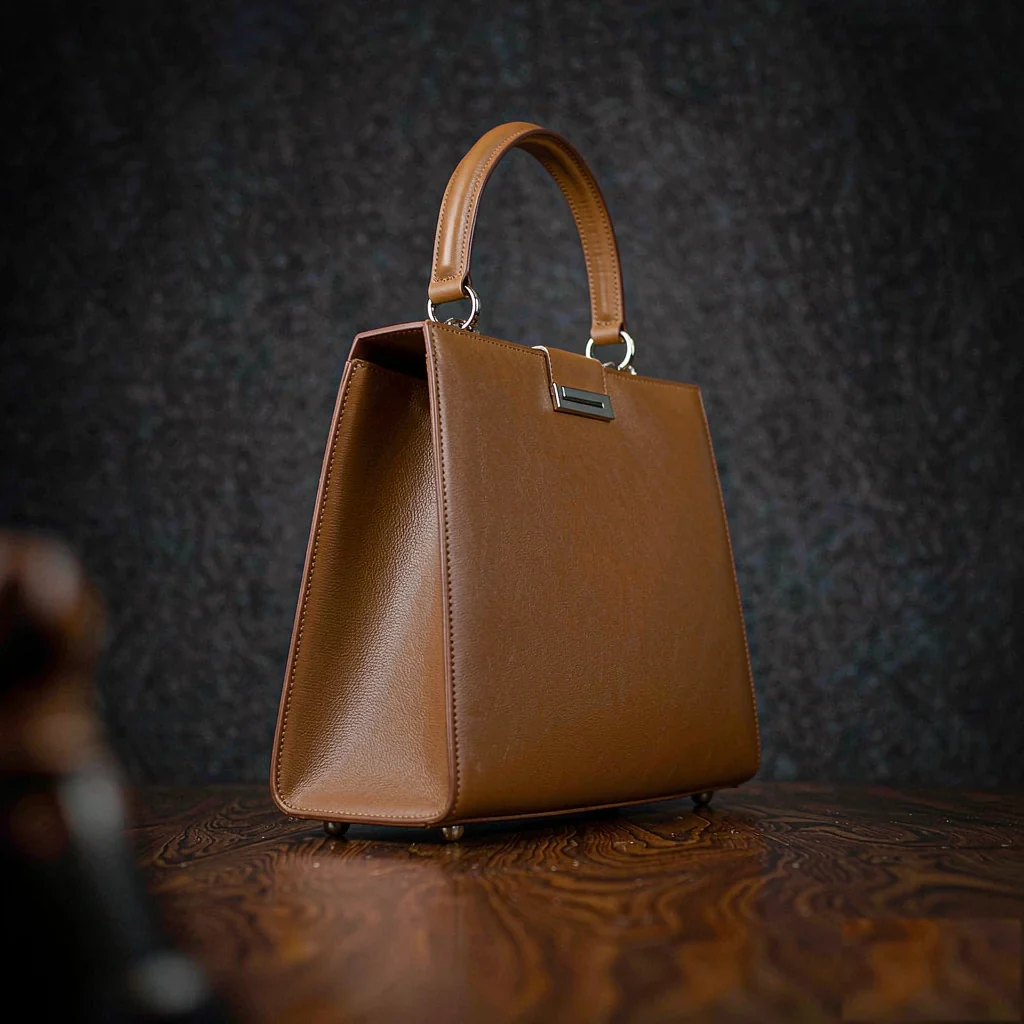
A silhouette is defined by four measurable things: the footprint of the base, the relationship between height and width, the load path from handle to body, and the way the closing edge behaves when the bag is empty. A top-handle bag, a shoulder bag and a hobo can share leather, lining and hardware and still belong to three different construction families. Sketching the look is the easy half; deciding how the bag stands on a table when it is empty is the half that determines whether clients photograph it or return it.
- Base footprint: the rectangle the bag occupies when set down, which drives pattern grading.
- Height-to-width ratio: roughly 0.75 to 1.0 for structured day bags, 1.1 to 1.3 for soft hobos.
- Load path: how the weight of the contents travels from the handle through the gusset into the base.
- Closing behaviour: whether the mouth stays open, folds softly, or snaps shut under frame tension.
- Empty-state stance: the single test most first collections fail, because samples are always shot full.
The Core Silhouette Families and What Each One Demands
Six families cover almost every premium line, and each one puts a different demand on the bench. A structured top-handle needs framing and a rigid base; an evening bag needs a frame and a precise gap tolerance; a bucket needs a drawcord channel that pulls evenly. Choosing the family first, then the leather, avoids the common error of specifying a soft milled calf for a shape that only works in a firm vegetable-tanned hide.
| Silhouette family | Typical dimensions | Construction demand |
|---|---|---|
| Top handle | 240-320 mm wide, 180-220 mm handle drop | Framed gusset, rigid base board, reinforced handle tabs |
| Shoulder bag | 280-360 mm wide, 450-600 mm strap drop | Soft gusset, strap anchor load test, lining stress relief |
| Crossbody | 180-240 mm wide, 1100-1300 mm strap length | Light build, flat base, adjustable slider that holds tension |
| Hobo | 300-380 mm wide, 250-300 mm drop | Milled leather, minimal interlining, controlled slouch line |
| Bucket | 200-260 mm diameter, 240-300 mm tall | Drawcord channel, even gather, base disc to stop rolling |
| Evening and minaudiere | 160-220 mm wide, 40-80 mm deep | Frame closure, 0.3-0.5 mm gap tolerance, hand-set hardware |
Structured vs Soft: Framing, Interlining and Tolerance
Structure is not a look, it is a stack: leather at 1.2-1.4 mm, interlining at 0.8 mm, a base board and a framed gusset, all held to a tolerance of about 1 mm across the mouth. Remove the interlining and the same pattern becomes a soft bag with a different silhouette altogether. The error most new houses make is specifying a structured drawing with a soft build, which produces a bag that photographs well for one day and then loses its crown.
- Outer leather
- Full-grain calf, 1.2-1.4 mm
- Interlining
- 0.8 mm non-woven, bonded to the outer panel
- Base board
- 1.5-2.0 mm, wrapped in matching leather
- Stitch density
- 8-9 stitches per inch, 0.45 mm bonded thread
- Edge finish
- Three coats of edge paint, sanded between coats
- Mouth tolerance
- 1.0 mm across the full closing edge
- Hardware plating
- 0.15-0.3 µm, salt spray 24-48 h
Proportion and Body Fit: How Size Is Actually Chosen
Proportion is chosen against the body, not against the sketch. A handle drop of 180-220 mm clears a shoulder and a coat sleeve; a crossbody strap of 1100-1300 mm puts the bag at the hip for most frames; a depth under 90 mm stops a day bag from bulging forward when worn. Testing three sizes on a live model, then adjusting the pattern by 10 mm increments, resolves in one afternoon what months of drawing cannot.
- Top-handle drop of 180-220 mm clears a winter coat sleeve without lifting the shoulder.
- Crossbody length of 1100-1300 mm places the bag at the high hip on most body types.
- Depth under 90 mm keeps a day bag from pushing forward against the arm.
- Base width above 240 mm makes a bag read as a travel piece rather than a day piece.
- Mini silhouettes hold proportion when the hardware is scaled down, not kept at full size.
Hardware That Shapes the Bag
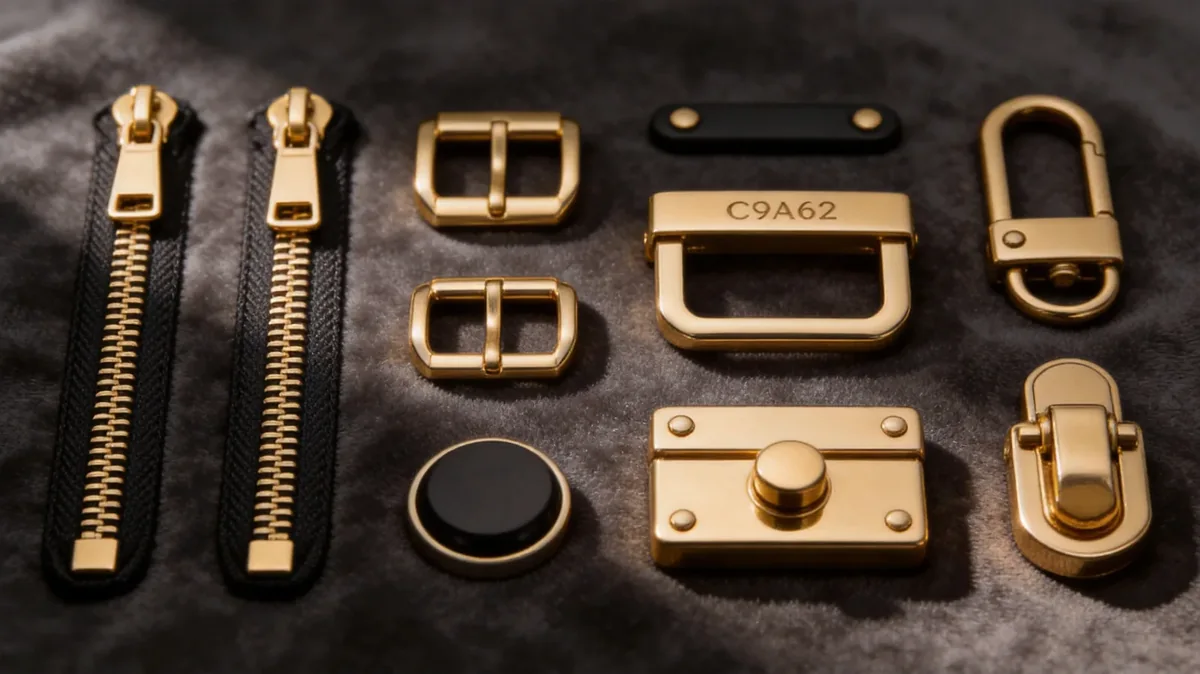
Hardware is structural. A turn-lock pulls the flap into a fixed position, a frame dictates the mouth geometry of an evening bag, and feet set the attitude of the bag on a table. Custom hardware is quoted on its own tooling and unit economics: a custom zamak turn-lock at 500 pieces lands at about USD 4.80 per unit, with plating held to 0.15-0.3 µm and verified by a 24-48 h salt spray test before the run is released.
Turn-lock
Sets flap tension and closing feel. Specify zamak or brass, 0.15-0.3 µm plating, and test 5,000 open and close cycles.
Frame and kiss-lock
Dictates mouth geometry on evening shapes. Gap tolerance of 0.3-0.5 mm along the full closing line.
Feet
Sets the attitude of the bag on a surface. Four feet at 4-5 mm, riveted through a reinforcement patch.
D-rings and anchors
Carry the strap load. Anchors must be backed with a leather patch and tested to the filled bag weight.
Zips
#5 metal or coil for main openings, #3 for pockets. Tape colour matched to the lining, not to the outer leather.
Sliders and adjusters
Must hold tension under load. A slider that creeps turns a crossbody into a shoulder bag within a month.
Quilting, Topstitching and Surface Construction
Surface work is where the hand of the house becomes visible, and it is also where tolerance errors multiply. Quilting shifts the panel dimensions, so the pattern has to be cut after the quilting operation is defined, not before. Topstitching at 8-9 stitches per inch with 0.45 mm bonded thread reads as precision; the same seam at 6 stitches per inch reads as casual, and mixing the two on one panel looks like an accident.
- Fix the quilting pitch and foam thickness first; quilted panels grow 3-6 percent smaller than flat ones.
- Keep topstitch density constant across every panel of the bag, including the gusset.
- Run a 3 mm stitch allowance on the top line so the seam cannot migrate under load.
- Match thread to the lining on interior seams and to the leather on exterior seams.
- Hand-finish the edge in three coats, sanding between coats, then buff after the final coat cures.
Building a Collection: Core, Seasonal and Hero Pieces
A workable first collection has three tiers, not twelve unrelated shapes. Core pieces repeat every season and amortise the pattern and tooling, seasonal pieces carry the trend story, and one hero piece carries the press. Planning the line this way keeps the programme inside a 500 pcs per style / colourway threshold while still giving boutique clients something new on every visit.
Core
Two or three silhouettes repeated each season in new colourways. They amortise tooling, patterns and photography across years.
Seasonal
Two shapes that answer the current trend read. Produced once, then retired, so they never dilute the core line.
Hero
One engineered piece with custom hardware or an unusual construction. Carries editorial coverage and boutique interest.
Colourway rule
Two neutral colours plus one seasonal colour. Each colourway carries its own 500 pcs threshold.
From Runway Sketch to Production Sample
The translation from sketch to sample happens in three rounds. Round one confirms the stance, proportion and handle drop on a toile. Round two confirms leather, interlining and hardware on a true-material sample. Round three confirms the finishing standard and the packing sequence, and that is the sample a boutique buyer should be shown. Each round is quoted at 6-10 working days, extended to 12-15 for engineered or multi-material builds.
What to approve at each round
- Approve stance, proportion and handle drop at round one; approve leather, interlining, hardware and stitch density at round two; approve edge finish, lining, branding and packing sequence at round three. Do not carry a round-one question into round three, because by then every change costs a full pattern revision rather than a trim.
Programme Numbers: MOQ, Sampling and Bulk
Every silhouette in the collection carries the same commercial framework, which is what makes a multi-shape line predictable. The threshold is 500 pcs per style / colourway, sampling runs 6-10 working days, complex engineered builds run 12-15 working days, bulk runs 35-50 days, inspection is AQL 2.5 under ISO 2859-1 with third-party inspection available, and the terms are FOB Xiamen with FOB, CIF or DDP available on request.
| Stage | Standard | Complex build |
|---|---|---|
| Threshold | 500 pcs per style / colourway | 500 pcs per style / colourway |
| Sampling | 6-10 working days | 12-15 working days |
| Bulk production | 35-50 days | 35-50 days |
| Inspection | AQL 2.5 (ISO 2859-1) | AQL 2.5 plus functional test |
| Terms | FOB Xiamen | FOB, CIF or DDP available |
| Capacity context | 7 production lines, about 200,000 pcs per month | Same line allocation |
Fit Testing and Silhouette QC
Silhouette faults are dimensional, so they are caught with measurements rather than opinions. The reference sample is measured flat and filled, the stance is photographed empty on a level surface, and the strap is loaded to the filled bag weight for a set period. These checks run alongside the standard AQL 2.5 inspection, because a bag can pass a visual inspection and still lean 4 mm to one side.
- Measure the reference sample empty and filled, and record both sets of dimensions.
- Photograph the empty bag on a level surface from front, side and three-quarter views.
- Load the strap to the filled bag weight and check anchor movement after a set period.
- Check the closing edge gap along its full length against the 1.0 mm tolerance.
- Confirm the stance: the bag should not lean more than 3 mm on a level surface.
- Verify stitch density on every panel, including the gusset and the handle tabs.
- Run the hardware cycles and the salt spray result against the plating specification.
- Record everything under AQL 2.5 (ISO 2859-1) and hold the reference for the repeat.
Choosing Silhouettes That Hold Their Value
Silhouettes that hold resale value share three traits: a recognisable geometry that survives photographing at a distance, a construction that ages rather than degrades, and hardware that can be serviced. Quiet lines with restrained branding and full-grain leather read as investment pieces, while heavily treated coatings and complex glued assemblies tend to fail visibly in the second year. That is the commercial argument for spending the development effort on structure instead of surface.
If you want the detail behind each family, begin with the top handle silhouette guide, then compare structured against soft silhouettes and read how to build a luxury handbag collection. Sizing questions are answered in the silhouette sizing guide and the proportion and body fit guide, while the seasonal calendar is set out in silhouette planning by season.
Request a collection and silhouette quotation
Send us your sketches, target dimensions and quantity per colourway. We will return a silhouette feasibility review, a sampling calendar and a landed cost per shape on FOB Xiamen terms, quoted at 500 pcs per style / colourway.
How Silhouettes Move From Runway to Repeat Orders
Runway shapes are scaled for a two-metre walk, not for a client's arm, so the production version is almost always adjusted. The usual adjustments are a 10-20 mm reduction in depth, a firmer interlining to hold the stance on a shelf, and hardware scaled down by about 15 percent. Once a shape has been through that translation it becomes a repeatable core piece, and the second season's order carries no development risk at all.
Our validated partner factory Quanzhou Yingming Bags has run this translation on seven production lines with about 200,000 pcs monthly capacity and export experience since 2014, which is why a shape approved in round three can be repeated two seasons later without re-opening the pattern. Consistency across repeats is the quiet test of a collection programme, and it is decided at the sampling stage, not at the bulk stage.
Frequently Asked Questions
How many silhouettes should a first luxury collection have?
Plan three tiers rather than a long list: two or three core shapes that repeat each season, two seasonal shapes that answer the current trend read, and one hero piece with custom hardware. That structure keeps every style inside its quantity threshold while still giving boutiques something new.
What leather thickness suits a structured handbag?
Full-grain calf at 1.2-1.4 mm with a 0.8 mm bonded interlining and a wrapped base board at 1.5-2.0 mm. Softer milled hides suit hobo and slouch shapes but will not hold a framed top handle through a season of daily use.
What is the MOQ for a new silhouette?
Each silhouette is quoted at 500 pcs per style / colourway. The threshold applies per colour as well as per shape, so a three-colour launch of one bag is three separate commitments and should be planned as such.
How long does it take to develop a new bag shape?
Sampling runs 6-10 working days per round, extended to 12-15 working days for engineered or multi-material builds. Most shapes need three rounds: one for stance and proportion, one for materials and hardware, one for finishing and packing.
How much does custom hardware cost?
A custom zamak turn-lock at 500 pieces is quoted at about USD 4.80 per unit once tooling is covered. Plating is held to 0.15-0.3 µm and verified with a 24-48 h salt spray test before the run is released.
What stitch density is used on luxury handbags?
Exterior seams are sewn at 8-9 stitches per inch with 0.45 mm bonded thread, held constant across every panel including the gusset. A looser density reads as casual and, mixed on one panel, looks like an unplanned change.
How do you test whether a silhouette holds its shape?
Measure the reference sample empty and filled, photograph it on a level surface, and confirm it leans no more than 3 mm. Then load the strap to the filled bag weight and check the anchors, and verify the closing edge gap to a 1.0 mm tolerance.
What handle drop works for a top-handle bag?
A drop of 180-220 mm clears a shoulder and a winter coat sleeve without lifting the arm. Crossbody straps run 1100-1300 mm to sit at the high hip, and day bags stay under 90 mm deep so they do not push forward.
How are runway silhouettes adapted for production?
Production versions are usually 10-20 mm shallower, use a firmer interlining to stand on a shelf, and carry hardware scaled down by about 15 percent. Once translated, the shape becomes a repeatable core piece with no development risk.
Which silhouettes hold resale value best?
Shapes with a recognisable geometry at a distance, full-grain leather that ages rather than degrades, and hardware that can be serviced. Heavily coated surfaces and complex glued assemblies tend to fail visibly in the second year.
How is a collection inspected before it ships?
Every style is inspected to AQL 2.5 under ISO 2859-1, with third-party inspection available. Dimensional checks on stance, closing gap and strap anchorage run alongside the visual inspection, because a bag can look correct and still lean.
Can one shape be repeated in later seasons?
Yes. Once a shape is approved at round three, the pattern, tooling and hardware reference are held on file, so a repeat two seasons later needs no new development. That continuity is what makes a core line commercially reliable.
Should a first collection open with a soft or a structured body?
It depends on what the line needs to prove. A structured body demonstrates pattern control and holds its shape on a shelf, but it costs more to engineer and shows tolerance errors immediately. A soft body is faster to develop and more forgiving in transit. Many first collections open with one of each and let sales decide.
People Also Ask
What is the most popular luxury handbag silhouette?
Structured top-handle and shoulder shapes dominate premium collections because they photograph clearly and hold their stance on a shelf. Mini and underarm proportions lead seasonal demand, while evening shapes carry the press story.
Why do some bags lose their shape after a season?
Usually the structure stack was specified for the drawing rather than the build: no interlining, a base board that is too thin, or a soft hide used for a framed shape. The fix is decided at sampling, not in production.
Should a new house launch with mini or medium sizes?
Launch with one medium core size and one mini, because the mini drives press and social imagery while the medium carries the revenue. Scale the hardware down on the mini rather than reusing full-size fittings.
How much does quilting change a pattern?
Quilted panels finish roughly 3-6 percent smaller than the flat cut, so the pattern must be developed after the quilting pitch and foam thickness are fixed. Cutting first is the most common cause of a short gusset.
What makes a silhouette look expensive in photographs?
A clean stance, a consistent stitch line, an edge that is finished in three coats, and hardware scaled to the bag. Viewers read the closing edge and the feet before they read the logo.
Sources and further reading
Every figure on this page is either our own programme data or attributed below. Open the originals before you write them into a specification.
- ISO standards catalogueInternational Organization for Standardization Source of ISO 2859-1 sampling procedures used for AQL 2.5 inspection and of the ISO 105 colour fastness series.
- Leather Working GroupLeather Working Group Tannery audit and traceability programme referenced when selecting full-grain calf for structured silhouettes.
- CITES AppendicesCITES Listing that governs which exotic skins may be used in a collection and what documentation travels with each shipment.
- REACH legislationEuropean Chemicals Agency Annex XVII restrictions screened for leather finishes, adhesives and hardware coatings.
- Sourcing JournalSourcing Journal Trade coverage of luxury material sourcing, capacity and lead time reporting used for market context.
- Women's Wear DailyWWD Industry reporting on handbag silhouette demand, resort and seasonal collection read.