Luxury Bag Proportion and Body Fit Guide: Nine Combinations Measured Across Three Wearer Heights
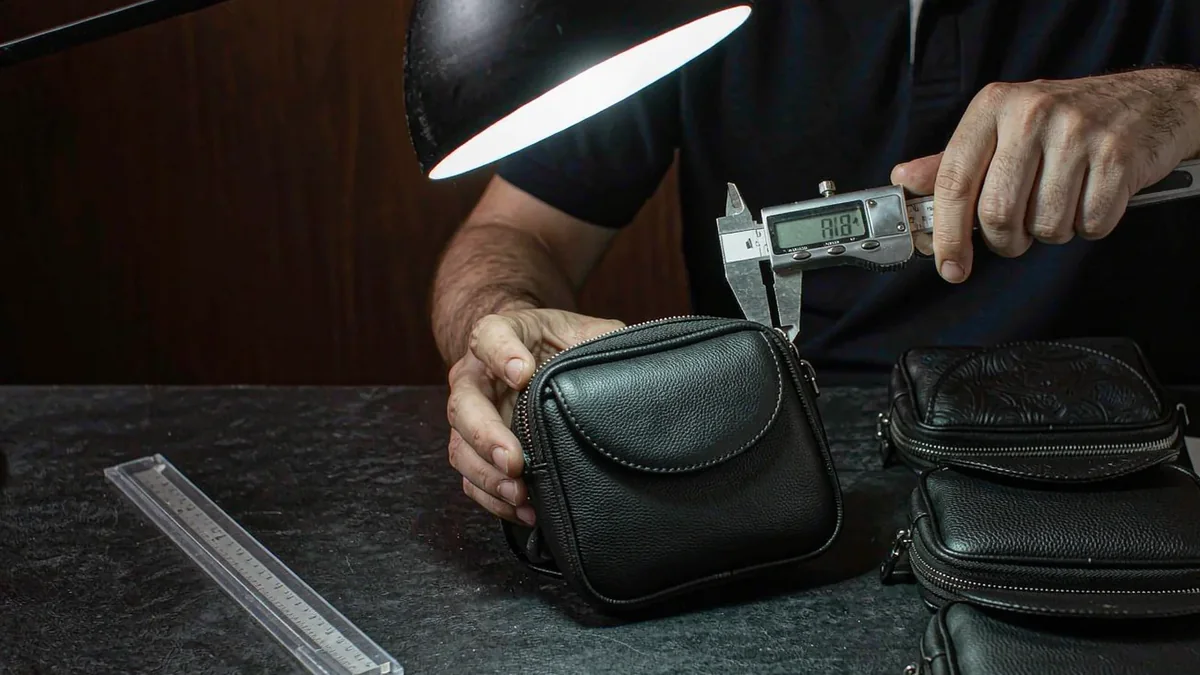
What determines whether a luxury bag looks right on the body? Three measurements do most of the work: strap drop, body height against torso length, and how far the silhouette extends past the hip. Say it plainly: a shoulder drop of 520-560 mm suits most wearers, a crossbody needs 1,100-1,300 mm of adjustment, and anything wider than the hip reads oversized. A useful fit matrix compares the nine combinations rather than trusting one fitting model.
Three Proportion Rules, and Where They Conflict
Proportion is treated as taste because nobody writes it down. Three rules cover most of it, and they conflict often enough that a decision order is worth agreeing before the first toile is sewn.
The first rule governs height: the body should sit between the natural waist and the high hip on most wearers. The second governs width: the silhouette should not extend past the hip line except deliberately. The third governs the strap: drop decides where the first two land, so it is resolved first.
They conflict in the obvious place. A tall wearer with a long torso wants a longer strap than a tall wearer with a short torso and long legs, which is why every fit argument inside a design team resolves into somebody volunteering to model it. Measuring three heights solves it faster.
Shoulder Drop: Why 520 to 560 mm Is the Working Band
Shoulder drop is measured from the top of the strap at its highest point to the top edge of the bag body, not along the strap. It is the figure that decides where the body lands on the torso, and most day bags work somewhere between 520 and 560 mm.
Below 500 mm the body rides under the arm and crowds the bust on many wearers; above 580 mm it swings against the hip when walking. That leaves a narrow band, and it narrows further once winter clothing is counted, since a coat adds roughly 15-25 mm of effective shoulder height before the body moves anywhere.
| Wearer height | Torso type | Shoulder drop | Crossbody strap length | Notes |
|---|---|---|---|---|
| 158 cm | Short torso | 500-520 mm | 1,100-1,160 mm | Body sits at the natural waist |
| 165 cm | Average | 520-545 mm | 1,160-1,220 mm | The reference most brands fit to |
| 172 cm | Long torso | 545-560 mm | 1,220-1,270 mm | Watch the hip swing when walking |
| 178 cm | Long torso | 560-580 mm | 1,270-1,320 mm | Usually needs the longest adjustment hole |
Crossbody: Measuring on Three Heights Rather Than One
A crossbody that fits one person perfectly will sit a hand's width higher or lower on the next, because the strap crosses the diagonal of the torso and every torso is a different length. Specify an adjustment range rather than a single length.
1,100-1,300 mm covers most wearers, with adjustment holes at 60 mm intervals rather than 25. Wider intervals mean fewer holes to finish and fewer edge-paint points to fail, and 60 mm is below the threshold most wearers notice when they move between a shirt and a coat.
- State strap length as a range, not a figure, with adjustment intervals specified.
- Measure on three wearer heights: 158, 165 and 172 cm covers most of a market.
- Check the loaded position, since an empty body sits higher than a full one.
- Place the adjustment holes clear of the shoulder seam area by at least 100 mm.
- Photograph rather than measure alone; proportion disputes resolve faster visually.
Body Height Against Torso Length: What Wearers Actually Feel
Height is the dimension most often argued about and least often measured. The ratio that matters is body height against the distance from shoulder to high hip, and for a day body a body height of 220 mm against a 400 mm torso reads balanced on most figures.
Push the same body to 260 mm and it stops reading as a day silhouette on a short torso while still looking correct on a long one. That is why a mid-size body sells across more figures than a large one, and why the small version of a popular body often outperforms its larger sibling commercially.
Width: How Far a Body Can Extend Past the Hip
Width is the second rule, and it is the one photographers notice. A body wider than the hip line reads oversized regardless of its actual dimensions, because the eye compares the silhouette to the wearer rather than to itself.
The practical test measures the wearer's hip width and compares it to the bag width across its widest point, taken loaded rather than empty. Below roughly 0.75 of hip width the body reads compact; between 0.75 and 1.0 it reads balanced; above 1.0 it reads oversized and should be doing so deliberately.
Compact
Bag width below about 0.75 of hip width, measured loaded. Reads urban and practical, and suits a body meant for travel or daily commuting rather than for statement dressing.
Balanced
Between 0.75 and 1.0 of hip width. The commercial middle, where most successful day bodies sit, because it photographs well on the largest share of wearers without reading either small or oversized.
Deliberately oversized
Above 1.0 of hip width. Legitimate, but it has to be matched with a longer strap and a softer construction, or the body will fight the wearer's gait and look accidental rather than intentional.
Weekender scale
Beyond the hip entirely, carried by handles alone or on a longer webbing strap. Proportion rules give way to clearance rules here: how much room the arm needs, and whether the body clears a standard airline seat.
Handle Geometry in the Hand Rather Than on the Table
A handle tested flat on a table tells you nothing. A handle has to clear four fingers under load, which means a minimum internal clearance of 55 mm and a top-edge grip width no greater than about 14 mm before the hand starts aching at the joint.
A 12 mm flat handle folded over a 3 mm core is the usual answer: wide enough to spread the load, narrow enough to close around. Anything wider needs a rolled section rather than a flat one, or the corners of the fold dig into the palm over twenty minutes of carrying.
- Shoulder drop working band
- 520-560 mm for most day bodies
- Crossbody strap range
- 1,100-1,300 mm with 60 mm intervals
- Handle internal clearance
- minimum 55 mm for four fingers
- Handle width over a core
- 12 mm flat over a 3 mm core
- Body width against hip
- 0.75 to 1.0 reads balanced
- Body height against torso
- about 220 mm on a 400 mm torso
- Coat allowance
- add 15-25 mm of effective shoulder height
- Handle pull test
- 150-250 N on a finished body
Loaded Mass and the Strap Pressure Problem
Proportion arguments usually ignore mass, and mass changes where a strap goes. A body carrying 1.2 kg pulls a 25 mm strap into the shoulder in a way a body carrying 600 g does not, which is why the strap width and the target loaded mass belong in the same line of the tech pack.
Above roughly 1.5 kg, a 25 mm strap becomes uncomfortable within about thirty minutes on most wearers. Either widen it to 35-40 mm, add a leather shoulder pad over the contact area, or accept that the body will be carried by its handles and the strap is secondary.
The Fit Matrix: Nine Combinations Compared
Rather than fitting to one model, score the three bodies most capsules contain against three wearer heights. Nine cells is enough to expose the pattern before sampling money is spent, and it takes an afternoon with a tape measure and three people.
| Combination | Body size | Wearer height | Verdict | Adjustment |
|---|---|---|---|---|
| 1 | Petit 230 mm | 158 cm | Balanced, slightly large | Reduce height 20 mm |
| 2 | Petit 230 mm | 165 cm | Balanced | None |
| 3 | Petit 230 mm | 172 cm | Compact | Lengthen strap 40 mm |
| 4 | Moyen 255 mm | 158 cm | Deliberately oversized | Narrow the body or shorten strap |
| 5 | Moyen 255 mm | 165 cm | Balanced | None |
| 6 | Moyen 255 mm | 172 cm | Balanced | None |
| 7 | Grand 280 mm | 158 cm | Oversized, reads accidental | Reserve for taller market |
| 8 | Grand 280 mm | 165 cm | Balanced to full | Check width against hip |
| 9 | Grand 280 mm | 172 cm | Balanced | None |
Why Sizes in One Family Cannot Share a Strap Length
A capsule that ships three sizes on one strap length has made a decision nobody examined. The strap has to clear the larger body as well as the smaller one, and since the bodies differ in height by 20 mm per grade, the drop that suits the middle size leaves the largest riding low and the smallest riding high.
The correction is on paper and costs nothing if it happens there. Carry the drop forward by 10 mm per grade step, in the same direction as the height change, and the three sizes read as one family on three different wearers rather than as three attempts at the same idea. Measure each size loaded, since the smaller body carries proportionally more weight relative to its panel area.
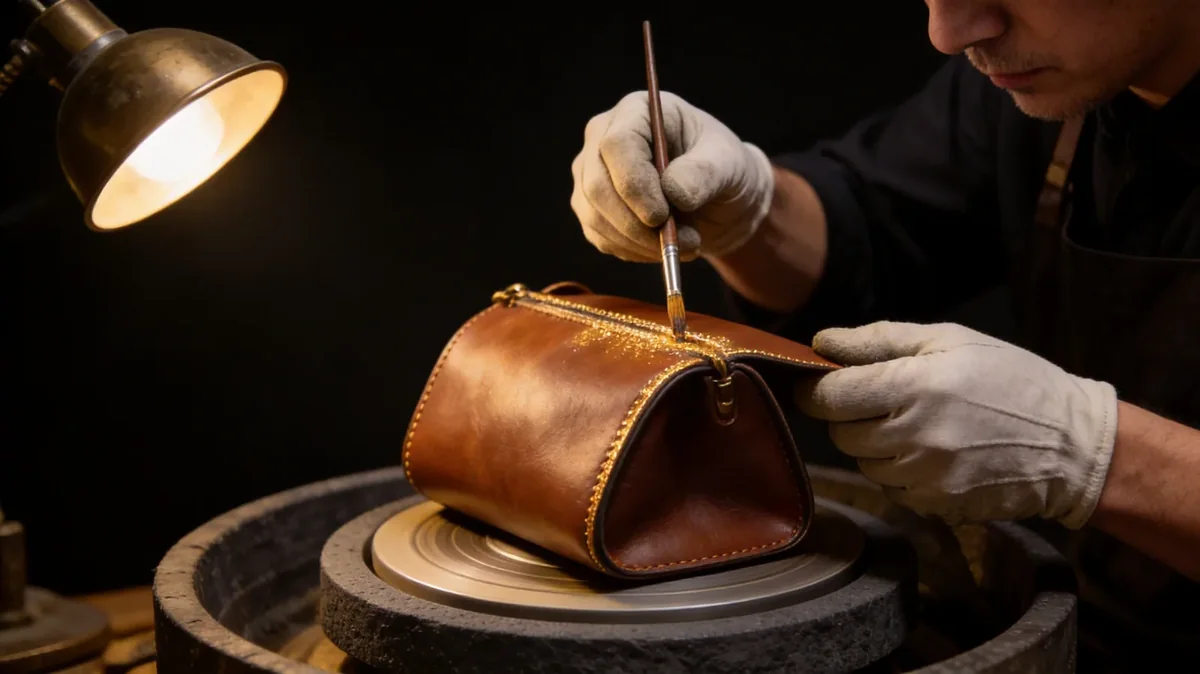
Doing it later costs more than the arithmetic suggests. A strap is cut, finished and edge-painted against a fixed length; changing it after approval means re-cutting, re-finishing and re-testing, and the drawn pattern for the strap stays wrong for the next season unless somebody revises it too.
Specifying Fit in the Tech Pack
Fit is not communicated by photographs in a specification. Four lines carry it: drop measured vertically, strap length given as a range, body width stated loaded, and the wearer heights the drawing was tested against. Without the fourth, nobody downstream knows whose fit was being judged.
The fourth line also settles disputes later. When somebody asks why the body looked wrong on their model, the answer is in the tech pack rather than in an argument about taste.
Eight lines that carry fit through development
- Strap drop measured vertically, not along the strap.
- Strap length stated as a range with the adjustment interval.
- Handle internal clearance, measured under load rather than flat.
- Body width measured loaded, not empty.
- Wearer heights the drawing was tested against, named explicitly.
- Target loaded mass stated alongside strap width.
- Photographs of each fitting, taken straight on and in profile.
- The retained fitting notes kept with the approved sample.
Our programme works to MOQ 500 pcs per style and colourway, with sampling at 6-10 working days and 12-15 for a complex construction, bulk at 35-50 days on FOB Xiamen terms, inspected to AQL 2.5 under ISO 2859-1. It runs across 7 production lines with about 200,000 pcs per month of capacity and export experience since 2014, delivered through our validated partner factory Quanzhou Yingming Bags, an SGS-validated site. Development routes sit under luxury sampling and the bench practice under craftsmanship.
Send the drawing and we will build the fit matrix
Tell us the drop, the strap range and the wearer heights you sell to. We will build nine cells, photograph them, and return the pattern adjustment each one needs within two working days. Request a quote.
Frequently Asked Questions
What shoulder drop suits most luxury handbags?
Between 520 and 560 mm, measured vertically from the strap apex to the top edge of the body. Below 500 mm the bag crowds the bust on many wearers; above 580 mm it swings against the hip when walking. Count a coat as adding 15-25 mm of effective shoulder height.
How long should a crossbody strap be?
Specify a range of 1,100 to 1,300 mm rather than one length, because the strap crosses the diagonal of the torso and every torso differs. Adjustment holes at 60 mm intervals give enough movement between a shirt and a winter coat without multiplying the finishing points.
How wide can a handbag be before it looks oversized?
Measure the widest point of the loaded body against the wearer's hip width. Below 0.75 reads compact, 0.75 to 1.0 reads balanced, above 1.0 reads oversized. Going past 1.0 is legitimate when it is deliberate and matched with a longer strap and softer construction.
What handle clearance do I need?
At least 55 mm of internal clearance so four fingers pass under load, with a grip width no greater than about 14 mm. A 12 mm flat handle folded over a 3 mm core is the usual answer; anything wider needs a rolled section or the fold corners dig into the palm.
Why does the same bag look different on two people?
Because the body is judged against the wearer rather than against itself. Height against torso length and body width against hip width both change between wearers. Testing on 158, 165 and 172 cm and photographing each resolves the argument faster than debating it.
Should the bag be measured empty or loaded?
Loaded, always. An empty body sits higher and narrower than a full one, so a strap that reads correct empty can drop past the intended line once a day's contents are inside. Record the target loaded mass on the same line as the strap width.
Does coat thickness matter for strap length?
Yes. A winter coat adds roughly 15-25 mm of effective shoulder height, which is why a fitted strap range should span at least 200 mm. Without the allowance, the same body sits visibly higher in December than in July and returns follow.
What loaded mass makes a strap uncomfortable?
Above about 1.5 kg, a 25 mm strap becomes uncomfortable within roughly thirty minutes on most wearers. Widen it to 35-40 mm, add a leather shoulder pad over the contact area, or design the body to be carried by its handles with the strap secondary.
How is drop defined in a specification?
Vertically, from the highest point of the strap to the top edge of the bag body. Measuring along the strap gives a longer figure that varies with how the strap was cut, which is why two teams can quote different numbers for the same sample.
How many wearers should a fitting use?
Three, at 158, 165 and 172 cm, photographed straight on and in profile. Three exposes the pattern across a market; one produces a drawing that fits whoever happened to be available on the day and nobody else in particular.
How quickly can fit be checked during sampling?
Sampling runs 6-10 working days for a standard construction and 12-15 for a complex one. Ask for the fitting photographs alongside the sample rather than after it, since asking for another round costs two weeks that the calendar rarely has.
Where should fit figures be recorded?
In the tech pack, on the same page as the graded dimensions: vertical drop, strap range with the adjustment interval, loaded width, handle clearance measured under load, target mass, and the three wearer heights tested. That set survives staff changes; a set of photographs does not.
People Also Ask
What is strap drop on a handbag?
The vertical distance from the highest point of the strap to the top edge of the bag body. It decides where the bag lands on the torso, so it is the single most consequential measurement in a fitting.
Why do handbags swing when I walk?
The drop is too long, or the loaded mass is too high for the strap width. Lengthening the strap moves the body past the hip line where the gait pushes it, which is why a longer strap often makes the swing worse rather than better.
Should a small body forgo a shoulder strap?
Not necessarily, but a 520 mm drop on a small body can sit awkwardly high. Shortening toward 500 mm and narrowing the strap keeps the option without forcing the proportion to match a larger sibling.
How much does a body stretch in service?
A soft construction in a relaxed leather will lengthen under its own load over a season, particularly on a strap. Specify the drop measured after twenty-four hours of hanging loaded, not fresh off the bench.
Is proportion measured differently for an evening body?
Yes. Evening frames are carried in the hand rather than on the shoulder, so clearance, handle geometry and how the body reads against a formal silhouette matter more than strap drop and hip width.
Sources and further reading
Every figure on this page is either our own programme data or attributed below. Open the originals before you write them into a specification.
- ISO — International Organization for StandardizationISO Publisher of ISO 8559 series on body measurement for garment construction, the reference behind wearer height bands.
- ISO 2859-1 Sampling ProceduresISO The sampling standard referenced for AQL 2.5 inspection of finished lots at intake.
- Business of FashionBusiness of Fashion Trade reporting on how designer houses size and fit accessories across international markets.
- FashionUnitedFashionUnited Industry data and commentary on accessory category performance and regional size preferences.
- SGS — Testing, Inspection and CertificationSGS Third-party testing body referenced for strap and handle pull testing on finished bodies.