Luxury Leather Handbag Colour Maturation: An Eleven-Item Checklist Signed at Approval
How does colour mature on a luxury leather handbag, and how is it controlled? Shade moves through four mechanisms: oxidation, oil transfer, light exposure and abrasion. Control it with eleven checks at approval, holding ΔE to 1.0 within a unit and 2.0 across a lot, testing light fastness to ISO 105-B02 at 4 or better on the blue wool scale, and confirming the match under three light sources before the lot is released.
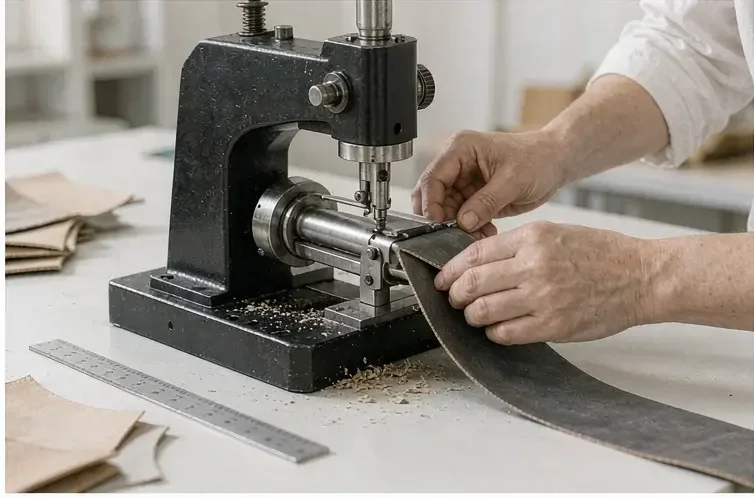
The Maturation Checklist: Eleven Items Signed at Approval
Colour is approved once and then it moves. Eleven items, each with a figure, describe where the shade starts and how far it is allowed to travel, and they are what a disagreement in month nine is settled against.
Sign them at approval rather than at delivery. Most colour disputes are not about whether a lot was wrong on the day it arrived; they are about whether the change since then was within the band the brand accepted.
- Record the starting shade by spectrophotometer, not by eye and not by shade name.
- Set ΔE 1.0 as the tolerance within a unit and ΔE 2.0 across the lot.
- Test light fastness to ISO 105-B02 and record the blue wool rating.
- Test rub fastness to ISO 11640 dry and wet, on the assembled body.
- Confirm the match under three light sources, to catch metamerism.
- Name the dye family, since aniline, pull-up and pigmented age differently.
- Run an accelerated exposure and record the ΔE it produced.
- State the accepted movement after six and after twelve months.
- Keep a retained sample per lot, stored away from light.
- Re-measure retained samples at six and twelve months against the record.
- Decide in advance what counts as maturation and what counts as a fault.
What Actually Changes: Oxidation, Oil, Light and Abrasion
Four mechanisms move a shade, and they act at different rates on different parts of one unit. Naming them is what turns an argument about quality into a discussion about which mechanism is at work.
| Mechanism | What it does | Where it shows first | Rate |
|---|---|---|---|
| Oxidation | Darkens the dye and the finish as it reacts with air | Exposed panels and open-topped bodies | Slow and continuous across 6-12 months |
| Oil transfer | Darkens where the hand touches, and feeds the surface | Handles, straps and the mouth of the body | Visible within 8-12 weeks of regular use |
| Light exposure | Fades some dyes while darkening others | Panels facing a window or a retail light | Depends on the blue wool rating of the dye |
| Abrasion | Brightens a fold before oil settles into it | Gussets, corners and the base edge | Fastest at the corners, within weeks |
The fourth is the one most often misread as damage. A gusset that brightens at the crease is abrading, and it will darken again once oil settles in, which is why a piece can look worse at month three than at month twelve.
Four Dye Families and How Each Ages
Dye family predicts maturation better than any other single variable. Ask which family the shade belongs to before asking how stable it is, because the same colour behaves differently in aniline and in pigmented leather.
Aniline
Dyed through with almost no film above 5 µm. Deepest colour and the most movement: light fastness around 3 on the blue wool scale on pale shades, and oil transfer shows quickly at the handle.
Semi-aniline
A light pigment film of 8-12 µm over a dyed base. More stable than aniline and still shows grain character. The usual compromise where a brand wants depth and a workable fastness figure.
Pull-up or waxed
A wax-loaded finish of 5-10 µm that moves shade at every fold by design. Predictable maturation, because the movement is the effect rather than a side effect of it.
Pigmented
A corrected surface with a film of 15-25 µm. The most stable of the four, at 4 or better on the blue wool scale, and the least characterful. Chosen where repeatability matters more than depth.
The third family deserves a note in the specification rather than in the care card. Where a pull-up finish is specified, movement at a fold is the intended effect, and a buyer who treats that movement as a fault has specified the wrong finish.
Measuring Colour: The Instrument, the Geometry and the Lights
Colour is measured, not judged. A spectrophotometer with d/8 geometry under a D65 illuminant gives a reading that can be repeated a year later by someone who has never seen the style, which is the whole point of recording it.
- Use a spectrophotometer with d/8 geometry and a D65 illuminant, recorded on the sheet.
- Take three readings per panel and use the average, since leather is not uniform.
- Measure the assembled body where possible, not only flat swatches.
- Record the observer angle and the aperture, so a later reading is comparable.
- Re-measure the instrument against its calibration tile before each session.
The second item matters more than the others. Leather varies within one panel, so a single reading is a reading of one spot, and two people taking single readings on the same panel will report different numbers and believe both.
Setting the Tolerance: ΔE 1.0, ΔE 2.0 and What They Mean
ΔE is the distance between two colours in a defined colour space, and it is the only colour tolerance worth writing down. Within one unit, hold panels to ΔE 1.0 or below; across a production lot, ΔE 2.0 is workable.
- Within a unit
- ΔE 1.0 or below between any two visible panels
- Across a lot
- ΔE 2.0 or below against the approved retained sample
- Against a re-order
- ΔE 2.0 or below against the original retained sample
- Accepted maturation
- Stated as a band for six months and for twelve months
- Light fastness
- ISO 105-B02, 4 or better on the blue wool scale for most programmes
- Rub fastness
- ISO 11640, 4 dry and 3-4 wet on the grey scale
- Instrument
- Spectrophotometer, d/8 geometry, D65 illuminant, three readings averaged
- Light sources
- Three: daylight, retail warm white and cool white fluorescent
The fourth row is the one most often missing, and it is the row that decides a dispute. Without an accepted movement band, any change is arguable, and the party holding the invoice usually loses the argument.
Accelerated Exposure: What Twenty Hours Tells You
Accelerated exposure compresses months of light into hours, and it is useful for ranking rather than for prediction. Twenty hours under a controlled xenon source will separate a dye that moves quickly from one that does not; it will not tell you the exact shade in month nine.
Use it comparatively. Expose the approved shade and the candidate side by side, measure both after twenty hours, and choose on the difference between them rather than on an absolute figure.
Record the exposure alongside the blue wool rating rather than instead of it. The two answer different questions: the rating describes the dye, and the exposure describes that dye on that leather with that finish, which is the combination that actually reaches a customer.
Accelerated exposure is a comparison tool. Expose the approved shade and the candidate together, measure both, and decide on the gap between them. An absolute figure from a single exposure predicts very little about month nine.
Metamerism: The Pair That Matches Under One Light
Metamerism is the reason a panel that matches under a bench lamp does not match in a shop window. Two surfaces can reflect the same colour under one illuminant and different colours under another, and leather and thread are the commonest metameric pair in a body.
- Check shell against lining under daylight, warm retail white and cool fluorescent.
- Check thread against the shell under the same three, since thread is a different fibre.
- Check hardware plating against the leather, where the two sit adjacent.
- Reject a pair that matches under one source and splits under another.
- Record which source the approval was made under, so re-orders are checked the same way.
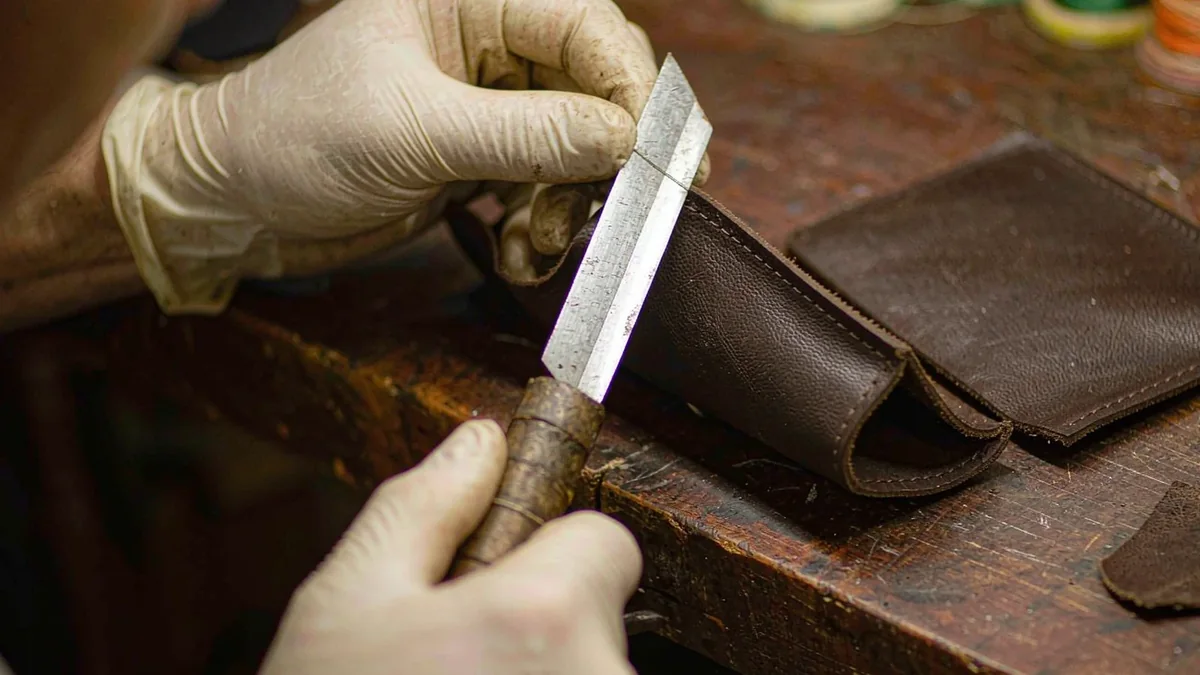
Tracking a Lot Across Twelve Months
Maturation is only understood by measuring the same piece twice. Keep a retained sample per lot, store it away from light, and re-measure it at six and twelve months against the figures recorded at approval.
Two samples per lot is better than one: one stored in the dark as the reference, and one left in ordinary conditions to show what a customer will see. The distance between the two is the maturation of that shade under that exposure.
- Cut two retained samples at approval and label both with the lot reference and the date.
- Measure both and record the readings, the instrument and the illuminant used.
- Store one in the dark and one under ordinary indoor light, away from direct sun.
- Re-measure both at six months and record the ΔE against the approval reading.
- Re-measure both at twelve months, and compare the dark sample against the light one.
The fourth and fifth steps take minutes and they are the only source of real maturation data a brand owns. Everything else about how a shade ages is inference from a datasheet written by somebody else.
What to Tell the Retail Floor
Most colour complaints are expectation failures rather than material failures. A customer who was told a piece would deepen buys a story; a customer who was not told reads the first change as a defect and asks for a replacement.
Give the floor three sentences: what will change, how fast, and what to do about a mark. Those three sentences prevent more returns than any change to the specification, because they act at the point where the complaint is formed.
Add a fourth where the piece is displayed. Retail lighting accelerates the light mechanism considerably, and a body left under a window or a spotlight for a season will move further than the same body carried daily, which is why display stock and storage stock age differently.
Writing Maturation Into the Specification
A colour specification that ends at a shade reference is incomplete. Eight lines cover what the shade is, how far it may move, and what evidence settles a question raised a year later.
Eight lines before you sign a colour specification
- Starting shade measured by spectrophotometer, with instrument and illuminant named.
- ΔE tolerance within a unit and across a lot, stated separately.
- Dye family named, since aniline, pull-up and pigmented age differently.
- ISO 105-B02 blue wool rating, and ISO 11640 dry and wet figures.
- Three light sources the match was approved under.
- Accepted movement at six months and at twelve months, as a band.
- Retained samples per lot, one stored dark and one under ordinary light.
- Re-measurement dates recorded against the lot reference.
Our programme works to MOQ 500 pcs per style and colourway, with sampling at 6-10 working days and 12-15 for a complex construction, bulk at 35-50 days on FOB Xiamen terms, inspected to AQL 2.5 under ISO 2859-1. It runs across 7 production lines with about 200,000 pcs per month of capacity and export experience since 2014, delivered through our validated partner factory Quanzhou Yingming Bags, an SGS-validated site. The framework sits under luxury materials and the bench detail under craftsmanship.
Send the shade and we will measure it
Tell us the target colour, the leather and how much movement you will accept. We will return the dye family options, the fastness figures and a sampling calendar, within two working days. Request a quote.
Frequently Asked Questions
What causes leather colour to change over time?
Four mechanisms: oxidation, oil transfer from handling, light exposure and abrasion. Oxidation darkens slowly across 6-12 months, oil darkens handles within 8-12 weeks, light fades some dyes while darkening others, and abrasion brightens a fold before oil settles into it. Write the figure into the specification, since an unrecorded figure cannot be enforced at intake.
What ΔE tolerance should a colour specification set?
ΔE 1.0 or below between any two visible panels within a unit, and ΔE 2.0 or below across a lot measured against the approved retained sample. Recording both separately matters, because the two tolerances answer different questions about the same production run. Confirm it at sampling, which runs 6-10 working days, or 12-15 for a complex construction.
Which dye family is most stable?
Pigmented, with a film of 15-25 µm and light fastness of 4 or better on the blue wool scale. Aniline is the least stable and the most characterful. Semi-aniline at 8-12 µm and pull-up at 5-10 µm sit between the two in different ways. Check it per lot at intake, inspected to AQL 2.5 under ISO 2859-1.
How is colour measured on leather?
With a spectrophotometer using d/8 geometry under a D65 illuminant, taking three readings per panel and averaging them. Leather varies within a single panel, so one reading is a reading of one spot, and two people taking single readings will disagree. Our programme works to MOQ 500 pcs per style and colourway, with bulk at 35-50 days.
What is metamerism and why does it matter?
It is when two surfaces match under one illuminant and differ under another. Leather and thread are the commonest metameric pair in a handbag, so a match approved under a bench lamp can split under retail warm white. Check under three sources. Keep the result with the retained sample so a re-order can be checked against it.
What light fastness rating should a luxury programme require?
ISO 105-B02 at 4 or better on the blue wool scale for most programmes. Unfinished vegetable tanned leather on a pale shade typically reaches 3, which is a known trade for the character of the material rather than a defect in the dye. Agree the detail before the order is placed and hold it across the life of the style.
Does accelerated light exposure predict real ageing?
It ranks rather than predicts. Twenty hours under a controlled source separates a dye that moves quickly from one that does not. Expose the approved shade and the candidate together and decide on the gap between them. Write the figure into the specification, since an unrecorded figure cannot be enforced at intake.
How should retained samples be kept?
Two per lot: one stored in the dark as the reference and one under ordinary indoor light, both labelled with the lot reference and date. Re-measure both at six and twelve months; the distance between them is the maturation of that shade. Confirm it at sampling, which runs 6-10 working days, or 12-15 for a complex construction.
Why does a gusset look lighter than the panel beside it?
Abrasion. The crease is rubbed every time the body flexes, which lifts the surface and brightens it before oil settles in and darkens it again. It is a stage in maturation rather than a fault, and it usually resolves by the end of the first year.
How fast should a handle be expected to darken?
Visible change within 8-12 weeks of regular handling, reaching one to two shades darker than the body after a first season. Oil from the hand transfers at every use, which makes the handle the fastest-moving part of any unit. Check it per lot at intake, inspected to AQL 2.5 under ISO 2859-1.
Can colour maturation be specified as acceptable?
Yes, and it should be. State the accepted movement at six and at twelve months as a band, measured against the approval reading. Without that band, any change after delivery is arguable and the party holding the invoice usually loses. Our programme works to MOQ 500 pcs per style and colourway, with bulk at 35-50 days.
What should retail staff be told about colour change?
Three sentences: what will change, how fast, and what to do about a mark. Most colour complaints are expectation failures rather than material failures, and they are prevented at the point of sale rather than in the specification. Keep the result with the retained sample so a re-order can be checked against it.
People Also Ask
Will my leather handbag change colour?
Yes. Every leather moves through oxidation, oil, light and abrasion. The useful question is how far and how fast, which is answered by the dye family and the light fastness rating rather than by the shade itself.
Is a darker handle a defect?
No. Oil from the hand transfers at every use, so handles darken faster than any other part. Expect visible change within 8-12 weeks and one to two shades darker than the body after a season.
How do I keep a pale leather bag pale?
Choose a pigmented finish at 15-25 µm with light fastness of 4 or better, keep it away from direct sun, and accept that some movement still occurs. An unfinished pale shade is the hardest request any leather can be given.
What is the blue wool scale?
A rating of 1 to 8 used by ISO 105-B02 to express how much a dye fades under artificial light. Rating 4 or better is a reasonable requirement for a programme; a rating of 3 signals a shade that will move noticeably.
How often should retained samples be re-measured?
At six months and at twelve months against the approval reading, using the same instrument and illuminant. Two samples per lot, one dark and one under ordinary light, gives the clearest picture of what a customer sees.
Sources and further reading
Every figure on this page is either our own programme data or attributed below. Open the originals before you write them into a specification.
- ISO — International Organization for StandardizationISO Publisher of ISO 105-B02 on fastness to light, ISO 11640 on rub fastness and ISO 2859-1 on sampling procedures.
- International Commission on IlluminationCIE The body behind the standard illuminants, observer angles and colour difference formulae used to express ΔE.
- Leather Working GroupLeather Working Group Tannery audit protocol covering the substance controls and dye house records behind consistent shade delivery.
- ECHA — European Chemicals AgencyEuropean Chemicals Agency Administrator of REACH, including the Annex XVII restrictions that apply to dyes and substances in leather articles.
- Sourcing JournalSourcing Journal Reporting on dye availability, shade consistency and the colour tolerances expected in luxury accessories programmes.