Luxury Leather Handbags: A Material Selection Guide Written in Nine Numbers
How do you choose leather for luxury handbags? Write the specification as nine numbers and test each one on intake: substance in millimetres, temper as a measurable deflection, finish film in microns, hide grade, cutting yield, tensile strength, finish adhesion, colour fastness to light and colour fastness to rub. Everything else on a swatch card is description, and description cannot be inspected.
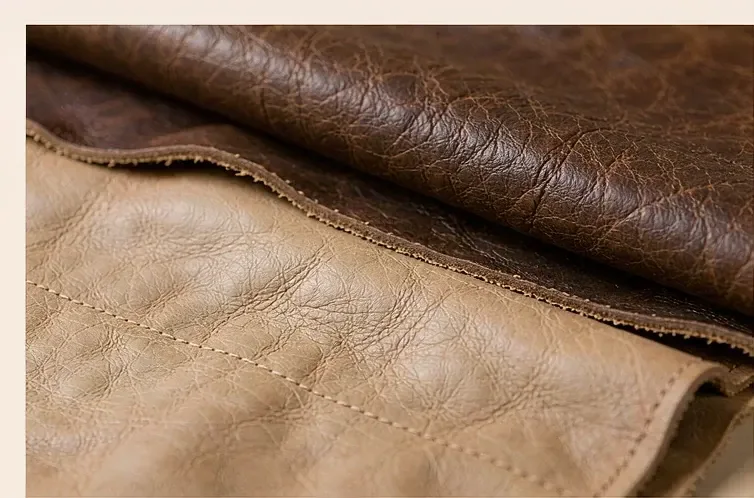
The Nine Numbers That Decide a Leather Specification
A leather specification for luxury handbags is nine numbers: substance in millimetres, temper, finish film thickness, hide grade, cutting yield, tensile strength, finish adhesion, colour fastness to light and colour fastness to rub. The tannery name, the finish designation and the story attached to the hide are description, and description cannot be inspected on intake.
Each of the nine converts into something a buyer can verify. Substance governs whether a body holds its shape. Grade governs how much of the hide becomes panels. Adhesion governs whether a surface lifts at a fold after one season.
- Substance
- 1.2-1.4 mm for a structured body; 0.9-1.1 mm for a soft, slouched body
- Temper
- Medium-firm for structure, soft for a body meant to collapse
- Finish film
- 15-25 µm pigmented, 8-12 µm semi-aniline, under 5 µm aniline
- Hide grade
- Grade I and II for panels; grade III for linings and internal parts
- Cutting yield
- 65-72% of purchased hide area converted into first-quality panels
- Tensile strength
- ISO 3376, minimum 15 N/mm² in the load-bearing direction
- Finish adhesion
- ISO 11644, no transfer at 500 dry cycles and 100 wet cycles
- Fastness to light
- ISO 105-B02, 4 or better on the blue wool scale
- Units per hide
- 4.5-5.2 units from a calf hide on a medium structured body
Substance: Why 1.2-1.4 mm Governs a Structured Body
Substance is the figure that decides whether a body stands up on its own. A structured top-handle body in calfskin works at 1.2-1.4 mm; the same drawing cut at 0.9 mm collapses at the gusset within a season, and cut at 1.8 mm it becomes a box that will not close over its own frame.
Substance is not rigidity, and confusing the two is the commonest error in a first specification. Two hides at 1.3 mm behave differently: one holds a folded edge crisply, the other creases at the same fold. Temper separates them, and temper has no unit on a swatch card.
Structured bodies
Calfskin at 1.2-1.4 mm, medium-firm temper. Gussets are skived to 0.7-0.8 mm so the fold sits flat, while the panel stays at full substance to hold the silhouette.
Soft bodies
0.9-1.1 mm with a soft temper, backed at 0.4-0.6 mm where a handle attaches. The backing is invisible once assembled and it is what stops a soft body tearing at its load points.
Gussets and folds
Skived to 0.7-0.8 mm across an 8-10 mm width. Skiving is a bench operation, and a house that skives by eye rather than by setting produces folds of inconsistent depth.
Handles and straps
1.8-2.2 mm, or two plies laminated at 1.0-1.2 mm each. A single-ply handle cut at panel substance stretches under load and does not recover afterwards.
Temper and Fullness: The Variable No Drawing Shows
Temper is how a leather resists bending, and it is why two hides of identical substance and finish behave differently on the same pattern. It cannot be read from a drawing and is rarely written into a specification, so it is the variable most often left to chance.
Ask for temper in physical terms rather than adjectives: how far a 100 × 25 mm strip deflects under a fixed load, or the force needed to bend it through 90 degrees. A house that answers in adjectives will accept whatever arrives that week.
- Ask for temper as a measurable deflection rather than as soft or firm.
- Confirm whether temper is held across a re-order or only within the first lot.
- Ask how hides are sorted: by temper band, or only by grade and colour.
- Confirm the band is recorded against the lot reference, not just the style.
- Ask what happens when a delivery arrives outside band: rejection or acceptance.
Finish: Aniline, Semi-Aniline and Pigmented
Finish is a film measured in microns, and its thickness tells you what it is hiding. Pure aniline carries almost no film and shows every mark; a pigmented finish carries 15-25 µm and hides most of them, along with the grain character you were paying for.
| Finish family | Film thickness | What it shows | What it costs you |
|---|---|---|---|
| Aniline | Under 5 µm | Every pore, scar and shade variation | Matching across lots; visible marks |
| Semi-aniline | 8-12 µm | Grain character with light correction | Some matching tolerance |
| Pigmented | 15-25 µm | Corrected, uniform surface | Grain character largely lost |
| Pull-up / waxed | 5-10 µm with wax | Shade movement at every fold | Patina by design |
The fourth row deserves a note in both directions. A pull-up finish is specified deliberately for the way shade moves at a fold, so a buyer who treats that movement as damage has specified the wrong finish. The reverse error is more common: pigmented leather chosen because it matches easily, on a piece sold as natural grain.
Grain and Grade: How Much of a Hide You Receive
Grade is the number that decides what you receive for your money, and it is best expressed as the proportion of a hide that can be cut into first-quality panels. A grade I hide yields 85-90% usable area; a grade III hide yields 55-65%, and the difference is not cosmetic.
Grading follows the defects a hide carries: brand marks, insect bites, scars and the neck area, whose fibre structure is looser than the rest. A house buying grade III for a lower hide price usually pays more per usable panel.
- Grade I: 85-90% usable area, few defects, panels taken from the prime area.
- Grade II: 70-80% usable, with defects placed away from panel positions.
- Grade III: 55-65% usable, defects scattered, suited to linings and internal parts.
- Neck and belly: looser fibre structure, used for gussets or avoided entirely.
- Matching: every panel of one unit comes from the same hide, not one dye lot.
The fifth item is quieter than the first four and more often the difference between a luxury piece and an assembly of parts. Panels cut from two hides in the same dye lot still differ in grain character, and across a large front panel that is visible from two metres.
The Four Tests Worth Writing Into a Specification
Four tests cover most of what goes wrong with leather in service, and each has an ISO method behind it. Naming the method rather than the property is what makes a specification enforceable, because a method can be repeated by a third party who has never seen the style.
| Property | Method | What it measures | Programme minimum |
|---|---|---|---|
| Tensile strength | ISO 3376 | Force per section area before the leather tears | Minimum 15 N/mm² in the load-bearing direction |
| Finish adhesion | ISO 11644 | Resistance of the finish to rubbing, dry and wet | No transfer at 500 dry and 100 wet cycles |
| Fastness to light | ISO 105-B02 | Resistance to fading under artificial light | 4 or better on the blue wool scale |
| Fastness to rub | ISO 11640 | Transfer of colour onto a dry and wet cloth | 4 dry and 3-4 wet for dark shades |
The second row is the one to insist on wherever the construction includes a folded or turned edge. A finish that lifts at a fold does so within months and does so on pieces already shipped, which makes it the costliest of the four failures to put right.
Restricted substances sit alongside these four rather than inside them. REACH Annex XVII governs what may be present in an article placed on the European Union market, and California Prop 65 governs the warnings required in that state; both are checked against a test report per lot, never against a swatch.
Yield: One Hide, How Many Units
Yield converts a hide price into a unit cost, and it is the arithmetic least often done before a price is quoted. One calf hide cut for a medium structured body produces 4.5-5.2 units with panels matched; cut for maximum economy and without matching, the same hide produces 6.0-6.8.
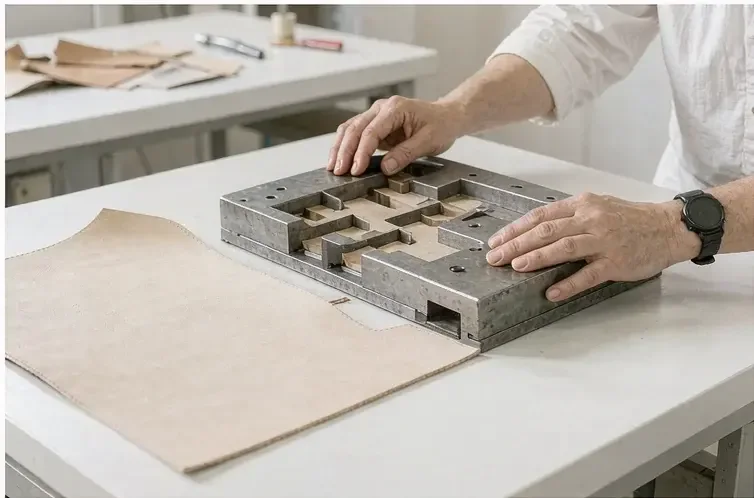
The gap is the matching decision, and matching is a design decision rather than a cutting one. Grain matched across a front panel and its gusset buys 4.5-5.2 units per hide; accepting unmatched panels buys more units and a visibly different piece.
Note what the layout cannot avoid. A hide is an irregular outline with a looser neck and belly, and defect marking consumes area before a single pattern piece is placed. Yield is quoted against purchased area, which is why 65-72% is a good result.
Matching the Leather to the Silhouette
Silhouette and leather are specified together, and specifying them separately produces the most common failure in a first collection: a drawing developed for one material and then cut in another that cannot hold it.
- Structured top-handle: calfskin at 1.2-1.4 mm, medium-firm temper. Lambskin slumps at the gusset within a season.
- Slouched hobo: lambskin or soft calfskin at 0.9-1.1 mm, backed at load points, where drape matters more than firmness.
- Evening and minaudière: fine calfskin at 0.8-1.0 mm over a rigid frame, since the frame carries the shape.
- Travel and weekend: calfskin at 1.4-1.6 mm with a reinforced base panel, where abrasion resistance matters most.
The last item is where substance decisions get reversed. A large body needs more substance but also more support, and the support is usually a base panel and a stiffener rather than simply a thicker leather throughout.
Where the Leather Money Actually Goes
Leather is the largest single share of FOB cost on a structured body, but not the majority of it. On a medium structured calfskin body at 500 pcs, material runs 38-52%, with the remainder across hardware, trims, bench time and finishing.
| Cost element | Share of FOB | What moves it |
|---|---|---|
| Leather | 38-52% | Grade, substance and yield; matching adds 8-12 points |
| Hardware | 12-20% | Plating specification and whether the closure is bespoke |
| Trims and linings | 9-14% | Lining material, zipper gauge and edge finishing |
| Bench time | 18-26% | Stitch density, skiving and hand-finished operations |
| Presentation packing | About USD 4.80 per unit | Dust bag, rigid box and printed care card |
The last row is worth separating out because it is often forgotten until freight is booked. Presentation packing leads its own schedule, and a dust bag, rigid box and care card at about USD 4.80 per unit are ordered with the packing rather than with the leather.
A five-point improvement in cutting yield is worth more than a five-point concession on hide price. Teams that spend a season negotiating price and no time on yield leave the larger number on the table.
The Specification Sheet Worth Signing
A specification sheet is ready to sign when each of the nine numbers carries a method and a tolerance. Anything recorded as an adjective is a preference, and a preference is not enforceable at intake.
Nine lines before you sign a leather specification
- Substance in millimetres, with the skived dimension recorded separately.
- Temper as a measurable deflection, with the band agreed for re-orders.
- Finish family and film thickness in microns.
- Hide grade, and the proportion of usable area that grade implies.
- Cutting yield agreed in advance, quoted with matching or without it.
- ISO 3376 tensile minimum, with the direction tested named.
- ISO 11644 adhesion minimum, with dry and wet cycles stated.
- ISO 105-B02 light fastness minimum on the blue wool scale.
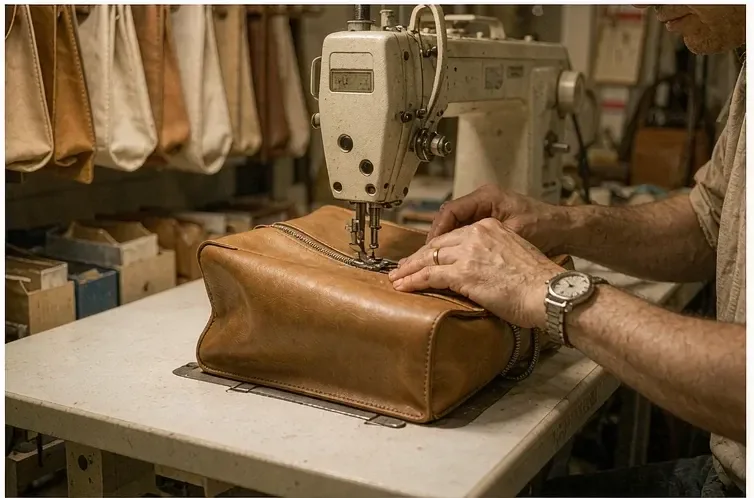
Our programme works to MOQ 500 pcs per style and colourway, with sampling at 6-10 working days and bulk at 35-50 days on FOB Xiamen terms, inspected to AQL 2.5 under ISO 2859-1. It runs across 7 production lines with about 200,000 pcs per month of capacity and export experience since 2014, delivered through our validated partner factory Quanzhou Yingming Bags, an SGS-validated site.
Send us the drawing and the target quantity
Tell us the silhouette, the leather you have in mind and the quantity per colourway. We will return the nine-number specification, the yield arithmetic and a sampling calendar, within two working days. Request a quote.
Frequently Asked Questions
What is the first number to fix when selecting leather for a handbag?
Substance, in millimetres. A structured body in calfskin works at 1.2-1.4 mm, while a slouched body takes 0.9-1.1 mm. Fix it before finish or colour, because it governs whether the silhouette holds its shape at all, and it changes the skiving setting, the handle construction and the panel reinforcement.
Why does temper matter more than the swatch suggests?
Temper is how a leather resists bending, and two hides of identical substance and finish behave differently on the same pattern because of it. Ask for a measurable deflection rather than an adjective, and record the band against the lot reference so a re-order matches the first run rather than merely resembling it.
How thick should a finish film be?
Under 5 µm for pure aniline, 8-12 µm for semi-aniline and 15-25 µm for a pigmented finish. Thicker film hides defects and makes colour matching easier, but it also removes the grain character you are paying for, so the choice is a trade rather than a technical improvement.
What cutting yield should a brand expect from calfskin?
Around 65-72% of purchased hide area converted into first-quality panels, which is a good result rather than a poor one. A hide is an irregular outline with a looser neck and belly, and defect marking consumes area before any pattern piece is placed on the table.
How many units does one calf hide produce?
Between 4.5 and 5.2 units on a medium structured body when panels are grain matched, and 6.0-6.8 when cut for maximum economy. The difference is a design decision about matching rather than a cutting inefficiency, and it belongs in the brief rather than in the cutting room.
Which ISO methods belong in a leather specification?
ISO 3376 for tensile strength, ISO 11644 for finish adhesion under dry and wet rubbing, ISO 105-B02 for fastness to light and ISO 11640 for fastness to rub. Naming the method rather than the property is what makes the specification testable by a third party later.
What tensile strength is reasonable to demand?
A minimum of 15 N/mm² in the direction that carries load, tested to ISO 3376. Direction matters: a hide tested across the fibre rather than along it reports a different figure, so the specification should name which was measured and on which panel of the style.
Why does finish adhesion matter on a folded edge?
Because a finish that lifts at a fold does so within months, on pieces that have already shipped. Insist on ISO 11644 with no transfer at 500 dry cycles and 100 wet cycles; it is the most expensive of the four failures to put right once delivery has been made.
Should panels within one unit come from the same hide?
Yes. Panels cut from two hides in the same dye lot still differ in grain character, and across a large front panel that difference is visible from two metres. Keeping every panel of a unit inside a single hide is one of the quiet markers of luxury work.
Which hide grade should a luxury line buy?
Grade I and grade II for visible panels, and grade III only for linings and internal parts. Grade III looks cheaper per hide, but at 55-65% usable area against 85-90% it usually costs more per usable panel once the yield arithmetic is done and the waste is counted.
How much of the unit cost is leather?
Typically 38-52% of FOB cost on a medium structured calfskin body at 500 pcs, with hardware at 12-20%, bench time at 18-26% and trims and linings at 9-14%. Grain matching adds 8-12 points to the leather share on its own, before a single stitch is sewn.
How is a leather lot inspected before bulk is accepted?
Against the specification: substance measured with a dial gauge, finish adhesion and colour fastness checked against test reports for the lot, and panels inspected to AQL 2.5 under ISO 2859-1. Retained swatches are then held with the hide records so that a later re-order can be matched.
People Also Ask
What leather is best for luxury handbags?
Full-grain calfskin at 1.2-1.4 mm for structured bodies, and lambskin at 0.9-1.1 mm where drape is wanted. The better question is which substance, temper and finish the silhouette needs, since those three decide how it behaves in service.
How do you tell full grain from corrected grain?
Look at the pores. Full grain keeps the natural grain surface with pores visible; corrected grain has been sanded and covered with a 15-25 µm pigmented film, which removes the pore structure and much of the character along with it.
Why do two hides of the same colour look different?
Grade, temper and grain character vary within a dye lot, and the neck and belly of a hide have a looser fibre structure than the prime area. Matching panels within one hide is how the difference is kept off the finished piece.
What does REACH require of leather sold in the EU?
REACH Annex XVII restricts certain substances in articles placed on the European Union market, including chromium VI in leather. Compliance is shown with a test report per lot rather than with a swatch or a tannery certificate.
How long does leather selection add to a calendar?
Hide reservation and confirmation sit alongside sampling rather than inside it: 6-10 working days for a first sample and 12-15 for a complex construction. Bulk then runs 35-50 days on FOB Xiamen terms.
Sources and further reading
Every figure on this page is either our own programme data or attributed below. Open the originals before you write them into a specification.
- ISO — International Organization for StandardizationISO Publisher of ISO 3376 on tensile strength, ISO 11644 and ISO 11640 on rub fastness, and ISO 2859-1 on sampling plans.
- Leather Working GroupLeather Working Group Tannery audit protocol covering environmental performance, traceability and the substance controls behind hide records.
- ECHA — European Chemicals AgencyEuropean Chemicals Agency Administrator of REACH, including the Annex XVII restrictions that apply to substances in leather articles sold into the EU.
- Office of Environmental Health Hazard AssessmentOEHHA The California agency that administers Proposition 65 and its warning requirements for listed substances in consumer articles.
- Sourcing JournalSourcing Journal Reporting on hide availability, leather pricing and the traceability expectations now placed on luxury material chains.