Premium Leather Bag Grade Selection Explained: Six Questions Before You Sign a Hide Clause
How does grade selection work for premium leather bags? Ask six questions in order: what selection means on a hide, what share of a delivery reaches it, what counts as a defect, how tight substance tolerance should be, who grades and under what light, and what the purchase clause must say. Top selection rarely exceeds 15-25% of a lot, and paying for it only helps when the bodies actually consume prime panel area. This article answers the six questions and gives figures to write into your own specification.
Question One: What Does Selection Mean on a Hide?
Selection is the name a tannery gives to how much usable surface survived the hazards of the animal's life and the hazards of the tanning process. It is assigned at the tannery, not at the cutting table, and it is expressed as a name rather than as a test result.
That distinction matters because two houses can use the same selection word for different things. One may grade on surface defects only; another may also fold in substance regularity and handle. Before discussing price, make every selection word resolve to a written description attached to your order.
- Selection grades describe usable surface, usually assessed defect by defect.
- Grades are assigned by eye and experience, then recorded per hide or per bundle.
- Naming conventions differ between houses; the written description governs, not the word.
- Grading covers tanning damage as well as natural marks from the animal's life.
- The same word can cover two different realities unless it is written down.
Some makers dismiss grading as commercial language rather than technical language. They are half right: the word is commercial, but the yield it predicts is as technical as anything in your specification, and it is the number that decides your cost per unit.
Question Two: How Much of a Lot Reaches Top Selection?
Fewer hides than most plans assume. On a typical premium delivery, top selection is usually in the range of 15-25% of the hides received; second selection accounts for roughly 40-55%, and the balance goes lower. Plan your prices against that distribution rather than against the best sample you were shown.
- Top selection
- Typically 15-25% of a delivery, prime panel area largely intact
- Second selection
- Typically 40-55%, usable with careful pattern layout
- Lower selections
- The balance, suited to small panels, linings and facings
- Substance tolerance
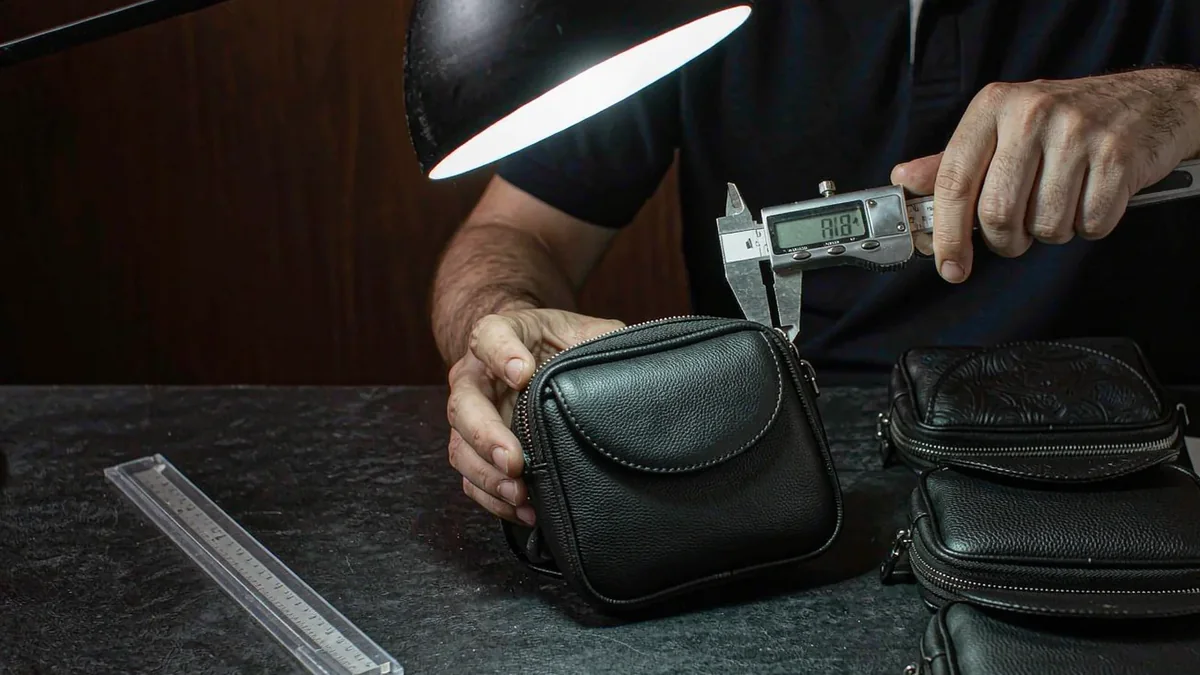
- +/-0.1 mm within a declared band, measured with a dial gauge
- Bundle practice
- Hides are usually sold by bundle, mixed selections within stated limits
- Resorting right
- Agree in writing what happens when a bundle misses the stated mix
The fifth line is where disagreements start. A bundle is a practical way to sell, but if the stated mix is not written into the order, the tops of three bundles will quietly drift and the cutting rejects will drift with them.
Question Three: What Counts as a Defect, Panel by Panel?
A defect is only a defect in relation to the pattern piece it would spoil. A healed scar sitting in the middle of a gusset does nothing to a body panel, and the same scar in the centre of a front panel ruins it. Define defects against panel area, not against the hide overall.
Write the allowance as numbers rather than adjectives. State the maximum number of healed scars per panel area, the largest measurement any single one may reach, and whether holes, brand marks or thin grain are acceptable anywhere in the prime area. Adjectives invite arguments at intake, numbers settle them.
Prime area
The centre of the hide, roughly the panel zone of the bend; it carries the strictest allowance because visible panels come from it.
Secondary area
Edges and belly where gussets, facings and interior parts are cut; a looser allowance here costs nothing.
Healed marks
Barbed wire and healed scratches are limited by count and by size, typically up to three per prime panel area with none larger than about 20 mm.
Open marks
Holes, brand marks and scrape damage are usually excluded from prime area altogether rather than counted.
Applying the third card literally across a whole hide will push you up a selection grade for no functional gain. Grade tightly where the visible panels come from and sensibly everywhere else, and the arithmetic improves without the surface looking different.
Question Four: How Tight Should Substance Tolerance Be?
Substance is the thickness of the leather, measured in millimetres, and for a premium body it is usually declared as a band rather than a single figure. A typical declaration is 1.2-1.4 mm with a permitted variation of +/-0.1 mm across hides in one delivery.
Tightening further is possible and rarely worth it. Below +/-0.1 mm the hides have to be sorted again by touch, which adds handling cost and forces further divides in an already small pool of grade A hides. The visible result of a looser tolerance usually shows in structure rather than in comfort.
- Declare substance as a band, typically 1.2-1.4 mm for a structured body.
- Permit +/-0.1 mm variation across a delivery rather than demanding uniformity.
- Measure with a dial gauge at agreed points, not at the thickest or thinnest.
- Separate the requirement for bodies from the requirement for facings and linings.
- Record the measured figures per bundle so fabric panel sorting can plan around them.
The fourth bullet saves money more often than any other line in the specification. Facings, straps and interior panels do not need the substance you specified for the front body, yet many orders apply one figure across every component.
Question Five: Who Grades, and Under What Light?
Grading is a visual judgement, so it is entirely dependent on the conditions it is made under. Hides should be assessed flat on a neutral surface in consistent light, commonly judged under a D65 source at around 1,000 lux, by graders working to one written standard.
The light is not pedantry. Signs of damage that vanish under warm showroom lighting are obvious under daylight-equivalent conditions, and a decision reached at nine in the morning is not the decision reached at the end of a shift. Ask where grading happens and what it is judged under, then put both in the order.
| Condition | What to specify | Why it changes the result |
|---|---|---|
| Light source | D65-equivalent at roughly 1,000 lux | Finish and shade differences read very differently under warm light |
| Surface | Neutral grey table, hides laid flat | Colourful surfaces contaminate the eye on pale neutral tones |
| Standard | One written description per selection word | Without it, two graders sort to different rules |
| Reference | A sealed swatch or panel set per grade | A reference is what makes the written word enforceable |
| Timing | Graded before bundling, recorded per hide | Post hoc grading tends to favour whoever is holding the invoice |
The fourth row deserves attention. A sealed reference set is the least costly lever in this entire article: it converts every later argument from a matter of opinion into a matter of comparison.
Question Six: What Should the Purchase Clause Say?
The clause is where grading becomes enforceable. It should name the selections permitted, the share each selection may take within a bundle, the defect allowance by area, the substance band with tolerance, the light and reference used, and what happens when a delivery misses any of them.
Most clauses stop at the first two items, which is why most grading disputes are unresolvable. Without a remedy written down, a buyer who finds 9% instead of 22% top selection has a grievance rather than a claim, and grievances are settled by whoever has more patience.
- Name the permitted selections in writing, with the tannery's own descriptions attached.
- State the share each selection may take within a bundle and overall.
- Set the defect allowance by panel area rather than across the hide.
- Declare the substance band and the permitted variation across a delivery.
- Fix the light, the surface and the sealed reference used for grading.
- Write the remedy: replacement, credit, or acceptance against an agreed adjustment.

Grading Language Compared
The vocabulary differs enough between houses to be worth translating. The terms below cover what most premium trade conversations mean, but the written definition always supersedes the word used in an email.
| Term | What it usually means | Where it is used |
|---|---|---|
| Top selection | Largely clean prime area, few healed marks | Visible panels on structured bodies |
| Second selection | Usable with layout discipline and component planning | Bodies, gussets, larger straps |
| Lower selections | Suitable for small parts only | Facings, bindings, interior components |
| Corrected grain | Surface sanded and refinished to even out damage | Pigmented finishes, higher yield per hide |
| Full grain selection | Uncorrected surface; defects therefore more visible | Aniline and semi-aniline bodies |
The fourth row explains a counter-intuitive pricing effect. Correcting a surface lets lower-choice hides become visually consistent, which is why a corrected-grained runner and a full-grain choice sit closer in price than their yield suggests.
What Grade Costs at the Cutting Table
Grade matters because it converts directly into cutting rejects. Moving from a lower selection to top selection on the same pattern typically raises hide cost while reducing sorting rejects, and the two numbers move in opposite directions at different rates.
- A tighter selection usually adds to hide cost and cuts rejects at the table.
- The saving appears as labour and time rather than as material returned.
- Mixed-selection bundles can be the pragmatic answer for multi-component bodies.
- Extra sorting and pairing adds roughly USD 4.80 per unit on medium structured bodies.
- Component planning lets one body carry two selections without visible difference.
- Yield figures quoted without a selection assumption describe nothing you can buy.
The last line is the one to carry into any negotiation. A yield figure offered without stating which selection it assumes is not a quotation; it is a wish, and it will be revised on the day the first bundle arrives.
Writing Grade Into Your Own Specification
Bring the six answers together as one sheet that travels with the order and travels with the hides. One page, six entries, each with a number, is enough to make a grade argument resolvable months later by someone who was not in the original conversation.
Our development programme works to MOQ 500 pcs per style and colourway, with sampling at 6-10 working days and 12-15 days where a body is complex, and bulk at 35-50 days on FOB Xiamen terms, inspected to AQL 2.5 under ISO 2859-1. It runs across 7 production lines with about 200,000 pcs per month of capacity and export experience since 2014, delivered through our validated partner factory Quanzhou Yingming Bags, an SGS-validated site. Hides are graded on the grey table before intake, against the sealed reference rather than from memory.
The strictest allowance belongs on the area visible panels come from. Extending it across the whole hide buys nothing visible and costs real money, because it forces you into a selection the rest of the body never needed.
Get the grade clause written before you place the order
Send the silhouette, the finish you want and the quantity. We will return a grade specification with defect limits, substance band and selection shares you can attach to a purchase order. Request a quote.
Frequently Asked Questions
What does the selection grade on a hide actually describe?
How much usable surface survived marks from the animal's life and damage during tanning. It is assigned by eye against a written description, recorded per hide or per bundle, and it predicts cutting yield more reliably than any single technical measurement on the leather.
Why is top selection such a small share of a delivery?
Because prime area is limited and most hides carry some damage. Realistically top selection runs 15-25% of a premium delivery, with second selection taking 40-55% and the balance below. Planning as though most hides were top grade produces a costing that cannot be met.
Should every component use the top selection?
No. Facings, bindings and interior parts rarely need it. Set the strictest allowance on the area visible panels come from and allow secondary selections elsewhere; the finished body looks identical and the material arithmetic improves without any compromise you can see.
What is a reasonable defect allowance for a visible panel?
Typically up to three healed marks in the prime panel area with none larger than about 20 mm, and no open damage, holes or brand marks at all. Write it as count and measurement rather than as language like minimal or slight, which nobody can enforce later.
How tight should substance tolerance be for a premium body?
A band of 1.2-1.4 mm with +/-0.1 mm variation across a delivery is the common specification for structured bodies. Tighter is possible but forces additional sorting by touch, which costs money and further divides an already small pool of better hides.
Under what light should hides be graded?
Daylight-equivalent conditions, commonly D65 at around 1,000 lux, on a neutral grey surface with hides laid flat. Warm showroom light hides grain damage and shifts pale neutrals, which is why so many intake arguments happen in rooms rather than at tables.
What is a sealed reference card and why keep one?
A signed panel or swatch set kept for each selection grade, held against the order. It converts disagreement into comparison: instead of arguing about whether a delivery met the standard, you place the panel beside the reference and read the answer.
How should a purchase clause handle bundles with several selections?
State the permitted selections and the share each may take, both within a bundle and across the delivery. Then write the remedy: replacement, credit, or agreed acceptance with adjustment. Without a stated share and remedy, a shortfall is a complaint rather than a claim.
Does a higher grade always reduce cutting rejects?
It reduces them, but at diminishing returns. The saving appears as sorting labour and layout time rather than as material you can return, and beyond a point the extra hide cost outruns it. Component planning usually delivers more arithmetic than simply buying up another selection.
Why can two houses use the same grade word differently?
Because the word is commercial rather than tested. One house may sort only on surface defects while another also considers substance regularity and handle. That is why the written description attached to the order governs, never the word exchanged in an email.
How much does extra sorting and pairing add per unit?
Roughly USD 4.80 per unit on a medium structured body, covering the additional handling when panels have to be matched rather than simply cut. It is usually worth paying on bodies with two visible symmetrical panels and rarely worth paying on soft unstructured shapes.
What should I do if a delivery misses the agreed mix?
Refer to the remedy you wrote. If one exists, it resolves in days; if not, you are negotiating from patience rather than entitlement. In either case record the measured distribution per bundle so the next order can be specified with figures you have actually observed.
People Also Ask
What are premium leather grade names?
Most trade conversations use selections: top, second and lower, sometimes alongside terms such as full grain or corrected grain. The names vary between houses, so the written description attached to the order always governs over the word used in correspondence.
How much of a hide lot is top selection?
Usually 15-25% of a premium delivery, with roughly 40-55% reaching second selection and the balance below. Plans built on the assumption that most hides are top grade produce figures that cannot be met on intake.
What thickness should luxury bag leather be?
A structured body commonly runs 1.2-1.4 mm declared as a band, with +/-0.1 mm tolerated across a delivery. Facings and linings can sit lighter, and specifying one figure for every component costs money without changing how the finished body feels.
What disqualifies a hide from prime panel area?
Open damage: holes, brand marks and scrape marks through the grain. Healed scars are limited by count and size instead of excluded outright, commonly up to three per prime panel area with none larger than about 20 mm.
Is buying a higher grade always worth it?
Not always. Higher selection reduces sorting rejects but adds hide cost, and the saving arrives as labour rather than material. Component planning across two selections often delivers a better result than buying everything up one grade.
Sources and further reading
Every figure on this page is either our own programme data or attributed below. Open the originals before you write them into a specification.
- Leather Working Group — tannery audit protocolLeather Working Group The audit protocol behind the environmental records a house can show for the tanneries behind its selection grades.
- ISO/TC 289 — Leather technical committeeISO Develops the ISO leather test methods, including ISO 3376 for tensile strength and ISO 11644 for finish adhesion.
- Regulation (EU) No 1007/2011 on textile fibre names and labellingEUR-Lex Sets naming and labelling discipline relevant to composition claims made about linings and textile-backed materials.
- REACH legislationEuropean Chemicals Agency Restricted substance requirements, including chromium VI limits in leather, which grade selection cannot override.
- Sourcing JournalSourcing Journal Reporting on hide availability and grade mix movements that affect what selection can realistically be bought in a season.