Tech Pack Errors That Ruin Luxury Bag Sampling: Eight Mistakes Compared by Where They Surface and What They Cost
Which tech pack errors ruin luxury bag sampling? Eight, and they differ sharply in where they surface. A missing provisional list costs a round; a missing thickness costs the silhouette; a missing tolerance costs the argument at bulk. The seven numbers — leather 1.2-1.4 mm, stitch 8-9 per inch, thread 0.45 mm, three edge coats, plating 0.15-0.3 microns, interlining 0.8 mm, #5 zip — prevent five of the eight outright.
Eight Errors, Compared by Where They Surface
The eight errors are not equally expensive, and the useful way to rank them is by the point at which they become visible. An error that surfaces on the bench costs a day; one that surfaces at approval costs a round; one that surfaces at bulk costs the order.
| Error | Where it surfaces | What it costs | Prevented by |
|---|---|---|---|
| No leather thickness stated | On the bench, at the first fold | The silhouette, and usually two rounds | Writing 1.2-1.4 mm on the material line |
| Stitch pitch without a thread gauge | At the first sample, visibly | One round, and a weakened seam if missed | Writing 8-9 per inch with 0.45 mm thread |
| A drawing without tolerances | At approval, as an argument | The ability to reject anything at all | Writing ±1 mm against each dimension |
| Hardware named by its look | After approval, when it is ordered | Lead time, and often a re-specified fitting | A catalogue or drawing reference plus a chip number |
| An interior nobody drew | At the first sample, in the hand | One round, and a re-cut lining | A drawn interior plan with pocket depths |
| Edge finish unspecified | After conditioning, or in the customer's hands | A whole season's returns in the worst case | Writing three thin coats on the pack |
| Materials without batch or grade | At bulk, when the hide arrives | An unmatchable approval | Batch numbers on every material line |
| No provisional declaration | At approval, as a discovery | One round, and approval of the wrong thing | A declared provisional list in the parcel |
Two of the remaining three, the hardware reference and the interior plan, are prevented by drawing rather than by numbering. The last, the provisional declaration, is a discipline of communication rather than of specification, and it is the one most often omitted because nobody thinks of it as part of the pack.
Error One: No Thickness on the Leather Line
A material line reading box calf says what the material is and not how thick it is, and thickness is what determines whether the piece stands up or slumps.
- 1.2-1.4 mm
- Structured pieces that must hold a silhouette empty
- 1.0-1.2 mm
- Soft constructions where the panel is meant to relax
- 0.8 mm interlining
- The weight that adds body without stiffness at the fold
- 1.5 mm base board
- Keeps the floor flat without visible bulk at the edge
- 0.45 mm thread
- Matched to the pitch at 8-9 per inch and to the needle
The error is expensive because it is discovered late. A piece cut at 1.0 mm when the silhouette needed 1.4 mm looks correct in photographs and wrong in the hand, and by the time that is noticed the pattern has been graded against the softer result.
Error Two: Stitch Pitch Without a Thread Gauge
Pitch and thread are a matched set against the needle, and specifying one without the other produces a seam that is either perforated or bulky.
- 8-9 stitches per inch reads as fine without weakening the seam.
- 0.45 mm thread matches that pitch without oversizing the hole.
- A coarser pitch looks hand-worked in the wrong way on a fine piece.
- A finer pitch perforates the leather along the stitch line and the seam tears before the leather does.
- At the handle root, pitch and thread together decide whether the attachment holds under load.
The fifth point is where the error becomes structural. A handle root is the highest-load seam on the piece, and a pitch specified for appearance rather than for load is a specification that fails at 4 kg rather than at 500 cycles.
Error Three: A Drawing Without Tolerances
A dimension without a tolerance is a preference, and a pack full of preferences produces a piece that cannot be rejected however wrong it is.
| Dimension | Working tolerance | How it is measured |
|---|---|---|
| Handle drop | ±1 mm on the production sample | Tape from the crown of the handle to the top of the body, piece empty |
| Body width | ±1 mm | Steel rule across the base at the widest point |
| Gusset depth | ±1 mm | Rule at the centre of the gusset, piece empty |
| Strap length | ±3 mm | Laid flat and unloaded, measured end to end |
| Stitch pitch | 8-9 per inch, counted | Counted over 25 mm and multiplied by 25.4 on a straight run |
The commercial consequence is worth stating plainly. A pack without tolerances removes the buyer's ability to reject a bulk delivery on dimensional grounds, because there is no agreed figure against which the delivery is wrong.
Error Four: Hardware Named by Its Look
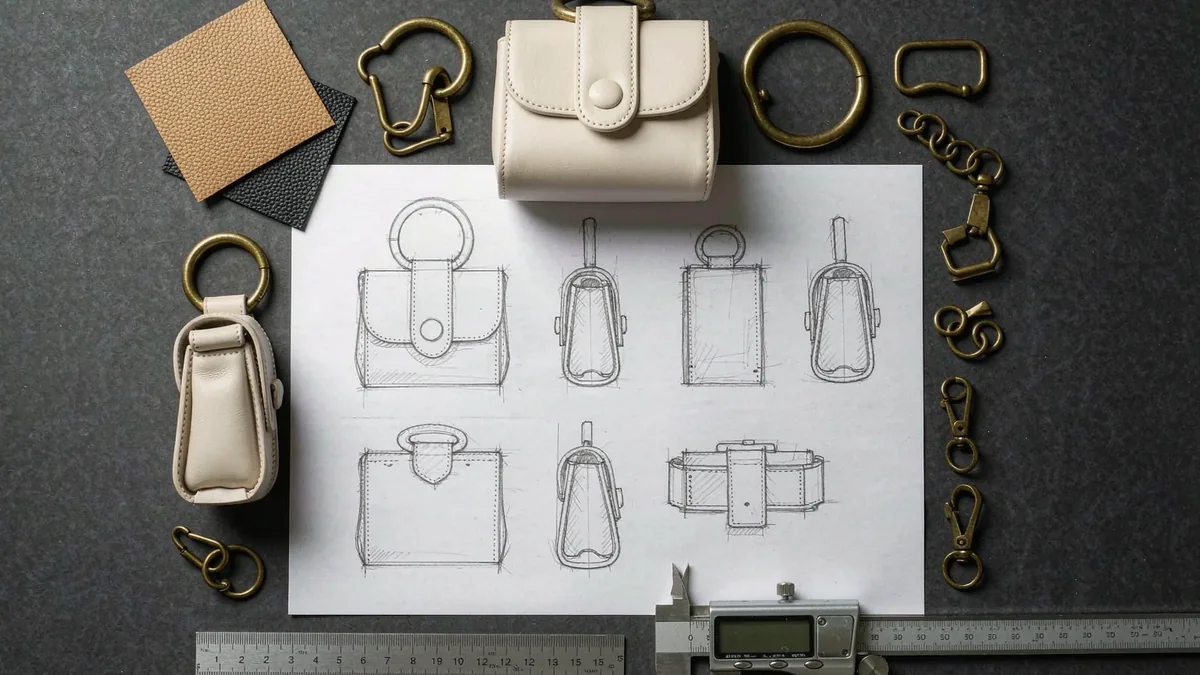
A fitting described as a brushed brass turn-lock can mean six different parts to six different people, and the sample will contain whichever one the bench had to hand.
What to write
The catalogue or drawing reference, the finish chip number, the plating thickness at 0.15-0.3 microns and the salt spray expectation of 24 to 48 hours.
What it prevents
A sample approved with a stock fitting in place of the engineered one, and the re-specification that follows when the real part arrives.
What it costs if omitted
Lead time above all. A fitting identified late pushes bulk more than almost any other single omission on the pack.
The discipline
Approve the drawing for an engineered part and the chip for the finish, and never approve the substitute as if it were the real thing.
The fourth card is the habit that matters. Where a sample carries a stock substitute, the correct approval is of the drawing rather than of the piece, and saying so on the pack prevents the error entirely.
Error Five: An Interior Nobody Drew
The exterior is drawn in detail and the interior is described in a sentence, and the interior is where the sample is first found wanting in the hand.
- Draw the interior plan, including pocket number, position and depth.
- State pocket depth as a figure: a slip pocket at 135 mm takes a large phone without crowding the opening.
- Say whether the lining is to be visible at the opening, because it will be unless it is specified otherwise.
- Specify the lining material and its weight, and check show-through against the shell.
- State the finish on interior edges, since raw edges inside are accepted on samples and regretted in use.
The third item is the commonest fault in this category and the one most visible in a photograph. A lining showing at the opening reads as unfinished regardless of how good the rest of the piece is, and it is also the fault most often corrected late, because it is discovered on the finished piece rather than on the drawing.
There is a second reason the interior gets skipped, and it is worth naming. Most tech packs evolve from an exterior sketch that someone liked, and the interior is added later as a note. Reversing that order costs nothing: an interior plan drawn at the same time as the exterior takes an extra hour and removes an entire class of second round. Where a house is short of drawing resource, a photographed interior of a reference piece, annotated with depths, is an acceptable substitute and much better than a sentence.
Error Six: Edge Finish Unspecified
An edge is either specified or it is not, and the difference is invisible at handover and obvious after a cold fold.
What the edge line on a tech pack should say
- Three thin coats rather than one thick one.
- The colour reference for the coating, matched to the leather rather than approximated.
- The finish required: matt, satin or gloss, stated as a chip where possible.
- That the edge is to be checked after conditioning cold and warm, not at room temperature alone.
- That the same specification applies to interior as well as exterior edges.
The fourth line is what makes the specification testable. An edge approved at room temperature tells you nothing about the same edge in a cold climate, and the pack is the place to say so.
Error Seven: Materials Without Batch or Grade
A material line naming a hide without a batch, or a skin without a grade, produces an approval that cannot be matched when the run is cut.
- Every leather line carries a batch or lot number, not only a name.
- Exotic skins carry a grade, recorded at selection rather than at packing.
- Lining, interlining and thread carry their own references rather than inheriting the shell's.
- Where a tannery is specified by the brand, the lead time is recorded on the same line.
- A retained cutting from the approved batch is tagged and kept with the sealed reference.
The retained cutting is the least costly protection in this category. Six months later, a disputed delivery is settled in ninety seconds by putting the cutting, the reference and the delivered piece under the same light.
Error Eight: No Provisional Declaration
A provisional component is one fitted to the sample because the specified part has a longer lead time than the sample window, and failing to declare it is the error that most reliably costs a round.
- Declare every substituted component on the pack before the sample is cut.
- State what the real component is and when it is expected.
- Approve the drawing rather than the sample for any declared provisional element.
- Require the substituted list to travel inside the sample parcel, not only in correspondence.
- Re-check the list at approval, before signing anything.
The third step is the protective one. Where an element is provisional, an approval of the piece is an approval of a part that will not appear in bulk, and the round that follows is spent discovering that.
A dimension without a figure after it is a preference. An approval given against preferences cannot be enforced later, because there is no agreed standard the delivery has missed.
The Check Before You Send It
Twelve questions, and a pack that answers all twelve will sample in two rounds more often than not.
- Is the leather thickness written, at 1.2-1.4 mm for a structured piece?
- Is the stitch pitch written with its thread, at 8-9 per inch and 0.45 mm?
- Is the edge finish written as three thin coats?
- Is the hardware identified by reference, with a chip number and plating at 0.15-0.3 microns?
- Is the interlining weight written, at 0.8 mm?
- Is the zip size written, at #5 for a main opening?
- Does every dimension carry a tolerance?
- Is the interior drawn, with pocket depths?
- Does every material line carry a batch or grade?
- Is anything provisional, and is it declared?
- Is the packing specified as bulk packing?
- Is the quantity stated, against the MOQ of 500 pcs per style and colourway?
Once the pack passes and the sample is approved, the programme runs on fixed terms: bulk in 35-50 days, inspection at AQL 2.5 under ISO 2859-1 with third-party inspection available, and handover on FOB Xiamen terms. Export experience on this programme runs since 2014 across 7 production lines with about 200,000 pcs per month of capacity, delivered through our validated partner factory Quanzhou Yingming Bags.
Have your tech pack reviewed before the first cut
Send the drawings and the material direction and we will return a marked-up pack with the missing numbers identified. Request a quote.
Frequently Asked Questions
What is the most damaging tech pack error?
A missing leather thickness. It surfaces at the first fold rather than at the drawing stage, changes the silhouette, and usually costs two rounds because the pattern has been graded against the wrong result.
Why must stitch pitch be specified with thread gauge?
Pitch, thread and needle are a matched set. Eight to nine stitches per inch needs 0.45 mm thread; a finer pitch with the same thread perforates the leather and the seam fails before the leather does.
What happens if a drawing has no tolerances?
Every dimension becomes a preference rather than a requirement. The practical consequence is that a bulk delivery cannot be rejected on dimensional grounds, because there is no agreed figure it has missed.
What tolerance should be used on a bag drawing?
One millimetre on body dimensions such as handle drop, body width and gusset depth, and three millimetres on strap length. The fit sample is allowed two millimetres of argument before those tighten.
How should hardware be specified?
By catalogue or drawing reference, with a finish chip number, plating thickness at 0.15-0.3 microns and a salt spray expectation of 24 to 48 hours. A description of the look is not a specification.
What should a provisional declaration contain?
Every substituted component, what the real one is, when it is expected, and a note that the drawing rather than the sample is to be approved for that element. It should travel inside the parcel.
Why is the interior so often a source of a second round?
Because the exterior is drawn in detail while the interior is described in a sentence. Pocket number, position and depth, and whether the lining may show at the opening, are all decisions that need figures.
What is the correct pocket depth to specify?
A slip pocket at 135 mm is a working figure for a large phone without crowding the opening. It should be stated as a number on the interior plan rather than left to be discovered in the hand.
How should edge finish be written on a pack?
Three thin coats rather than one, the coating colour reference, the finish required, and a line stating that the edge is checked after conditioning cold and warm rather than at room temperature alone.
Why do material lines need batch numbers?
Because a hide specified by name alone can be re-supplied differently. The batch number is what makes an approval enforceable, and a retained cutting from it settles any later dispute quickly.
What additional fields do exotic skins need?
A grade recorded at selection, confirmation that the grade can supply the full quantity, and the CITES documentation requirement noted at selection rather than left until the cartons are packed.
How many of the eight errors does a numbers pack prevent?
Five outright. Writing leather thickness, stitch pitch, thread gauge, edge coats, plating thickness, interlining weight and zip size on the pack removes the majority of the commonest failures before the first cut.
What should the packing line on a pack say?
That the sample is packed as bulk will be packed. A piece presented better than bulk will be is a piece that proves nothing about the run, and it is the most flattering omission on a pack.
What are the terms once a clean pack is approved?
MOQ 500 pcs per style and colourway, bulk in 35-50 days, inspection at AQL 2.5 under ISO 2859-1 with third-party inspection available, and handover on FOB Xiamen terms.
People Also Ask
What should a handbag tech pack include?
Seven numbers above all: leather thickness, stitch pitch, thread gauge, edge coats, plating thickness, interlining weight and zip size, plus tolerances on every dimension.
Why does my sample keep coming back wrong?
Most often because a dimension was written without a tolerance, or a component was substituted without being declared as provisional.
Do I need to specify the interior?
Yes, in detail. Pocket number, position, depth and whether the lining may show at the opening are all decisions that become faults if left unwritten.
What is a provisional component?
A part fitted to the sample because the specified one has a longer lead time than the sample window. Declare it and approve the drawing instead of the piece.
How do I make an approval enforceable?
Write tolerances, batch numbers and finish chip references. An approval expressed in adjectives cannot be measured and therefore cannot be enforced.
Sources and further reading
Every figure on this page is either our own programme data or attributed below. Open the originals before you write them into a specification.
- ISO — International Organization for StandardizationISO Publisher of ISO 2859-1 for inspection and of the dimensional and material test methods referenced on a tech pack.
- SATRASATRA Technology Centre Independent testing organisation for leather and accessories, covering the flex, rub and salt spray tests behind pack specifications.
- Leather Working GroupLeather Working Group Tannery audit protocol behind the batch and grade identification recorded on material lines.
- CITES — Convention on International Trade in Endangered SpeciesCITES The permit and documentation regime that applies to listed skins specified on a pack.
- Sourcing JournalSourcing Journal Reporting on specification practice, tech pack discipline and development calendars in the accessories trade.