Premium Handbag Hardware Cost Guide: What a Fitting Really Costs
What does premium handbag hardware actually cost? Five lines: base metal, plating and finish, tooling amortised across the run, testing and compliance, and scrap. Brass sits at roughly two to two and a half times the cost of a zamac casting of the same part, decorative gold plating runs at 0.15-0.3 µm, and tooling is the line that disappears as quantity rises. This guide opens with one custom clasp on a 500-unit run, then sets out every number behind the quote.
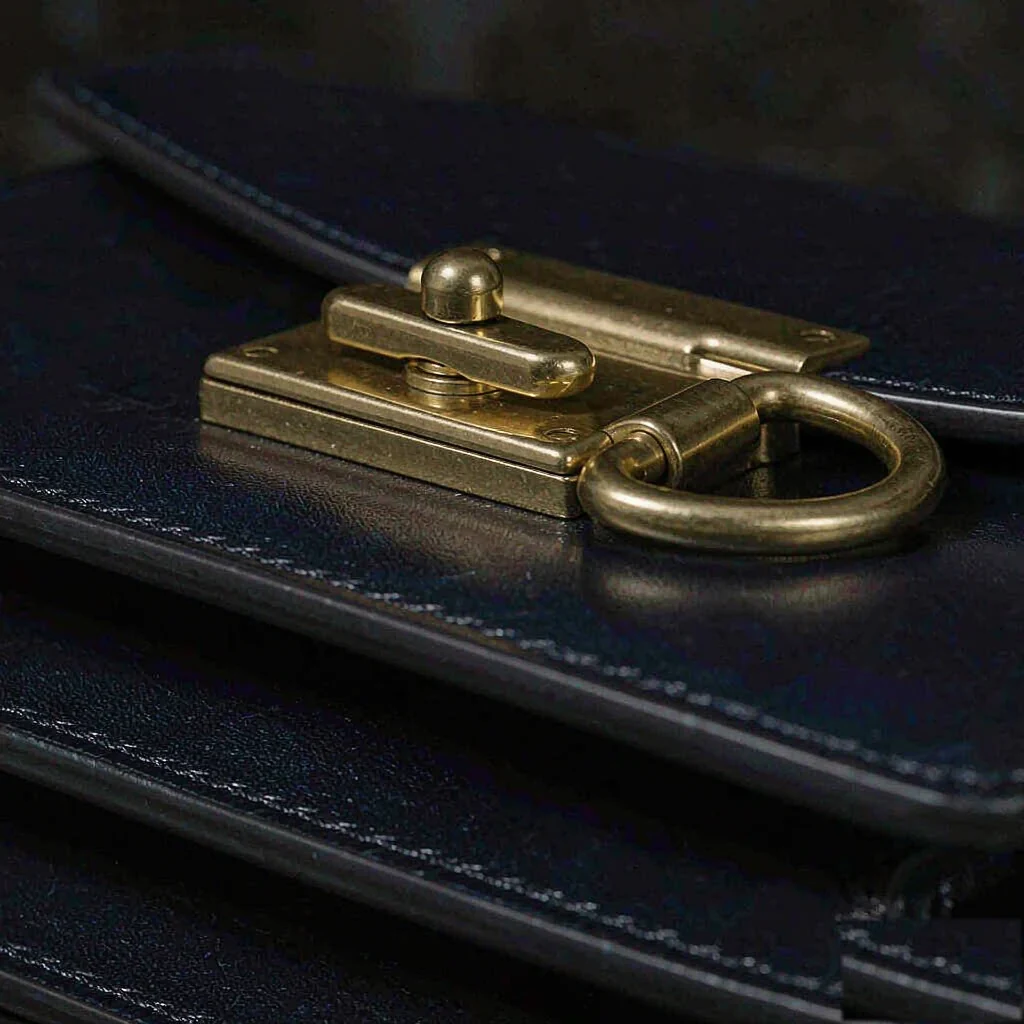
The Case: One Custom Clasp and a 500-Unit Run
A house designed a cast clasp for a structured body and asked for it on the first run of 500 units. The drawing was elegant and the part was small. Three lines appeared on the quote that the design studio had not expected: a tooling charge for the die, a plating charge priced per piece on a short run, and a testing charge for the corrosion and restricted-substance checks. None was large. Together they moved the unit cost enough to matter.
The studio had two options and took the second. The first was to proceed and absorb the cost. The second was to keep the clasp design, switch from brass to a zamac casting with a heavier plated finish, and move the custom work into the second season when the run would be larger. The look survived the change; the tooling line did not. This is the decision most hardware cost conversations actually come down to.
Five Lines Make Up a Hardware Cost
Every hardware quote resolves into five lines, and knowing them makes any quote readable. Base metal is the material and the casting or machining. Plating and finish is the surface stack and the polishing. Tooling is the die or the jig, amortised across the run. Testing and compliance covers corrosion, adhesion and restricted substances. Scrap is the share of parts rejected, priced into the unit.
- Base metal
- Zamac casting, brass, stainless steel, or brass with a cast body
- Plating, decorative gold
- 0.15-0.3 µm over a nickel or palladium underlayer
- Plating, heavier duty
- Specified where a surface rubs; thickness named per surface
- Corrosion check
- Neutral salt spray exposure of 24 or 48 hours
- Testing
- Corrosion, adhesion, and restricted substances for the destination market
- Scrap allowance
- Priced into the unit; rises sharply with tight cosmetic tolerances
- Stock trim set
- Reference unit of USD 4.80 per bag before custom work
- Programme
- MOQ 500 pcs per style and colourway, bulk 35-50 days
Base Metal: The First and Largest Decision
The base metal sets the floor. A zamac die casting is the reference at an index of 1.0 and gives crisp detail at a modest cost. Brass sits at roughly two to two and a half times that index, brings weight and a warmer colour, and machines rather than casts in some forms. Stainless steel sits higher again and is chosen for corrosion resistance and a cool tone. The choice is visual as much as financial, and it should be made before the drawing is finished.
Weight is the hidden consequence. A brass fitting is heavier than the same part in zamac, and that extra mass is carried by the panel. On a body at 1.2-1.4 mm in calfskin it is rarely a problem; on 0.8-1.0 mm lambskin it is, and the answer is a reinforcement patch rather than a lighter metal. Cost and structure therefore have to be decided together, not in sequence.
| Base metal | Cost index | Where it belongs | Consequence |
|---|---|---|---|
| Zamac die casting | 1.0, the reference | Detailed decorative parts at any price point | Crisp detail, light weight, needs a good plating stack |
| Brass | Roughly 2.0-2.6 | Warm-tone houses and higher price points | Heavier; check the panel can carry it |
| Stainless steel | Roughly 3.0-4.0 | Cool modern ranges and high-wear parts | Excellent corrosion behaviour, costly to machine |
| Brass body, cast detail | Between the two above | Weight where a fitting is handled | Balanced hand; two processes in one part |
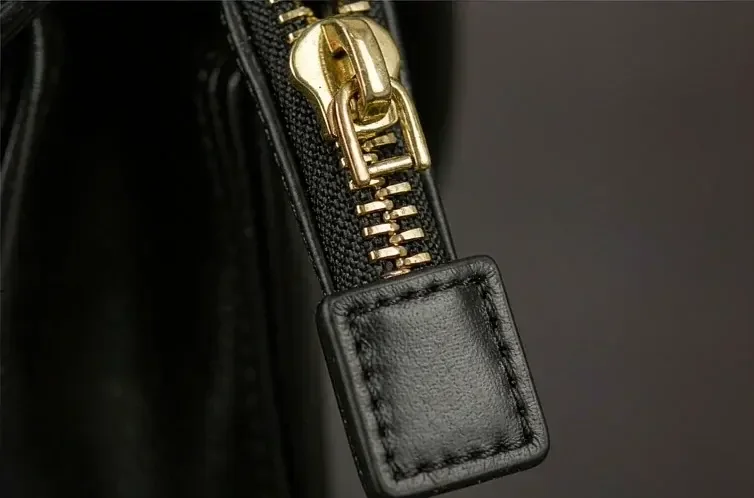
Zippers deserve their own line because they are the only component with a mechanism. A metal zip in a #5 gauge costs more than a coil zip of the same length, takes a plated finish on the teeth and the pull, and carries a failure mode no other fitting has: a slider that jams. Specify the gauge, the tape colour and the pull finish, and test the slider action on the assembled body rather than on the component card.
Plating and Finish: Where Cost Hides
Decorative gold is commonly specified at 0.15-0.3 µm over a nickel or palladium underlayer. That is a thin film, and the cost sits less in the metal than in the handling: racking, polishing before plating, and the rejection rate afterwards. A part that is polished to a mirror before plating costs more than one polished to a satin finish, because the mirror shows every porosity in the casting beneath it.
Rack versus barrel
Rack plating holds parts individually and gives a more even film on visible faces; barrel plating is quicker and suits small parts where contact marks do not show.
Physical vapour deposition
A denser, more wear-resistant film that holds colour longer at a contact point. Costs more and usually adds lead time, so specify it on feet and rings rather than everywhere.
Antique and brushed
Applied finishes that hide minor casting variation and reduce rejection. They flatter warm colourways and are often the most forgiving route on a decorative part.
Mirror polish
The most demanding finish. It exposes casting porosity, raises the reject rate and raises the unit cost. Reserve it for parts that are genuinely looked at.
Tooling, Minimums and Amortisation
Tooling is the only line that falls as quantity rises. A die for a cast part, a jig for a machined one, and any custom stamp or engraving are one-off charges spread across the run. On a programme at MOQ 500 pcs per style and colourway the tooling line is visible on the unit cost; on a repeat order of several thousand it effectively disappears. This is the arithmetic behind the decision in the opening case.
The practical rule is to match ambition to quantity. Put custom tooling behind a body that is expected to repeat, and take a stock trim set for a first season or a capsule. A stock set costs a reference unit of USD 4.80 per bag and carries no tooling at all, which is why so many sensible first collections look more restrained than the designer's original drawing.
Tolerances, Scrap and What Drives Rejection
Scrap is priced into every unit, and it is driven by the cosmetic tolerance more than by anything else. A dimensional tolerance of a few tenths of a millimetre is routine; a cosmetic standard that rejects any visible pore on a mirror-polished face is not, and it can double the rejection rate on the same part. State which faces are visible in the assembled body and set the cosmetic standard only for those.
- Mark the visible faces on the drawing and set the cosmetic standard only there.
- Allow a dimensional tolerance in tenths of a millimetre rather than a nominal figure.
- Choose a finish that forgives casting variation where the design allows it.
- Avoid a mirror polish on a part that sits in shadow or against the body.
- Ask for the reject rate that the price assumes, and whether it is capped.
Testing and Compliance Cost
Testing is a small line and a necessary one. Corrosion is checked by neutral salt spray exposure, commonly 24 or 48 hours, graded afterwards. Adhesion is checked on the plated film. Restricted substances are checked against REACH Annex XVII for Europe and California Proposition 65 for the United States, with nickel release and lead content the usual focus for metal components. Ask for written statements naming the destination markets.
Five Ways to Reduce Hardware Cost Without Losing the Look
The reductions that work are the ones the client cannot see. Switch the base metal on a decorative part. Change the finish from mirror to satin or antique. Take a stock trim set for the first season. Reduce the number of distinct components on a body. And concentrate custom tooling on the one part that carries the identity of the house. Each is invisible in the finished article and each is visible on the cost sheet.
Cost reductions that keep the look
- Zamac with a strong plating stack instead of brass on a decorative part.
- Antique or brushed instead of mirror, which also lowers the reject rate.
- A stock trim set in season one, custom tooling in season two.
- Fewer distinct components: one closure family across the range.
- Custom tooling only on the part that carries the house identity.
What to Send When You Brief a Hardware Cost Enquiry
A costing enquiry needs six things: the drawing with visible faces marked, the base metal preference, the finish with a reference, the quantity per colourway and the expected repeat, the destination markets, and the calendar. With those six a hardware house can quote accurately the first time. Without them the quote will be hedged, and a hedged quote is always higher than the honest one.
Programme terms underneath are unchanged: MOQ 500 pcs per style and colourway, sampling at 6-10 working days and 12-15 for a complex construction, bulk at 35-50 days on FOB Xiamen terms, inspection at AQL 2.5 under ISO 2859-1, and a base reference unit of USD 4.80 before material and custom work. Capacity runs across 7 production lines at about 200,000 pcs per month with export experience since 2014, delivered through our validated partner factory Quanzhou Yingming Bags.
Costing hardware for a new body?
Send the drawing, the preferred metal and the quantity. We will return a cost index, a tooling view and a lead time. Request a quotation
Frequently Asked Questions
What are the main cost drivers for handbag hardware?
Five: base metal, plating and finish, tooling amortised across the run, testing and compliance, and scrap priced into the unit. Only tooling falls as quantity rises. Knowing the five makes any quote readable and makes a negotiation possible, because each line can be discussed separately.
Is brass hardware worth the extra cost over zamac?
It is when weight and warmth are part of the design. Brass sits at roughly two to two and a half times the cost index of the same part cast in zamac, and it is heavier, which the panel has to carry. On a decorative part that is barely handled, a zamac casting with a strong plating stack usually reads identically.
How thick is gold plating on a premium fitting?
Decorative gold is commonly 0.15-0.3 µm over a nickel or palladium underlayer. It is a thin film and it wears through at contact points, so the specification should name the thickness per surface and mark which faces actually rub. Contact surfaces deserve a heavier stack or a harder route.
Why does a custom fitting cost so much on a small run?
Because of tooling. A die or a jig is a one-off charge spread across the units, so on a programme at MOQ 500 pcs per style and colourway the tooling line is clearly visible on the unit cost. On a repeat of several thousand it effectively disappears, which is the arithmetic behind moving custom work to a second season.
What is a stock trim set and what does it cost?
A stock set is existing tooling used with a chosen finish, so it carries no tooling charge. It costs a reference unit of USD 4.80 per bag and it is why many sensible first collections look more restrained than the original drawing. Custom work can follow once the body is proven to repeat.
How does the finish choice affect cost?
Substantially, through rejection. A mirror polish exposes every pore in the casting and raises the reject rate, which is priced into every unit. A satin or antique finish hides minor variation, costs less to produce and often flatters a warm colourway more. Reserve mirror polishing for faces that are genuinely looked at.
What testing should hardware pass before bulk?
Corrosion by neutral salt spray exposure, commonly 24 or 48 hours and graded afterwards; adhesion of the plated film; and restricted-substance checks against REACH Annex XVII for Europe and California Proposition 65 for the United States. Ask for written statements naming the destination markets.
How much does quantity change the hardware unit cost?
Mostly through tooling amortisation and through set-up charges that are spread across the run. The material and plating cost per piece falls only modestly with volume. Expect a visible improvement between a first run and a repeat, and a much smaller one between two large runs.
Is a physical vapour deposition finish worth the premium?
On contact parts, yes. It gives a denser and more wear-resistant film that holds colour longer where a component rubs, such as feet, D-rings and closure tongues. On a decorative plate that never touches anything it is unnecessary. Specify it selectively rather than across the whole trim set.
How does hardware weight affect the bag design?
Through the panel. A brass fitting is heavier than the same part in zamac, and that mass is carried locally. On calfskin at 1.2-1.4 mm it is rarely an issue; on lambskin at 0.8-1.0 mm it needs a reinforcement patch. Decide the metal and the substance together rather than in sequence.
What causes the highest scrap rates on hardware?
Cosmetic standards applied to faces nobody sees. A dimensional tolerance in tenths of a millimetre is routine; a standard rejecting any visible pore on a mirror-polished face can double rejection. Mark the visible faces on the drawing and set the cosmetic standard only for those.
Are there hidden costs in a hardware quote?
Three recur: tooling not shown separately, a reject allowance that is not capped, and testing quoted as an extra after the fact. Ask for all three as named lines. A quote that itemises them can be negotiated honestly, and one that bundles them cannot.
How long does custom hardware add to the calendar?
Custom tooling is usually what moves a body from standard sampling of 6-10 working days into the complex band of 12-15. Bulk then runs 35-50 days on FOB Xiamen terms, and a hard coating route can add further. Where the calendar is tight, take a stock set and put the custom work in the next season.
How should a brand brief a hardware costing enquiry?
Send six things: the drawing with visible faces marked, the base metal preference, the finish with a reference, the quantity per colourway and expected repeat, the destination markets, and the calendar. With those a quote can be accurate first time; without them it will be hedged and therefore higher.
People Also Ask
How much does luxury bag hardware cost?
It resolves into five lines: base metal, plating, tooling, testing and scrap. Compare metals by index rather than price, with zamac at 1.0, brass around 2.0-2.6 and stainless around 3.0-4.0.
Why is brass hardware more expensive?
Raw material and process. Brass costs roughly two to two and a half times the same part cast in zamac, weighs more and often needs machining rather than casting alone.
Does a custom clasp need tooling?
Yes. A die or jig is a one-off charge amortised across the run, so it is clearly visible at MOQ 500 pcs per style and colourway and effectively invisible on a repeat of several thousand.
How can hardware cost be reduced without changing the look?
Switch base metal on decorative parts, use antique or brushed instead of mirror, take a stock trim set in season one, reduce component count and confine custom tooling to the identity part.
What tests should bag hardware pass?
Neutral salt spray for 24 or 48 hours, adhesion of the plated film, and restricted-substance checks against REACH Annex XVII and California Proposition 65 for the destination markets.
Sources and further reading
Every figure on this page is either our own programme data or attributed below. Open the originals before you write them into a specification.
- ASTM — standardsASTM International Publisher of the neutral salt spray practice used to compare corrosion behaviour between plating routes before bulk.
- REACH legislationECHA The European regulation whose Annex XVII governs restricted substances in metal components, including nickel release.
- California Proposition 65OEHHA The California list applied alongside REACH for hardware sold into the United States, with lead content a common focus.
- ISO — international standardsISO Publisher of ISO 2859-1, the sampling standard behind the AQL 2.5 inspection applied to finished bodies and fittings.