Brass vs Zamac Hardware for Luxury Handbags: A Twelve-Item Comparison Checklist
Should a luxury handbag use brass or zamac hardware? Brass, at 8.4 g/cm³, machines to a crisp edge and holds a plating deposit through 48 hours of salt spray to ISO 9227. Zamac, at 6.6 g/cm³, die-casts fine detail to ±0.1 mm at roughly 25-30% less mass and a lower unit cost. The usual answer is neither alone: brass at contact points, zamac where the hand does not land.
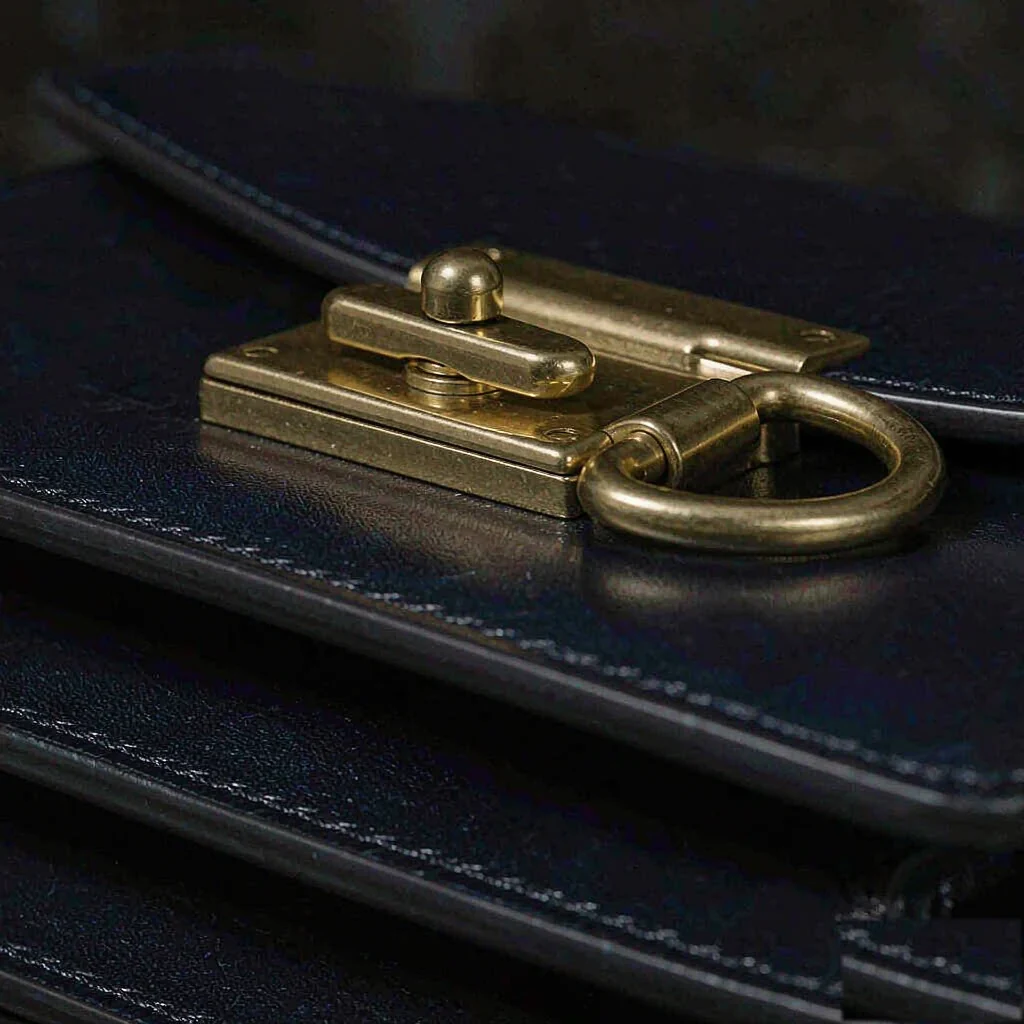
The Comparison Checklist: Twelve Items Scored Before You Choose
The choice is not made once per style. It is made once per component, and twelve items decide it. Score them in the order below and the decision stops being a matter of taste.
Start with the two items that cannot be traded: where the component sits, and what it has to survive. Everything after that is a cost question rather than a quality one.
- Where the component sits: contact point, visible but untouched, or hidden.
- What it carries: load, cycles, or nothing at all.
- Detail required: fine relief, a crisp edge, a large flat surface.
- Weight allowance for the body as a whole, in grams.
- Plating build the component needs, in microns.
- Corrosion exposure: humidity, coastal retail, frequent handling.
- Tolerance the component has to hold, in millimetres.
- Unit quantity, since tooling cost is spread across it.
- Compliance: lead content, nickel release, and the market it ships to.
- Finish: polished, brushed, antiqued, and how it will wear.
- Re-order likelihood, and whether tooling will be reused.
- Delivery date, against tooling and casting lead time.
Weight: The 25-30% Gap and Where It Lands
Density is the difference that shows on the scale. Brass sits around 8.4 g/cm³, zamac around 6.6, so the same component geometry is roughly 25-30% heavier in brass. On a closure-led design where hardware carries 12-20% of unit weight, that is a visible number.
| Property | Brass | Zamac | What it means |
|---|---|---|---|
| Density | About 8.4 g/cm³ | About 6.6 g/cm³ | 25-30% weight difference on one geometry |
| Typical process | Machined or forged | Die-cast | Casting holds fine relief; machining holds a crisp edge |
| Tolerance | ±0.05 mm machined | ±0.1 mm die-cast | Machining wins where two halves must meet |
| Tensile strength | Roughly 350-450 MPa | Roughly 280-330 MPa | Brass carries more load in a thin section |
| Plating adhesion | Strong, with standard preparation | Requires a thicker barrier layer | Zamac needs 3-5 µm beneath the deposit |
| Unit cost | Higher | Lower | The gap narrows as quantity and re-orders rise |
The weight difference is not automatically a disadvantage. On a top-handle body, mass at the closure is felt as quality; on a travel body, the same mass is felt as fatigue. The right answer depends on where the component sits.
Strength and Detail: What Each Metal Holds
Brass carries more load in a thin section, with tensile strength roughly 350-450 MPa against zamac at 280-330 MPa. That matters on a D-ring, a strap end or a chain link, where a thin section carries the whole load.
Zamac wins on detail. Die casting fills a fine relief that would be expensive to machine, so a component with a monogram, a guilloché pattern or a shaped recess is usually cast rather than cut, at a tolerance of ±0.1 mm.
- Brass, machined: crisp edges, tighter tolerance, a higher unit cost.
- Brass, forged: the strongest option for a load-bearing ring or link.
- Zamac, die-cast: fine relief and shaped recesses at a lower unit cost.
- Zamac in a thin section: check the load, since the strength is lower.
- Either: tolerance stated in millimetres on the component drawing.
Plating: Why the Same Deposit Behaves Differently
A decorative deposit of 0.5-1.0 µm behaves differently on the two metals. Brass accepts plating with standard preparation and holds it; zamac needs a thicker barrier layer beneath the deposit, typically 3-5 µm, to reach the same durability.
That barrier layer is the whole difference, and it is why a zamak component quoted without one will delaminate at roughly the point a brass one is only beginning to show wear.
Brass with a standard barrier
A 0.5-1.0 µm decorative deposit over a normal preparation cycle reaches 48 hours of salt spray to ISO 9227. This is the premium band and the reference for a closure.
Zamac with a thin barrier
The same decorative deposit over an inadequate barrier lifts under thermal shock. It is the commonest cause of plating flaking in sheets within the first year.
Zamac with a 3-5 µm barrier
Reaches 24 hours of salt spray reliably and 48 in many cases, at a lower unit cost than brass. The right choice for a visible component the hand does not touch.
Either, unplated
Used on hidden magnetic housings and internal fixings. Corrosion resistance comes from the base metal, which is where stainless steel usually replaces both.
Corrosion: What Happens After the Year One Complaint
Corrosion in service is tested before delivery with salt spray to ISO 9227, and the hours are what separate the grades: 24 hours for a standard component, 48 for a premium one, with no base metal corrosion as the acceptance criterion.
The complaint pattern is worth knowing. Zamac that corrodes does so from the inside out at a scratch or a casting pore, producing a bloom under the plating rather than a mark on it. Brass tarnishes at the surface, which is slower and far easier to live with.
Ask for the result on the component rather than on a test panel. A plated coupon tells you about the bath; a plated component tells you about the casting as well, and casting porosity is where a zamac failure usually begins rather than where the deposit is thinnest.
Cost: Unit Price Against Total Programme Cost
Zamac is lower per unit and brass is lower per complaint. The comparison that matters is total programme cost rather than component price, and it is decided by quantity, re-orders and where the component sits.
- Brass unit cost
- Higher, from material and machining time
- Zamac unit cost
- Lower, from die casting at volume
- Tooling
- Machining needs none; casting needs a die, spread across the quantity
- Re-orders
- A die already cut makes a zamac re-order faster and cheaper
- Complaint exposure
- Higher on zamac at contact points without a barrier layer
- Weight effect
- Brass adds grams where they may or may not be wanted
- Break-even
- Usually reached where quantity and re-order frequency are both high
- Practical default
- Brass at contact points, zamac elsewhere
The fourth row is the one buyers forget. A die cut for a first run makes every subsequent run cheaper, so a component that will be re-ordered for three seasons is a different calculation from a one-season piece.
Choosing by Component, Not by Style
The decision that works is made per component rather than per style. One body can carry brass at the closure and the feet, zamac at the nameplate and the D-rings, and steel at a hidden magnetic housing, and that is a considered specification rather than a compromise.
| Component | Metal | Why | Plating build |
|---|---|---|---|
| Turn-lock and clasp | Brass | Cycles 1,000 times and the hand touches it | 0.5-1.0 µm over a barrier, 48 h salt spray |
| Feet | Brass or steel | Abrasion against surfaces | 0.5-1.0 µm, or unplated steel |
| Zipper teeth and slider | Brass or zamac | Cycles; plating shade must match the closure | 0.3-1.0 µm, plated in a matched bath |
| D-rings and strap ends | Brass | Load in a thin section | 0.3-0.5 µm, pull tested at 150-250 N |
| Nameplate | Zamac | Fine relief, low contact | 0.3-0.5 µm over a 3-5 µm barrier |
| Magnetic housing | Stainless steel | Hidden, and corrosion resistance matters most | Unplated |

Compliance: Lead, Nickel and What Gets Tested
Brass is a copper-zinc alloy that may carry a small lead content for machinability, which is why a low-lead specification is requested explicitly for a piece shipping to a regulated market. Zamac is a zinc alloy with aluminium and copper, and it carries no lead of the same kind.
Both are tested as part of the finished article. REACH Annex XVII restricts certain substances in articles placed on the European Union market, including nickel release, and California Prop 65 governs warnings in that state. Both are shown with test reports per lot.
- Ask for the alloy reference, not only the metal name.
- Request low-lead brass where the market requires it, in writing.
- Test nickel release on any component in prolonged skin contact.
- Keep the test report per lot, and check the article described matches the piece shipped.
- Confirm the plating bath complies, since the deposit is part of the article.
Where Each Metal Fails First
Both metals fail predictably, and the pattern is what tells you which was the wrong choice rather than which was the wrong component.
- Brass: tarnishes at the surface, slowly, and can be polished back.
- Brass: costs more, and adds grams where a travel body does not want them.
- Zamac: blooms under the plating from a scratch or a casting pore.
- Zamac: creeps under sustained load in a thin section, opening a ring.
- Either: fails at the bond if the barrier layer was omitted from the quotation.
The fourth item is the one worth checking on any load-bearing ring. A ring that opens slowly under sustained load is a ring that will eventually drop a strap, and no amount of plating thickness prevents it.
Both metals also fail at the same place for the same reason, which is the fixing rather than the component. A pull test of 150-250 N in position on a sample body catches the failures that component testing alone never reaches, because the leather around the fixing changes how the load is carried.
The Decision Line on the Specification
Write the metal name against every component on the hardware list, alongside the plating build and the test figures. A list that names only finishes leaves the most consequential choice in the piece to whoever is quoting that week.
Eight lines before you sign a hardware metal specification
- Metal named per component, with the alloy reference where one applies.
- Process: machined, forged or die-cast, with the tolerance stated.
- Plating thickness for the decorative layer, in microns.
- Barrier layer thickness beneath it, in microns.
- Salt spray hours to ISO 9227, with the acceptance criterion stated.
- Pull test figure for any load-bearing component, in newtons.
- Compliance: low-lead where required, and nickel release tested in contact.
- Re-order note: whether a die exists, and who owns it.
Our programme works to MOQ 500 pcs per style and colourway, with sampling at 6-10 working days and 12-15 for a complex construction, bulk at 35-50 days on FOB Xiamen terms, inspected to AQL 2.5 under ISO 2859-1. It runs across 7 production lines with about 200,000 pcs per month of capacity and export experience since 2014, delivered through our validated partner factory Quanzhou Yingming Bags, an SGS-validated site. The framework sits under luxury materials and the bench detail under craftsmanship.
Send the component list and we will specify the metal
Tell us the components, where each sits and the finish you want. We will return the metal, the plating build, the test figures and a sampling calendar, within two working days. Request a quote.
Frequently Asked Questions
Is brass hardware better than zamac?
At contact points, yes: brass at 8.4 g/cm³ holds a 0.5-1.0 µm deposit through 48 hours of salt spray and machines to a crisp edge. Zamac at 6.6 g/cm³ costs less and weighs 25-30% less, and it needs a 3-5 µm barrier layer to plate comparably.
How much weight does the choice add?
Around 25-30% on the same component geometry, from density: brass about 8.4 g/cm³ against zamac about 6.6. On a closure-led design where hardware carries 12-20% of unit weight, the difference is measurable on the scale and felt in the hand. Write the figure into the specification, since an unrecorded figure cannot be enforced at intake.
Which metal holds fine detail better?
Zamac, because die casting fills a fine relief that would be expensive to machine, at a tolerance of ±0.1 mm. Brass machines to ±0.05 mm and gives a crisper edge, which is why a plain geometric component often looks better in brass. Confirm it at sampling, which runs 6-10 working days, or 12-15 for a complex construction.
Why does plating flake off zamac components?
The barrier layer beneath the decorative deposit was too thin or omitted. Zamac needs 3-5 µm beneath the surface layer to reach comparable durability. Without it, the deposit lifts under thermal shock, which is what tape testing at sampling is designed to catch. Check it per lot at intake, inspected to AQL 2.5 under ISO 2859-1.
How many salt spray hours should hardware reach?
24 hours to ISO 9227 for a standard component and 48 for a premium one, with no base metal corrosion as the acceptance criterion. State the criterion alongside the hours, since no visible change and no corrosion are very different requirements. Our programme works to MOQ 500 pcs per style and colourway, with bulk at 35-50 days.
Should one style use one metal throughout?
No. Choose per component: brass at the closure, feet and load-bearing rings; zamac at a nameplate or a decorative plate; stainless steel at a hidden magnetic housing. That is a considered specification rather than a compromise on quality. Keep the result with the retained sample so a re-order can be checked against it.
Does brass contain lead?
Some machinable brasses carry a small lead content, which is why a low-lead specification is requested in writing for a regulated market. Zamac is a zinc alloy with aluminium and copper and does not carry lead of the same kind, but both are tested as part of the article.
What compliance testing does hardware need?
REACH Annex XVII restricts certain substances in articles placed on the European Union market, including nickel release, and California Prop 65 governs warnings in that state. Both are shown with test reports per lot, and the report must describe the article actually shipped. Agree the detail before the order is placed and hold it across the life of the style.
How does each metal corrode in service?
Brass tarnishes at the surface, slowly, and can be polished back. Zamac corrodes from the inside out at a scratch or a casting pore, producing a bloom under the plating rather than a mark on it, which cannot be polished away. Write the figure into the specification, since an unrecorded figure cannot be enforced at intake.
Is zamac strong enough for a D-ring?
At 280-330 MPa against brass at 350-450, it is the weaker choice in a thin load-bearing section. A D-ring or strap end that carries the weight of a full body is better specified in brass or forged brass, and pull tested at 150-250 N in position.
Does tooling change the cost comparison?
Yes. Die casting needs a die, whose cost is spread across the quantity and which makes every re-order cheaper. A component that will run for three seasons is a different calculation from a one-season piece, so re-order likelihood belongs on the checklist. Confirm it at sampling, which runs 6-10 working days, or 12-15 for a complex construction.
How is the choice recorded on a specification?
By naming the metal and alloy against every component on the hardware list, with the process, the plating build in microns, the barrier layer and the test figures. A list that names only finishes leaves the most consequential decision unmanaged. Check it per lot at intake, inspected to AQL 2.5 under ISO 2859-1.
People Also Ask
Which is heavier, brass or zamac hardware?
Brass, at about 8.4 g/cm³ against zamac at 6.6. On the same component geometry that is roughly a 25-30% difference, which matters on a closure-led design where hardware carries 12-20% of unit weight.
Can zamac be plated to look like brass?
Yes, and at its best the difference is hard to see. The difference appears in service: zamac needs a thicker barrier layer to hold the deposit, and it corrodes from within rather than tarnishing at the surface.
Why is my hardware tarnishing?
Surface tarnish on brass is normal and polishes back. If the plating itself is lifting or blooming beneath, the bond failed, which is a barrier layer problem and cannot be corrected by polishing.
What tolerance should hardware be held to?
±0.05 mm on a machined component and ±0.1 mm on a die-cast one. Tolerance matters most where two halves have to meet without force, such as a turn-lock, and on any part set into a prepared recess.
Is stainless steel an option for handbag hardware?
Yes, and it is the usual choice for a hidden magnetic housing or feet where corrosion resistance matters more than warmth of colour. At 7.9 g/cm³ it sits between brass and zamac in weight.
Sources and further reading
Every figure on this page is either our own programme data or attributed below. Open the originals before you write them into a specification.
- Institute of Materials, Minerals and MiningIOM3 Reference data on copper-zinc and zinc-aluminium alloys, their densities and mechanical properties.
- ISO — International Organization for StandardizationISO Publisher of ISO 9227 on salt spray testing and ISO 2859-1 on the sampling plans used at intake inspection.
- ECHA — European Chemicals AgencyEuropean Chemicals Agency Administrator of REACH, including the Annex XVII restrictions on nickel release and lead in metal components.
- Office of Environmental Health Hazard AssessmentOEHHA The California agency that administers Proposition 65 and its warning requirements for listed substances in articles.
- International Copper AssociationCopper Alliance Technical reference on brass alloy composition, machinability and the low-lead grades used in regulated markets.