Luxury Handbag Lining Materials: Five Families Compared Across Nine Properties
Which lining material belongs in a luxury handbag? Five families are in normal use: cotton or viscose twill at 180-220 gsm, microfibre at 0.6 mm, jacquard for a monogram, cupro or silk for a fine interior, and recycled polyester where a content claim is required. Compare them on nine properties, of which abrasion to ISO 12947-2 and seam slippage to ISO 13936-2 decide most choices.
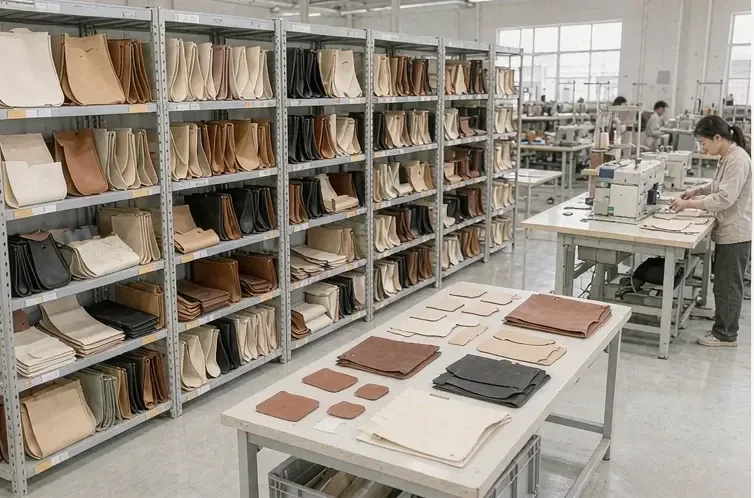
Five Lining Families Compared
Five families cover almost every lining a luxury handbag uses, and each wins on a different property. The comparison below is the one to make before a swatch book is opened, because the differences that matter are measured rather than seen.
| Family | Weight or substance | Abrasion | Character | Best placed in |
|---|---|---|---|---|
| Cotton or viscose twill | 180-220 gsm | 20,000-30,000 rubs | Matte, stable, printable | Everyday structured bodies |
| Microfibre | 0.6 mm, about 200 gsm | 40,000 rubs or more | Uniform, technical | High-abrasion interiors |
| Jacquard | 200-260 gsm | 15,000-25,000 rubs | Woven identity, monogram | Signature and gift-led lines |
| Cupro or silk | 70-120 gsm | 8,000-12,000 rubs | Cool hand, high lustre | Evening and framed pieces |
| Recycled polyester | 120-180 gsm | 25,000-35,000 rubs | Matte, technical | Programmes with a content claim |
The third column is the one that decides most choices and the one least often specified. Abrasion is a duty question: a base panel lining carrying keys and a phone is a different specification from a gusset lining that only folds against itself.
The fourth family is a deliberate exception. Cupro and silk at 70-120 gsm abrade poorly and are chosen anyway, because in a framed evening piece the interior is seen and barely touched, which is a different duty from the one an everyday body faces.
Weight: What 120, 180 and 220 gsm Buy
Weight in grams per square metre is the first figure on a lining specification, and it is often read as a quality signal when it is really a duty signal. Heavier is not better; it is heavier.
120 gsm
Light and cool, used where the interior must not add bulk: a framed piece, a soft body, a summer collection. Abrades quickly and needs a bound seam because a raw edge frays.
180 gsm
The default for an everyday body. Stable on the cutting table, takes a print, and survives normal use at the pocket mouth. The reference weight most programmes quote.
220 gsm
Heavier duty, used where the interior carries hardware or tech. Adds bulk at the mouth and reads as stiffness on a soft body, so it is paired with structured silhouettes.
0.6 mm microfibre
The technical answer, around 200 gsm equivalent. Highest abrasion performance of the five and the most uniform roll to roll, at the cost of tactile character.
Abrasion: Martindale Rubs Against Where the Lining Sits
Abrasion is measured in Martindale rubs to ISO 12947-2, and the figure a specification needs depends entirely on where the lining sits. Setting one figure for the whole interior is the commonest specification error in this category.
- Base panel lining
- 30,000-40,000 rubs, or microfibre at 0.6 mm
- Pocket mouth
- 25,000 rubs minimum, with the mouth bound or turned
- Gusset lining
- 15,000-20,000 rubs is sufficient; the duty is folding, not rubbing
- Slip pocket facing
- 20,000-25,000 rubs, where contents are inserted repeatedly
- Evening interior
- 8,000-12,000 rubs accepted, where the interior is seen and rarely touched
- Pilling resistance
- ISO 12945-2, grade 4 after 7,000 revolutions
- Tear strength
- ISO 13937-2, minimum 15 N in both directions
- Seam slippage
- ISO 13936-2, no more than 6 mm at a 60 N load
The last two rows are the pair most often omitted, and they describe the failures that actually occur. A lining that tears at a pocket corner has failed on tear strength, and one that opens at a seam has failed on slippage; neither shows up in an abrasion figure.
Seam Behaviour: Slippage, Tear and the Pocket Mouth
Most lining failures are seam failures, and seam behaviour is a property of the cloth rather than of the stitch. A loosely woven twill slips at the seam under load, opening a gap that no amount of extra stitching will close.
- Seam slippage to ISO 13936-2: no more than 6 mm at a 60 N load.
- Tear strength to ISO 13937-2: a minimum of 15 N in both directions.
- Seam allowance 8-10 mm on a lining seam, trimmed to 5-6 mm after closing.
- Stitch density 8-9 per inch, finer than the 6-7 used on a shell seam.
- Pocket mouth bound or turned; a raw woven edge frays at the mouth.
The second item is worth testing in both directions because cloth is not isotropic. A twill that reaches 15 N along the warp can fall well short across the weft, and a pocket corner is loaded across it.
Compatibility With Hardware and Zipper Tape
A lining does not exist on its own: it sits against metal, and it is sewn to a zipper tape. Two compatibility questions decide whether the interior survives the first season, and both are specification items.
The first is abrasion against hardware. A chain strap dropped into a body, or feet pressing against a base lining from the inside, abrades a cloth that was specified for fold duty rather than for rubbing. The fix is local: a heavier or microfibre panel at the base rather than a heavier lining throughout.
The second is tape compatibility. A zipper tape at 12-15 mm is sewn to the lining, and the two should be of comparable weight and shrinkage. A 120 gsm lining against a heavy tape puckers along the seam, and puckering at a pocket zipper is visible from the outside.
Colour: Dyeing, Fastness and Matching to the Shell
Lining colour is matched to the shell and checked fast, because a lining is the more likely of the two to transfer. Two ISO methods cover the risk, and both are tested on the cloth in the shade actually being used.
| Property | Method | Programme minimum | Where it bites |
|---|---|---|---|
| Fastness to rub, dry | ISO 11640 or ISO 105-X12 | 4 on the grey scale | Pale lining under a dark shell |
| Fastness to rub, wet | ISO 11640 or ISO 105-X12 | 3-4 on the grey scale | Interiors meeting moisture or cosmetics |
| Fastness to light | ISO 105-B02 | 4 on the blue wool scale | Pale linings on an open-topped body |
| Shade tolerance | Spectrophotometer, d/8, D65 | ΔE 1.0 in a unit, ΔE 2.0 across a lot | Matching across a re-order |
The fourth row is a measurement rather than a test, and it is the row that settles disputes. A shade name is a description; a ΔE figure recorded at approval is a number a re-order can be checked against.
Recycled Content and What a Claim Requires
A recycled content claim is a documentation question before it is a material one. The cloth has to carry certification, and each lot has to carry the transaction certificate that links the claim to what was actually bought.
- Ask for the transaction certificate for the lot, not a general certificate for the mill.
- Check the claimed percentage against what the certificate states, rather than against the marketing figure.
- Confirm the certificate covers the article being shipped, in the same composition.
- Keep the certificate with the lot records so a retail partner can ask for it later.
- Expect a minimum and a lead time on a certified cloth that a stock twill does not carry.
The fifth item is the practical one. Certified cloth is often made to order rather than held in stock, so it is booked alongside the shell leather rather than after the sample is approved.
Cost and Minimums by Family
Lining sits inside the trims line of a cost sheet and runs about 9-14% of FOB cost on a medium structured body once pocket construction and interlining are counted. What differs between families is less the price per metre than the minimum each carries.
| Family | Minimum | Lead time | What it costs besides money |
|---|---|---|---|
| Stock twill | Low, against availability | Days | Nothing; the default choice |
| Microfibre | Low to moderate | Days to weeks | Tactile character at the interior |
| Jacquard | Woven minimum, often 500-1,000 m | Weeks, with development | A development step ahead of sampling |
| Cupro or silk | Moderate | Weeks | Abrasion performance |
| Certified recycled | Made to order in many cases | Weeks, with certification | Administrative load per lot |
Presentation packing runs separately at about USD 4.80 per unit, and it is ordered with the packing rather than with the cloth, which is a distinction that catches programmes out at freight booking.
Testing a Lining Lot Before Release
Five checks on a lining lot catch what matters, and all five are run on the cloth in the shade being used rather than on a generic swatch from the same family.
- Abrasion to ISO 12947-2, at the figure the part of the interior requires.
- Seam slippage to ISO 13936-2, no more than 6 mm at 60 N.
- Tear strength to ISO 13937-2, minimum 15 N in both directions.
- Rub fastness dry and wet, on the assembled pocket mouth rather than a flat swatch.
- Shade measured by spectrophotometer against the approved reference, held to ΔE 2.0.
The fourth check is the one that catches the complaint customers actually make. A flat swatch that passes will not predict dye transfer at a bound pocket mouth, where the cloth is under pressure and folded.
Most lining failures are seam or fold failures. Rub, load and cycle the assembled interior rather than a flat cloth sample, because a swatch that passes says nothing about a pocket mouth under pressure.
The Lining Line on the Specification
A lining specification is nine lines, and it is the line most often filled in with a colour reference alone. Nine lines convert it into something enforceable at intake and repeatable on a re-order.
Nine lines before you sign a lining specification
- Family named, with weight in gsm or substance in millimetres.
- Abrasion figure to ISO 12947-2, stated per part of the interior.
- Seam slippage to ISO 13936-2, no more than 6 mm at 60 N.
- Tear strength to ISO 13937-2, minimum 15 N in both directions.
- Pilling resistance to ISO 12945-2, grade 4 after 7,000 revolutions.
- Rub fastness dry and wet, tested on the assembled pocket mouth.
- Shade tolerance measured by spectrophotometer, inside a unit and across a lot.
- Zipper tape compatibility: weight and shrinkage matched, seam lying flat.
- Certification documents, where a recycled content claim is made.
Our programme works to MOQ 500 pcs per style and colourway, with sampling at 6-10 working days and 12-15 for a complex interior, bulk at 35-50 days on FOB Xiamen terms, inspected to AQL 2.5 under ISO 2859-1. It runs across 7 production lines with about 200,000 pcs per month of capacity and export experience since 2014, delivered through our validated partner factory Quanzhou Yingming Bags, an SGS-validated site. The framework sits under luxury materials and the bench detail under craftsmanship.
Send the interior brief and we will specify the lining
Tell us the silhouette, the duty of each part of the interior and the shade you want. We will return the family, the weight, the test figures and a sampling calendar, within two working days. Request a quote.
Frequently Asked Questions
What is the best lining material for a luxury handbag?
Cotton or viscose twill at 180-220 gsm for an everyday body, and microfibre at 0.6 mm where the interior carries hardware or tech. Jacquard suits a signature line, and cupro or silk at 70-120 gsm suits an evening piece whose interior is seen and rarely touched.
What weight of lining should a handbag use?
180 gsm is the default for an everyday body, 120 gsm where bulk must stay low, and 220 gsm where the interior carries weight. Microfibre at 0.6 mm is around a 200 gsm equivalent. Weight is a duty signal rather than a quality signal.
How much abrasion resistance does a lining need?
Set it per part: 30,000-40,000 Martindale rubs to ISO 12947-2 at the base panel, 25,000 at a pocket mouth, and 15,000-20,000 at a gusset, whose duty is folding rather than rubbing. One figure for the whole interior is the commonest error.
Why does my lining seam open under load?
Seam slippage. A loosely woven cloth slips at the seam rather than tearing, opening a gap that extra stitching will not close. Test to ISO 13936-2 and hold slippage to no more than 6 mm at a 60 N load. Write the figure into the specification, since an unrecorded figure cannot be enforced at intake.
What tear strength should a lining have?
A minimum of 15 N to ISO 13937-2, tested in both directions. Cloth is not isotropic: a twill reaching 15 N along the warp can fall short across the weft, and a pocket corner is loaded across it. Confirm it at sampling, which runs 6-10 working days, or 12-15 for a complex construction.
Why does the pocket zipper seam pucker?
The tape and the lining are mismatched in weight or shrinkage. A 12-15 mm tape sewn to a 120 gsm lining puckers along the whole seam. Specify comparable weight and shrinkage, and check the seam lies flat on the sample. Check it per lot at intake, inspected to AQL 2.5 under ISO 2859-1.
Is a silk lining practical in a handbag?
In an evening or framed piece, yes. At 70-120 gsm it abrades poorly, reaching only 8,000-12,000 rubs, but the interior of such a piece is seen and barely touched. It is the wrong choice for an everyday body. Our programme works to MOQ 500 pcs per style and colourway, with bulk at 35-50 days.
What does a recycled lining claim require?
A transaction certificate for the lot, linking the claim to what was actually bought, rather than a general mill certificate. Check the stated percentage, confirm the composition matches the article shipped, and keep the certificate with the lot records. Keep the result with the retained sample so a re-order can be checked against it.
How is lining colour fastness tested?
Rub fastness to ISO 11640 or ISO 105-X12, at 4 dry and 3-4 wet on the grey scale, tested on the assembled pocket mouth rather than a flat swatch. Add ISO 105-B02 for fastness to light on a pale lining in an open-topped body. Agree the detail before the order is placed and hold it across the life of the style.
How much does lining add to unit cost?
About 9-14% of FOB cost on a medium structured body once pocket construction and interlining are counted. The difference between families is usually in minimum and lead time rather than in price per metre. Write the figure into the specification, since an unrecorded figure cannot be enforced at intake.
Which lining has the longest lead time?
A jacquard, because it is a woven development with its own minimum, often 500-1,000 metres, and its own development step. Certified recycled cloth is frequently made to order. Both are booked alongside the shell leather rather than after approval. Confirm it at sampling, which runs 6-10 working days, or 12-15 for a complex construction.
How is a lining lot inspected before bulk?
Lining panels are inspected to AQL 2.5 under ISO 2859-1 before entering the line, and the assembled interior is tested: abrasion, seam slippage, tear strength, rub fastness at the pocket mouth, and shade measured against the approved reference. Check it per lot at intake, inspected to AQL 2.5 under ISO 2859-1.
People Also Ask
What is the most durable handbag lining?
Microfibre at 0.6 mm, reaching 40,000 Martindale rubs or more. A heavy twill at 220 gsm is the durable choice among woven options. Durability is only part of the decision: the lining also has to fold and to hold a seam.
Does a heavier lining mean better quality?
No. Weight signals duty, not quality. A 220 gsm lining adds bulk at the mouth and reads as stiffness on a soft body, so the right weight is the one matched to what that part of the interior has to survive.
Can a lining be matched exactly across re-orders?
Close enough, if the shade was measured at approval. Hold ΔE 1.0 within a unit and ΔE 2.0 across a lot, recorded against a retained sample. A shade name alone cannot settle a re-order question.
Why does a pale lining pick up colour from the shell?
Dye migration under pressure and warmth. Prevent it with a fastness figure rather than an assurance: 4 dry and 3-4 wet on the grey scale, tested on the assembled pocket mouth where pressure and folding are highest.
Is a monogram jacquard worth the development?
On a signature or gift-led line, yes: the woven identity is the point. It carries a minimum of 500-1,000 metres and a development step ahead of sampling, so it is booked early and reserved against the style.
Sources and further reading
Every figure on this page is either our own programme data or attributed below. Open the originals before you write them into a specification.
- ISO — International Organization for StandardizationISO Publisher of ISO 12947-2 on abrasion, ISO 13936-2 on seam slippage, ISO 13937-2 on tear strength and ISO 2859-1 on sampling.
- Textile ExchangeTextile Exchange Standards body behind recycled and preferred-fibre claims and the transaction certificates that support them.
- OEKO-TEXOEKO-TEX Testing and certification system for textile articles against restricted substance limits.
- ECHA — European Chemicals AgencyEuropean Chemicals Agency Administrator of REACH, including the Annex XVII restrictions that apply to substances in textile and leather articles.
- Sourcing JournalSourcing Journal Reporting on lining availability, certification practice and the traceability expectations of luxury retail partners.