Luxury Handbag Thread and Stitching Materials: Tex, Needles, Stitch Density and the Checks That Keep a Seam Alive
Which thread belongs on a luxury handbag? For a structured calfskin panel, a bonded nylon 6.6 in Tex 40 with a size Nm 90/14 leather needle at 8-9 stitches per inch; for a heavier 1.8-2.0 mm bridle or a load-bearing handle join, Tex 69 with an Nm 110/18 needle at 6-7 stitches per inch. Thread is the only component in a bag that is thinner than the material it holds and stronger than the load it carries, and it is the one most tech packs leave unspecified. Getting the size, the needle and the density right costs nothing and removes the seam failures that appear in month three.
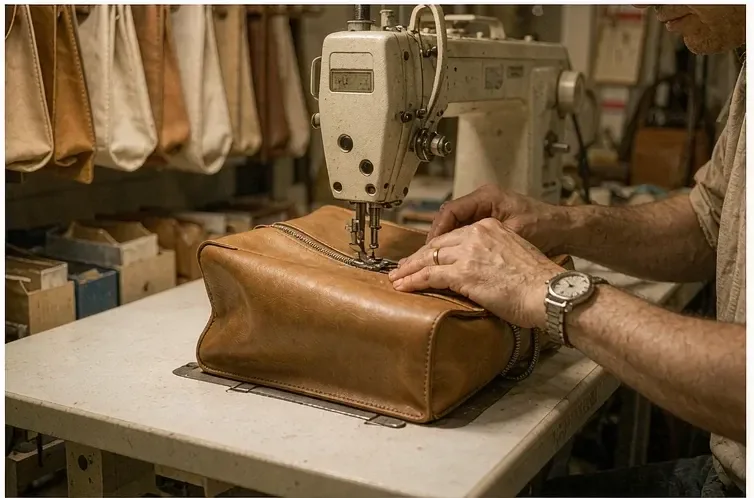
What Thread Actually Is: Tex, Ticket and Construction
Thread is specified by linear density, not by thickness: the Tex number is the weight in grams of 1,000 metres, so a higher Tex is a heavier thread and everything else follows from that.
Three constructions cover almost all fine bag work. A bonded filament is a continuous-filament nylon or polyester with a resin bond that stops it fraying at the needle and resists abrasion; a twisted or spun polyester is softer, duller and chosen where a matte stitch line is wanted; and a waxed linen is chosen on heritage pieces where the stitch should sit proud and darken with handling.
| Size | Approximate diameter | Typical breaking load | Where it appears on a bag | Needle it wants |
|---|---|---|---|---|
| Tex 27 (ticket 40) | About 0.35 mm | Roughly 18-25 N | Fine edge stitching, light linings, top-stitch on soft panels | Nm 80/12 |
| Tex 40 (ticket 30) | About 0.45 mm | Roughly 25-35 N | The default for structured calfskin panels and gussets | Nm 90/14 |
| Tex 69 (ticket 20) | About 0.60 mm | Roughly 45-60 N | Handle joins, strap attachments, load-bearing seams | Nm 110/18 |
| Tex 135 (ticket 15) | About 0.85 mm | Roughly 90-120 N | Heavy travel pieces, webbing straps, decorative saddle stitch | Nm 120/19 to 140/22 |
Ticket numbers run backwards against Tex, which is why two spec sheets can appear to disagree. Always quote Tex in a tech pack and put the ticket number in brackets if the construction team expects it.
Bonded Nylon, Twisted Polyester and Waxed Linen
Each of the three families fails differently, and choosing between them is choosing which failure you would rather not have.
- Bonded nylon 6.6: highest abrasion resistance and the strongest of the three at a given size, with a slight sheen. It absorbs a little water and loses some strength when wet, and it degrades under prolonged ultraviolet exposure.
- Twisted polyester: about 10-15% lower breaking load than the same size in nylon, but it holds its strength when wet and resists ultraviolet far better, which is why it suits pale leathers and pieces sold in sunny markets.
- Waxed linen: the lowest strength of the three and the only one that patinates. It is chosen on heritage silhouettes and hand-sewn details, and it needs a larger needle because the wax builds up in the hole.
The ultraviolet difference is the one that surprises people. A bag displayed near a shop window in a strong sun will show nylon stitch fading and weakening long before the leather does, and the repair is a full re-stitch rather than a patch.
Matching Thread Size to Leather Thickness
Thread size follows the thickness of what it has to pass through, because a thread that is too fine cuts the leather and one that is too coarse cannot sit inside the hole it makes.
- Leather 0.8-1.0 mm, garment and soft panels
- Tex 27 to Tex 40, seam allowance 8 mm
- Leather 1.2-1.4 mm, structured calfskin panels
- Tex 40, seam allowance 8-10 mm, the most common pairing
- Leather 1.6-2.0 mm, bridle and heavier vegetable-tanned
- Tex 69, seam allowance 10 mm, skived at the fold
- Handle join, doubled and reinforced
- Tex 69, stitch line set 3 mm from the edge, two rows on load-bearing joins
- Thread diameter against hole diameter
- Thread should occupy roughly 60-70% of the needle hole, no more
The last line is the one to watch. When thread fills the hole completely, the leather has no room to close around it and the stitch line becomes a perforation that tears under load — the classic failure on a handle that has been over-specified with too heavy a thread.
Needles: Size, Point and the Hole They Leave
The needle decides the hole, and the hole is permanent: leather does not close, so a hole made by the wrong point shows for the life of the bag.
- Nm 80/12: fine work, linings and top-stitch on soft panels up to about 1.0 mm.
- Nm 90/14: the default on structured calfskin at 1.2-1.4 mm with Tex 40.
- Nm 110/18: heavier panels and handle joins with Tex 69.
- Round point (S): pierces between fibres and is used on soft, loosely fibred leather.
- Cutting point (LR or D): cuts a small slit and is used on firm, densely fibred leather so the stitch line stays straight.
- Change interval: a needle is replaced roughly every 8 hours of running, or at the first skipped stitch.
A blunt needle is the single commonest cause of a stitch line that looks acceptable on the outside and is shredded on the inside. A needle that has begun to skip will heat the thread, glaze it, and leave a seam that parts under a pull test.
Stitch Density: 8-9 Per Inch and Why It Is Not a Style Choice
Stitch density is a structural decision dressed as an aesthetic one: eight to nine stitches per inch is the standard on a structured bag, and moving away from it changes how the seam behaves rather than how it looks.
| Application | Stitches per inch | Stitch length | Why that number |
|---|---|---|---|
| Structured panel, top-stitch | 8-9 | About 2.8-3.2 mm | Enough stitches to hold a fold without perforating the leather |
| Soft, slouchy silhouette | 6-7 | About 3.6-4.2 mm | Fewer holes, so the panel stays supple and drapes |
| Handle and strap attachment | 7-8 | About 3.2-3.6 mm | Balances tear resistance against the number of holes in a loaded area |
| Decorative saddle stitch, hand-sewn | 5-6 | About 4.2-5.0 mm | Reads as handwork, and two threads share the load |
| Edge stitch close to a painted edge | 9-10 | About 2.5-2.8 mm | Holds the edge paint line and stops it lifting at a fold |
On a machine-made seam, higher density weakens the material rather than strengthening the join. The limit is set by the leather, not by the machine, and it sits around 10 stitches per inch before the perforations begin to run into one another.
Colour, Fastness and the Lighting Test
Thread is dyed separately from leather and the two almost never match perfectly, so the specification is a tolerance and not a shade: agree a Delta E limit and a sealed thread card rather than a description.
- Shade agreement
- Delta E of 1.0 or less against the sealed thread card, measured under D65
- Rub fastness, ISO 105-X12
- Grade 4-5 dry and grade 4 wet for an exterior stitch line
- Light fastness on pale threads
- Grade 4 or better where the bag will sit in daylight for long periods
- Stitch tear resistance, ISO 23910
- Tested on the actual leather and thread pairing, not on a generic sample
- Reference retained
- One sealed thread card per colourway, held by both sides
Contrast stitching is a deliberate departure and should be specified as one. When a contrasting thread is chosen, the fastness requirement rises rather than falls, because any bleeding or crocking shows immediately against the neighbouring leather.
The Checklist: Fourteen Lines Before a Stitch Is Sewn
These fourteen lines are the practical heart of a stitch specification, and agreeing them before sampling removes most of the arguments that otherwise happen after the first prototypes arrive.
Fourteen lines for the stitch specification
- Tex number stated, with the ticket number in brackets.
- Fibre: bonded nylon 6.6, twisted polyester or waxed linen, named.
- Colour, with a Delta E limit against a sealed card rather than a name.
- Needle size in Nm, and point type: round or cutting.
- Stitch density in stitches per inch, and stitch length in millimetres.
- Seam allowance in millimetres, and whether the edge is skived.
- Distance of the stitch line from the edge, typically 3 mm on a structured panel.
- Number of rows on a load-bearing join: two, where the load warrants it.
- Bobbin or lower thread, specified to the same Tex as the upper.
- Tension setting recorded for the approved sample, not left to the operator.
- Back-tack or lock-stitch at the start and end of every run.
- Rub fastness target to ISO 105-X12, dry and wet.
- Stitch tear resistance to ISO 23910 on the real pairing.
- A sealed approved sample, retained by both sides and compared under D65.
Line eleven is the one most often skipped and the one that produces the most returns. A run that ends without a back-tack unravels from the end, and it unravels slowly enough to pass inspection and quickly enough to reach a customer.
Where Stitching Fails, and the Tests That Find It First
Seams fail in five recognisable ways, and each has a test that finds it on the bench rather than in a customer's hands.
Tear along the stitch line
Caused by too many stitches per inch or too heavy a thread for the leather. Found by a stitch tear test to ISO 23910 on the actual pairing, and fixed by dropping density by one or two per inch.
Seam opens under load
Caused by a thread too fine for the load or a missing second row. Found by a static load test on the handle join, and fixed by moving up one Tex size rather than by adding stitches.
Thread fades or weakens
Caused by ultraviolet exposure on nylon. Found by a light fastness comparison against a retained card, and fixed by specifying polyester for pieces sold in sunny markets.
Stitch line looks uneven
Caused by a blunt needle, wrong point type or drifting tension. Found by a visual check under raking light, and fixed by changing the needle and recording the tension used on the approved sample.
A pull test on the finished seam is the least costly of all these and takes under a minute per sample. It will not tell you why a seam failed, but it will tell you that one did, which is usually enough to stop a bulk run going wrong.
Writing the Stitch Specification Into the Tech Pack
A stitch specification occupies one block of a tech pack and is read by two people: the person who sets up the machine and the person who inspects the result. It should be legible to both without a conversation.
- State the thread first: fibre, Tex, colour code, and the mill reference if one exists.
- State the needle second: Nm size and point type.
- State the geometry third: density, stitch length, seam allowance, distance from edge.
- State the tests fourth: rub fastness grade, stitch tear result, load result.
- Attach the sealed sample reference last, with the lighting condition it was approved under.
Once that block exists, the rest of the programme is unchanged: MOQ 500 pcs per style and colourway, sampling in 6-10 working days and 12-15 for complex constructions, bulk in 35-50 days, and handover on FOB Xiamen terms.
Getting one line of this wrong is not abstract. Re-stitching a single failed panel after finishing costs around USD 4.80 in thread, needle and bench time before any freight is counted, which is more than the entire thread cost of the bag by a wide margin.
Send the panel and get the stitch specification back
Tell us the leather, the thickness and where the seam sits, and we will return the thread, needle, density and test targets in writing before sampling begins. Request a quote.
Frequently Asked Questions
What thread size is used on a luxury handbag?
Tex 40, about 0.45 mm across, is the default on structured calfskin panels at 1.2-1.4 mm. Tex 69 is used on handle joins, strap attachments and heavier vegetable-tanned leather, and Tex 27 appears on fine linings and soft panels. Tex is grams per 1,000 metres, so the number scales with strength.
What is the difference between Tex and ticket numbers?
Tex is the weight in grams of 1,000 metres of thread, while ticket numbers run in the opposite direction, so a larger Tex carries a smaller ticket number. Two spec sheets can therefore appear to disagree while describing the same thread, which is why a tech pack should quote Tex first.
Should I use bonded nylon or polyester thread?
Bonded nylon 6.6 is stronger and more abrasion resistant at a given size, with a slight sheen. Polyester is roughly 10-15% lower in breaking load but holds its strength when wet and resists ultraviolet far better, so it suits pale leathers and bags displayed in strong daylight.
How many stitches per inch should a handbag have?
Eight to nine per inch is standard on a structured bag, which is a stitch length of about 2.8-3.2 mm. Soft silhouettes run 6-7 to stay supple, and hand-sewn saddle stitch runs 5-6. Above about 10 per inch the perforations begin to run together and the seam weakens.
What needle size goes with Tex 40 thread?
A size Nm 90/14 leather needle is the usual pairing on structured calfskin at 1.2-1.4 mm. Tex 69 wants an Nm 110/18, and fine Tex 27 work wants an Nm 80/12. Point type matters as much as size: round for soft leather, cutting for firm, densely fibred leather.
Why does my stitch line tear when I pull it?
Usually because the thread is too heavy for the leather, or the density is too high. Thread should occupy roughly 60-70% of the needle hole; beyond that the leather cannot close around it and the perforations join into a tear line. Dropping one Tex size or two stitches per inch normally fixes it.
How often should sewing needles be changed?
Roughly every eight hours of running time, or immediately at the first skipped stitch. A needle that has begun to skip heats and glazes the thread, producing a seam that looks correct on the outside and is weakened on the inside, which no visual inspection will catch.
How do I specify thread colour against leather?
As a tolerance rather than a name. Agree a Delta E of 1.0 or less against a sealed thread card, measured under D65 lighting, and retain one card per colourway on each side. Thread and leather are dyed separately and will almost never match exactly.
What is stitch tear resistance and how is it tested?
It is the force needed to tear a seam apart along the stitch line, tested to ISO 23910. It must be run on the actual leather and thread pairing rather than a generic sample, because the result depends on both: a thread that passes on one leather can fail on another.
Does thread need to meet chemical restrictions?
Yes. Dyestuffs on thread fall under the same REACH Annex XVII restrictions as the leather, and azo dye restrictions and nickel release limits both apply to components. Ask for a declaration from the thread source alongside the one from the tannery rather than treating thread as exempt.
Is contrast stitching harder to get right?
It raises the fastness requirement rather than lowering it. Any crocking or bleeding shows immediately against a neighbouring leather of a different colour, so contrast thread should be specified at rub fastness grade 4-5 dry and grade 4 wet, and tested before approval.
What is a back-tack and why does it matter?
A short reverse run at the start and end of a stitch line that locks the thread so it cannot unravel. Without it, a run can come undone slowly enough to pass inspection and quickly enough to reach a customer, which makes it one of the most expensive omissions in a specification.
People Also Ask
What thread do luxury handbags use?
Bonded nylon 6.6 in Tex 40 for structured calfskin panels, with twisted polyester where ultraviolet or wet strength matters and waxed linen on heritage hand-sewn details. Tex 69 is used on handle joins and heavier panels.
How many stitches per inch is luxury quality?
Eight to nine per inch on a structured bag, which is about 2.8-3.2 mm per stitch. More is not better: past roughly 10 per inch on a 1.2 mm panel, the needle holes begin to join and the seam becomes a tear line.
Is nylon or polyester thread better for bags?
Nylon is stronger and more abrasion resistant; polyester is about 10-15% weaker but resists ultraviolet and keeps its strength when wet. Choose polyester for pale leathers, sunny markets and anything displayed in a window.
What size needle sews 1.4 mm leather?
An Nm 90/14 leather needle with Tex 40 thread, using a cutting point on firm leather and a round point on soft. Replace it roughly every eight hours of running, or at the first skipped stitch.
How much does it cost to fix a failed seam?
Re-stitching one failed panel after finishing runs around USD 4.80 in thread, needle and bench time before freight, which is far more than the entire thread cost of the bag and the reason the specification is worth an hour.
Sources and further reading
Every figure on this page is either our own programme data or attributed below. Open the originals before you write them into a specification.
- ISO — International Organization for StandardizationISO Publisher of ISO 105-X12 for rub fastness and ISO 23910 for stitch tear resistance on leather.
- SATRASATRA Technology Centre Independent testing body for footwear and leather goods, publisher of widely used seam and stitch test methods.
- ECHA — REACHEuropean Chemicals Agency Administrator of REACH Annex XVII, whose azo dye and nickel restrictions apply to thread and trim as well as leather.
- Leather Working GroupLeather Working Group Tannery audit protocol behind the leather declarations that accompany a stitch specification in a tech pack.
- FashionUnitedFashionUnited Industry data on returns and repair costs across accessories, used to benchmark the cost of a failed seam.