Luxury Handbag Stitch Density Explained: Stitches Per Inch, Spacing, Thread Size and What Each Number Does
Stitch density is the number of stitches in one inch of seam, and on a luxury handbag it is specified rather than chosen. Seven, nine and eleven per inch are the three figures in general use, each tied to a leather substance, a thread size and a pricking iron spacing. This glossary explains the term, the numbers that travel with it, and the four faults that appear when density and substance are specified independently of each other.
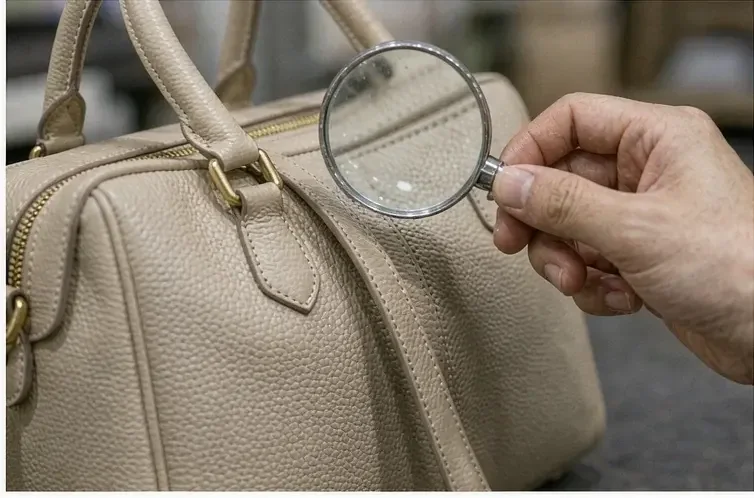
Stitch Density: the Definition
Stitch density is the count of stitches in one inch of finished seam, written as stitches per inch or SPI. It is measured along the seam on the finished bag, not read from a drawing and not estimated from a photograph. A specification that says nine per inch is a measurement to be checked at inspection; a specification that says fine stitching is a preference with nothing behind it.
Density matters because every stitch is a perforation. A seam is a line of holes through a panel, and the leather between those holes is what carries the load. Increasing density removes material from that line; decreasing it leaves the seam loose and the panels free to shift against each other. The right figure sits between the two, and it depends on the substance of the leather rather than on taste.
The Density Scale: Seven, Nine and Eleven
Three figures cover almost every luxury handbag in production. Each is tied to a leather substance and a thread size, and moving a figure between substances is the commonest cause of a seam that fails early.
| Density | Leather substance it suits | Thread | Pricking iron spacing | Where it belongs |
|---|---|---|---|---|
| 7 per inch | 1.8-2.2 mm harness or bridle leather | 0.60-0.80 mm waxed linen or bonded nylon | About 3.6 mm between holes | A heavy rustic construction, a strap on a large bag |
| 9 per inch | 1.2-1.4 mm full-grain calf | 0.45 mm bonded nylon 69 | About 2.8 mm between holes | The default on a structured calfskin handbag |
| 11 per inch | 0.9-1.1 mm fine calf or a lined panel | 0.35-0.40 mm bonded nylon | About 2.3 mm between holes | A strap end, a tab, or fine small-scale detail |
| 13 and above | Not specified on load-bearing seams | Too fine for the hole it must fill | Perforation becomes the weak point | Decorative work only, never a seam under load |
The last row is the boundary rather than a recommendation. Above eleven per inch the line of perforation is weaker than the leather around it, so the seam tears at the holes rather than holding. It looks finer in a photograph and fails sooner in the hand.
Terms That Travel With Density
Density is meaningless without the terms around it. Six of them appear in every stitch specification, and each changes what a figure of nine per inch actually produces on the bag.
Stitches per inch
The count of stitches in one inch of finished seam. The figure is measured on the bag between two marks, and it governs both the appearance of the line and the strength of the panel between the holes.
Pricking iron
A toothed tool that marks hole positions before any needle is used. Its spacing sets the density: nine teeth per inch gives about 2.8 mm between holes, and the iron must match the specified figure.
Awl
The tool that opens each marked hole at the angle the thread will enter. Opened perpendicular to the surface, the stitches pull out of line however accurate the iron spacing was.
Saddle stitch
Two threads crossing inside the same hole from opposite directions. The structure that makes density safe to specify, because a single break does not run along the seam.
Lockstitch
A machine structure interlocking an upper and a lower thread at the surface of each hole. Even and fast, and it can run from one break, which is why density is specified alongside the structure.
Back stitch
The two or three reverse stitches that start and finish a hand-sewn seam. They replace a knot, which would be felt inside a lining on every use.
Thread Size and Hole Size
Thread has to fill the hole it passes through. Too thin and the stitch sits loose in the perforation; too thick and it distorts the panel and crowds the neighbouring hole. Size is therefore specified alongside density rather than independently of it.
- Thread on a 9 spi seam
- 0.45 mm bonded nylon 69, waxed, colour matched under D65 light
- Thread on a 7 spi seam
- 0.60-0.80 mm waxed linen or bonded nylon on a heavy substance
- Thread on an 11 spi seam
- 0.35-0.40 mm bonded nylon on a fine or lined panel
- Hole diameter
- Set by the awl to the thread, so the stitch seats without distorting the panel
- Wax
- Applied to bed the thread into the hole and resist moisture carried in by handling
- Tension
- Held by hand and even along the seam: tight enough to seat, never tight enough to pucker
- Substance at the seam
- 1.2-1.4 mm full-grain, skived to 0.6-0.8 mm where the seam folds
A mismatched pair is easy to spot once you know to look for it. A thread too thin for its hole produces a seam that looks neat and loosens over a season; the same seam with the correct thread holds its tension for years.
Density and Substance: the Relationship
Density and substance are a pair, and specifying one without the other is the most common error in a stitch specification. The rule is simple: the thinner the leather, the wider the spacing must be, because there is less material between the holes.
- At 1.2-1.4 mm full-grain, nine per inch leaves enough leather between holes for the seam to carry its load.
- At a lighter substance, the same density perforates the panel too closely and the seam tears before the leather does.
- Where a design needs a lighter hide, widen the stitch line rather than raising the density: two rows set further apart carry the same load.
- On a heavy harness leather, a finer stitch looks wrong and tears the panel; seven per inch is correct at 1.8-2.2 mm.
- A lined panel can take a higher density than an unlined one, because the lining shares the load across the perforation line.
- Where density is increased for appearance, the thread size must fall with it, or the holes crowd and the panel distorts.
The fourth line is worth stating separately, because it is the trap for houses moving from a heritage silhouette to a lighter one. A nine-per-inch seam is right on one substance and wrong on another, and the drawing rarely says which leather it was written for.
Needle and Awl Numbers That Belong With Each Density
Density, substance and thread decide the needle, and the needle decides whether the specification can actually be sewn. A needle sized for a heavier seam tears a fine panel at every hole; one sized too fine flexes and skips, and a skipped stitch reads at inspection as a tension fault it never was. The table writes the pairing down so the bench is never asked to improvise.
| Density | Substance | Thread | Needle for lockstitch | Awl for saddle stitch |
|---|---|---|---|---|
| 7 per inch | 1.8-2.2 mm | 0.60-0.80 mm | Nm 130-140, cutting point on the heaviest hides | 1.0-1.1 mm blade, opened at the stitch angle |
| 9 per inch | 1.2-1.4 mm | 0.45 mm | Nm 100-110, round point | 0.7-0.8 mm blade, opened at the stitch angle |
| 11 per inch | 0.9-1.1 mm | 0.35-0.40 mm | Nm 80-90, round point, lined panel | 0.6 mm blade, opened at the stitch angle |
The numbers are a set, not a menu. Move the density and the whole row moves with it: the thread falls, the needle falls, and the hole the awl opens narrows. A specification that changes one number and leaves the rest is asking for whichever of the four faults arrives first.
How Density Is Measured and Specified
Four steps take density from a preference to a specification. They cost minutes at sample approval and remove an argument that otherwise returns at every bulk delivery.
- Name the figure on the drawing: nine per inch, not fine stitching or as sample.
- Name the substance it was written for, so a future lighter hide triggers a review rather than a silent change.
- Name the thread: 0.45 mm bonded nylon 69 where the figure is nine and the substance is 1.2-1.4 mm.
- Count it at inspection: mark one inch on the finished bag and count the stitches within it.
Two people can disagree about whether a seam looks fine for a whole afternoon. Neither can disagree about how many stitches fall between two pencil marks an inch apart. Put the marks on the bag and the specification enforces itself.
The fourth step is also the inspection check. Density, straightness, tension and the back-stitch finish are all read on the finished bag inside an AQL 2.5 draw under ISO 2859-1, which on a 500 pc lot at general inspection level II gives a 50-piece sample with three majors allowed.
Four Faults Caused by the Wrong Density
Each of these faults is attributed to the thread or to the artisan and is in fact a density error, usually a density chosen for appearance and applied to a substance it was never written for.
- A seam that tears at the holes: density too high for the substance, so the perforation line is weaker than the leather around it.
- A seam that gapes under load: density too low, leaving the panels free to shift against each other between stitches.
- A puckered seam: the thread is too thick for the hole at that density, so each stitch distorts the panel as it is drawn.
- A loose seam after a season: the thread is too thin for the hole, so it never seated and has slowly worked free.
All four are prevented by the same discipline: density, substance and thread size written on the drawing together, and counted on the bag rather than admired in a photograph.
Broken Thread and Struck Adhesive: Judgement and Rework
Two faults arrive at inspection looking worse than they are, and the judgement in each case depends on the stitch structure. On a saddle stitch, a single broken thread is a minor fault: the crossing threads hold, the seam does not run, and the repair is two back stitches at the bench. On a lockstitch, the same break can travel along the seam, which makes it a major and moves the piece out of the passed count.
Struck adhesive is read the same way. A bead that has squeezed onto the face of the seam is a finish fault, cleaned and re-read. Adhesive that has migrated into the stitch line and glued the holes closed is a construction fault, because the thread can no longer seat and the seam will loosen even though it still measures nine per inch. The first stays in the lot; the second goes back to the bench.
The rework flow has four steps and they always run in the same order. Quarantine the failed pieces so they cannot be packed out with the passed count. Re-draw the sample under the same AQL 2.5 plan rather than inspecting every piece by eye. Re-stitch or re-clean at the bench with the specified thread, never a close match from another drawer. Then re-inspect the reworked pieces before they rejoin the lot. Skipping the second step is how a fault found on three pieces becomes a fault found on three hundred after delivery.
Commercial Frame: Sampling, MOQ and Bulk
MOQ 500 pcs per style and per colourway. Sampling for a new style runs 6-10 working days, extending to 12-15 where a frame, a moulded handle or a new tool is involved. Bulk production at 35-50 days. FOB Xiamen as the standard term, with alternatives available where a programme needs them.
The programme runs across 7 production lines with about 200,000 pcs per month of capacity and has held export experience since 2014, carried out through our validated partner factory Quanzhou Yingming Bags, an SGS-validated site. Finish sample cards showing up to three thread and plating options on the intended leather are billed at USD 4.80 and credited against the first bulk order.
Stitch density in six numbers
- 7 per inch: heavy harness and bridle leather at 1.8-2.2 mm substance.
- 9 per inch: the default on structured calfskin at 1.2-1.4 mm.
- 11 per inch: fine work and strap ends on a 0.9-1.1 mm panel.
- 2.8 mm: the hole spacing a nine-per-inch pricking iron produces.
- 0.45 mm: the bonded nylon 69 thread that fills a nine-per-inch hole.
- 1.5-2.0 mm: the setback of a stitch line from a finished edge.
Set the stitch specification for your leather
Send your drawings, the substance you are cutting at and the seams you consider load-bearing. You will receive a seam-by-seam density note with the matching thread and iron spacing, within two working days. Request a quote.
Frequently Asked Questions
What is stitch density on a handbag?
The count of stitches in one inch of finished seam, measured between two marks on the bag rather than read from a drawing. It governs both how the line looks and how much leather is left between the perforations to carry the load.
How many stitches per inch does a luxury handbag have?
Nine per inch is the figure most houses write for a structured calfskin bag at 1.2-1.4 mm substance. Seven suits heavy harness leather at 1.8-2.2 mm, and eleven is reserved for fine work and strap ends.
What spacing does nine stitches per inch give?
About 2.8 mm between holes. The spacing is set by the pricking iron, which must match the specified figure; an iron of a different spacing produces a different density however carefully the seam is sewn.
What thread size goes with nine stitches per inch?
0.45 mm bonded nylon 69, waxed and colour matched under D65 light. The thread has to fill the hole: too thin and the stitch never seats, too thick and it distorts the panel as it is drawn.
Can you use a higher stitch density for a finer look?
Only up to eleven per inch, and only on a fine or lined panel. Beyond that the perforation line becomes weaker than the leather around it, so the seam tears at the holes rather than holding its load.
Why does density depend on leather substance?
Because every stitch is a perforation. A thinner hide has less material between the holes, so the same density removes a larger proportion of the load path. The rule is that a thinner hide needs wider spacing, not finer stitching.
What is a pricking iron?
A toothed tool that marks hole positions before any needle is threaded. Its spacing sets the density of the seam, so the iron is specified alongside the figure rather than chosen at the bench.
Why is an awl used after the pricking iron?
To open each marked hole at the angle the thread will enter. A hole opened perpendicular to the surface pulls the stitches out of line, which is why a seam can be evenly spaced and still look crooked.
How is stitch density checked at inspection?
By marking one inch on the finished bag and counting the stitches within it, inside an AQL 2.5 draw under ISO 2859-1. On a 500 pc lot at level II that is a 50-piece sample with three majors allowed.
What causes a seam to pucker?
Usually a thread too thick for the hole at that density, so each stitch distorts the panel as it is drawn. It can also come from tension held too high, which is why tension is specified as even rather than tight.
Should a lighter leather use finer stitching?
No. It should use wider spacing. Where a design needs a lighter hide and a finer line, the answer is two rows set further apart rather than a higher density on the same seam.
What is the minimum order for a hand-stitched programme?
MOQ 500 pcs per style and per colourway, with bulk at 35-50 days on FOB Xiamen terms. Finish sample cards are billed at USD 4.80 and credited against the first bulk order.
People Also Ask
What does stitches per inch mean on a bag?
The number of stitches counted in one inch of finished seam. It is measured on the bag between two marks, and it sets both the fineness of the line and how much leather remains between the perforations to carry load.
Is a higher stitch count better quality?
Not beyond eleven per inch. Past that the perforation line is weaker than the leather around it and the seam tears at the holes. Nine per inch on structured calfskin is the balance most houses specify.
What thread thickness suits a handbag seam?
0.45 mm bonded nylon 69 for a nine-per-inch seam on 1.2-1.4 mm calf. Heavier leathers take 0.60-0.80 mm and fine work takes 0.35-0.40 mm, always matched to the hole the awl produces.
Why does my bag seam look crooked?
Usually the awl angle rather than the spacing. Holes opened perpendicular to the surface pull the stitches out of line even when the pricking iron was perfectly even.
How do you measure stitches per inch?
Mark one inch along the finished seam and count the stitches between the marks. It is the check written into an inspection sheet, because a figure quoted from a drawing is a claim rather than a measurement.
Sources and further reading
Every figure on this page is either our own programme data or attributed below. Open the originals before you write them into a specification.
- ISO — International Organization for StandardizationISO Publisher of ISO 2859-1 sampling procedures used for the AQL 2.5 draw in which stitch density is counted.
- Leather Working GroupLeather Working Group Tannery audit protocol behind the hides whose substance governs stitch density, with the reference filed per lot.
- European Chemicals AgencyECHA Administrator of REACH, including the restrictions answered by a chemical report per lot for leather, thread and waxes.
- California Office of Environmental Health Hazard AssessmentOEHHA The authority behind California Proposition 65, which governs warning requirements for listed substances in threads and finishes.
- CPSCU.S. Consumer Product Safety Commission Administrator of CPSIA limits on lead in substrates and coatings, relevant to hardware set beside stitched seams.