Luxury Handbag Retail Display Best Practices: The Decision Order From Door to Shelf
What are the best practices for displaying luxury handbags in a boutique? Work through eight decisions in a fixed order: sight line at 900-1,100 mm, no more than three bags per facing, 250-300 mm between centres, lighting at 3,000-3,500 K with CRI 90 or better and 300-500 lux on the bag face, and a 14-day rotation. Display is a selling tool before it is decoration, and each decision above changes sell-through more than any campaign a house runs.
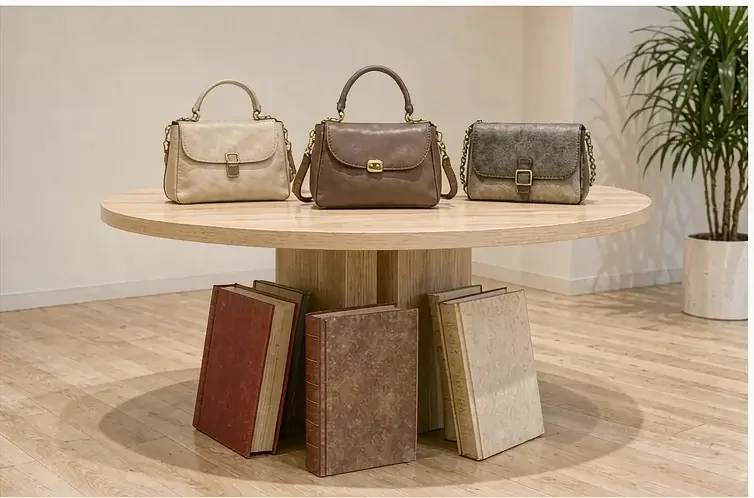
The Decision Order: Seven Choices Before a Bag Is Placed
Most display work fails because it starts with the object rather than with the room. A house decides which bag it wants heroed, builds a plinth around it, and discovers in week three that the plinth sits below the sight line and the hero cannot be seen from the door. The order below runs from the room inward: read the approach, set the height, set the count, choose the furniture, set the light, group, and only then decide how the client touches the bag.
The order matters because later decisions are constrained by earlier ones. Height determines whether a vitrine can be used at all. Count determines how much light is needed. Furniture determines whether the bag is seen at eye level or looked down upon, and looking down on a bag flattens a silhouette that was designed to be read from the side. Work backwards from what the client can see when she is standing.
A useful test: stand at the door, at 1,600 mm from the threshold, and photograph the wall at eye height. If the hero silhouette is not identifiable in that photograph, no amount of styling on the shelf will fix the problem, because the client has already walked past the decision point.
Decision 1: What Sells From the Door — the 3-Metre Read
A client decides whether to approach a wall within about three seconds of entering, and in that time she reads silhouette, not detail. The bag that earns the approach is the one whose outline is unmistakable at 3 metres: a structured top-handle with a clear trapeezoid, or a hobo with a distinctive slouch. Detail — the turn-lock, the edge paint, the stitch line — is read at 400 mm and closes the sale, but it does not create the approach.
So the first decision is which silhouette gets the 3-metre position, and it should be the one with the most distinctive outline rather than the most expensive one. A house that leads with its most expensive style often leads with its quietest shape, and quiet shapes disappear at distance. Put the distinctive outline at the door and the expensive quiet one at the counter, where it can be handled.
- Sight line band
- 900-1,100 mm from finished floor level for the primary facing
- Maximum top shelf
- 1,350 mm — above this a bag is looked up at and reads smaller
- Door read distance
- 1,600 mm from threshold to the first decision point
- Detail read distance
- 400 mm — where hardware and edge finish are judged
- Approach corridor
- 1,100-1,200 mm clear in front of the display
- Facing width
- 600-900 mm per hero, whichever the wall allows
Decision 2: How Many Bags Belong on One Facing
Three is the working maximum for a premium facing, and two is better. Display density is the most reliable signal of positioning in a shop: a wall of fourteen bags reads as assortment, a wall of three reads as selection, and a client shopping at this level is buying selection. Every bag added past three reduces the time spent on each one and lowers the odds that any of them is picked up.
Spacing does the rest of the work. Hold 250-300 mm between bag centres on a shelf and 350-400 mm of plinth depth so a structured bag can sit without its handle overhanging. A bag whose handle overhangs the plinth edge is a bag that gets knocked, and knocked bags are the single largest source of display stock that can no longer be sold as new.
Reserve stock changes the count. If the door sells three of a style a month, hold two in reserve behind the counter rather than filling the shelf. A facing that looks stocked rather than curated loses the positioning argument even when the product is identical.
Decision 3: Plinth, Shelf or Vitrine
The three furniture types solve three different problems and are often used in the wrong order. A plinth isolates one object and creates importance; a shelf allows comparison across a line; a vitrine protects and, wrongly used, distances. Choose by what the client needs to do at that point in the room: recognise, compare, or be reassured about value.
| Furniture | Best for | Key dimension | Common mistake |
|---|---|---|---|
| Plinth | One hero silhouette at the door | 350-400 mm deep, top at 900-1,100 mm | Too shallow, so the handle overhangs and gets knocked |
| Open shelf | Comparing three colourways of one style | 250-300 mm between centres, 300 mm deep | Four or more bags, which reads as assortment |
| Wall niche | A full collection on one wall | 600-900 mm per bay, 1,350 mm max height | Uniform heights, which flatten the wall |
| Locked vitrine | Exotic or high-value pieces | 8 mm laminated glass, two units per case | Putting everyday stock behind glass, which kills handling |
| Counter tray | The piece the client will actually touch | 400 mm from the client edge | Too far back, so she has to ask before touching |
Vitrines deserve one caution. Glass sells protection and it also sells untouchability, and a bag that cannot be touched sells slowly at any price. Use the case for pieces where provenance or value genuinely requires it — a crocodile-panel style with CITES documentation, or a single runway piece — and keep everything else reachable.
Decision 4: Light — Temperature, CRI and Lux on the Face
Light is the decision that most often separates a professional display from an amateur one, and it is the least costly to fix. Three numbers govern it: colour temperature at 3,000-3,500 K so leather reads warm rather than grey, colour rendering index at 90 or above so a burgundy does not read brown, and illuminance of 300-500 lux measured on the bag face rather than on the floor.
Aim matters as much as level. A 20-30° beam from above and slightly in front of the bag gives the edge paint a highlight and the hardware a specular point without throwing the client's own shadow across the piece. Vertical grazing light, common in shopfitting, exaggerates every grain irregularity in a full-grain hide and makes good leather look corrected.
- Colour temperature
- 3,000-3,500 K warm white
- Colour rendering index
- 90 or above; below 80 distorts reds and browns
- Illuminance on the bag face
- 300-500 lux, measured at the object, not at floor level
- Beam angle
- 20-30° from above and slightly in front
- Ambient contrast
- Display no more than 3x the ambient level
- UV exposure
- Filter ultraviolet; 45-55% relative humidity and 18-22 °C in the room
Decision 5: Grouping — Silhouette, Colour or Material
Group by silhouette for a house with one strong shape and several colourways, by material for a house whose story is leather, and by colour only when the collection is broad enough to make a colour wall read as intent. Silhouette grouping is the default for a debut house because it teaches the client one shape at a time, and a client who understands one shape buys it.
By silhouette
Best default. One shape, two or three colourways, read left to right. The client learns the shape and then chooses a colour, which is a shorter decision than the reverse.
By material
Use when leather is the story: calfskin, lambskin and an exotic panel on one shelf, with a material card naming each. Provenance questions get answered before they are asked.
By colour
Works only with breadth. A colour wall of six shades reads as intent; a colour wall of three reads as leftover stock from a drop that did not sell.
By occasion
Rarely right on a wall, always right at the counter. Group day, evening and travel pieces where a client is already standing and asking for help.
Decision 6: How the Client Handles the Bag
Handling closes more sales than any visual decision, and it is governed by one rule: the client should be able to touch the bag without asking permission. Permission creates a barrier at exactly the moment desire is forming, and a client who has to ask will often decline rather than risk refusal. Keep one unit at the counter front, 400 mm from the client edge, unpacked and ready.
The second rule is that the handled unit is not the sold unit. Hold the display piece, sell from reserve, and rotate the handled piece out after 14 days of traffic. Leather picks up hand oils and a bag that has been handled two hundred times will not read as new under showroom lighting, however carefully it was treated.
Staff handling matters too. Stock is moved in cotton handling gloves and placed with two hands under the base, never lifted by the handle or the strap. A handle lifted repeatedly off a shelf will elongate at the root, and the first person to notice is the client who picks it up.
Decision 7: Rotation Cadence and What Moves
Fourteen days is the working rotation for a facing in a door with steady traffic, seven days for a window facing direct daylight. Rotation is not decoration; it prevents the two forms of damage that quietly destroy display stock — ultraviolet fading on one side and compression of the base panel from standing in one position for a month.
- Rotate the facing every 14 days, every 7 days in direct daylight.
- Rest a rotated bag for 48 hours on its side before returning it to a shelf, so the base recovers.
- Refill the interior with acid-free tissue after every handling week; a hollow bag loses its shape on the shelf.
- Dust weekly with a dry, soft brush along the grain, never across it.
- Log every bag that leaves the shelf for a client appointment; display stock is stock and belongs in the count.
- Replace the price card and the material card together, so the two never disagree.
The Numbers Behind a Facing That Converts
A display is measurable. Four figures are enough to judge one: pick-up rate, meaning the share of visitors who touch a bag; dwell time at the facing, which should run 40-90 seconds for a considered purchase; conversion from touch to sale, working at 20-30% in a specialist door; and units sold per facing per month, which tells you whether the position was worth the rent. A facing that draws dwell but no touch has a barrier — usually glass, height or a missing price card.
| Metric | Working band | What a low figure means |
|---|---|---|
| Pick-up rate | 25-40% of visitors to the facing | A barrier: glass, height above 1,350 mm, or no handled unit |
| Dwell at the facing | 40-90 seconds | The silhouette is not readable at 3 metres |
| Touch-to-sale conversion | 20-30% in a specialist door | Price objection, or the client could not find a mirror |
| Units per facing per month | 3-6 for a premium line | Wrong silhouette in the 3-metre position |
| Display stock written down | Under 2% of units per season | Rotation too slow or spacing too tight |
What a Stockist Will Ask a House to Supply
Display is a shared cost and the split is negotiated, not assumed. Specialist doors expect the house to supply the riser, the material card, the care card and often the handled unit, and they expect to supply the furniture, the light and the labour. A house that arrives with a riser set and a counter card arrives as a partner; a house that arrives with a carton arrives as a delivery.
Cost the display kit the way you would cost a component: a house-supplied riser, edge-protected card set and handled-unit allowance references at USD 4.80 per unit across a season order, and it is the least costly line on the sheet relative to its effect on sell-through. Confirm who replaces the handled unit and how often, because that single clause decides whether the arrangement survives the third month.
- House supplies
- Riser or stand, material card, care card, price card, handled unit
- Door supplies
- Furniture, lighting at CRI 90 or above, labour, security
- Handled unit
- One per style at the counter, 400 mm from the client edge, replaced on rotation
- Signage
- Material card and price card; type no smaller than 12 pt at 140-160 mm reading distance
- Security
- RFID tag on every unit; two units maximum per locked case
- Documentation
- Care card and, for exotic panels, the CITES reference the door must be able to show
Where Displays Fail Quietly
The failures that cost a season are rarely visible ones. A bag placed above 1,350 mm is not obviously wrong; it simply sells nothing and the door concludes the style is weak. A facing lit at 4,000 K makes calfskin read grey and the door concludes the colourway is unpopular. Both conclusions are wrong and both end with the style not reordered, which is a far larger loss than the display itself.
Putting the most expensive style in the 3-metre position. Expensive styles are usually the quietest shapes, and quiet shapes do not read at distance. Put the most distinctive outline at the door and the most expensive quiet piece at the counter, where it can be handled.
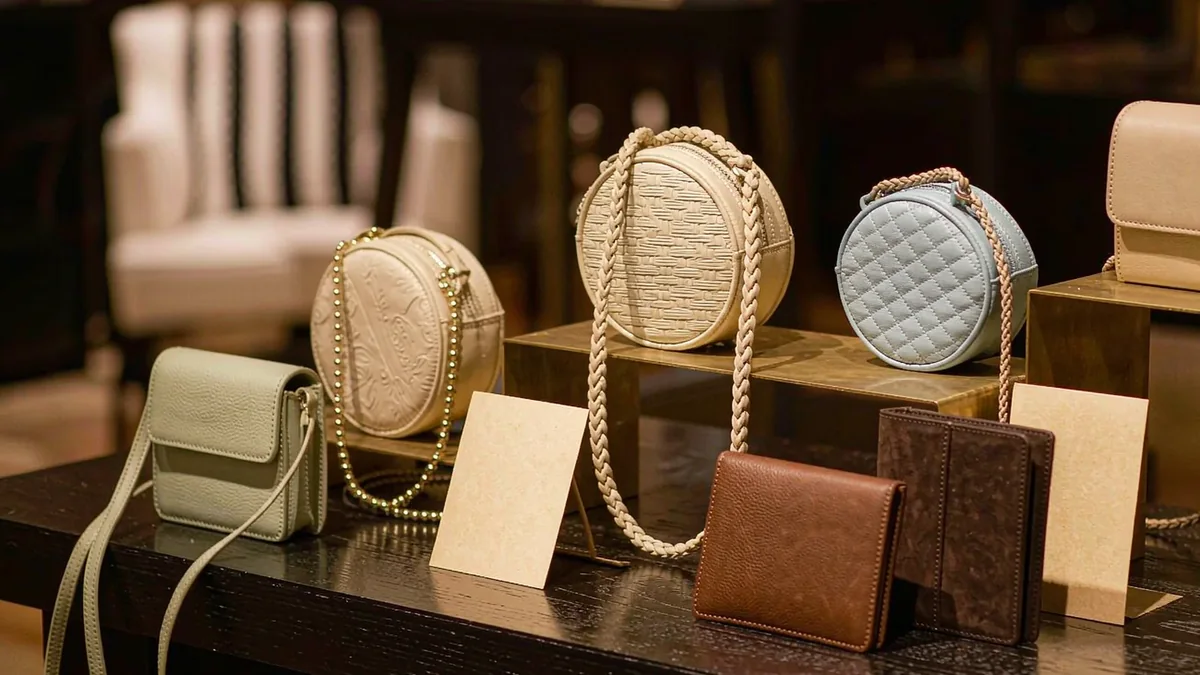
The remedy is a written display specification issued with the stock, one page and eight lines, covering height band, count, spacing, lighting, rotation, handling, signage and the handled unit. Doors that receive it use it; doors that do not will improvise, and improvisation at this price level is what produces a wall of fourteen bags.
Rolling a Display Into a New Door in Ten Days
Ten working days is realistic for a single wall: two to measure and photograph the approach, one to agree the facing, three to make or ship the riser and card set, two to install and light, one to train staff on handling, and one to review the first weekend's pick-up rate. Compressing it usually means skipping the measurement step, and every problem that appears in month two traces back to a dimension nobody checked.
Build the display kit behind your next door
Send the silhouette, colourway count and the door you are opening. Our team returns a specification for risers, cards and handled units, a sampling plan at 6-10 working days and bulk at 35-50 days for 500 pcs per style and colourway, FOB Xiamen, inspection at AQL 2.5 under ISO 2859-1. Our validated partner factory Quanzhou Yingming Bags runs 7 production lines at about 200,000 pcs per month with export experience since 2014. Start with the quotation desk.
Frequently Asked Questions
What is the best height to display luxury handbags in a boutique?
Hold the primary facing between 900 and 1,100 mm from the finished floor, which puts it in the natural sight line for most clients. Never place a bag above 1,350 mm: at that height it is looked up at, reads smaller than it is, and sells poorly for reasons nobody attributes to the shelf.
How many handbags should be on one shelf or facing?
Three at most, and two is usually better. Density is the clearest positioning signal in a shop: three bags reads as selection, fourteen reads as assortment. Past three, time spent per bag falls and the odds of any single piece being picked up drop sharply.
What lighting specification suits a luxury handbag display?
Warm white at 3,000-3,500 K, a colour rendering index of 90 or above, and 300-500 lux measured on the bag face rather than on the floor. Use a 20-30° beam from above and slightly in front. Below CRI 80, burgundy and tan leathers read brown.
How much space should there be between bags on a shelf?
Allow 250-300 mm between bag centres, and a plinth 350-400 mm deep so a structured bag sits fully supported. A handle overhanging the plinth edge gets knocked by passing traffic, and knocked display stock is the largest source of units that cannot be sold as new.
Should luxury handbags be displayed behind glass?
Only where value or provenance genuinely requires it, such as an exotic-panel style that must show CITES documentation. Glass sells protection and untouchability, and a bag that cannot be touched sells slowly at any price. Keep everyday stock reachable and put one unit at the counter.
How often should a boutique rotate its handbag display?
Every 14 days for a facing in steady traffic, and every 7 days for a window receiving direct daylight. Rotation prevents ultraviolet fading on one side and compression of the base panel from standing in one position. Rest each rotated bag 48 hours on its side before it returns.
Should a client be allowed to touch a displayed bag?
Yes, and without asking permission. Requiring permission puts a barrier in front of the client at the moment desire is forming, and many will decline rather than risk refusal. Keep one unit 400 mm from the client edge, unpacked, and sell from reserve rather than from the handled piece.
What is a good pick-up rate for a luxury handbag display?
Between 25% and 40% of visitors to the facing in a specialist door. If dwell is healthy but pick-up is low, look for a physical barrier: glass, a shelf above 1,350 mm, or no handled unit at the counter. Those three account for most of the gap.
How should a house group a small collection on one wall?
Group by silhouette. One shape in two or three colourways, read left to right, teaches the client the shape first and lets her choose a colour second, which is a shorter decision than the reverse. Group by colour only when six or more shades are available.
What display items should the house supply and what should the door supply?
The house supplies the riser, the material card, the care card, the price card and the handled unit. The door supplies furniture, lighting at CRI 90 or above, labour and security. Confirm in writing who replaces the handled unit and how often, since that clause decides whether the arrangement survives month three.
How do you stop display stock from deteriorating on the shelf?
Rotate every 14 days, refill interiors with acid-free tissue each week so a bag does not hollow out, dust along the grain with a dry soft brush, and lift stock with two hands under the base rather than by the handle. Handle movement in cotton gloves.
What should a written display specification contain?
Eight lines on one page: height band, count per facing, spacing, lighting numbers, rotation cadence, handling method, signage type size and the handled-unit rule. Doors that receive a specification use it. Doors that do not will improvise, and improvisation produces a wall of fourteen bags.
How long does it take to install a new handbag display?
Ten working days for a single wall: two to measure and photograph the approach, one to agree the facing, three for the riser and cards, two to install and light, one for staff handling training and one to review the first weekend's pick-up rate. Skipping the measurement step saves two days and costs the season.
What temperature and humidity suit a room holding fine leather bags?
Hold the room at 18-22 °C with 45-55% relative humidity and filter ultraviolet from both daylight and display lighting. Dry air draws moisture out of a full-grain hide and the edge finish cracks first; damp air risks mould on suede and on unfinished linings. Log both readings weekly.
People Also Ask
What is the single most important display rule for luxury bags?
Put the most distinctive silhouette, not the most expensive one, in the 3-metre position. Expensive styles tend to be quiet shapes, and quiet shapes disappear at distance, so the door concludes the line is weak.
Why does a well-lit bag still look flat on the shelf?
Usually grazing light from the side, which exaggerates grain irregularity and makes good full-grain leather look corrected. Move to a 20-30° beam from above and slightly in front and check the result at CRI 90 or above.
Should a boutique display the bag it sells or a separate unit?
Display one and sell from reserve. A bag handled two hundred times picks up hand oils and will not read as new under showroom lighting, however carefully it was treated.
How do you measure whether a display is working?
Count four things: pick-up rate at 25-40%, dwell of 40-90 seconds, touch-to-sale conversion at 20-30%, and units per facing per month at 3-6 for a premium line. Low pick-up with healthy dwell means a barrier.
What type size should a luxury price card use?
No smaller than 12 pt at a reading distance of 140-160 mm. Replace the price card and the material card together so the two never disagree on leather name or price.
Sources and further reading
Every figure on this page is either our own programme data or attributed below. Open the originals before you write them into a specification.
- ISO — International StandardsInternational Organization for Standardization Publisher of ISO 2859-1, referenced when display stock is inspected before it is released to a door.
- CITES — Convention on International Trade in Endangered SpeciesCITES Appendix listings govern the documentation a boutique must be able to show for exotic leather panels on display.
- Business of FashionBusiness of Fashion Trade reporting used to benchmark boutique sell-through, store experience and specialist door economics.
- WWDWWD Accessories trade coverage used for context on boutique merchandising and display practice.
- Sourcing JournalSourcing Journal Reporting on order patterns, drop cadence and door-level replenishment across premium accessories.