Luxury Handbag OEM Lead Times From Xiamen: A Stage-by-Stage Checklist From Pack to Port
How long does a luxury handbag programme take from Xiamen? Counting from a complete pack: 2-3 days for review, 6-10 working days for sampling, 6-10 working days for leather lot reservation, 35-50 days in production 35-50 days for inspection and release, then 16-22 days ocean transit to Los Angeles or 26-32 days to Rotterdam. The stages that slip are almost never bulk; they are sampling and lot reservation, both of which the brand controls.

The Lead Time Checklist, Stage by Stage
A handbag calendar is six stages long, and only one of them is production. Treating the calendar as a single 35-50 day block is the reason first capsules arrive late, because the four stages before bulk are the ones that move, and three of the four are driven by the brand rather than by the bench.
- Pack review and costing, 2-3 days, gated on complete drawings and a named destination list.
- Sampling, 6-10 working days, or 12-15 for framed and hand-set constructions.
- Leather lot reservation, 6-10 working days, gated on tannery stock and lot grading.
- Bulk production, 35-50 days, gated on construction complexity and line position.
- Inspection and release, 2-4 days, gated on the report format agreed in advance.
- Consolidation, port handling and ocean transit, 16-32 days depending on destination.
Read as a checklist rather than as a narrative, the calendar becomes manageable: each stage has one gate, and each gate has one owner. Our luxury sampling process page shows what sits inside stage two in the order it happens.
Stage 1 — Pack Review: What Must Be Complete Before Day One
Review takes 2-3 days when the pack is complete and much longer when it is not, because an undefined dimension becomes a research item and research items are billed in days. The checklist below is what a complete pack contains.
- Dimensioned drawings, not mood imagery, since undefined geometry adds billed research days.
- Leather type, thickness and grade, with 1.2-1.4 mm full-grain calfskin as the structured default.
- Hardware direction fixed, including plating thickness in microns and the base alloy.
- Lining and interlining specification, with weight stated in grams per square metre.
- Destination markets named in full, since each adds a report requirement per lot.
- Quantity per style and per colourway, against a minimum of 500 pcs per style and colourway.
The last two lines are the ones most often missing, and they are the two that cost the most days later. A market added after costing means a fresh report against a fresh lot; a colourway added after reservation means a second lot and a second plating run.
Stage 2 — Sampling: The Window That Decides Everything Else
Sampling is 6-10 working days for a standard build and 12-15 working days for framed or hand-set work, with two correction rounds inside the window. It is the stage that decides whether the rest of the calendar is spent once or twice, because every unresolved specification re-opens it.
- Standard build sampling
- 6-10 working days, two correction rounds included
- Framed or hand-set build
- 12-15 working days, frame drawing approved in advance
- Pre-production sample
- Signed 7 days before bulk starts, against the approved specification
- Pilot run
- 20-30 pcs run first, checked before the full quantity is cut
- First-off approval
- Dimensions, skive and edge build signed within 48 hours
The pilot run is the least costly insurance in the whole calendar. Twenty to thirty units run on the production line, checked against the approved sample before the remaining quantity is cut, will expose a nesting error or a hardware misalignment while there is still time to correct it inside the window.
Stage 3 — Lot Reservation: The Stage Nobody Plans For
Reservation takes 6-10 working days and is the stage most first capsules forget to schedule, because it happens off the bench at a tannery rather than inside the workshop. It is also the stage where choosing a running colour pays, since a shade the tannery already produces shortens grading considerably.
- Hides are graded and sold by lot, so reservation is what makes shade control possible.
- Usable area is logged at 45-52 sq ft per hide after defect marking, against the lot number.
- A structured run of 500 pcs consumes roughly 38-45 hides at 62-70% cutting yield.
- Exotic skins additionally require CITES Appendix II or III documentation to travel with the lot.
- Booking the bulk slot before reservation closes is what starts the 35-50 day count earlier.
A hardware set arriving late is the other common cause of a slipped bulk start. At roughly USD 4.80 per unit for a mid-tier brass set, the component is modest in cost and disproportionate in consequence, which is why plating runs should be booked in the same week the lot is reserved.
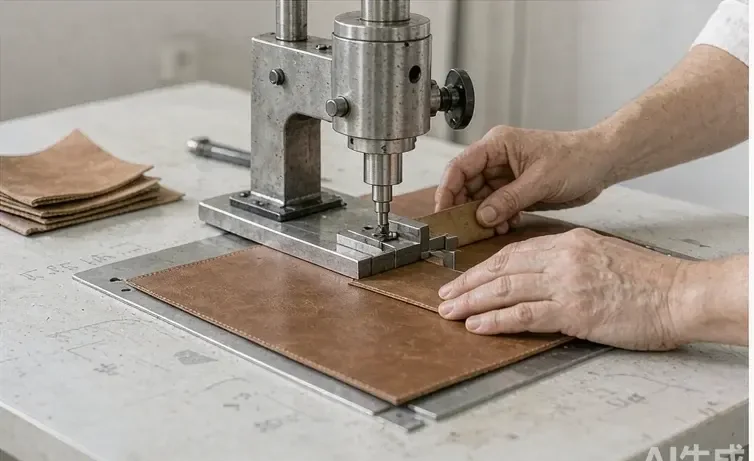
Stage 4 — What Actually Happens Inside 35-50 Days
Bulk is 35-50 days, and the range is explained by construction rather than by quantity. A framed or hand-set body needs the top of the range; a soft body with a proven hardware family sits nearer the bottom. The week-by-week view below is the honest shape of it.
| Week | What happens | Checkpoint | Owner |
|---|---|---|---|
| Week 1 | Cutting, skiving and panel matching against the lot | Panel shade within ΔE 1.5 under D65 | Cutting bench |
| Week 2 | Pilot run of 20-30 pcs, checked against the approved sample | Signed pilot report | Line supervisor |
| Week 3 | Assembly begins, hardware set and reinforcement placed | Stitch density 8-9 per inch verified | Assembly bench |
| Week 4 | Edge work, three coats abraded between, 0.8-1.0 mm build | Edge gauge check at first-off | Finishing bench |
| Week 5 | Lining, bonding at 85-95 °C, final closure setting | Bonding parameter recorded | Finishing bench |
| Week 6 | Cleaning, conditioning, packing 12 pcs per six-ply carton | Packing list and carton marks | Packing team |
| Week 7 | Finished-goods inspection and report issue | AQL 2.5 under ISO 2859-1 | Inspection team |
Weeks two and four carry the checkpoints that matter most. The pilot run catches a systematic error before it is repeated five hundred times, and the edge gauge check at first-off is what keeps a three-coat build consistent across a run rather than correct only on the sample.
Stage 5 — Inspection and Release
Inspection and release take 2-4 days, and the length is governed almost entirely by whether the report format was agreed before bulk started. Agreeing it in advance turns release into a formality; discovering it at release turns it into correspondence.
- Finished goods are inspected at AQL 2.5 under ISO 2859-1, with third-party inspection available.
- At a lot of 281-500 pcs, general inspection level II gives code letter H, a sample of 50, accept 3 and reject 4.
- Conditioning at 20 °C and 65% relative humidity for 24 hours precedes measurement.
- A signed first-off card covers dimensions, skive allowance and edge build.
- Dated audit documents are issued with the report rather than on separate request.
The second line is worth knowing before a release meeting. An acceptance number is not an opinion: at 281-500 pcs under general level II, fifty units are drawn and three faults are tolerated. Knowing that figure in advance removes the argument about whether a run is acceptable.
Stage 6 — Consolidation and Transit From Xiamen
On FOB Xiamen terms, the unit covers the bag, its packing and the compliance work, and everything from consolidation onward sits outside it. Transit is the longest single line in the calendar and the one a brand can plan around most easily once the port pair is known.
- Xiamen to Los Angeles
- 16-22 days ocean transit, plus 2 days documentation
- Xiamen to Rotterdam
- 26-32 days ocean transit, plus 2 days documentation
- Booking cut-off
- 5 working days before the intended vessel
- Packing standard
- 12 pcs per six-ply export carton, carton marks agreed in advance
- Trade term
- FOB Xiamen, with CIF and DDP priced from the same unit
Booking cut-off is the detail that quietly costs a week. Five working days before the intended vessel means a release slip of two days can become a sailing miss of seven, which is why the inspection report date and the booking date should be planned as one line rather than two.
Five Things That Add Days Without Warning
Most slipped calendars trace back to one of five causes, and all five are visible in the email trail weeks before they cost anything. Naming them at the planning stage is what keeps a season intact.
Hardware swapped after first sample
Re-opens the pattern and the plating run, adding 10-15 working days that no amount of pressure on bulk will recover.
Market added after costing
Means a fresh report set against a fresh lot, adding 6-10 working days at the point in the calendar where there is least room.
Colourway added after reservation
Commits a second lot, a second plating run and a line changeover, each with its own lead time.
Booking cut-off missed
A two-day release slip becomes a seven-day sailing miss once the five-working-day cut-off passes.
Seasonal shutdown
A Lunar New Year closure can add 15-20 days, so a bulk slot should be reserved before the calendar closes.
Get a dated calendar for your capsule
Send your pack, quantity per colourway and destination port. You will receive a week-by-week calendar with named gates and a reserved bulk slot within two working days. Request a quote.
A Calendar Checklist You Can Print
Print this and keep it against the order. Each line is a gate with an owner, and a calendar with named gates is the only reliable defence against a season that slips one quiet week at a time.
Twelve gates from pack to port
- Drawings dimensioned and hardware direction fixed before day one.
- Destination markets named in full before costing begins.
- Sampling window agreed at 6-10 working days, or 12-15 for complex builds.
- Leather lot reserved with usable area logged at 45-52 sq ft per hide.
- Hardware plating run booked in the same week as the lot.
- Bulk slot reserved before the sampling window closes.
- Pre-production sample signed 7 days before bulk starts.
- Pilot run of 20-30 pcs checked before full cutting.
- First-off card signed within 48 hours of the pilot.
- Inspection report format agreed before bulk, at AQL 2.5 under ISO 2859-1.
- Vessel booked 5 working days before cut-off, carton marks agreed.
- Dated audit documents issued with the report, not on separate request.
Our fixed figures sit behind every line: MOQ 500 pcs per style and colourway, sampling in 6-10 working days or 12-15 for framed and hand-set work, bulk in 35-50 days, inspection at AQL 2.5 under ISO 2859-1, seven production lines at about 200,000 pcs per month, export experience recorded since 2014, and FOB Xiamen with CIF and DDP available.
How to Compress the Calendar Honestly
There are only three honest ways to shorten a handbag calendar, and none of them involves pressuring the bulk stage. They are: send a complete pack, choose a running tannery colour, and reserve the bulk slot before sampling closes. Together those three typically remove two weeks without touching a single specification.
Everything else that looks like compression is a transfer: a stage skipped becomes a defect found later, and a report deferred becomes a release held. Our luxury quality control standards page shows what the inspection stage contains, so a buyer can judge which compressions are real and which are deferred cost.
Frequently Asked Questions
How long does a luxury handbag programme take from Xiamen?
From a complete pack, count 2-3 days for review, 6-10 working days for sampling, 6-10 working days for lot reservation, 35-50 days for production 35-50 days for inspection and release. Ocean transit then adds 16-22 days to Los Angeles or 26-32 days to Rotterdam.
Which stage of the handbag calendar slips most often?
Sampling and lot reservation, not bulk. Sampling slips because a specification was left open, and reservation slips because a lot was not booked early. Both are owned by the brand rather than by the bench, which is why they are also the stages a buyer can genuinely control.
What is the sampling window for a structured handbag?
Six to ten working days for a standard build, extending to 12-15 working days for framed or hand-set constructions, with two correction rounds inside the window. Sending dimensioned drawings with a fixed hardware direction is what keeps the run inside the shorter figure.
Why does leather lot reservation take five to ten days?
Hides are graded and sold by lot, so reservation covers selecting, grading and recording usable area at 45-52 sq ft per hide. Choosing a shade the tannery already runs shortens grading considerably, while an unusual colour adds days before any cutting can begin.
What is a pilot run and why does it matter?
A pilot run is 20-30 pcs made on the production line and checked against the approved sample before the remaining quantity is cut. It exposes a nesting error or a hardware misalignment while there is still time to correct it inside the sampling window rather than after five hundred units.
How many units are inspected at a 500 pc order?
At a lot of 281-500 pcs under general inspection level II, ISO 2859-1 gives code letter H, a sample size of 50, and an accept number of 3 with a reject number of 4 at AQL 2.5. Knowing those figures before a release meeting removes the argument about whether a run passes.
What conditioning is required before inspection?
Twenty degrees Celsius and 65% relative humidity held for 24 hours before measurement. Leather and lining read differently straight off a line than they do after rest, so conditioning converts a potential argument about conditions into a measurement both parties accept.
How long is ocean transit from Xiamen?
Around 16-22 days to Los Angeles and 26-32 days to Rotterdam, plus roughly two days of documentation. The booking cut-off sits five working days before the intended vessel, so a two-day slip in release can become a seven-day sailing miss.
What does FOB Xiamen cover and exclude?
FOB Xiamen covers the bag, its packing and the compliance work. Consolidation, port handling and ocean freight sit outside the unit. CIF and DDP can be priced as alternatives, and they should always be quoted from the same underlying unit so the comparison stays honest.
How does adding a colourway affect the calendar?
It commits a second leather lot, a second plating run and a line changeover of roughly 45 minutes, each with its own lead time. Three silhouettes sharing one colourway is the faster route, because the lot, the plating bath and the tooling family are shared.
What happens if a destination market is added late?
Each market can require its own report against its own lot, so a late addition means a fresh set of reports rather than a copy of an existing certificate. That typically adds 6-10 working days at the point in the calendar where there is least room to absorb it.
Can the bulk stage be compressed?
Only by reducing construction complexity, and even then modestly. The honest compressions are a complete pack, a running tannery colour and a bulk slot reserved before sampling closes. Together those remove about two weeks without touching a single specification or control step.
How are seasonal shutdowns handled?
A Lunar New Year closure can add 15-20 days, so a bulk slot should be reserved before the calendar closes. Planning around a known shutdown is far cheaper than discovering it after a sampling window has already been spent.
What packing standard applies to export?
Twelve pcs per six-ply export carton, with carton marks agreed in advance and a packing list issued with the inspection report. Carton efficiency is worth designing deliberately, since it lowers freight without touching the bag itself.
When should the pre-production sample be signed?
Seven days before bulk starts, against the approved specification and the reserved lot. Signing it that early gives room for one correction inside the calendar rather than a change that lands after cutting has begun.
People Also Ask
How long does it take to produce a luxury handbag order?
Bulk takes 35-50 days, but the full calendar is longer: 2-3 days review, 6-10 working days of sampling, 6-10 working days lot reservation, then 2-4 days inspection and release.
Why does sampling take longer than expected?
Usually because a specification was left open. Undefined geometry, an unfixed hardware direction or an unapproved lining all add billed research days inside the 6-10 working day window.
How long is shipping from Xiamen to Europe?
Around 26-32 days ocean transit to Rotterdam, plus about two days of documentation. Booking cut-off sits five working days before the intended vessel.
What is a pilot run in handbag production?
Twenty to thirty units made on the production line and checked against the approved sample before the remaining quantity is cut, so systematic errors are caught while the calendar can still absorb them.
How many bags are inspected in a 500 piece order?
Under ISO 2859-1 general inspection level II, a lot of 281-500 pcs gives code letter H, a sample of 50, and accept 3 / reject 4 at AQL 2.5.
Sources and further reading
Every figure on this page is either our own programme data or attributed below. Open the originals before you write them into a specification.
- ISO — International Organization for StandardizationISO Publisher of ISO 2859-1, the sampling standard behind code letter H, sample size 50 and accept 3 / reject 4 at AQL 2.5.
- ICC — Incoterms rulesInternational Chamber of Commerce Publisher of the Incoterms framework behind FOB Xiamen and its CIF and DDP alternatives.
- Leather Working GroupLeather Working Group Tannery environmental audit protocol referenced when a leather lot is reserved against a named source.
- CITES — Convention on International Trade in Endangered SpeciesCITES Appendix II and Appendix III permit framework whose documentation can add days to a reservation stage.
- European Chemicals AgencyECHA Authority behind REACH and the Annex XVII restrictions that apply to goods entering the European Union by sea.