Best Practices for Luxury Handbag OEM Tech Packs: The Decision Order Behind a Pack a Bench Can Build
What makes a luxury handbag tech pack buildable? Seven decisions taken in a fixed order: construction family, leather grade and grain direction, proven or bespoke hardware, structure and skiving, stitch and edge specification, interior layout, then tolerances and marking. A pack built in that order lets a bench sample in 6-10 working days instead of spending the window asking questions. The minimum that follows is 500 pcs per style and colourway.
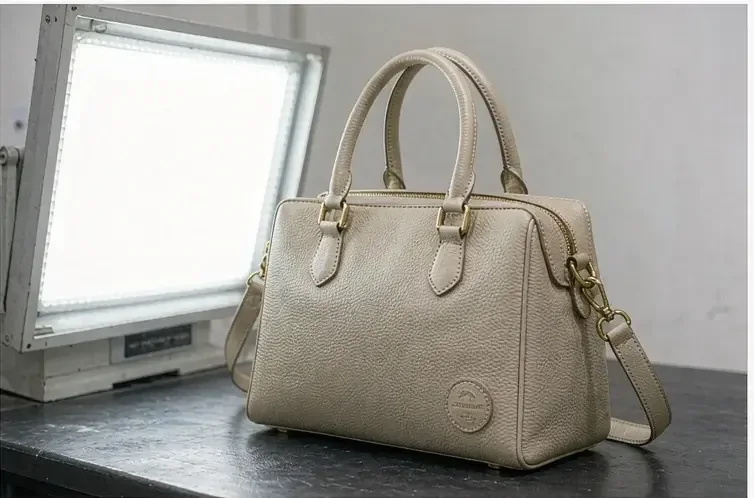
The Decision Order: Seven Choices Before You Draw Anything
A tech pack is a sequence of decisions, not a document produced at the end of one. Taken in the wrong order, the same decisions produce a pack that has to be revised; taken in the right order, they produce one that can be costed and cut without a single clarifying email.
- Choose the construction family, because it sets the pattern, the tooling and the bench hours.
- Choose the leather grade, thickness and grain rule, because it sets the largest cost line.
- Choose between proven and bespoke hardware, because bespoke adds tooling and weeks.
- Choose the structure: interlining weight, reinforcement and skiving allowance.
- Choose the stitch density, thread gauge and edge build, because they set bench time.
- Choose the interior layout and closures, which drive most second-round corrections.
- Choose the tolerances and marking, which decide whether the run is reproducible.
The order is not arbitrary. Each choice constrains the ones after it, so reversing the sequence produces contradictions a bench has to resolve by guessing, and guesses are what consume correction rounds. Our luxury sampling process page shows how a pack moves through those seven gates.
Choice 1 — Construction Family Sets Everything Else
The construction family — structured, semi-structured, soft, framed — determines the panel count, the tooling, the interlining and the bench hours before a single dimension is drawn. It is the first decision because every later choice is made inside it, and it is the decision most often left implicit.
- State the family in words on page one, not only in the drawing.
- A structured body needs 1.2-1.4 mm leather with reinforcement behind every hardware point.
- A soft body works at 1.0-1.1 mm milled leather and needs far less interlining.
- A framed or hand-set body adds tooling, a proving step and 12-15 working days to sampling.
- Say which operations are hand-finished, since that ratio is the honest capability statement.
Leaving the family implicit is the single most expensive omission in a pack. A drawing can be read either way, and a bench asked to guess will build the easier version, which is not usually the one the designer had in mind when the silhouette was approved.
Choice 2 — Leather: Grade, Thickness and Grain Direction
Leather is the largest cost line, and the pack has to say more than the word calfskin. Grade, thickness, finish, grain direction and a shade reference with a tolerance are the five items that make the line costable and reproducible.
- Leather type and grade
- Full-grain calfskin, named tannery, tannery grade stated
- Body thickness
- 1.2-1.4 mm structured, 1.0-1.1 mm soft, tolerance ±0.1 mm
- Grain direction
- Arrow marked on every pattern piece, one direction per bag
- Shade reference
- Pantone TCX reference plus physical swatch, ΔE 1.5 under D65
- Lot record
- Usable area 45-52 sq ft per hide, logged against the reserved lot
The grain arrow is the item most often missing and most often needed. Without it, a cutter nests for yield alone, and panels from the same bag end up with grain running in different directions, which is what makes a structured body twist after a month on a shoulder.
Choice 3 — Proven Hardware or Bespoke Hardware
Hardware is the choice that decides the calendar. A proven component from an existing catalogue is predictable in cost and lead time; a bespoke mechanism adds a die, a proving step and two to three weeks, and it re-opens the pattern if it arrives late.
- Specify plating thickness in microns, commonly 0.15-0.3 µm over a palladium underlayer.
- Name the base metal, since brass takes plating more evenly than zinc alloy.
- State the neutral salt spray hours required, usually 24 h as a floor and 48 h for coastal retail.
- Give the zip size, as a #5 metal zip and a #3 coil zip read as entirely different bags.
- A brass set at roughly USD 4.80 per unit still needs its own drawing sheet with these figures.
The drawing sheet is what makes the component reproducible. A catalogue code alone does not capture the plating finish or the salt spray requirement, and those two are what a re-order eight months later will be judged against.
Choice 4 — Structure: Interlining, Reinforcement and Skiving
Structure is the smallest monetary line and the largest behavioural one. Interlining weight, reinforcement coverage and skiving allowance decide whether a silhouette holds its line, and they are almost never visible in a photograph of a finished sample.
| Element | Working figure | Why it matters | How to state it |
|---|---|---|---|
| Interlining | 240 gsm non-woven at 0.8 mm | Holds a flap line without stiffening the body | Weight in gsm and thickness in mm |
| Reinforcement | Behind every hardware point | Stops a plate tearing through plain lining | Placement marked on the pattern |
| Seam allowance | 8 mm, consistent across panels | Inconsistent allowance causes panel mismatch | Stated once, applied everywhere |
| Skive width | 6-8 mm at turned edges | Too wide weakens the fold, too narrow shows a ridge | Width in mm on the pattern |
| Crease line | 1.5 mm from the finished edge | Sets the visual line of the fold | Distance in mm from edge |
Stating the seam allowance once and applying it everywhere sounds trivial and prevents a specific, common failure: panels cut from a pattern with two different allowances will not meet at the gusset, and the correction is a new pattern rather than a new seam.
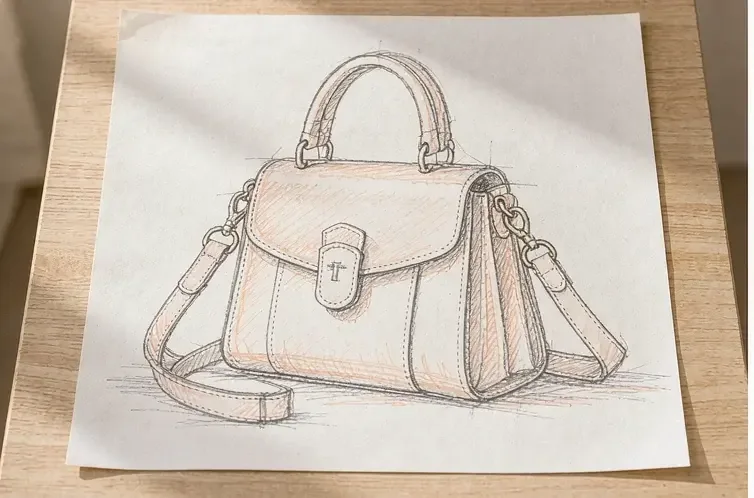
Choice 5 — Stitch, Thread and Edge Specification
Stitch and edge specifications are where bench hours concentrate, and they are the two items most often left to habit. Written down, they make a sample reproducible; left to habit, they make every bench interpret the drawing differently.
- Stitch density of 8-9 per inch on structured seams, with a 0.45 mm bonded thread.
- Thread colour stated separately from the leather colour, since they are rarely identical.
- Edge paint in three coats, each abraded, cured 4 hours at 55-60 °C after the third.
- Finished edge build of 0.8-1.0 mm, checked with a gauge at first-off rather than by eye.
- Back-tack at the start and end of every structural seam, stated once in the pack.
Thread colour is the detail that separates a considered pack from a competent one. A thread matched exactly to the leather disappears, which is usually wrong; a thread chosen one shade darker reads as a deliberate line, and stating it prevents a bench from making the opposite decision silently.
Choice 6 — Interior Layout and Closures
Interior layout drives most second-round corrections, because it is the part of a design usually decided last and drawn least carefully. Pockets, card slots, dividers, key leashes and closures all need placement dimensions and a tolerance, not a sketch.
- Give every pocket a placement dimension from two reference edges, not from one.
- State the closure holding force, around 1.8 kgf for a medium magnetic flap.
- Specify lining cloth by weight and finish, commonly 0.9 mm split suede or equivalent.
- Name the bonding parameters, with activation at 85-95 °C recorded on the process card.
- Mark the dust-bag cloth and the packing arrangement as lines in the bill of materials.
Two reference edges rather than one is the rule that prevents cumulative error. A pocket placed by a single dimension can drift across the panel across a run; the same pocket placed from two fixed references cannot, which is why the rule appears in packs that survive a second season.
Choice 7 — Tolerances, Marking and Labelling
Tolerances turn a design into a specification. Without them, every dimension in the pack is an aspiration and every disagreement at inspection becomes a matter of opinion, which is the least useful form a disagreement can take.
- Overall dimensions
- ±2 mm against the graded pattern set
- Handle drop
- 220 mm, held at ±5 mm across the run
- Logo or monogram placement
- ±1.5 mm from the stated reference point
- Hardware drawing tolerance
- ±0.2 mm on the 2D component drawing
- Interior pocket placement
- ±1 mm from two fixed reference edges
Marking and labelling belong in the same section because they are inspected together. Fibre composition under EU Regulation 1007/2011, country of origin, care symbols and any recycled content claim all need a placement and a method — embossed, foil-stamped or woven — rather than a note in the margin.
What a Finished Pack Contains, Page by Page
A structured style with hardware runs to 12-18 pages. The page order below is the one a bench reads fastest, because it follows the same sequence as the seven choices rather than grouping everything by type.
| Page | Contents | What must be stated |
|---|---|---|
| 1 | Cover and construction family | Family in words, style code, revision date |
| 2-3 | Dimensioned drawings | Overall dimensions, handle drop, ±2 mm tolerance |
| 4 | Panel count and pattern notes | Seam allowance 8 mm, grain arrow, skive width 6-8 mm |
| 5 | Leather specification | Grade, thickness, Pantone TCX reference, lot rule |
| 6 | Hardware drawings | Plating microns, base alloy, salt spray hours, ±0.2 mm |
| 7 | Structure specification | Interlining 240 gsm, reinforcement placement, crease line |
| 8 | Stitch and edge specification | 8-9 per inch, 0.45 mm thread, three coats, 0.8-1.0 mm build |
| 9-10 | Interior and closures | Pocket placement from two references, closure holding force |
| 11 | Lining and bonding | Lining weight, activation at 85-95 °C |
| 12 | Marking, labelling and packing | Composition, origin, care symbols, 12 pcs per carton |
| 13-18 | Bill of materials | 30-45 line items, each with material and finish named |
Have your pack reviewed before sampling opens
Send your drawings and bill of materials. You will receive a page-by-page review with the missing specifications listed and a sampling plan within two working days. Request a quote.
Ten Pack Errors That Cost the Most
Ten omissions account for most correction rounds, and all ten can be caught by reading the pack once against this list before it goes out. None requires design work; each requires one sentence.
No construction family stated
A drawing read either way will be built the easier way, which is rarely the silhouette that was approved.
No grain direction arrow
Cutters nest for yield alone, and mixed grain across panels makes a structured body twist in wear.
Plating thickness absent
A catalogue code does not capture finish or corrosion hours, and both are judged on a re-order.
Edge build unspecified
Without coats, curing time and finished thickness, edge quality is left to whoever is on the bench that week.
Single-reference pocket placement
Cumulative error drifts across a run; two fixed references prevent it entirely.
The second five, in one line each
- Seam allowance stated twice with two different values, which guarantees a gusset mismatch.
- Thread colour left to the bench, which quietly decides whether the stitch reads as a line.
- Bonding temperature omitted, so lining lifts months later in a humid market.
- No shade tolerance, so ΔE arguments at release are settled by opinion rather than measurement.
- No revision date on the page, so nobody can tell which version the sample was built from.
Our fixed figures sit behind every pack we build: MOQ 500 pcs per style and colourway, sampling in 6-10 working days or 12-15 for framed and hand-set work, bulk in 35-50 days, inspection at AQL 2.5 under ISO 2859-1, seven production lines at about 200,000 pcs per month, export experience recorded since 2014, and FOB Xiamen with CIF and DDP available. Our craftsmanship standards page shows which operations in a pack stay hand-finished.
Frequently Asked Questions
What is a handbag tech pack?
It is the complete written specification for one style: dimensioned drawings, a panel and pattern note, leather and hardware specifications, structure and edge details, interior layout, marking and a bill of materials. For a structured style with hardware it runs 12-18 pages and 30-45 line items.
Why does the order of decisions in a pack matter?
Because each choice constrains the next. Construction family sets panel count and tooling, leather grade sets the largest cost line, and hardware decides the calendar. Reversing the sequence produces contradictions a bench resolves by guessing, and guesses consume correction rounds.
What leather details must a pack state?
Grade, thickness with a ±0.1 mm tolerance, finish, a grain direction arrow on every pattern piece, and a Pantone TCX shade reference held within ΔE 1.5 under D65. Also state the lot rule, with usable area logged at 45-52 sq ft per hide.
Why is a grain direction arrow necessary?
Without it a cutter nests for yield alone, so panels from one bag can end up with grain running in different directions. That is what makes a structured body twist after a month on a shoulder, and it is a defect no photograph of a finished sample reveals.
What hardware details belong in a pack?
Plating thickness in microns, commonly 0.15-0.3 µm, the base alloy, the neutral salt spray hours required, and a 2D drawing held at ±0.2 mm. A catalogue code alone does not capture finish or corrosion hours, which are exactly what a re-order is judged against.
Should hardware be proven or bespoke?
Proven wherever the design allows. A proven component is predictable in cost and lead time, while a bespoke mechanism adds a die, a proving step and two to three weeks, and re-opens the pattern if it arrives late. Bespoke is justified when it is the signature of the style.
What interlining weight suits a structured body?
A 240 gsm non-woven at 0.8 mm is the working figure, with reinforcement behind every hardware point. Interlining is the smallest monetary line and the largest behavioural one: removing it saves a little and costs the silhouette the line it was drawn for.
How is a turned edge specified?
Skive width 6-8 mm, seam allowance 8 mm, a crease line 1.5 mm from the finished edge, then three coats of paint each abraded, cured 4 hours at 55-60 °C after the third, to a finished build of 0.8-1.0 mm checked with a gauge.
What stitch density should a pack state?
Eight to nine stitches per inch on structured seams with a 0.45 mm bonded thread, stated together with the thread colour as a separate line. Thread chosen one shade darker than the leather reads as a deliberate line; matched exactly, it disappears.
How should interior pockets be dimensioned?
From two fixed reference edges rather than one, with a ±1 mm placement tolerance. A single dimension allows cumulative error to drift across a run; two fixed references prevent it, which is why packs built this way survive a second season unchanged.
What tolerances belong on the drawings?
Overall dimensions at ±2 mm against the graded pattern set, handle drop at 220 mm held to ±5 mm, logo or monogram placement at ±1.5 mm, hardware drawings at ±0.2 mm and interior pockets at ±1 mm. Without them every dimension is an aspiration.
What labelling information is required?
Fibre composition under EU Regulation 1007/2011, country of origin, care symbols and any recycled content claim, each with a placement and a method such as embossed, foil-stamped or woven. Leaving these to the margin produces inconsistent marking across a run.
How long does sampling take once a pack is complete?
Six to ten working days for a standard build with two correction rounds, extending to 12-15 working days for framed or hand-set constructions. A complete pack is what keeps the run at the shorter figure; an incomplete one spends the window on questions.
How many pages should a structured pack run to?
Twelve to eighteen, following the order of the seven choices: cover and family, drawings, pattern notes, leather, hardware, structure, stitch and edge, interior, lining, marking and packing, then a 30-45 line bill of materials.
What is the minimum order once a pack is approved?
500 pcs per style and per colourway, with bulk running 35-50 days from approved sample and reserved materials. Three silhouettes sharing one colourway commit 1,500 units but share a leather lot, a hardware family and a tooling set.
People Also Ask
What should a handbag tech pack include?
Dimensioned drawings, panel and pattern notes with grain arrows, leather grade and thickness, hardware drawings with plating in microns, interlining weight, stitch and edge specification, interior layout, marking and a bill of materials.
How many pages is a handbag tech pack?
Twelve to eighteen pages for a structured style with hardware, ending with a 30-45 line bill of materials. Packs are ordered to follow the decision sequence rather than grouped by type.
Why do handbag samples need two or three rounds?
Usually because a specification was left implicit. Construction family, grain direction, plating thickness and edge build are the omissions that most often force a second round.
What tolerance should handbag drawings carry?
Overall dimensions at ±2 mm against the graded pattern set, handle drop at ±5 mm, logo placement at ±1.5 mm and hardware drawings at ±0.2 mm.
Should I use proven or bespoke hardware in a first pack?
Proven wherever the design allows. Bespoke hardware adds a die, a proving step and two to three weeks, and re-opens the pattern if the component arrives late.
Sources and further reading
Every figure on this page is either our own programme data or attributed below. Open the originals before you write them into a specification.
- ISO — International Organization for StandardizationISO Publisher of ISO 2859-1 for AQL sampling inspection and ISO 3376 for leather tensile behaviour referenced in pack specifications.
- Leather Working GroupLeather Working Group Tannery environmental audit protocol referenced when a pack names the source of full-grain calfskin.
- EUR-Lex — European Union lawEUR-Lex Access point for EU Regulation 1007/2011 on textile fibre names and the labelling requirements stated in a pack.
- European Chemicals AgencyECHA Authority behind REACH and the Annex XVII restrictions that shape the material lines in a bill of materials.
- Office of Environmental Health Hazard AssessmentOEHHA Administers California Proposition 65 and the warning position required before goods land in that state.