What to Expect From a Luxury Handbag Programme Partner: Service Levels and Deliverables
What should a luxury handbag programme partner actually deliver? A written feasibility answer, a line-split quotation inside 3-5 working days, sampling in 6-10 working days, bulk in 35-50 days, an AQL 2.5 inspection report under ISO 2859-1, material certificates and a sealed golden sample per style and colourway — at 500 pcs per style, quoted FOB Xiamen. This guide compares three service levels side by side, lists the deliverables you should receive at each stage, and names the response times worth holding a partner to.
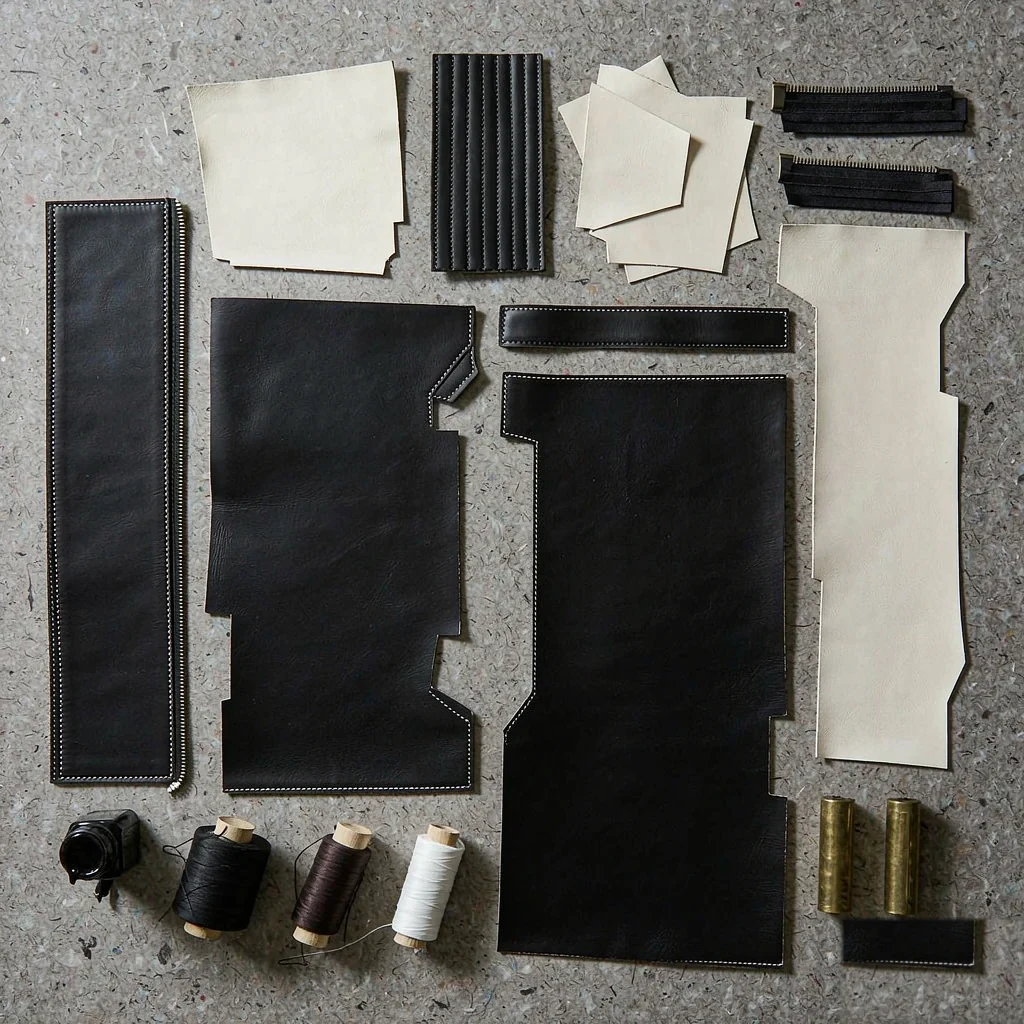
What a Partner Owes You: The Deliverable List
A partnership in this category is a set of deliverables, not a feeling. By the end of a first season you should hold: a written feasibility answer, a line-split quotation, a tech pack with tolerances, material certificates, an X-ray fluorescence reading for every hardware lot, one sealed golden sample per style and colourway, a pre-production photograph set, an AQL 2.5 inspection report, and export documentation. If any of those is missing, the programme is running on trust rather than on record.
The list is worth stating early because it converts a vague dissatisfaction into a specific gap. A brand that cannot point to a missing deliverable tends to argue about tone; one that can, tends to get the deliverable. Most houses that change partner do so after a season of the former. There is also a commercial reason to insist on the list. Each deliverable is a point at which a decision can still be changed without cost. A material certificate can stop a cutting order; a pre-production photograph can stop a run; an inspection report can stop a shipment. Once goods are loaded, the only remaining remedy is a claim, which is slower, more expensive and far less certain than any of the gates above.
Three Levels of Service, Compared
Not every brand needs the same depth, and not every partner offers it. The matrix below sets out three service levels as they are commonly arranged, so you can tell which one a quotation is actually describing. Read the middle column as the standard a luxury programme should meet; the first column is what a volume arrangement typically provides.
| Deliverable | Volume arrangement | Luxury programme standard | Atelier level |
|---|---|---|---|
| Feasibility answer | Verbal, at quotation | Written, with alternatives | Written, with a measured teardown |
| Quotation | Single figure | Six lines, 3-5 working days | Six lines plus a tooling schedule |
| Sampling | 10-15 working days | 6-10 working days | 6-10, or 12-15 with frame work |
| Material certificates | On request | Filed before cutting | Filed with tannery batch reference |
| Hardware verification | Visual | 0.15-0.3 µm by XRF, 24-hour salt spray | XRF per lot, 48-hour spray for humid markets |
| Sealed golden sample | Not standard | One per style and colourway | One per style, held on both sides |
| Pre-production unit | Not standard | Built and photographed | Built, photographed and measured |
| Inspection | AQL 4.0 or in-house | AQL 2.5, ISO 2859-1, level II | AQL 2.5 plus third-party option |
| Re-order window | Quoted fresh | 28-35 days against a sealed sample | 28-35 days, with spares held |
Which Level Fits Which Brand
A volume arrangement suits a carry-over shape at a commodity standard, where the design is frozen and the decision is made on unit price. The luxury programme standard suits any line whose selling point is a specification — a substance, a stitch density, a closure. The atelier level suits a house where the bag is the brand and the tolerance set is the product, and where a season cannot afford a re-work.
Volume arrangement
Fits a carry-over tote at 5,000 pcs a colourway where the specification is already frozen and price is the only variable.
Luxury programme standard
Fits a designer line of three to five styles at 500 pcs a colourway, where substance, plating and shade are the selling points.
Atelier level
Fits a house launching a signature piece with a custom-cast closure, where a re-work would cost the season rather than the order.
Response and Turnaround: The Clock Worth Holding a Partner To
Service levels are only real if they carry a clock. Four response times are worth stating in the first exchange: an acknowledgement inside 24 hours, a feasibility answer inside 3 working days, a quotation inside 3-5 working days against a complete brief, and an inspection report inside 48 hours of the final check. None of these is heroic; all four are the difference between a programme that can be planned and one that has to be chased.
- Acknowledgement of a brief
- Within 24 hours
- Feasibility answer
- Within 3 working days
- Quotation against a complete brief
- 3-5 working days, valid 30 days
- Sampling
- 6-10 working days, 12-15 with frame work
- Correction round
- 5-7 working days
- Bulk from approval sample
- 35-50 days, re-orders 28-35
- Inspection report
- Within 48 hours of final inspection
- Complaint response
- Within 5 working days, with a root cause
Communication Deliverables: What Lands in Your Inbox and When
Silence is the most common complaint in this category, and it is usually a scheduling gap rather than an attitude one. A luxury programme should produce a predictable rhythm of contact, and the rhythm is worth agreeing at the outset so that neither side has to ask for an update.
- Brief acknowledgement with a named contact, inside 24 hours.
- Feasibility note: what can be built as drawn, and what must move, inside 3 working days.
- Line-split quotation inside 3-5 working days, with a validity period stated.
- Material approval pack: certificates, ISO panel results and shade readings, before any cutting.
- Pattern and sampling progress note at the midpoint of the 6-10 day window.
- Photograph set of the first prototype, with the corrections already noted in writing.
- Pre-production photographs against the sealed sample before bulk starts.
- Weekly progress note during the 35-50 day bulk window, with a confirmed loading date.
Quality Deliverables: Certificates, Reports and the Sealed Sample
Quality deliverables are the ones that survive a dispute. Material certificates name the hide by tannery and batch. Hardware reports give the plating thickness at 0.15-0.3 µm from an X-ray fluorescence reading, plus salt spray hours at 24 or 48. The ISO panel records rub fastness at grade 4-5 under ISO 105-X12, finish adhesion at 4 N per 10 mm under ISO 11644, and tensile strength under ISO 3376. Restricted-substance declarations cover REACH Annex XVII, Prop 65 and CPSIA.
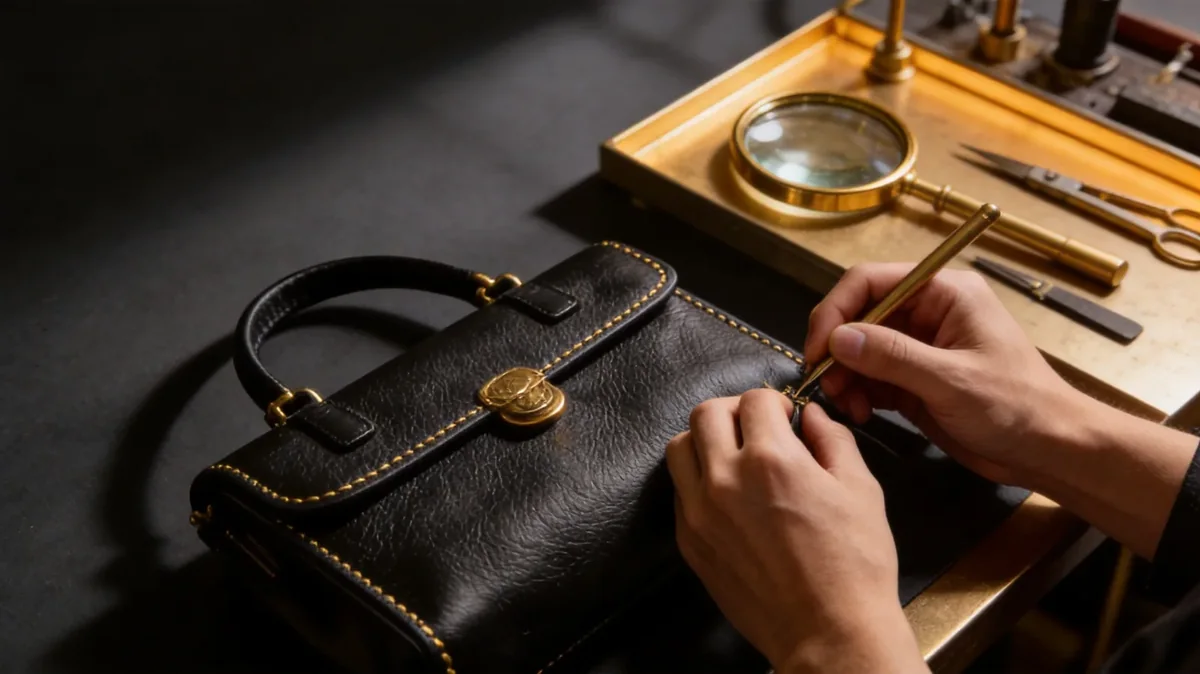
One sealed golden sample per style and colourway sits above all of it. The unit is signed by both sides, photographed, and stored with the tech pack, the tolerance ledger and the material certificates attached. One copy stays with the brand and one with the atelier. Against that reference a re-order runs 28-35 days rather than 35-50, because the approvals are already on file.
Commercial Deliverables: Quote Structure, Validity and Terms
A quotation should be readable without a telephone call. It separates unit price from one-off costs, names the hide by tannery, states the plating thickness, gives the inspection standard and level, and carries a validity period — thirty days is standard, because hide moves with the tannery market. Where CIF or DDP is quoted instead of FOB Xiamen, the freight and duty lines should be shown separately rather than folded into the unit price.
What You Owe in Return
The clock runs both ways, and a partner cannot hold these service levels against a brief that keeps moving. Four obligations on the brand side make the difference. Give dimensioned drawings with tolerances rather than reference images alone. Decide hardware at feasibility rather than at sampling. Answer material approval questions inside two working days, because the hide reservation is held open meanwhile. And confirm corrections in writing after each sample rather than verbally on a call.
- Dimensions with tolerances — ±1.5 mm on cut panels is the working default.
- A hardware decision at feasibility, including whether the closure is custom-cast at USD 450-900.
- Material approval responses inside 2 working days, so hide reservations do not lapse.
- Written corrections after each sample, and one named approver for the sealed sample.
- Quantity confirmed per style and colourway before the quotation is issued.
- Destination market declared, so the right restricted-substance scope is collected.
- A single named approver for corrections, so a sample is not revised against two different instructions.
Red Flags in a First Response
The first exchange tells you more than any brochure. Six signs are worth watching for, and each has a specific consequence rather than a general feeling of unease. A partner who cannot name any of the standards below is not being modest; they are telling you the record does not exist.
| Signal in the first reply | What it usually means | Consequence |
|---|---|---|
| A single-figure quote with no split | No visibility on hide or hardware | You cannot negotiate specific lines |
| Plating described by colour only | Thickness not specified | 0.15-0.3 µm may become a flash finish |
| AQL named without a level | The figure means nothing | Sample size is undefined at inspection |
| No sealed sample offered | No reference for re-orders | Season two repeats season one's work |
| Material approval skipped | Testing happens after cutting | Defects surface at final inspection |
| No validity period on the quote | Hide price exposure is hidden | The number moves when you accept |

The Deliverable Checklist
Everything above condensed into one list you can hold a partner to. Tick it at the end of the first season; anything unticked is a gap to raise before the second, not after it. The list also works in reverse — a partner can reasonably ask you for the items in the second half.
Hold your partner to these
- Acknowledgement inside 24 hours; feasibility inside 3 working days; quotation inside 3-5, valid 30 days; sampling 6-10 working days; correction 5-7; bulk 35-50 and re-orders 28-35; material certificates before cutting; XRF plating readings per hardware lot; a sealed golden sample per style and colourway; pre-production photographs; AQL 2.5 inspection under ISO 2859-1 with the report inside 48 hours; spare hardware at 2%; and a root-cause response to any complaint within 5 working days.
The sealed golden sample. A partner who offers one unprompted is thinking about your second season; one who does not is thinking about this order. It costs one unit out of 500 and it is the clearest signal of how the relationship will run.
Hold us to this list
Send your brief and launch date, and our team will respond inside 24 hours with a feasibility answer, then a line-split quotation within 3-5 working days through our quotation desk.
Frequently Asked Questions
How quickly should a handbag partner respond to a brief?
An acknowledgement inside 24 hours with a named contact, a written feasibility answer inside 3 working days, and a line-split quotation inside 3-5 working days against a complete brief. Those three response times are the clearest early signal of how the rest of the programme will run.
What should a handbag quotation include?
Six separated lines — hide, hardware, lining and interlining, edge paint, assembly and hand finishing, inspection and packing — plus one-off tooling shown separately. It should name the hide by tannery, state plating thickness at 0.15-0.3 µm, give the inspection standard and level, and carry a 30-day validity period.
How long is a quotation valid?
Thirty days is standard, because hide prices move with the tannery market rather than with the order. Hardware and labour lines are more stable. If you need longer to decide, ask which lines are firm and which are exposed rather than asking for an open-ended quote.
What material certificates should I expect?
Certificates naming the hide by tannery and batch, the lining, the thread and the hardware plating thickness, plus ISO panel results: ISO 105-X12 rub fastness at grade 4-5, ISO 11644 adhesion at 4 N per 10 mm and ISO 3376 tensile strength. Restricted-substance declarations cover REACH Annex XVII, Prop 65 and CPSIA.
Should I expect a sealed sample as standard?
Yes. One golden sample per style and colourway, signed by both sides, photographed, and stored with the tech pack, tolerance ledger and material certificates. One copy stays with you and one with the atelier. Against it, a re-order runs 28-35 days rather than 35-50. It costs one unit out of a 500-piece run and is the clearest signal of how the relationship will be run.
How fast should an inspection report arrive?
Within 48 hours of the final inspection. The report should state the standard — AQL 2.5 under ISO 2859-1 — the inspection level, the sample size, and the defect count split into critical, major and minor. On a 5,000-piece lot at level II the sample is 200 units, accepted at 10 major defects.
What should I expect during the bulk window?
A weekly progress note through the 35-50 day window, with a confirmed loading date once inspection clears. A pre-production unit should already have been built and photographed against the sealed sample before the run began, which is the last low-cost place to catch a material or fitting error.
How are complaints handled after delivery?
A root-cause response within 5 working days, identifying whether the origin was material, hardware or assembly, and a correction plan for the next drop. Spare hardware held at 2% of unit quantity means a repair pipeline can run without waiting on a new casting. Complaints are classified by origin so the correction lands on the right stage next season.
What spare parts should ship with an order?
Hardware at 2% of unit quantity — clasps, turn-locks and feet — plus matched thread for repairs. For custom-cast components, holding a reserve of unplated castings is sound insurance against a mould reaching the end of its service life. Feet, rings and strap ends are bought from the same finish lot as the main closure, so the colour family stays aligned.
What do I owe the partner to keep the schedule?
Dimensioned drawings with tolerances, a hardware decision at feasibility rather than at sampling, material approval answers inside 2 working days so hide reservations do not lapse, written corrections after each sample, and quantity confirmed per style and colourway before the quotation is issued, and one named approver for corrections so a sample is never revised against two different instructions.
Is third-party inspection part of the service?
It is offered rather than assumed, and it is worth taking on the first drop of any new style or on any shipment whose value makes a re-work costly. An independent inspector applies the same ISO 2859-1 plan on site and reports before release. For repeat styles with a stable record, in-house inspection at AQL 2.5 is normally sufficient.
What is the difference between service levels?
A volume arrangement provides the goods to a commodity standard with limited documentation. A luxury programme standard adds tolerances, certificates, a sealed sample and AQL 2.5 inspection. The atelier level adds a measured teardown, per-lot hardware verification and spares held for the life of the style.
People Also Ask
What should be in a handbag production quotation?
Six separated cost lines plus one-off tooling, the hide named by tannery, the plating thickness, the inspection standard and level, the minimum order, the sampling window, the bulk window and a validity period.
How fast should a production partner reply to an enquiry?
Acknowledgement inside 24 hours, feasibility inside 3 working days and a quotation inside 3-5 working days against a complete brief. Slower responses usually indicate the record behind the number does not exist yet.
What documents come with a luxury handbag order?
Material certificates, an ISO panel report, hardware plating readings, pre-production photographs, a sealed golden sample record, an AQL 2.5 inspection report and export documentation. The pack should reach you before bulk cutting begins, not with the shipment.
Why is a sealed sample important?
It is the only reference a later shipment can be measured against. Without it, a re-order has no standard, and the second season repeats the development work of the first.
How quickly should an inspection report be issued?
Within 48 hours of the final check, stating the standard, the inspection level, the sample size and the defect count split into critical, major and minor categories. On a 5,000-piece lot at level II the sample is 200 units.
Sources and further reading
Every figure on this page is either our own programme data or attributed below. Open the originals before you write them into a specification.
- ISO — International StandardsInternational Organization for Standardization Publisher of ISO 2859-1 sampling procedures, ISO 105 colour fastness, ISO 11644 finish adhesion and ISO 3376 tensile strength.
- Leather Working GroupLeather Working Group Tannery audit protocol referenced when a programme names a hide source in the material certificate pack.
- Understanding REACHEuropean Chemicals Agency Annex XVII restrictions covered by the restricted-substance declaration for goods entering the European Union.
- Sedex — Responsible SourcingSedex Social compliance audit framework referenced in the compliance documentation pack for a luxury programme.