Luxury Handbag Closure Systems Compared: Turn-Lock, Magnet, Zip, Frame and Slide Against Cycle Life
A closure system is the only part of a handbag the customer operates every single day, and it is the part most often specified by photograph rather than by number. Compared properly, the six families in use today separate on three axes: how much load they carry, how many cycles they survive before the action degrades, and what they do to the lead time of the programme. This comparison puts each family against the test that proves it, with the specification floors a maison can write into a pack.
How to Compare Closure Systems Before Specifying One
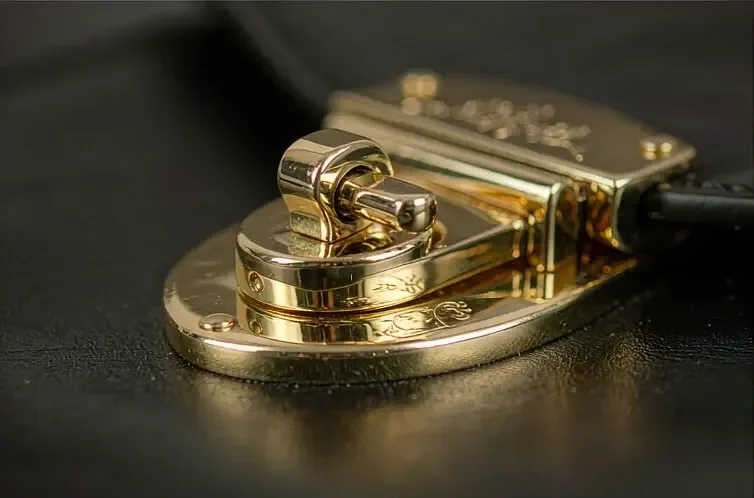
Three questions settle the choice, and none of them is about appearance. First, how much load does the closure carry: is it holding two panels together under the weight of the contents, or is it simply keeping a flap from lifting? Second, how many cycles does it need to survive, which for a daily bag means several thousand openings over its life. Third, what does the closure do to the construction sequence, because a frame closure has to be set before the lining goes in and a riveted turn-lock can be set at the very end.
The fourth question is quieter but decides the outcome more often than any of the others: what happens when it fails? A magnet that weakens is invisible from the outside and returns as a complaint six months after delivery. A turn-lock that binds is obvious on the first opening and is caught at the bench. Specifying for the failure you can see is easy; specifying for the one you cannot is the work.
Six Closure Systems Compared Side by Side
The table below sets the six families against the three axes that matter. Read the cycle column first: it is the number most often missing from a specification, and the one that separates a closure built for a bag from a closure built for a sample.
| Closure family | Load it carries | Cycle floor | Test that proves it | Typical lead-time effect |
|---|---|---|---|---|
| Turn-lock | High: holds a flap closed under content weight | 5,000 open-close cycles with no looseness | Cycle rig plus a 3.0 kgf pull on the locked cam | None if a stock tool; 20-25 working days if a new die is cut |
| Magnetic closure | Low to medium: resists a flap lifting, not a pull | 5,000 cycles with pull force retained above 2.0 kgf | Pull force to 2.5-3.5 kgf new, measured again at 5,000 cycles | None: stock component, fitted late in the sequence |
| Metal zip | Medium: contains the contents, takes lateral stress | 5,000 full-length runs with no tooth loss | Drag test across the full tape plus a lateral pull at the slider | None for stock tape; 15-20 working days for a dyed-to-match tape |
| Kiss-lock frame | Medium: frame carries the mouth of the bag | 3,000 cycles with spring tension retained | Spring tension gauge plus a visual on the frame plating at the pivot | 20-30 working days: the frame is a tooled part |
| Twist clasp | Low: decorative fastening on a light flap | 3,000 cycles with no deformation of the tongue | Cycle rig plus a torque check on the fixing screw | 15-25 working days depending on the tool |
| Slide and buckle | High: adjustable, carries strap load | 2,000 adjustments with no slip at the set position | Static load to the strap rating plus a slip test after adjustment | None for stock; 20-25 working days for a cast buckle |
The last column is the one that surprises houses. A closure is rarely the most expensive line on a bag and is frequently the one that moves the delivery date, because tooling sits behind four of the six families and tooling is booked before anything else.
Turn-Lock: the Load-Bearing Default
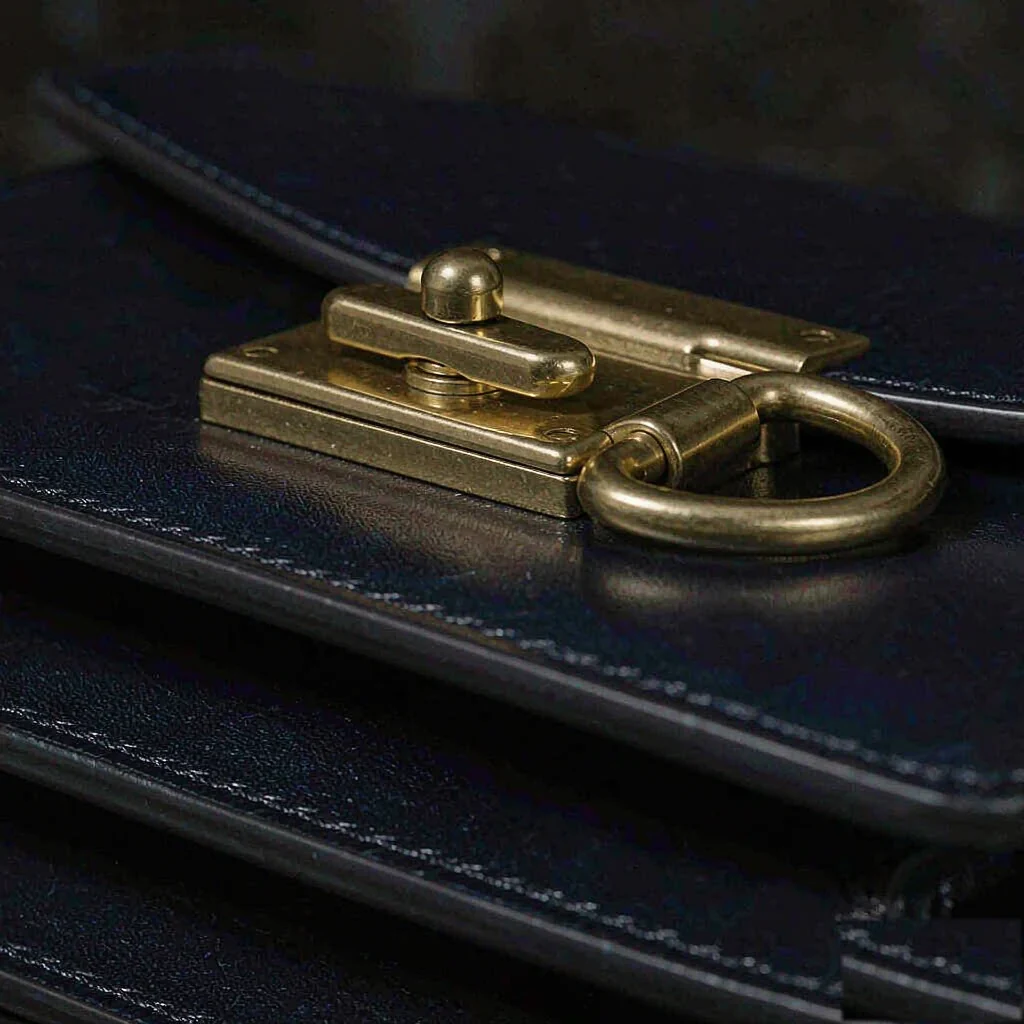
The turn-lock remains the default wherever a bag has to stay shut under its own contents. It is the only closure in this group whose failure mode is legible: the action stiffens, the cam shows wear, and both are visible before the bag leaves the bench. That legibility is why it survives in programmes where the appearance is otherwise entirely modern.
- Specify the substrate, not just the finish: solid brass where the cam takes torque, zinc alloy where the part is decorative.
- Plating at 0.15-0.3 µm over a nickel barrier, with 0.2-0.4 µm for pale finishes that show wear sooner.
- Corrosion proved at 24 hours neutral salt spray to ISO 9227, rising to 48 hours for antique finishes.
- Locating pin held to ±0.2 mm of the drawing, checked with a go/no-go gauge on the first shots.
- Cycle the finished bag, not the loose component: 5,000 openings on the assembled flap reveals alignment faults the rig cannot.
- Fit the lock late in the sequence so a tooling correction does not strand finished panels.
The one specification houses omit is the pull force on the locked cam. A lock that cycles beautifully and releases under 2.0 kgf has not been specified, only admired. Write the number into the pack alongside the cycle count.
Magnetic Closure: Invisible, and Easily Under-Specified
Magnets are the most under-specified component in luxury handbags, precisely because they work perfectly on the day the sample is approved. The failure is slow and invisible: pull force decays with cycles and with heat, and the bag starts to open itself in a car or on a chair. By the time it reaches a customer review, the lot has shipped.
- Pull force, new
- 2.5-3.5 kgf depending on flap weight and content mass
- Pull force at 5,000 cycles
- Retained above 2.0 kgf, tested on the assembled bag rather than on the bare pair
- Plating on a visible magnet
- 0.15-0.3 µm over a nickel barrier, since the face is often the only metal the eye sees
- Detachment risk
- Treated as critical: a magnet that can release from its housing is never a cosmetic fault
- Housing
- Riveted or stitched into a reinforced panel; a magnet set into a single layer of leather will migrate
- Heat exposure
- Declared in the pack, because a bag left in direct sun loses pull force faster than the test bench suggests
The second magnet failure is positional rather than magnetic. A pair fitted 1.5 mm off centre reads as a weak magnet to the customer, because the two halves never meet squarely. A jig for the housing costs little and removes the fault entirely.
Zips: Gauge, Tape and the Drag Test
A zip specification has three numbers and houses usually write one of them. The gauge, the tape and the pull force on the slider all matter, and the drag test across the full length of the tape is the only test that catches the fault customers actually complain about, which is resistance rather than failure.
- Name the gauge by number: #3 for a light interior pocket, #5 for the main mouth of a medium bag, #8 where the tape is structural.
- Name the tape: polyester tape dyed to match takes 15-20 working days and must be approved against the leather under D65 light.
- Prove corrosion on metal teeth at 24 hours neutral salt spray, because teeth are handled constantly.
- Drag test the full length twenty times and record the resistance; a zip that drags is returned more often than one that breaks.
- Set the stop: a metal stop crimped too loosely walks along the tape and the bag opens at the corner.
- Specify the pull separately from the chain: the pull is the contact point, and it is where plating wears first.
Where a bag closes with a zip and a flap, the two systems have to be specified together. A zip that holds and a magnet that does not produce a bag that looks shut and opens anyway, which is the complaint no specification anticipated.
Kiss-Lock Frames and Twist Clasps
These two families carry the heritage end of the category, and both are tooled rather than bought. That single fact shapes everything else about them: the tool has to be cut before sampling, the first shots carry a dimensional report, and a correction costs weeks rather than days.
Kiss-lock frame
A sprung frame that carries the mouth of the bag. The spring tension is the specification, not the shape: 3,000 cycles with tension retained, and the pivot inspected for plating wear because it is a moving contact point.
Twist clasp
A decorative tongue that rotates into a keeper. Low load, low cost, and the failure is deformation of the tongue. Cycle to 3,000 and torque-check the fixing screw, which works loose if it is set into a single layer.
Frame with a fabric mouth
Where the frame carries a gathered panel rather than a structured one, the load moves to the stitching at the mouth. Stitch density at 9 per inch and a reinforced tape behind the gather.
Ornate clasp
A cast decorative part with a functional tongue. Casting quality governs: no visible porosity on a Class A face, gate dressed flat before plating, and the cycle floor still applies.
The pattern across both families is that the tool is the decision. Once the die exists, the closure is stable for the life of the programme; before it exists, every change costs a tooling round.
Slide, Buckle and Strap-End Closures
These are the closures that carry load through the strap rather than across the mouth, and they are tested differently as a result. The question is not how many cycles they survive but whether they slip once the wearer has set them, because a slide that creeps under load is a bag that changes shape during the day.
Two thousand adjustments with no measurable slip at the set position is the floor most programmes write, followed by a static load test to the strap rating. Where a buckle is cast rather than stock, addition of 20-25 working days for the tool applies before the first shots arrive for dimensional review.
What Each Closure Does to the Calendar
Sampling for a new style runs 6-10 working days, extending to 12-15 where a frame, a moulded handle or a new tool is involved. A closure decision made late is the commonest reason a programme slides from the shorter window into the longer one, because four of the six families need tooling that has to be cut before the first sample can be assembled.
- Stock turn-lock, magnet or zip: no effect on sampling; bulk at 35-50 days.
- Dyed-to-match zip tape: add 15-20 working days for the tape before the sample is assembled.
- New twist clasp or cast buckle: add 15-25 working days for the tool and the first shots.
- New kiss-lock frame: add 20-30 working days, including the dimensional report on first shots.
- New turn-lock die: add 20-25 working days, plus a cycle rig run on the assembled flap.
Closure Failure Under AQL 2.5
Inspection is drawn to AQL 2.5 under ISO 2859-1, with critical defects accepting none. On a 500 pc lot at general inspection level II that is a 50-piece sample with three majors allowed. A closure fault on a visible face is a major; a closure that can release is critical, and one such piece fails the shipment regardless of how good the other 49 are.
A closure that fails cosmetically is a major and counts against the allowance. A closure that can release is critical and accepts none. Write both classes into the inspection sheet before the draw, because deciding at the table is how a shipment that should stop gets released.
Commercial Frame: MOQ, Capacity and What to Send
MOQ 500 pcs per style and per colourway. Bulk production at 35-50 days. FOB Xiamen as the standard term, with alternatives available where a programme needs them. The programme runs across 7 production lines with about 200,000 pcs per month of capacity and has held export experience since 2014, carried out through our validated partner factory Quanzhou Yingming Bags, an SGS-validated site.
Six items to send with a closure enquiry
- A dimensioned drawing or a reference part, with the substrate named: solid brass, zinc alloy or steel.
- The load in words: daily torque, decorative only, or load-bearing at the mouth.
- Quantity per style and per colourway, remembering MOQ 500 pcs applies to each combination.
- Destination markets, because REACH nickel release and California Prop 65 are answered per lot.
- The date you cannot move, so tooling is booked rather than hoped for.
- Finish sample cards at USD 4.80, credited against the first bulk order, to settle the tone before the tool is cut.
Compare closure options against your drawing
Send the bag silhouette, the load each closure will carry and the quantity per colourway. You will receive a family-by-family comparison with cycle floors, tooling time and the effect on your delivery date, within two working days. Request a quote.
Frequently Asked Questions
Which closure is strongest on a luxury handbag?
A turn-lock on solid brass, specified at 5,000 open-close cycles with a 3.0 kgf pull on the locked cam. It carries the highest load in the group and its failure is visible before the bag leaves the bench, which is why it is still the default for a structured flap.
How many cycles should a bag closure survive?
Five thousand open-close cycles is the floor for a turn-lock, a magnet and a zip on a daily bag. Kiss-lock frames and twist clasps are usually specified at 3,000, and slides and buckles at 2,000 adjustments, because the test measures slip rather than cycles.
What pull force should a magnetic closure have?
Between 2.5 and 3.5 kgf when new, depending on flap weight, retained above 2.0 kgf at 5,000 cycles. The test is run on the assembled bag rather than on the bare pair, because a pair fitted off centre reads as weak to the customer.
Why does a magnetic closure weaken over time?
Pull force decays with cycles and with heat. A bag left in direct sun loses force faster than the bench suggests, and a housing fitted off centre means the two halves never meet squarely, which reads as weakness before any real decay has occurred.
What zip gauge should a luxury handbag use?
A #3 for a light interior pocket, a #5 for the main mouth of a medium bag, and a #8 where the tape is structural. The tape matters as much as the gauge: polyester tape dyed to match takes 15-20 working days and is approved under D65 light.
How is a zip tested before bulk release?
By a drag test across the full length of the tape, run twenty times with the resistance recorded, plus a lateral pull at the slider and 24 hours neutral salt spray on metal teeth. Customers return a zip that drags more often than one that breaks.
Do closure systems affect sampling time?
Yes. Sampling runs 6-10 working days and 12-15 where a frame, a moulded handle or a new tool is involved. A dyed-to-match zip tape adds 15-20 working days, a new clasp or buckle tool 15-25, and a new kiss-lock frame 20-30.
What plating thickness applies to closure hardware?
Between 0.15 and 0.3 µm over a nickel barrier for standard gold tone, rising to 0.2-0.4 µm for pale finishes that show wear sooner. Corrosion is proved at 24 hours neutral salt spray to ISO 9227, or 48 hours for antique finishes.
How is a closure fault classified at inspection?
A cosmetic fault on a visible face is a major and counts against the AQL allowance. A closure that can release is critical and accepts none. Both classes belong on the inspection sheet before the draw rather than being decided at the table.
What sample size does AQL 2.5 give on a 500 pc lot?
Fifty pieces at general inspection level II, with three majors allowed under ISO 2859-1. No critical defects are accepted at any level, so a single closure that can release stops the shipment regardless of the rest of the draw.
Are kiss-lock frames expensive to develop?
The cost is time rather than unit price. A frame is a tooled part, so a new one adds 20-30 working days including the dimensional report on first shots. Once the die exists, the closure is stable for the life of the programme.
What is the minimum order for a bespoke closure?
MOQ 500 pcs per style and per colourway, with bulk at 35-50 days on FOB Xiamen terms. Bespoke tooling is amortised across that run, and finish sample cards are billed at USD 4.80 and credited against the first bulk order.
People Also Ask
What is the most durable handbag closure?
A solid brass turn-lock with a nickel barrier and 0.15-0.3 µm of plating, cycled to 5,000 openings and pulled to 3.0 kgf at the cam. It carries the most load and fails visibly, which is why it is still specified on structured bags.
Do magnets wear out in handbags?
Yes. Pull force decays with cycles and with heat, which is why the specification asks for 2.5-3.5 kgf new and retention above 2.0 kgf at 5,000 cycles, tested on the assembled bag rather than on the bare pair.
What does a metal zip gauge number mean?
It is the approximate width of the closed teeth in millimetres. A #3 suits an interior pocket, a #5 the main mouth of a medium bag, and a #8 a tape that carries structure rather than simply closing an opening.
How do you stop a slide buckle from slipping?
Specify 2,000 adjustments with no measurable slip at the set position, then run a static load test to the strap rating. Slip usually comes from a smooth strap underside rather than from the slide itself.
Which closure adds the most time to a programme?
A new kiss-lock frame, at 20-30 working days including the dimensional report on first shots. A new turn-lock die or cast buckle adds 20-25, and a dyed-to-match zip tape adds 15-20 before the sample can be assembled.
Sources and further reading
Every figure on this page is either our own programme data or attributed below. Open the originals before you write them into a specification.
- ISO — International Organization for StandardizationISO Publisher of ISO 2859-1 sampling procedures used for the AQL 2.5 draw, and ISO 9227 neutral salt spray testing referenced for closure plating.
- European Chemicals AgencyECHA Administrator of REACH, including Annex XVII entry 27 on nickel release from metal components in prolonged contact with skin.
- California Office of Environmental Health Hazard AssessmentOEHHA The authority behind California Proposition 65, which governs warning requirements for listed substances in plated metal closures.
- CPSCU.S. Consumer Product Safety Commission Administrator of CPSIA limits on lead in substrates and coatings, relevant to closure hardware on lines sold in the United States.
- Leather Working GroupLeather Working Group Tannery audit protocol behind the leather that closures are set into, since metal and hide are approved as one assembly.