Luxury Handbag Brand Website Checklist: 18 Items, Largest Paint Under 2.5 Seconds, Images Under 200 KB
What does a luxury handbag brand website need? Eighteen items, of which the most consequential are a largest contentful paint under 2.5 seconds, product images under 200 KB, nine fields on every product page and a three-click path from landing to enquiry. A premium site fails on credibility long before it fails on taste: a buyer on a phone will not wait for a hero image, and she will not chase a specification that is not written down. The checklist below is ordered by what costs an enquiry when it is missing.
Case: A House With Beautiful Pages and No Enquiries
A debut house launched a site with full-bleed video, a serif wordmark and eleven seconds of load time on a mid-range phone. Traffic from a press mention was healthy; enquiries were three. The post-mortem found nothing wrong with the art direction and everything wrong with the plumbing: the hero video blocked rendering, the product page carried four fields where nine were needed, and the only contact path was a form that failed silently on mobile.
The rebuild took three weeks. The video was replaced with a still at a long edge of 2400 px compressed under 200 KB, the product page gained substance, hardware, lining, dimensions, care, delivery window, minimum quantity, inspection standard and origin as written fields, and the contact path was reduced to three clicks with an email address visible as a fallback. Traffic did not change. Enquiries went from three in a month to nineteen, which is roughly the band a debut house should expect.
Speed: The Three Figures That Decide Whether the Page Is Read
Core Web Vitals are not an engineering vanity metric in this category; they are the difference between a buyer reading the specification and bouncing. Three figures matter: largest contentful paint under 2.5 seconds, interaction to next paint under 200 milliseconds, and cumulative layout shift under 0.1. A premium site that misses all three is paying for press coverage that delivers visitors to a page they never see.
- Largest contentful paint
- Under 2.5 s on a mid-range phone over 4G
- Interaction to next paint
- Under 200 ms
- Cumulative layout shift
- Under 0.1, achieved by fixing image dimensions
- Product image weight
- Under 200 KB per frame, 2400 px long edge
- Mobile share of traffic
- Usually above 60% — design for the phone first
- Path to enquiry
- Three clicks from any landing page
The Nine Fields Every Product Page Must Carry
Nine written fields turn a product page from a picture into a specification a buyer can act on. They are materials with substance, hardware with finish, lining, dimensions in three axes, care instructions, delivery window, minimum quantity, inspection standard and origin. A page missing three of them generates an email asking for the missing information, and half of those emails are never sent.
Materials
Full-grain calfskin at 1.2-1.4 mm, named tannery where possible, finish and dye lot recorded.
Hardware
Brass, plating at 0.15-0.3 µm, closure type, cycle count, salt spray hours.
Lining and interior
Lining material, pocket count, interior finish, closure of the inner pocket.
Dimensions
Width, height and depth with the handle drop, measured on a finished unit.
Care
Storage, cleaning and the refinishing path, with what the house will do for the owner.
Commercials
Delivery window, minimum per colourway, inspection standard and origin.
Imagery: Six Frames, One Set-Up, Honest Colour
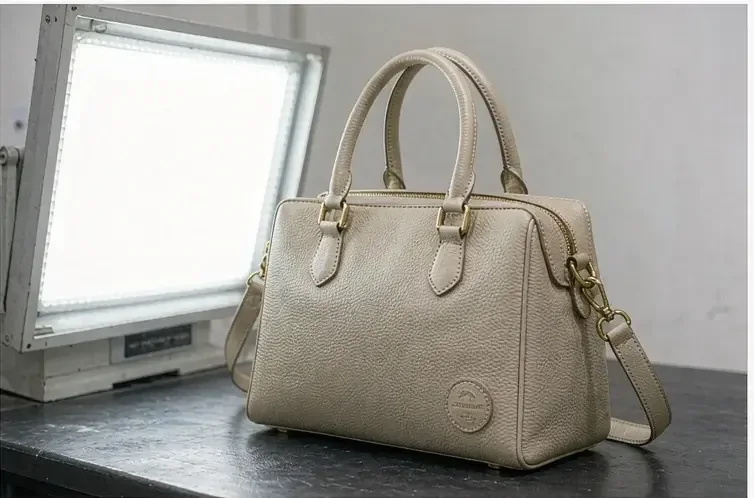
Six frames per style shot on one written set-up, proofed under D65 at ΔE ≤ 1.0 against the sealed sample. Front elevation, three-quarter, back, interior, hardware macro and scale reference. The web file goes out at 2400 px on the long edge compressed under 200 KB; the 300 dpi master is archived for print. Colour accuracy on screen is what prevents the returns that otherwise make a beautiful site unprofitable.
- Six frames per style: front, three-quarter, back, interior, hardware macro, scale reference.
- One written set-up at 5600K, reused every season so a new photographer matches the archive.
- Proof under D65 and hold ΔE ≤ 1.0 against the sealed sample before publishing.
- Compress every web frame under 200 KB without erasing grain or pore structure.
- Fix image dimensions in markup so the layout does not shift as frames load.
- Never colour-correct a new dye lot from an old file; re-shoot it under the same set-up.
The Three-Click Path to Enquiry
Every landing page should reach an enquiry in three clicks, and the enquiry path should offer more than a form. A visible email address, a messaging handle and a stated response window do more for conversion than any layout change, because a buyer comparing two houses will choose the one she can actually reach. Forms that fail silently are the single largest source of lost enquiries in this category.
- Landing page to collection, collection to product, product to enquiry — three clicks, tested on a phone.
- Publish a real email address beside the form, not instead of it.
- Publish a response window in hours or days, and hold to it.
- State the minimum quantity and the delivery window on the same screen as the enquiry path.
- Test the form monthly on two devices and one slow connection; silent failures are invisible otherwise.
- Confirm receipt automatically, with the name of the person who will reply.
Trust Surfaces: What a Premium Buyer Looks For
A buyer looks for four trust surfaces before she writes: an origin statement that is not invented, a materials statement with a figure in it, an inspection statement naming a standard, and a service statement with a real path. None of these requires a long page. Each is one sentence with a number in it, placed where a buyer looking for it will find it within a few seconds.
| Trust surface | Weak version | What to publish instead |
|---|---|---|
| Origin | Designed in Europe | Developed and made in one workshop, export experience since 2014 |
| Materials | Fine Italian leather | Full-grain calfskin 1.2-1.4 mm, one tannery lot, LWG-audited source |
| Inspection | Rigorous quality control | AQL 2.5 under ISO 2859-1, third-party inspection available |
| Service | Lifetime care | Spare hardware at 2% of unit quantity, edge refinishing for ten years |
| Delivery | Ships in 6-8 weeks | Sampling 6-10 working days, bulk 35-50 days, FOB Xiamen |

The Eighteen-Item Checklist, In Order
Ordered by what costs an enquiry when it is missing. The first six are load-bearing; a site can survive a miss on the last six and still convert. Work down the list rather than picking items, because the ordering reflects how much each item costs when it is absent rather than how hard it is to build.
- Largest contentful paint under 2.5 seconds on a mid-range phone.
- Product images under 200 KB each, at 2400 px on the long edge.
- Nine written fields on every product page.
- A three-click path from any landing page to an enquiry.
- A visible email address and a stated response window.
- Six frames per style, shot on one written set-up.
- Colour proofed under D65 at ΔE ≤ 1.0 against the sealed sample.
- Image dimensions fixed in markup so layout shift stays under 0.1.
- Origin stated without invented ancestry or borrowed dates.
- Materials named with a substance figure and a tannery.
- Hardware named with alloy, plating thickness and cycle count.
- Inspection standard named — AQL 2.5 under ISO 2859-1.
- Delivery windows stated: sampling 6-10 working days, bulk 35-50 days.
- Minimum quantity stated: 500 pcs per style and colourway.
- Service path stated: spare hardware at 2%, refinishing for ten years.
- Mobile layout tested on two devices and one slow connection.
- Care card text published on the site as well as in the box.
- One archive page listing every shipped style with its sealed reference.
The last six items are the ones a house can defer for a season without losing many enquiries, and they are also the ones that quietly separate a house that looks established from one that looks provisional. The archive page, the published care card text and the quarterly review cost almost nothing in time. Their absence is not what loses an enquiry; their presence is what makes a buyer comfortable committing to a second season.
The checklist in one paragraph
- Load under 2.5 seconds with images under 200 KB, publish nine fields per product, reach an enquiry in three clicks, show six frames shot on one set-up and proofed at ΔE ≤ 1.0, and state origin, materials, hardware, inspection, delivery, minimum and service in single sentences that each carry a figure. Test on a phone monthly. A site meeting those conditions converts press traffic instead of wasting it.
Publishing the minimum quantity. A buyer who cannot tell whether you work at 500 pcs or 5,000 pcs will not write, because she cannot tell whether you are the right scale for her. One sentence removes an entire category of wasted correspondence.
Get the specification right before you publish it
If your product pages need real figures rather than adjectives, send us the style and the quantity per colourway. Our team will develop it through sampling in 6-10 working days and return a written specification you can publish through our quotation desk.
Case Continued: What the Rebuild Actually Changed
Three months after the rebuild, the same house reviewed which changes had mattered. The load time fix accounted for most of the improvement, because press traffic had been arriving at a page that never finished painting on a phone. The nine product fields accounted for the next largest share, largely by removing the correspondence round in which a buyer asked for the substance, the delivery window and the minimum quantity before she could evaluate anything.
The surprise was the archive page, which had been added as an afterthought. It became the second most visited section of the site, read mainly by buyers evaluating whether the house would still exist in two years. A list of shipped styles with sealed references and dates communicates continuity more convincingly than any statement about heritage, and it costs one afternoon per season to maintain, which is less than the cost of a single product photography session.
Maintaining the Site Between Seasons
A site decays quietly. Images are replaced without proofing, the delivery window stays at a figure that stopped being true two seasons ago, and the archive page lists styles that no longer exist. A quarterly review of four things prevents all of it: load time, the nine fields on three random product pages, the delivery and minimum figures, and the archive list.
The review takes under an hour, needs no developer and is the least costly maintenance work a house can do. Where a figure has changed — a re-order window that moved from 35-50 days to 28-35 days against a sealed sample, for example — it should be updated everywhere it appears in the same session, because two different delivery figures on one site is exactly the kind of inconsistency a buyer notices, remembers and quietly holds against the house when she is choosing between two otherwise comparable lines.
Frequently Asked Questions
What does a luxury handbag brand website need?
Eighteen items, ordered by cost of omission. The load-bearing six are a largest contentful paint under 2.5 seconds, images under 200 KB, nine written fields per product page, a three-click path to enquiry, a visible email address and six frames shot on one set-up.
How fast should a luxury brand website load?
Largest contentful paint under 2.5 seconds on a mid-range phone over 4G, interaction to next paint under 200 milliseconds and cumulative layout shift under 0.1. A premium site that misses those figures is paying for press traffic that never sees the page.
What fields should a handbag product page carry?
Nine: materials with substance, hardware with finish, lining and interior, dimensions in three axes plus handle drop, care, delivery window, minimum quantity, inspection standard and origin. Missing fields generate emails, and roughly half of those emails are never sent.
How heavy can product images be?
Under 200 KB per frame at a 2400 px long edge for the web file, with a 300 dpi master archived separately for print. Compress without erasing grain or pore structure, and fix dimensions in markup so the layout does not shift.
How many photographs does each style need?
Six: front elevation, three-quarter, back, interior, hardware macro and scale reference. Shot on one written set-up at 5600K and proofed under D65 at ΔE ≤ 1.0 against the sealed sample so the screen matches the object that arrives.
Why does mobile matter so much for a premium site?
Because more than 60% of first views happen on a phone. A buyer reading a specification on a handset will not wait for a hero image, which is why load time is a credibility issue in this category rather than an engineering detail.
How many clicks should it take to make an enquiry?
Three, from any landing page: landing to collection, collection to product, product to enquiry. Publish a real email address beside the form and state a response window, because a buyer comparing two houses chooses the one she can actually reach.
What trust information should be published?
Four sentences, each with a figure: origin without invented ancestry, materials with a substance and a tannery, inspection named as AQL 2.5 under ISO 2859-1, and a service path with spare hardware at 2% and refinishing for ten years.
Should the minimum order quantity be published?
Yes. A buyer who cannot tell whether a house works at 500 pcs or 5,000 pcs per colourway will not write, because she cannot judge whether the scale fits her business. One sentence removes an entire category of wasted correspondence.
How do you keep colour accurate on a website?
Shoot on one written set-up, proof every frame under D65 against the sealed sample and hold ΔE ≤ 1.0. Never colour-correct a new dye lot from an older file; re-shoot it. Colour mismatch between screen and object is the largest single cause of returns.
How often should the site be reviewed?
Quarterly, for under an hour. Check load time, the nine fields on three random product pages, the delivery and minimum figures, and the archive list. Sites decay quietly — a delivery window that stopped being true two seasons ago is the most common find.
What is the most common cause of lost enquiries?
A contact form that fails silently on mobile. It is invisible to the house and fatal to the enquiry. Test the form monthly on two devices and one slow connection, and publish an email address so a failure does not cost the whole conversation.
People Also Ask
What is largest contentful paint?
The time taken for the biggest visible element on a page to render. Under 2.5 seconds on a mid-range phone is the threshold used in Core Web Vitals, and above it buyers leave before reading anything.
Why is image weight important on a luxury site?
Because heavy frames delay rendering and push the largest contentful paint past 2.5 seconds. Compressing to under 200 KB at a 2400 px long edge preserves detail while keeping the page fast enough to be read.
How do you reduce returns caused by website colour?
Shoot on a fixed set-up, proof under D65 against the sealed sample at ΔE ≤ 1.0, and re-shoot a new dye lot rather than correcting the old file. The screen then matches the object the customer receives.
Should a luxury site show prices?
For a house selling through boutiques, publish the retail band rather than a full price list, and state the minimum quantity and delivery window. The buyer needs scale and timing more than a figure she will negotiate anyway.
What is cumulative layout shift?
A measure of how much a page moves while loading. Fixing image dimensions in markup keeps it under 0.1, which prevents the jump that makes a premium page feel unstable on a phone.
Sources and further reading
Every figure on this page is either our own programme data or attributed below. Open the originals before you write them into a specification.
- web.dev — Core Web VitalsGoogle Defines the largest contentful paint, interaction to next paint and cumulative layout shift thresholds used on this checklist.
- ISO — International StandardsInternational Organization for Standardization Publisher of ISO 2859-1, the sampling procedure behind the AQL 2.5 inspection level that should be stated on a product page.
- Leather Working GroupLeather Working Group Tannery audit protocol referenced when a materials field names a hide source rather than a country.
- CIE — International Commission on IlluminationInternational Commission on Illumination Defines the D65 illuminant and colour difference metrics behind the ΔE ≤ 1.0 proofing rule.