How to Measure Luxury Handbag Brand Content ROI: Four Metrics, One 90-Day Attribution Window
How do you measure luxury handbag brand content ROI? Track four numbers rather than pageviews: content-assisted enquiries per 10,000 sessions, sample request rate, quote-to-order conversion and cost per qualified enquiry, all inside a 90-day attribution window. Working bands for a debut house are 18-24 content-assisted enquiries per 10,000 sessions, 12-18% quote-to-order and a sampling round closed in 6-10 working days. Content in this category does not sell a bag; it produces a measured sample request, and that request is the only figure worth attributing.

Why Pageviews Are the Wrong Denominator in This Category
Luxury content is read by very few people and acted on by even fewer. A page drawing 900 sessions a month and generating four sample requests is outperforming a page drawing 40,000 sessions and generating none, yet a pageview report ranks them the other way round. The denominator has to be the qualified enquiry, and everything else — time on page, scroll depth, social shares — is diagnostic rather than decisive.
The second correction is the window. A buyer does not read a technical article and request a sample the same afternoon. She reads, returns three weeks later from a different device, forwards the page to a colleague, and then writes. A 90-day attribution window captures that behaviour; a 7-day window attributes almost nothing and makes every piece of technical content look like a failure.
The Four Metrics That Actually Predict Revenue
Four figures are enough, and each one maps to a decision you can act on. Content-assisted enquiries tell you whether the page is finding the right reader. Sample request rate tells you whether the technical depth is right. Quote-to-order tells you whether the enquiries are qualified. Cost per qualified enquiry tells you whether to keep funding the programme. Anything that does not change a decision is a vanity figure.
Content-assisted enquiries
Enquiries where the reader touched a content page inside 90 days before writing. Target 18-24 per 10,000 sessions.
Sample request rate
Share of enquiries that convert into a formal sampling request with a specification attached.
Quote-to-order
Share of quotations that become purchase orders. A working band for a debut house is 12-18%.
Cost per qualified enquiry
Programme spend divided by enquiries carrying a real specification, a quantity and a target season.
Comparison Matrix: Four Measurement Models Ranked
Most houses pick a measurement model by habit rather than by fit. Last-click is the default and the least useful here; a 90-day multi-touch model costs more to set up and is the only one that reflects how a buyer actually behaves. The matrix below ranks the four common models against the decisions a luxury house needs to make, and the recommendation follows from the ranking rather than from preference.
| Model | Window | What it rewards | Verdict for a luxury house |
|---|---|---|---|
| Last click | Session | The final page before the form | Reject — attributes almost nothing to technical content |
| First click | Session or 30 days | Discovery pages and press mentions | Partial — useful for channel, poor for depth |
| Linear multi-touch | 90 days | Every page equally | Workable — simple to explain, over-credits weak pages |
| Position-based, 90 days | 90 days | Discovery and decision pages | Recommended — matches a 4-6 touch buying cycle |
- Attribution window
- 90 days from first touch to enquiry
- Content-assisted enquiries
- 18-24 per 10,000 sessions
- Quote-to-order rate
- 12-18% for a debut house
- Sample request conversion
- Measured from enquiry, 6-10 working days to close the round
- Minimum order referenced
- 500 pcs per style and colourway
- Inspection standard cited
- AQL 2.5 under ISO 2859-1
What Counts as a Qualified Enquiry
An unqualified enquiry carries a compliment and no specification. A qualified one carries three things: a quantity per colourway, a target season or delivery window, and either a sketch, a tech pack or a reference sample. Scoring enquiries on those three fields turns the metric from a volume count into a quality count, and it is the single change that most improves the usefulness of a content report.
- Quantity stated per style and colourway, with the minimum order discussed rather than avoided.
- A target delivery date or season, because an enquiry with no date is rarely a live project.
- A specification artefact — sketch, tech pack, reference sample or a list of materials.
- A named decision maker or a role, not a generic inbox address.
- An indication of whether the line is a debut or a re-order, since the two have very different lead times.
- A stated price band or intended retail position, which determines which materials are even viable.
Assigning Cost Without Fooling Yourself
Cost per qualified enquiry is the figure that decides whether the programme continues, and it is also the figure most often understated. A honest count includes writing, photography, the sample units consumed by press and buyer requests, and the time spent on technical review. Excluding any of those makes the programme look healthier than it is and produces a bad decision at renewal. A printed lookbook sent to a shortlisted buyer costs about USD 4.80 per copy and belongs in the count.
- List every content asset produced in the period and its production cost, including photography sessions.
- Add the sample units consumed by press, buyer review and photography — these are real programme costs.
- Add internal review time at an hourly rate, because technical accuracy is not free.
- Divide the total by qualified enquiries only, never by all enquiries.
- Report the figure per channel, because editorial coverage and search behave very differently.
- Track it over four quarters. A single quarter says nothing about a 90-day buying cycle.
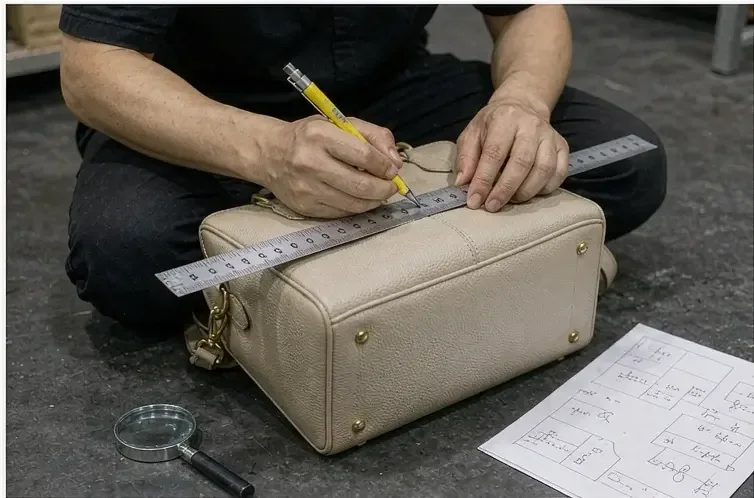
Connecting Content Metrics to the Production Calendar
The reason content ROI is measurable in this category is that the funnel ends in a physical artefact. An enquiry becomes a sample request, a sample request closes in 6-10 working days for a structured style or 12-15 with frame work, and an approved sample becomes a bulk order running 35-50 days. Each of those transitions has a date, which means every content page can be tied to a production milestone rather than to an abstraction.
The reporting cadence that works
- Review four figures monthly: content-assisted enquiries per 10,000 sessions at 18-24, sample request rate, quote-to-order at 12-18%, and cost per qualified enquiry including sample units. Use a 90-day position-based window. Tie each qualified enquiry to a date — sampling 6-10 working days, bulk 35-50 days at 500 pcs per style and colourway, FOB Xiamen — so the report ends in a production milestone rather than in an impression count.
Where Houses Misread the Numbers
Three misreadings recur. The first is treating a rise in sessions as success when the enquiry count is flat — usually a sign the page is attracting consumers rather than buyers, often because the language drifted towards retail. The second is cutting technical depth to improve readability, which raises time on page and lowers sample requests. The third is attributing a re-order to the newest page when the relationship started with an article read eleven months earlier.
All three are corrected the same way: keep the enquiry as the unit of account, keep the window at 90 days, and keep the technical content technical. A page that explains stitch density, plating thickness and inspection levels does not read like consumer copy and should not be edited into it. The buyers who convert are the ones who came looking for those numbers.
Sample request rate. Two pages can produce the same number of enquiries while one produces four times as many sampling requests, because its technical depth pre-qualified the reader. Track the transition from enquiry to sample, not just to form fill.
Turn content into a measured sampling round
If your content is producing enquiries but few sample requests, send us the specification behind your strongest enquiry. Our team will develop it in 6-10 working days at 500 pcs per style and colourway and return a quotation that your buyer can act on through our quotation desk.
Setting a Baseline When You Have No History
A debut house has no prior quarters to compare against, which makes the first measurement cycle uncomfortable. The practical answer is to borrow the bands and then replace them. Start with 18-24 content-assisted enquiries per 10,000 sessions and 12-18% quote-to-order as provisional targets, run two quarters, and then adopt your own numbers. A borrowed band that is wrong is still more useful than no band at all, because it gives the review something to argue with.
Two baselines are worth setting in the first month even before content volumes justify them. The first is the enquiry quality score: the share of enquiries carrying all three qualifying fields. The second is elapsed time from enquiry to sample request. Both are independent of traffic volume, so they can be measured from a handful of enquiries, and both respond quickly to a change in content depth — which makes them the earliest signal that a change in editorial approach has worked.
- Record enquiry quality score monthly from month one, even on single-digit volumes.
- Record elapsed days from enquiry to sample request, and to approved sample, for every enquiry.
- Replace borrowed bands with your own after two full quarters of data.
- Keep the old band on the report for one more quarter so the change is visible to everyone reading it.
- Note any channel change — a press mention or a trade show — beside the figures, because it distorts a quarter.
A Quarterly Review That Fits on One Page
A content review for this category should fit on one page and take twenty minutes. Four figures, the three best-performing pages by qualified enquiry rather than by session, the three pages that produced nothing and why, and a list of the specifications that enquiries most often ask about. That last item is the most valuable output, because it tells the house which technical article to write next — and technical articles are what produce sample requests.
Houses that run this review for four consecutive quarters, and that resist the urge to rewrite the technical pages into shorter consumer copy when sessions dip, end up with a content library that reads like a specification manual, which is exactly what a buyer in this category wants to find. The commercial result is not a shorter sales cycle but a better-qualified one: fewer enquiries, each carrying a quantity, a season and a specification, and each closing into a 500 pcs per style and colourway order inspected at AQL 2.5 under ISO 2859-1. That outcome is measurable, and once a house can measure it the argument about whether technical content is worth funding stops being a matter of opinion and becomes a line on the quarterly report that anyone in the house can read, check and argue with on the evidence rather than on taste.
Frequently Asked Questions
How do you measure luxury handbag brand content ROI?
Track four figures inside a 90-day attribution window: content-assisted enquiries per 10,000 sessions, sample request rate, quote-to-order rate and cost per qualified enquiry. Include sample units, printed lookbooks and technical review time in the cost. Ignore sessions as the primary metric, because a luxury buyer reads deeply and converts slowly.
Why is a 90-day attribution window necessary?
Because a buyer does not request a sample in the session where she first reads. She reads, returns weeks later from another device, forwards the page to a colleague and then writes. A 7-day window attributes almost nothing to technical content and makes every in-depth article look like a failure.
What is a good content-assisted enquiry rate?
Between 18 and 24 enquiries per 10,000 sessions is a working band for a house selling premium handbags to trade buyers. Far above 24 with no rise in sample requests usually means the content is attracting consumers rather than buyers, and the language has drifted towards retail.
What counts as a qualified enquiry?
One carrying three fields: a quantity stated per style and colourway, a target season or delivery window, and a specification artefact such as a sketch, a tech pack or a reference sample. Scoring enquiries on those fields turns a volume count into a quality count and improves every downstream figure.
What is a normal quote-to-order rate?
Between 12 and 18% for a debut house, rising once a line has shipped and re-orders begin. Below that, the usual cause is a specification gap: the quotation answered price but not materials, tolerances or inspection level, so the buyer cannot compare it against anything.
Should sample units be counted as content cost?
Yes. Sample units consumed by press review, buyer review and photography are real programme costs, and excluding them understates cost per qualified enquiry materially. A printed lookbook sent to a shortlisted buyer runs about USD 4.80 per copy and belongs in the same count.
Which attribution model suits a luxury house best?
A 90-day position-based multi-touch model. It credits both the discovery page and the decision page, which matches a four-to-six touch buying cycle. Last-click is the least useful option here because it attributes almost nothing to the technical content that actually pre-qualified the reader.
How does content connect to a production milestone?
An enquiry becomes a sample request, the sampling round closes in 6-10 working days for a structured style or 12-15 with frame work, and an approved sample becomes a bulk order running 35-50 days. Every transition has a date, so each page can be tied to production rather than to impressions.
Why do sessions rise while enquiries stay flat?
Usually because the content has drifted towards consumer language and is now read by retail customers rather than buyers. The correction is to restore technical depth — substance, stitch density, plating thickness, inspection level — which reduces sessions and raises sample requests.
How often should content ROI be reviewed?
Monthly for the four figures and quarterly for the conclusions. A single quarter says nothing meaningful when the buying cycle runs 90 days and the production cycle runs 35-50 days, so four consecutive quarters is the minimum before deciding whether to keep funding a programme.
What should a content review report contain?
Four figures, the three best pages ranked by qualified enquiry rather than by session, the three pages that produced nothing with the likely reason, and a list of the specifications enquiries most often ask about. That last list tells the house which technical article to write next.
Is search or editorial coverage more valuable here?
They behave differently and should be reported separately. Search produces fewer enquiries that arrive pre-qualified with a specification; editorial produces more enquiries that need educating first. Cost per qualified enquiry is usually lower from search, while reach and positioning come from editorial.
People Also Ask
What is content ROI in luxury handbags?
It is the return on content spend measured in qualified enquiries rather than sessions. Because a luxury buyer reads deeply and converts slowly, the useful window is 90 days and the useful unit is an enquiry carrying a quantity, a season and a specification.
What is a content-assisted enquiry?
An enquiry where the reader touched at least one content page within the attribution window before making contact. It is the metric that lets technical articles take credit for work that happens weeks before a form is filled in.
How long is a luxury B2B buying cycle?
Typically four to six touches over 60 to 120 days, involving more than one decision maker. That is why a 90-day attribution window is the practical setting and why a single quarter of data is not enough to judge a programme.
Why is cost per enquiry misleading?
Because it usually counts all enquiries, including compliments with no specification, and excludes sample units, printed material and technical review time. Counting only qualified enquiries and including all costs gives a figure that survives scrutiny.
How do you know if technical content is working?
Watch the transition from enquiry to sample request rather than to form fill. Content that pre-qualifies readers produces fewer enquiries and far more sampling requests, which is the outcome a production programme can actually act on.
Sources and further reading
Every figure on this page is either our own programme data or attributed below. Open the originals before you write them into a specification.
- ISO — International StandardsInternational Organization for Standardization Publisher of ISO 2859-1 sampling procedures referenced when a quotation states an inspection level.
- Business of FashionBusiness of Fashion Trade reporting used to benchmark how luxury houses talk about demand, drops and buyer behaviour.
- Sourcing JournalSourcing Journal Coverage of lead times, sampling rounds and order patterns across the premium accessories sector.
- FashionUnitedFashionUnited Market data and sector reporting used for context on premium accessories demand and trade channels.