How to Prioritize Bag Samples for a Luxury Collection: Three Tiers, One Shared Hardware Family and an Order That Fits the Calendar
How should you prioritize bag samples for a luxury collection? Sort the drop into three tiers — hero, support and carry-over — and sample the hero styles first, because their patterns and hardware decisions feed everything else. In a six-style drop, four are normally sampled in the first wave and two ride on proven patterns. One shared hardware family across three styles is the decision that frees the most calendar time.
How Many Samples Can One Collection Actually Carry?
The honest answer is fewer than the range plan contains, and knowing that in advance is what makes a priority list worth writing.
Each style costs 6-10 working days of sampling, or 12-15 where it carries a framed opening, an exotic skin or engineered hardware, plus a review window and then 35-50 days of bulk. Six styles sampled back to back is not six times one style; it is six times one style plus five opportunities for one to slip and push the ones behind it.
There is also a limit that has nothing to do with time and everything to do with attention. A reviewer who reads four samples in one week reads them well; a reviewer asked to read eight in the same week reads the first three properly and the rest quickly, and the comments on the last five arrive as impressions rather than as measurements. Sampling capacity is therefore as much a limit on the buyer as it is on the bench, and the honest range plan accounts for both.
What a Six-Style Drop Actually Looks Like
Worked through, a six-style drop normally resolves into four sampled styles and two that ride on decisions already made.
| Style | Tier | What it needs |
|---|---|---|
| Structured top-handle, new construction | Hero | Full round, 12-15 working days, engineered closure, sealed reference |
| Soft shoulder bag on the hero pattern | Support | One confirming piece in the new hide, 6-10 working days |
| Evening frame bag | Hero | Full round, 12-15 working days, frame graded before cutting |
| Day tote, proven pattern | Carry-over | Hide submission and a sealed reference only |
| Belt bag on the hero hardware family | Support | One piece, stock fitting, shared finish chip |
| Mini version of the top-handle | Deferred | Held until the hero pattern is sealed, then 6-10 working days |
The mini version is the instructive row. It looks like the easiest style in the drop and it is usually sampled first for that reason, but it depends entirely on the hero pattern, and sampling it early means cutting it twice.
Which Styles Should Be Sampled First?
Three tiers decide the order, and the tier of a style is set by what it teaches rather than by how important it looks.
- Hero
- A new construction whose pattern, structure and hardware decisions feed the rest of the drop
- Support
- A style that reuses a hero pattern or a hero hardware family with a different proportion or material
- Carry-over
- A proven style returned in a new colourway or hide, needing a submission and a sealed reference rather than a full round
- Deferred
- A style whose decisions depend on a hero outcome and which should not be cut until that outcome exists
The fourth tier is the one most range plans omit, and omitting it is why some drops sample the same question twice. A style that depends on a hero outcome sampled in parallel with that hero will be re-cut when the hero settles, and the re-cut costs the same as the original round while producing no new information. Naming a style as deferred is not a downgrade; it is a decision to spend the window where it buys something.
What Actually Decides the Order?
Five factors, weighted in this order, and the weighting is what stops the loudest style in the room from being sampled first.
| Factor | Weight | Why it ranks there |
|---|---|---|
| Dependency | Highest | A style others depend on must settle first, or everything downstream is re-cut |
| Construction risk | High | A framed opening or an engineered closure needs the longest window and the earliest start |
| Material lead time | High | A specified imported hide or a graded skin must be ordered alongside the first sample |
| Commercial weight | Moderate | The style most likely to carry the season deserves attention, but not at the cost of dependency |
| Ease of execution | Lowest | Easy styles are valuable precisely because they can wait without consequence |
The last row is counter-intuitive and worth defending in a range meeting. Easy styles are often pushed to the front because they sample cleanly and make the calendar look healthy. That is the wrong use of them: their value is that they can be held back without risk, which is exactly what frees the window for the difficult ones.
Should Every Style in a Drop Be Sampled?
No, and saying so is part of planning properly. Three categories genuinely do not need a full round.
A proven style in a new colourway
The pattern is settled and the hardware is settled. What is needed is a hide submission and a sealed reference in the new hide.
A support style on a hero pattern
Where the proportion change is dimensional and drawn, a single piece in the new material is usually enough to confirm it.
A repeat of a style from the previous season
Provided the records exist: the sealed pattern, the log and the retained cutting. Without those, it does need a round.
The third card carries a condition that is easy to overlook. A repeat style is only a repeat if its records are intact, and a house that cannot produce the sealed pattern and the log for a style is looking at a fresh development whether it intended one or not. Before assuming a style can be carried over, ask for three things: the sealed pattern, the iteration log and the retained cutting from the approved batch. If all three can be produced within a day, the style is genuinely a repeat.
How Do Colourways Affect Priority?
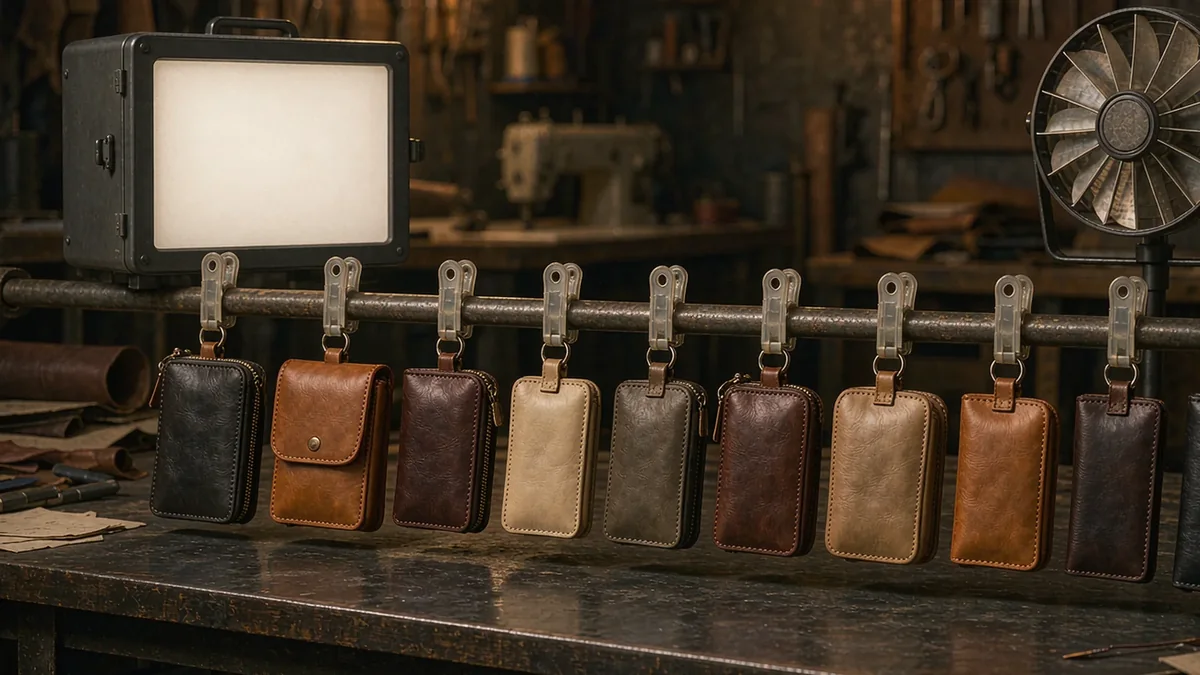
Colourways are the least costly way to make a drop look larger and the easiest place to lose a week, because each one carries a minimum and a decision.
- Sample the hero style in its principal colourway first, and settle the pattern before extending.
- Order the hide for every colourway at the same time as the first sample, so material runs in parallel.
- Treat a second colourway as a hide submission plus a sealed reference rather than as a new round.
- Pilot the hardest colourway rather than the easiest, so the defect list arrives while there is time.
- Remember the MOQ: 500 pcs per style and colourway, which is per colourway and not per style.
The last point changes the arithmetic of a drop more than any other. Four styles in three colourways is twelve minimums, and the range plan should be read that way rather than as four. It is also the point most often discovered late, at the point of order rather than at the point of planning, and discovering it late usually means consolidating colourways under pressure rather than by design. A house that decides its colourway count against the minimum at the planning stage makes a different and better set of decisions than one that decides it after sampling has finished.
How Do You Sequence Hardware Development?
Hardware is the slowest thread in a drop and the one that most rewards a decision made early rather than made well later.
- Decide the hardware family first: one closure language, one finish, one plating specification at 0.15-0.3 microns.
- Use a stock fitting for the first sample of every style, so the window is not held by a tool that does not exist yet.
- Commission engineered parts only once the style is close to approval, since a tool made early is usually revised.
- Share one family across three styles where the design allows, which is the decision that frees the most calendar time.
- Order the full hardware set for the drop at the first approval rather than at the last, so lead times run once.
The fourth step is the most valuable single move in this section. A shared family means one tool, one plating run, one finish approval and one set of salt spray testing at 24 to 48 hours, instead of three of each.
What Happens to the Styles That Wait?
Deferred styles are not abandoned, and handling them deliberately is what keeps a drop coherent rather than late.
- Keep them drawn, so that when the hero outcome arrives they can be cut immediately.
- Order their material alongside the hero material, since lead times are the constraint rather than bench time.
- Set a review date rather than leaving them open, because an open item silently becomes a dropped one.
- Decide in advance who has authority to start them, so the decision is not made under pressure later.
The second item is the one that saves the season. Bench time can be found at short notice; a specified hide ordered late cannot, and a deferred style whose material was ordered with the hero's is a style that can still make the drop. The fourth item matters more than it appears to as well, because the decision to start a deferred style is almost always taken under pressure, late in the calendar, by whoever happens to be in the room. Naming that person in advance removes both the delay and the argument.
What If the Calendar Will Not Fit?
Three options, in descending order of preference, and the ranking is not arbitrary.
| Option | What it costs | When it is right |
|---|---|---|
| Reduce the number of new constructions | Nothing, and it usually improves the drop | Always the first option, because untested constructions are the risk |
| Extend the colourway count on proven styles | Very little: a hide submission and a sealed reference | Where the range needs to look larger rather than to be technically new |
| Move the delivery date | A late season, and possibly a missed selling window | Last, but far better than sampling everything and approving nothing properly |
The third option is regularly resisted and regularly correct. A drop of four well-sampled styles outperforms a drop of six that were each approved in a hurry, and the gap is widest at bulk, where the hurried decisions arrive together.
How Is the Priority Decision Recorded?
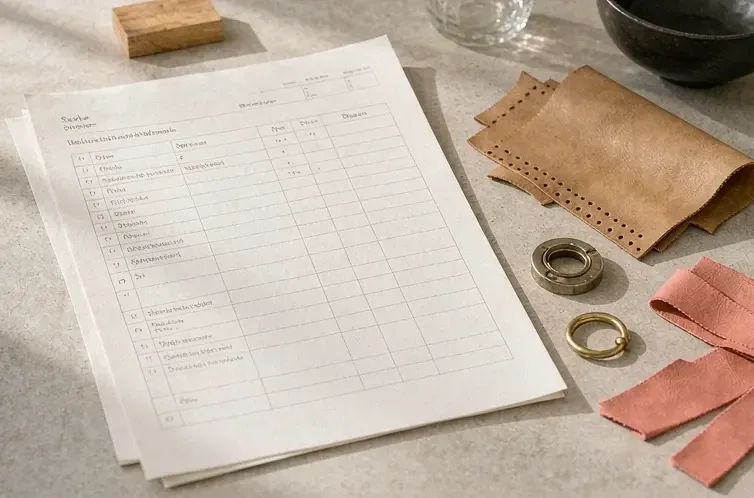
One sheet, six columns, kept with the range plan rather than in anyone's head.
Six columns on the priority sheet
- Style name and its tier: hero, support, carry-over or deferred.
- What it depends on, named, or none where it depends on nothing.
- Construction risk, and whether the window is 6-10 or 12-15 working days.
- Material, with the batch or grade and its lead time.
- Hardware: the family, whether stock or engineered, and the chip number.
- Sample wave: first, second or none, with a date and a named approver.
A hero style whose pattern and hardware decisions feed three others is worth more than a bestseller that settles nothing. Dependency outranks commercial weight.
From Priority List Into Bulk
Once the waves are settled and the first approvals are in, the programme runs on fixed terms: MOQ 500 pcs per style and colourway, bulk in 35-50 days, inspection at AQL 2.5 under ISO 2859-1 with third-party inspection available, and handover on FOB Xiamen terms. Export experience on this programme runs since 2014 across 7 production lines with about 200,000 pcs per month of capacity, delivered through our validated partner factory Quanzhou Yingming Bags.
The useful discipline at this point is to hold the priority sheet open. Styles enter bulk in the order they were approved rather than in the order they were drawn, and a sheet that says which is which prevents the commonest scheduling error of all: a support style starting bulk before its hero has been sealed.
Turn your range plan into a sampling sequence
Send the range plan, the material direction and the target quantities, and we will return a priority sheet with waves, dates and hardware decisions. Request a quote.
Frequently Asked Questions
How many samples should a luxury collection carry?
Fewer than the range plan contains. In a six-style drop, four are normally sampled in the first wave and two ride on proven patterns or on hero patterns already settled, since a second colourway needs a submission rather than a round.
What are the tiers used to sort a drop?
Hero, support, carry-over and deferred. A hero is a new construction whose decisions feed the rest; a support style reuses its pattern or hardware; a carry-over is a proven style in a new hide; a deferred style waits on a hero outcome.
Why does dependency outrank commercial weight?
Because a hero style whose pattern and hardware settle three others is worth more than a bestseller that settles nothing. Sampling a dependent style in parallel with its hero means re-cutting it when the hero outcome arrives.
Why are easy styles sampled last?
Because their value is that they can wait without consequence. Pushing them to the front makes the calendar look healthy while consuming the window that the difficult styles needed.
Does every style need a full sample round?
No. A proven style in a new colourway needs a hide submission and a sealed reference, and a support style on a hero pattern often needs only one piece in the new material to confirm a dimensional change.
How do colourways affect the minimum order?
The MOQ of 500 pcs applies per style and colourway. Four styles in three colourways is twelve minimums, and a range plan should be read that way rather than as four.
How should hardware be sequenced across a drop?
Decide the family first, use stock fittings for first samples, commission engineered parts close to approval, and share one family across three styles where the design allows, which frees the most calendar time.
Why share a hardware family across styles?
It means one tool, one plating run at 0.15-0.3 microns, one finish approval and one round of salt spray testing at 24 to 48 hours, rather than three of each.
What should happen to deferred styles?
Keep them drawn, order their material alongside the hero's, set a review date, and decide in advance who has authority to start them. Material lead time is the constraint, not bench time.
What if the calendar will not fit the range plan?
Reduce the number of new constructions first, extend colourways on proven styles second, and move the delivery date last. Cutting constructions costs nothing and usually improves the drop.
How is the priority decision recorded?
On one sheet with six columns: style and tier, what it depends on, construction risk and window, material with batch and lead time, hardware family and chip number, and the sample wave with a date and a named approver.
In what order do styles enter bulk?
In the order they were approved rather than the order they were drawn. Holding the priority sheet open prevents a support style starting bulk before its hero has been sealed.
How long does each sampled style take?
Six to ten working days for a standard construction, or 12-15 where it carries a framed opening, an exotic skin or engineered hardware, plus the review window and then 35-50 days of bulk.
What are the commercial terms once sampling is approved?
MOQ 500 pcs per style and colourway, bulk in 35-50 days, inspection at AQL 2.5 under ISO 2859-1 with third-party inspection available, and handover on FOB Xiamen terms.
People Also Ask
How do you sequence samples for a collection?
By dependency first, then construction risk, then material lead time. Hero styles that settle patterns and hardware for others are sampled before commercially important ones.
Should every style in a drop be sampled?
No. Colourway extensions need a hide submission and a sealed reference, and support styles on hero patterns often need only one confirming piece.
What is the biggest time saver in a drop?
One shared hardware family across several styles, which collapses tooling, plating, finish approval and testing into a single set of decisions.
How does the MOQ work across colourways?
It applies per style and colourway, so four styles in three colourways represent twelve minimums rather than four.
What is the best response to an impossible calendar?
Cut the number of new constructions. It costs nothing, usually improves the drop, and preserves the window the difficult styles need.
Sources and further reading
Every figure on this page is either our own programme data or attributed below. Open the originals before you write them into a specification.
- ISO — International Organization for StandardizationISO Publisher of ISO 2859-1, the inspection procedure applied at bulk handover on each wave.
- Leather Working GroupLeather Working Group Tannery audit protocol behind hide batch identification when several colourways are ordered together.
- SATRASATRA Technology Centre Independent testing organisation for leather and hardware, covering the salt spray testing behind a shared hardware family.
- Sourcing JournalSourcing Journal Reporting on range planning, drop calendars and development sequencing across the accessories trade.
- OEKO-TEXOEKO-TEX Testing and certification system for leather, lining and interlining against restricted substance lists.