How Premium Hardware Elevates a Luxury Bag: Weight, Travel, Plating and the Six Details Buyers Read First
Premium hardware elevates a handbag through four signals the customer reads before touching the leather: the weight of the metal in the hand, the travel of a closure, the thickness of the plating, and the line of a machined edge. None of these are visible in a photograph, and all of them are specifiable in numbers. This piece sets out the six details that separate premium hardware from hardware that is merely expensive, with the test attached to each and the effect on a programme calendar.
What the Hand Reads Before the Eye Does
A customer picks up a bag and, inside two seconds, has formed a judgement that no amount of leather quality will overturn. The judgement is made by the metal. A bag that is heavier than it looks reads as substantial; a closure that travels smoothly and stops precisely reads as engineered; a foot that sits flat without rocking reads as finished. All three are hardware decisions, and none of them appear in a product photograph.
This is why hardware is the highest-leverage line on a specification. Leather is judged slowly, over months of wear, and mostly by the owner. Hardware is judged in the shop, in seconds, by someone who has not yet decided to buy. A house that spends its allowance on the hide and treats the metal as a trim has inverted the order in which the bag is actually assessed.
Six Details That Separate Premium Hardware from Merely Expensive Hardware
Expensive and premium are not the same thing. Hardware can cost a great deal and still read poorly, usually because the money went into ornament rather than into the four properties the hand detects. The six details below are the ones that carry the judgement, in the order a customer encounters them.
- Mass: the bag weighs what it looks like it should weigh, which means solid metal at the load points rather than hollow castings.
- Travel: a closure moves the same distance every time and stops without a secondary movement.
- Temperature: solid metal warms to the hand; a hollow part stays cold and reads as light whatever it weighs.
- Edge: a machined edge has a defined radius and a clean line; a cast edge is rounded by tumbling and reads as soft.
- Sound: a lock closes with a short, dry sound. A rattle, a click that continues, or a scrape all read as faults.
- Surface: plating is even across the face and into the recesses, with no pooling at the low points and no thinning at the high ones.
Read that list as a specification rather than as a description. Mass is a substrate decision, travel is a tolerance decision, edge is a machining decision, and surface is a bath decision. Each has a number, and each can be written into a pack.
Weight: the First and Most Honest Signal
Weight is the signal a customer trusts most and questions least, because it is felt rather than seen. It is also the signal most easily faked and most quickly exposed: a hollow part can be weighted to feel right in the hand and will still sound wrong when set down on a table.
| Component | Substrate that reads premium | What it does to the bag | Where the trade-off bites |
|---|---|---|---|
| Turn-lock body | Solid brass | Holds a thread, takes torque, can be re-plated rather than replaced | Heavier at the flap; the panel needs reinforcement behind the fixing |
| Feet | Solid brass with a defined seat | Sits flat with four-point contact and no rock on a hard surface | Adds mass at the base, which suits a structured silhouette only |
| Frame and kiss-lock | Solid brass or steel | Spring tension holds for the life of the bag | Tooled rather than bought, so it adds 20-30 working days |
| Decorative plate | Zinc alloy | Holds fine detail at low mass, which keeps the bag light | Must not be used where the part carries load |
| Zip chain | Brass or nickel teeth on a matched tape | Runs without drag and takes lateral stress at the mouth | A heavy chain on a soft bag pulls the mouth out of shape |
| Strap slide | Solid brass or steel | Holds its set position under load without slipping | A cast slide creeps; the strap changes length during the day |
Plating, and Why Thickness Is the Only Number That Matters
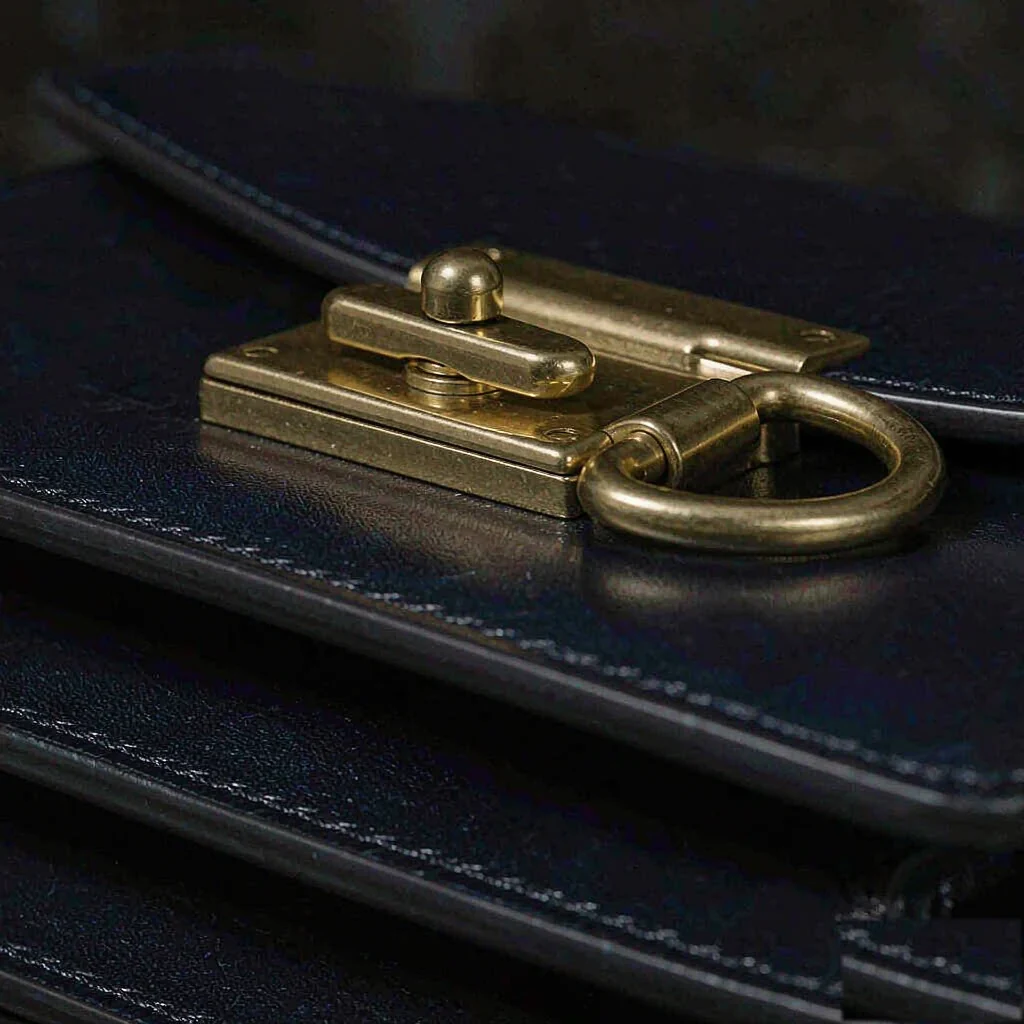
Plating is sold by name and specified in micrometres, and the gap between those two habits is where most disappointment lives. A finish name tells you the colour; a thickness in micrometres and a corrosion result tell you how long the colour will stay where the hand touches it.
- Gold tone thickness
- 0.15-0.3 µm over a 3-5 µm nickel barrier for standard finishes
- Pale gold thickness
- 0.2-0.4 µm, because a pale finish shows wear sooner than a saturated one
- Palladium on brass
- 0.20 µm palladium over solid brass, read by XRF and recorded per bath
- Corrosion proof
- 24 hours neutral salt spray to ISO 9227, rising to 48 hours for antique finishes
- Nickel release
- Answered under REACH Annex XVII entry 27 for skin contact
- Contact-point wear
- 5,000 cycles on the assembled bag, with the face inspected for breakthrough
- Bath record
- Bath ID, date, alloy and thickness reading, filed so a drift can be traced to one bath
The contact-point number is the one to insist on. A lock can pass a salt spray panel and still wear through at the cam inside a season, because the spray test measures corrosion and the cycle test measures abrasion. Premium hardware is proved on both.
The Sound and the Travel of a Closure
Sound is the detail houses never specify and customers always notice. A closure that closes with a short, dry sound reads as engineered; one that clicks twice, rattles, or scrapes reads as a fault, and no amount of finish quality recovers it. Travel is its partner: the distance a lock moves and the precision with which it stops.
- Cycle the assembled bag rather than the loose component: alignment faults appear only when the lock sits on the panel.
- Five thousand open-close cycles is the floor, with the action inspected for looseness at the end.
- Locating pin held to ±0.2 mm of the drawing and checked with a go/no-go gauge on the first shots.
- Pull force on the locked cam at 3.0 kgf, tested after cycling rather than before.
- Magnet pull at 2.5-3.5 kgf new and retained above 2.0 kgf at 5,000 cycles, tested on the assembled bag.
- Any rattle traced to a component before packing: a loose rivet inside a lined bag is a return waiting to happen.
A note on magnet sound specifically. A magnet that closes silently is often preferred by designers and reads to the customer as an absence of quality, which is why many houses specify a mechanical closure on the principal opening and reserve the magnet for a secondary pocket.
Edges, Radius and the Machined Line
The last of the four signals is visual: the line where a metal part meets daylight. A machined edge has a defined radius and a clean highlight along its length; a cast edge that has been tumbled is soft, and the highlight wanders. On a bag this difference is visible at arm's length and it is the one detail a customer can articulate without any vocabulary.
Machined edge
Cut on a machine after casting, with a defined radius, usually 0.3 mm, and a consistent highlight. Costs one operation and is the single most visible premium signal on a plate or a bar.
Cast edge
As it leaves the die, then tumbled. The radius varies around the part and the highlight breaks. Acceptable on a concealed component and visible at once on an exposed one.
Polished face
Polished before plating rather than after, so the metal is flat before the finish goes on. Polishing after plating thins the deposit at exactly the points that touch the hand.
Recessed logo
Struck or etched with the depth held constant, so the plating covers the floor of the recess. A shallow recess pools; a deep one thins at the entry.
Hold the bag at arm's length under shop lighting and look only at the metal. If the highlight along an exposed edge runs true, the hardware reads as premium whatever it cost. If it wanders, no amount of leather quality recovers the impression.
The test sounds subjective and is not. A wandering highlight is a measurable variation in radius, and radius is a drawing dimension like any other. Naming it turns a matter of taste into a matter of inspection.
Where Premium Hardware Pays and Where It Does Not
Premium hardware is not premium everywhere on the bag. The judgement a customer makes is formed at the points they touch and see: the closure, the handle attachments, the feet if the bag is set down, and the strap ends. Metal that is concealed inside a lining is metal nobody assesses.
Spend here, not there
- Spend on the closure: it is touched every day and is the detail most often mentioned in a review.
- Spend on the handle attachment: it carries the whole bag and is where a failure becomes a return.
- Spend on exposed plates and bars: the machined edge is read at arm's length.
- Do not overspend inside the lining: concealed metal is judged by no one.
- Do not overspend on decorative castings that carry no load: zinc alloy holds finer detail at lower mass.
- Spend once on tooling: a die cut well produces the same part for the life of the programme.
Specifying Premium Hardware in a Programme
Six items turn the four signals into a pack a bench can work from and an inspector can check. They are the difference between a hardware specification and a hardware wish.
- Substrate by component: solid brass where the part carries load or holds a thread, zinc alloy where it does not.
- Plating by number: finish, micrometres, and the barrier layer beneath the finish.
- Edge treatment named: machined with a defined radius on every exposed face.
- Cycle floor and pull force: 5,000 cycles and 3.0 kgf at the cam for a load-bearing closure.
- Assembly note: reinforcement behind every fixing, so a lock does not work loose in a single layer of leather.
- Retained reference: one sealed component per bath, held 24 months, for later comparison of tone and finish.
Commercial Frame: MOQ, Sampling and Bulk
MOQ 500 pcs per style and per colourway. Sampling for a new style runs 6-10 working days, extending to 12-15 where a frame, a moulded handle or a new tool is involved. Bulk production at 35-50 days. FOB Xiamen as the standard term, with alternatives available where a programme needs them.
New tooling adds 20-25 working days before the first shots arrive, and a new frame adds 20-30 including the dimensional report. The programme runs across 7 production lines with about 200,000 pcs per month of capacity and has held export experience since 2014, carried out through our validated partner factory Quanzhou Yingming Bags, an SGS-validated site.
Finish sample cards showing up to three plating options on the intended leather are billed at USD 4.80 and credited against the first bulk order. They settle the tone decision before a tool is cut, which is the least expensive point in the calendar at which to make it.
Specify the hardware your bag will be judged on
Send your silhouette, the load each component carries and the quantity per colourway. You will receive a component-by-component note with substrate, plating thickness, cycle floor and tooling time, within two working days. Request a quote.
Frequently Asked Questions
Why does hardware matter more than leather in the first impression?
Because the judgement is formed in the first two seconds, before the leather is touched. Weight, travel and the machined edge are felt and seen immediately, while leather quality is judged slowly over months, mostly by the owner rather than by the buyer.
What substrate reads as premium on a handbag closure?
Solid brass. It holds a thread, takes daily torque without deforming, and can be re-plated rather than replaced. Zinc alloy is correct for decorative plates and logo bars where no load is carried and lower mass keeps the bag light in the hand.
How thick should plating be on luxury bag hardware?
Between 0.15 and 0.3 µm of gold tone over a 3-5 µm nickel barrier, rising to 0.2-0.4 µm for pale finishes that show wear sooner. Palladium is usually specified at 0.20 µm over solid brass, read by XRF and recorded per bath.
What does a salt spray test prove about hardware?
It proves corrosion resistance, not abrasion resistance. Twenty-four hours neutral spray to ISO 9227, or 48 hours for antique finishes, shows how the finish resists the environment; a separate 5,000-cycle test shows how it resists the hand.
How is the travel of a closure specified?
By the locating pin held to ±0.2 mm of the drawing, checked with a go/no-go gauge on the first shots, and by 5,000 open-close cycles on the assembled bag with the action inspected for looseness at the end.
What makes a closure sound poor?
A second click, a rattle, or a scrape. A premium closure closes with a short, dry sound. Any rattle should be traced to a component before packing, because a loose rivet inside a lined bag is a return waiting to happen.
Why do machined edges matter on hardware?
Because the highlight along an exposed edge is read at arm's length. A machined edge has a defined radius, usually 0.3 mm, and the highlight runs true; a cast edge that has been tumbled is soft and the highlight wanders.
Should a magnet be used on the principal opening?
Many houses reserve it for a secondary pocket, because a magnet that closes silently can read to the customer as an absence of quality. Where a magnet is used, specify 2.5-3.5 kgf new and retention above 2.0 kgf at 5,000 cycles.
Where should a house not overspend on hardware?
Inside the lining and on decorative castings that carry no load. Concealed metal is judged by nobody, and zinc alloy holds finer detail at lower mass than brass on a part that is purely ornamental.
How long does new hardware tooling take?
A new die adds 20-25 working days before the first shots arrive, and a new frame adds 20-30 including the dimensional report. Against that, standard sampling runs 6-10 working days and 12-15 for complex styles.
What is the minimum order for bespoke hardware?
MOQ 500 pcs per style and per colourway, with bulk at 35-50 days on FOB Xiamen terms. Tooling is amortised across that run, and finish sample cards at USD 4.80 are credited against the first bulk order.
How do you compare two plating options before committing?
With finish sample cards: up to three options applied to the leather the bag will actually use, so the tone is judged in context rather than on a metal chip. They are billed at USD 4.80 and credited against the first bulk order.
People Also Ask
What makes hardware look expensive on a handbag?
Mass, travel, plating thickness and the machined edge. Solid brass at the load points, a closure that moves the same distance every time, 0.15-0.3 µm of plating over a barrier, and an edge with a defined radius.
Is heavier hardware always better?
No. Weight is right at the closure, the handle attachment and the feet, and wrong on decorative castings and on soft silhouettes where a heavy chain pulls the mouth of the bag out of shape.
How can you tell solid brass from zinc alloy?
By the sound when set down, by the temperature in the hand, and by whether the part holds a thread. A sectioned sample settles it definitively, which is why a specification names the substrate by component.
Does plating thickness really make a difference?
Yes, because wear happens at the contact points. A finish proved only by salt spray can still break through at the cam of a lock inside a season, which is why the cycle test and the thickness reading are specified together.
What is the least expensive way to improve hardware quality?
Order finish sample cards before tooling is cut, at USD 4.80 credited against the first bulk order. Settling the tone decision early removes the single largest source of late hardware rework.
Sources and further reading
Every figure on this page is either our own programme data or attributed below. Open the originals before you write them into a specification.
- ISO — International Organization for StandardizationISO Publisher of ISO 9227 neutral salt spray testing for plating and ISO 2859-1 for the AQL 2.5 inspection draw.
- European Chemicals AgencyECHA Administrator of REACH, including Annex XVII entry 27 on nickel release from metal components in prolonged contact with skin.
- California Office of Environmental Health Hazard AssessmentOEHHA The authority behind California Proposition 65, which governs warning requirements for listed substances in plated metal components.
- CPSCU.S. Consumer Product Safety Commission Administrator of CPSIA limits on lead in substrates and coatings, relevant to hardware on lines sold in the United States.
- Leather Working GroupLeather Working Group Tannery audit protocol behind the leather that hardware is fitted to, since metal and hide are approved as one assembly.