How to Position a Luxury Bag Against Heritage Houses: Four Axes, No Price Argument
How do you position a luxury bag against heritage houses? Compete on four axes where a young house can credibly win — provenance depth, construction evidence, scarcity arithmetic and service depth — and never on price or on borrowed history. A debut house can publish 1.2-1.4 mm calfskin from a named tannery, a custom-cast closure, 500 pcs per style and colourway and a ten-year service path, all of which are checkable. Heritage cannot be borrowed, but evidence can be built, and evidence is what a buyer actually compares.
Why Price and Provenance Are the Wrong Battlefields
Two arguments are unavailable to a young house and both are tempting. The first is price: undercutting a century-old maison is impossible without destroying the specification, and any house that tries ends up defending a lower figure rather than a better bag. The second is history: a founding date or a city the house has no connection to collapses under the first serious question and takes the credible parts of the story with it.
What remains is evidence. A heritage house has accumulated trust over decades; a debut house has to produce the same trust in a single season, and the only instrument available is specificity. Every claim must carry a noun and a figure, because a buyer comparing an unknown line against an established one is looking for reasons to believe, and reasons come from numbers she can check rather than from adjectives she has heard before.
Axis One: Provenance Depth Rather Than Provenance Length
Provenance has two dimensions and a young house should compete on depth, not length. Length is how long the house has existed; depth is how far down the material chain it can trace a single unit. A debut house can name the tannery, the dye lot, the alloy and the plating bath for one specific bag — a level of traceability that large houses rarely publish for an individual piece.
Length
How long the house has existed. Unavailable to a debut line, and invented dates are fatal.
Depth
How far down the chain one unit can be traced: tannery, lot, alloy, bath, bench.
Documented
Leather Working Group audit status, REACH Annex XVII and Prop 65 declarations on file.
Verifiable
A sealed reference sample per style and colourway, held by both sides, with photographs.
Axis Two: Construction Evidence a Buyer Can Test
Construction is where a young house can win outright, because the evidence is physical. Publish substance at 1.2-1.4 mm, skiving at 0.6 mm, stitch density at 8-9 per inch, edge paint in three coats, plating at 0.15-0.3 µm with a filed XRF reading, and cycle counts — 500 pull cycles on a #5 metal chain, 15 kg through 2,000 lift cycles on the handle. None of these require a century of history; all of them require a written specification ledger.
- Leather substance
- 1.2-1.4 mm full-grain calfskin, one tannery lot
- Skiving tolerance
- 0.6 mm ± 0.1 at every turned edge
- Stitch density
- 8-9 per inch, bonded Tex 40 thread
- Edge finish
- Three coats, weight-based formula, fixed drying cycle
- Hardware
- Brass, 0.15-0.3 µm plating, XRF reading filed per lot
- Closure validation
- 500 pull cycles on a #5 metal chain
- Handle load
- 15 kg through 2,000 lift cycles
Axis Three: Scarcity Arithmetic, Not Scarcity Language
Scarcity in this category is arithmetic, not language. 'Limited' means nothing; '500 pcs per style and colourway, two colourways per season, one production run' means something a buyer can plan around. Publish the run size, the number of colourways, and whether a second run will follow, because a buyer deciding whether to stock a line needs to know how many other doors will carry the same piece.
- State the run size per style and colourway — 500 pcs — rather than describing the line as limited.
- State how many colourways exist and whether the run will repeat.
- State whether the closure is custom-cast and therefore exclusive to the house.
- State whether exotic options are used, with CITES documentation available for listed species.
- State the territory terms offered to a stockist, so she knows what exclusivity she is buying.
- Never imply scarcity that does not exist. A buyer who discovers a second run loses confidence permanently.
Axis Four: Service Depth as a Positioning Instrument
Service is the axis where a young house can beat an established one outright, because large houses ration service and a small one can be generous. Spare hardware held at 2% of unit quantity, matched thread kept against the style, edge refinishing, a named repair path and a ten-year commitment are all achievable at 500 pcs and all impossible for a house shipping six figures of units a year to administer personally.
| Axis | Heritage house advantage | What a debut house can publish instead |
|---|---|---|
| Length of history | Decades of accumulated trust | Nothing — do not compete here |
| Provenance depth | Established tannery relationships | Named tannery, dye lot, alloy and plating bath per unit |
| Construction evidence | Documented house standards | Written tolerances, XRF readings, cycle counts on one page |
| Scarcity arithmetic | Controlled distribution | Published run size, colourway count and repeat policy |
| Service depth | Formal repair programmes | Spare hardware at 2%, refinishing, a named repair path |
The Positioning Statement: One Sentence, Four Clauses
Positioning collapses into one sentence with four clauses: what it is made of, how it is made, how many exist, and what the house will do for it afterwards. 'A structured day bag in 1.2-1.4 mm full-grain calfskin from one tannery lot, closed with a clasp we cast ourselves, produced at 500 pcs per style and colourway, with spare hardware held for ten years.' That sentence competes with any heritage house, because every clause is checkable.
- Clause one — material: name the substance, the tannery and the lot. No country-level generalities.
- Clause two — construction: name the operation, the tolerance and the test, not the adjective.
- Clause three — quantity: state the run size per style and colourway and the repeat policy.
- Clause four — service: state the spare holding, the refinishing path and the duration.
- Read it aloud in fifteen seconds. If it cannot be spoken, it will not be repeated.
- Use the identical sentence on the about page, the line sheet and the press kit.
Where Exotic Materials Change the Argument
An exotic option gives a young house a distinctive press angle without committing the whole season to it, but it changes the documentation burden. Listed species require CITES paperwork, and the house must be able to produce it for a specific unit. Used on one evening piece — a minaudière in a single colourway — the exotic option signals capability; used across a collection without documentation, it becomes a liability.
Sampling and Timing as Part of the Position
Responsiveness is a positioning claim too. A young house can develop a structured style in 6-10 working days and a frame bag or custom-cast closure in 12-15, then ship bulk in 35-50 days and re-order in 28-35 days against a sealed reference. Published as figures rather than as a promise, those windows tell a buyer the house can react within a season — which is something a house with a two-year internal calendar often cannot offer.
The positioning in one paragraph
- Compete on provenance depth, construction evidence, scarcity arithmetic and service depth; never on price or on borrowed history. Publish 1.2-1.4 mm calfskin from a named tannery, skiving at 0.6 mm, stitch density at 8-9 per inch, plating at 0.15-0.3 µm with a filed XRF reading, 500 pcs per style and colourway, and spare hardware at 2% for ten years. Sampling 6-10 working days, 12-15 for frame or custom casting, bulk 35-50 days, FOB Xiamen.
Never invite a side-by-side on price. When a buyer asks how the line compares on cost, answer with the tolerance set and the service path instead. A young house that argues on price has already conceded the only ground where it could have won.
Build the evidence behind your positioning
If your positioning sentence needs figures rather than adjectives, send us the style and the quantity per colourway. Our team will develop it in 6-10 working days and return a written tolerance set, inspection level and FOB Xiamen timing through our quotation desk.
The Questions a Stockist Asks in Numbers, and What Answers Them
A buyer stocking an unknown line asks a short list of quantified questions, and each one maps onto a figure the house should already have written. What is the landed cost per unit, delivered FOB Xiamen and freighted to her market? What multiplier between landed cost and retail does the house recommend, and does it hold across the region she sells in? How many units of the style exist worldwide, answered by the run size of 500 pcs per style and colourway, and how many doors in her city can carry it? When does the second drop land relative to her selling calendar, answered by 35-50 days for production 35-50 days for a re-order against a sealed reference? A house that answers all four from the ledger, without checking with anyone first, has already separated itself from most debut lines the buyer has seen that season.
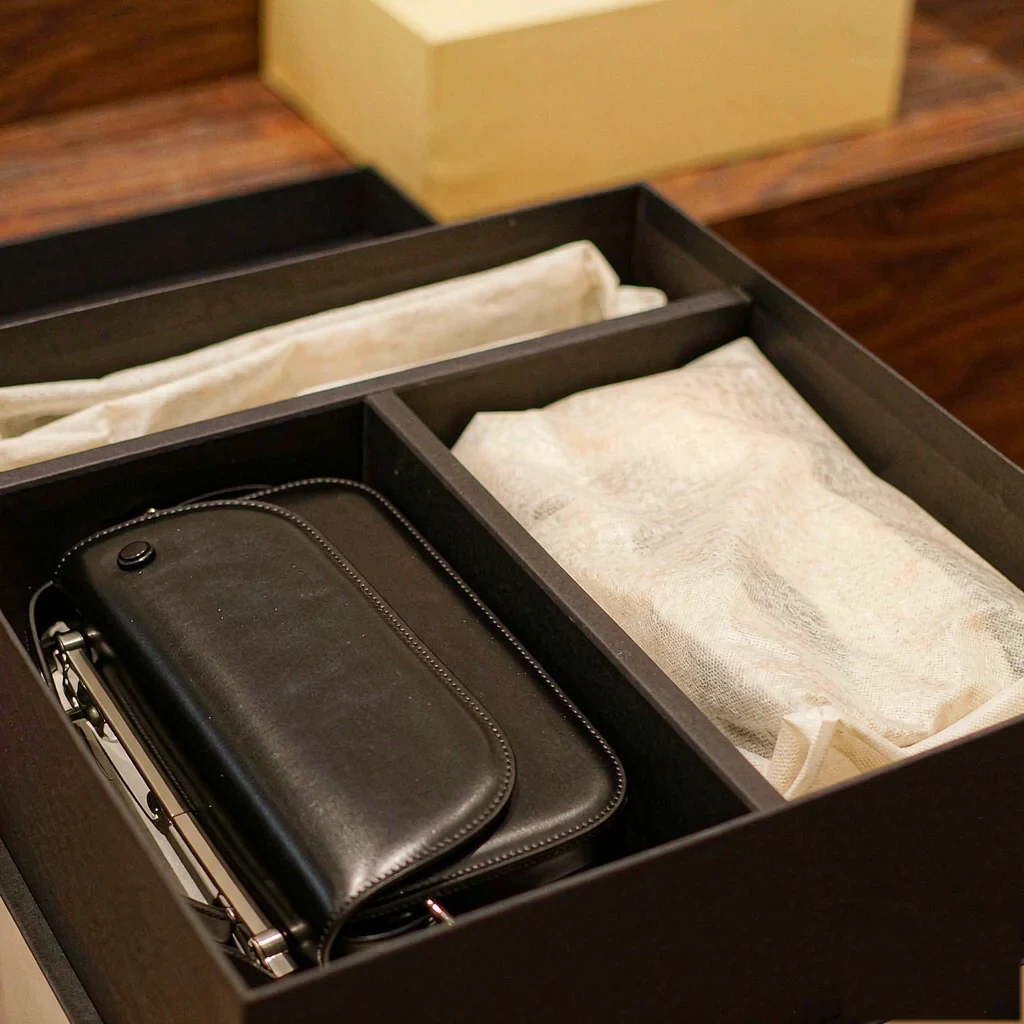
Presentation questions are quantified too. How does the piece arrive: in a dust bag with a numbered card recording the tannery lot and the plating reading? How does it sit on a shelf: does a structured panel hold its crease under retail lighting without a stuffing prop, and does the hardware read as one tone across clasp, feet and slides? What happens when a customer returns with a chipped edge after eight months, answered by the spare hardware holding at 2% and the named refinishing path rather than by a goodwill refund? None of these answers requires a decade of trading history; all of them require the same specification ledger that carries the other four axes.
On the product page the same evidence does the selling. A macro photograph of the stitch line at 8-9 per inch, a cutaway of the handle attachment, a scan of the XRF plating reading and the run number printed beside the buy button — unit 114 of 500 in this colourway — convert the positioning into something a customer verifies herself, and each asset is produced once and reused across every door that carries the line. That is the practical difference between evidence and history: history is told, evidence is displayed, and a page that shows its arithmetic earns the trust a heritage page has to borrow.
A Checklist Before You Publish Any Comparison
Before a positioning claim goes public, run six checks. Is the material named with a substance and a source? Is every tolerance written rather than implied? Is the run size stated? Is the service commitment backed by a real holding and a real process? Is any exotic option documented? And does every figure in the marketing text match the line in the specification ledger? A mismatch found by a buyer costs more than the claim was worth.
- Material named with substance and source, not with a country.
- Every tolerance written: substance, skiving, stitch density, plating, edge coats.
- Run size and colourway count published, with an honest repeat policy.
- Service commitment backed by a 2% spare holding and a named refinishing process.
- Exotic options carrying CITES documentation available per unit.
- Marketing figures reconciled line by line against the specification ledger.
How the Argument Holds in Year Three
The four axes only work if the house keeps its promises for three seasons. Provenance depth requires the tannery relationship to survive; construction evidence requires a sealed sample per style and colourway and a tolerance ledger maintained across drops; scarcity arithmetic requires the published run size to be true; service depth requires the spare holding to exist when someone asks. Each is an operational commitment rather than a marketing one.
Houses that hold all four for three seasons stop being compared against heritage houses at all. By then the line has an archive, a re-order pattern and a set of published figures that a buyer has verified across multiple drops — which is precisely what a century of history produces, arrived at by documentation rather than by waiting. That is the real argument against an established house: not that the young house is older than it is or more within reach than it is, but that it can show, for one specific bag, everything a buyer would otherwise have to take on trust.
Frequently Asked Questions
How do you position a luxury bag against heritage houses?
Compete on four axes a young house can win: provenance depth, construction evidence, scarcity arithmetic and service depth. Never compete on price or on borrowed history. Publish checkable figures — 1.2-1.4 mm calfskin from a named tannery, 0.15-0.3 µm plating, 500 pcs per style and colourway, spare hardware for ten years.
Why is price the wrong argument for a debut house?
Because undercutting an established house is impossible without cutting the specification, and the house then defends a lower figure rather than a better bag. When a buyer raises cost, answer with the tolerance set and the service path instead and the comparison moves onto ground the young house can win.
What is provenance depth?
How far down the material chain one unit can be traced: the tannery, the dye lot, the alloy and the plating bath, with a sealed reference sample per style and colourway. That level of traceability is available to a debut house and is rarely published per unit by larger houses.
What construction figures should be published?
Substance at 1.2-1.4 mm, skiving at 0.6 mm, stitch density at 8-9 per inch, edge paint in three coats, plating at 0.15-0.3 µm with a filed XRF reading, 500 pull cycles on the closure and 15 kg through 2,000 lift cycles on the handle.
How should scarcity be communicated honestly?
As arithmetic rather than language. State the run size — 500 pcs per style and colourway — the number of colourways, and whether a second run will follow. Never imply scarcity that does not exist, because a buyer who discovers a repeat run loses confidence permanently.
Why is service a strong axis for a young house?
Because large houses ration service across enormous volumes while a small house can be generous at 500 pcs. Spare hardware at 2%, matched thread kept against the style, edge refinishing and a named repair path are all achievable and all difficult for a very large house to administer personally.
What should a positioning statement contain?
Four clauses in one sentence: material with substance and source, construction with a tolerance and a test, quantity with a run size and repeat policy, and service with a holding and a duration. It should be speakable in fifteen seconds and used identically everywhere.
How should exotic materials be used in positioning?
On one evening piece in a single colourway, with CITES documentation available for the specific unit. Used sparingly it signals capability and earns press; used across a collection without paperwork it becomes a liability that a buyer or journalist will find.
Does responsiveness count as positioning?
Yes. Sampling in 6-10 working days, 12-15 for frame work or a custom-cast closure, bulk in 35-50 days and re-orders in 28-35 days tell a buyer the house can react inside a season, which a house running a two-year internal calendar often cannot.
What is a custom-cast closure worth to a debut house?
It is the one asset no established house can copy or claim, and it becomes the recognisable signature of the line. The mould is held against the house, spare castings can be reserved, and the closure survives even when the silhouette changes.
How do you avoid overclaiming against an established house?
Reconcile every published figure against the specification ledger before it goes out, and publish nothing the house cannot evidence with a document or a test result. One inflated claim discredits the accurate ones around it, and buyers check the easiest figure first.
How does the position hold after three seasons?
By keeping the four commitments operationally: the tannery relationship survives, the sealed samples and tolerance ledger are maintained, the published run size is true, and the spare holding exists when someone asks. Documentation accumulated over three seasons functions like history.
People Also Ask
What is brand positioning in luxury handbags?
The set of claims a house makes about material, construction, quantity and service that distinguish it from established competitors. Effective positioning is checkable rather than comparative.
Can a new house compete with established luxury maisons?
Yes, on evidence rather than on history. Traceability per unit, published tolerances, honest run sizes and generous service are all available to a young house and hard for a very large one to match.
Why should a luxury brand avoid price competition?
Because a lower price forces a lower specification, and the house ends up defending cost rather than quality. The durable position is built on tolerances, traceability and service instead.
What makes a handbag credible to a buyer?
Figures she can verify: substance, stitch density, plating thickness, cycle counts, inspection standard and a service path. Adjectives are set aside because every house uses them.
How important is material traceability in luxury?
Increasingly decisive. Naming the tannery, the dye lot and the audit status converts a general claim into a specific one, and it is the form of provenance a young house can actually supply.
Sources and further reading
Every figure on this page is either our own programme data or attributed below. Open the originals before you write them into a specification.
- CITES AppendicesCITES Appendix listings that determine whether an exotic material used in positioning may be traded and documented per unit.
- Leather Working GroupLeather Working Group Tannery audit protocol behind a provenance-depth claim that names a source rather than a country.
- ISO — International StandardsInternational Organization for Standardization Publisher of ISO 11644 finish adhesion, ISO 3376 tensile strength and ISO 2859-1 sampling procedures.
- Business of FashionBusiness of Fashion Trade reporting on how debut houses are covered alongside established maisons and which claims editors verify.